


When a Commercial Vehicle Crash Turns Your World Upside Down
Commercial vehicle accident lawyers are attorneys who specialize in crashes involving trucks, delivery vans, buses, and other vehicles used for business purposes. If you or someone you know was just hit by a commercial truck, here’s what you need to know right now:
Quick Answer: What Can a Commercial Vehicle Accident Lawyer Do for You?
- Investigate the crash — pulling black box data, driver logs, and maintenance records before evidence disappears
- Identify all liable parties — the driver, the trucking company, cargo loaders, and even manufacturers
- Handle insurance companies — so you don’t say something that hurts your case
- Pursue full compensation — medical bills, lost wages, pain and suffering, and more
- File before the deadline — most states give you 2–3 years, but some evidence vanishes within days
These crashes are not like ordinary car accidents. A fully loaded commercial truck can weigh up to 80,000 pounds — compared to roughly 3,000 pounds for a typical passenger car. The size difference alone explains why injuries are so often catastrophic and why the legal process is far more complicated.
There’s also a lot more money at stake. Commercial insurance policies often carry $1 million or more in primary coverage, sometimes with umbrella policies worth $5–$50 million on top of that. That means trucking companies and their insurers fight hard to limit what they pay out.
The legal landscape is layered too. Beyond state laws, commercial vehicles are governed by federal FMCSA regulations covering everything from how many hours a driver can work to how cargo must be secured. Violations of those rules can be powerful evidence in your case — but only if someone moves fast to preserve it.
As a business owner who manages vehicles yourself, you already know how quickly things can go wrong on the road. This guide walks you through exactly how specialized legal help works, what to look for in an attorney, and how to protect yourself after a commercial crash.
Why You Need Specialized Commercial Vehicle Accident Lawyers
When you are involved in a collision with a commercial vehicle, you are not just dealing with another driver and their personal insurance company. You are stepping into a legal arena dominated by massive transportation corporations, highly trained defense teams, and complex federal frameworks. This is why standard personal injury representation often falls short, and why securing specialized legal help is absolutely critical.
Commercial vehicle accidents are uniquely challenging because they involve a web of corporate relationships and highly specific industry standards. Specialized commercial vehicle accident lawyers understand how to untangle these relationships to find out who is truly at fault. If you want a deep dive into the legal mechanics of these cases, check out our comprehensive commercial vehicle accident lawyers guide 2026 to see how these claims are structured from start to finish.
Furthermore, commercial carriers must comply with strict Federal Motor Carrier Safety Administration (FMCSA) regulations. These rules dictate everything from driver health certifications and drug testing to vehicle maintenance protocols and maximum driving hours. A general practice lawyer might miss a subtle Hours of Service (HOS) violation that could instantly prove driver fatigue.
To level the playing field, you need an attorney who knows how to dissect corporate safety records and hold negligent operations accountable. For example, the legal team at Commercial Vehicle Accident Lawyer | Sean Regan Law emphasizes that commercial insurance policies carry massive limits, meaning their claims adjusters will use aggressive tactics to protect their bottom line. Having an expert in your corner ensures you do not get bullied into accepting a fraction of what your case is actually worth.
How Commercial Vehicle Accident Lawyers Investigate Your Case
Building a winning truck accident case requires immediate, aggressive investigation. Unlike passenger car accidents, where the evidence is mostly limited to police reports and photos of the scene, commercial vehicle cases produce a mountain of digital and physical data.
To learn more about the specific investigative steps an attorney takes, read our detailed guide on how commercial vehicle accident lawyers can help you. When you hire a specialist, they will immediately focus on securing the following critical pieces of evidence:
- Black Box Data (ECM/EDR): Most modern commercial trucks are equipped with an Electronic Control Module (ECM) or Event Data Recorder. This device records vital metrics leading up to a crash, including vehicle speed, braking activity, throttle position, and steering angles.
- Electronic Logging Devices (ELDs): Federal law requires drivers to use ELDs to record their driving hours. Your lawyer will cross-reference ELD data with toll receipts, GPS tracking, and dispatch logs to see if the driver exceeded their legal driving limits.
- Driver Qualification Files: This includes the driver’s commercial driver’s license (CDL) status, medical certifications, drug and alcohol testing history, and past traffic violations or safety infractions.
- Maintenance and Inspection Records: Trucking companies must perform pre-trip and post-trip inspections, as well as regular preventative maintenance. Your lawyer will look for signs of neglected brakes, worn tires, or steering defects.
Because this evidence is owned by the trucking company, it is highly vulnerable to being lost, overwritten, or destroyed. Most ECM devices overwrite crash data after a certain number of ignition cycles, and ELD records are only legally required to be kept for six months.
To prevent this, your attorney will immediately draft and send a formal preservation letter (also known as a spoliation letter). This legally warns the trucking company and its insurers that they must preserve all physical and electronic evidence related to the crash. If they destroy or alter this evidence after receiving the letter, they can face severe legal penalties in court.
What to Look for When Hiring Commercial Vehicle Accident Lawyers
Finding the right attorney can feel overwhelming when you are recovering from severe injuries. However, choosing the wrong lawyer can cost you hundreds of thousands of dollars in lost compensation. To make your search easier, we have compiled the 6 signs your commercial accident lawyer is right for you, which highlights the essential traits of a top-tier advocate.
When evaluating potential attorneys, keep these three pillars in mind:
- Board Certification and Trial Experience: You do not want a “settlement mill” lawyer who is afraid of the courtroom. Trucking companies track which law firms actually litigate cases and which ones settle early for cheap. Look for board-certified personal injury trial specialists who have a proven track record of taking complex cases all the way to a jury verdict.
- Resources to Fund the Case: Litigating a commercial truck case is expensive. It often requires hiring accident reconstruction specialists, biomechanical engineers, and medical life-care planners, which can cost tens of thousands of dollars. Your law firm must have the financial strength to front these costs.
- Contingency Fees and Free Consultations: You should never have to pay out-of-pocket to hire a truck accident specialist. Reputable firms, such as the San Diego Truck Accident Lawyer — No Fee team, operate strictly on a contingency fee basis. This means their consultation is completely free, and you pay absolutely nothing unless they win your case.
Key Differences: Commercial vs. Personal Vehicle Accidents
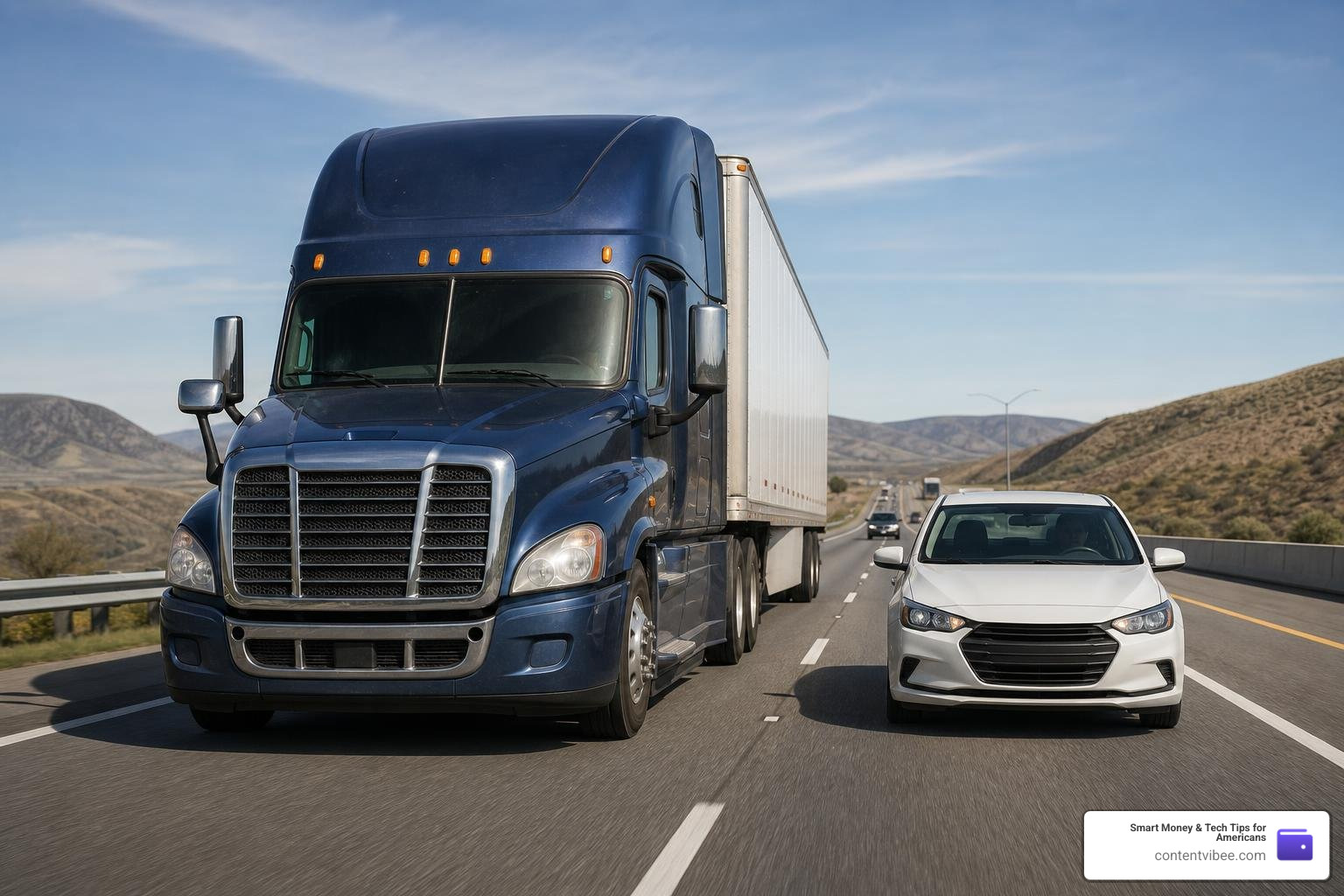
If you have ever been in a minor fender bender with another passenger car, you might think you know what to expect from the insurance process. However, a commercial vehicle accident is an entirely different beast. The scale of the damage, the legal complexity, and the financial stakes are exponentially higher.
| Feature | Personal Vehicle Accident | Commercial Vehicle Accident |
|---|---|---|
| Average Vehicle Weight | 3,000 to 4,500 lbs | Up to 80,000 lbs (fully loaded semi) |
| Typical Insurance Limits | $15,000 to $100,000 | $1,000,000 to $50,000,000+ |
| Primary Regulatory Body | State DMV / Local Traffic Laws | Federal FMCSA & State DOT |
| Number of Liable Parties | Usually just the at-fault driver | Driver, carrier, cargo loader, manufacturer, etc. |
| Evidence Complexity | Police report, photos, witness statements | Black box, ELD logs, maintenance files, dispatch data |
Because of the massive weight discrepancy, passenger car occupants bear the brunt of the force in a collision. While personal auto accidents often result in soft-tissue injuries or minor property damage, commercial crashes are highly prone to causing catastrophic, life-altering injuries or wrongful death.
Additionally, personal accidents usually involve a simple dispute between two drivers. In a commercial crash, a complex web of corporate entities—including third-party logistics brokers, trailer owners, and independent contractors—can all share liability, making the claims process highly adversarial.
Common Causes of Commercial Vehicle Crashes
While passenger car crashes are often caused by simple driver errors, commercial vehicle accidents frequently stem from systemic corporate negligence. When trucking companies push their drivers to meet unrealistic delivery deadlines, safety is often the first thing sacrificed.
According to federal crash data analyzed over a recent two-year period, driver-related factors were recorded in 2,554 of 7,368 fatal semi-truck crashes (34.7%). This highlights just how often human error—frequently influenced by corporate pressure—plays a role. The leading causes include:
- Speeding: This was the single leading driver-related factor, contributing to 609 fatal semi-truck crashes (8.3%) over that two-year period. An 80,000-pound vehicle traveling at high speeds requires the length of nearly two football fields to come to a complete stop.
- Distracted Driving and Inattention: Distraction was a major factor in 474 fatal semi-truck crashes (6.4%). Whether a driver is looking at a dispatch GPS, a mobile phone, or paperwork, taking their eyes off the road for even a few seconds can be fatal.
- Driver Fatigue: Despite strict federal regulations limiting driving hours, fatigue remains a massive issue. Trucking companies sometimes turn a blind eye to drivers who falsify their logs to keep moving.
- Improper Maintenance: Worn-out brake pads, bald tires, and defective steering components are incredibly dangerous. If a carrier skips regular inspections to keep a truck on the road, they are putting everyone else at risk.
- Improperly Secured or Shifting Loads: If cargo is not loaded evenly or secured tightly, it can shift during transit. This can cause the driver to lose control, lead to a jackknife accident, or result in dangerous debris falling directly onto the highway.
If you have been injured due to any of these negligent behaviors, a firm like Indiana Truck Accident Lawyer | Vaughan & Vaughan can help you identify exactly which FMCSA safety violations occurred and use them to build a rock-solid claim.
Catastrophic Injuries and Long-Term Impact
The physical toll of a commercial vehicle crash is often devastating. Victims frequently face long, painful recoveries, multiple surgeries, and permanent disabilities. Some of the most common catastrophic injuries we see include:
- Traumatic Brain Injuries (TBIs): The violent force of a truck impact can cause the brain to strike the skull, leading to permanent cognitive impairment, memory loss, and personality changes.
- Spinal Cord Damage and Paralysis: Damage to the neck or back can result in temporary or permanent paraplegia or quadriplegia, requiring lifetime medical care and home modifications.
- Complex Fractures and Crush Injuries: Bones are often shattered in multiple places, sometimes requiring metal plates, screws, and extensive physical therapy to heal.
- Internal Organ Damage: Severe blunt-force trauma can cause internal bleeding and damage to vital organs like the spleen, liver, or lungs.
The financial burden of these injuries can easily exceed hundreds of thousands of dollars in the first year alone. If you are struggling to figure out how to manage these overwhelming costs, read the ultimate guide to paying medical bills after a car wreck to learn about medical liens, health insurance coordination, and how to protect your credit during your recovery.
Steps to Take Immediately After a Commercial Crash
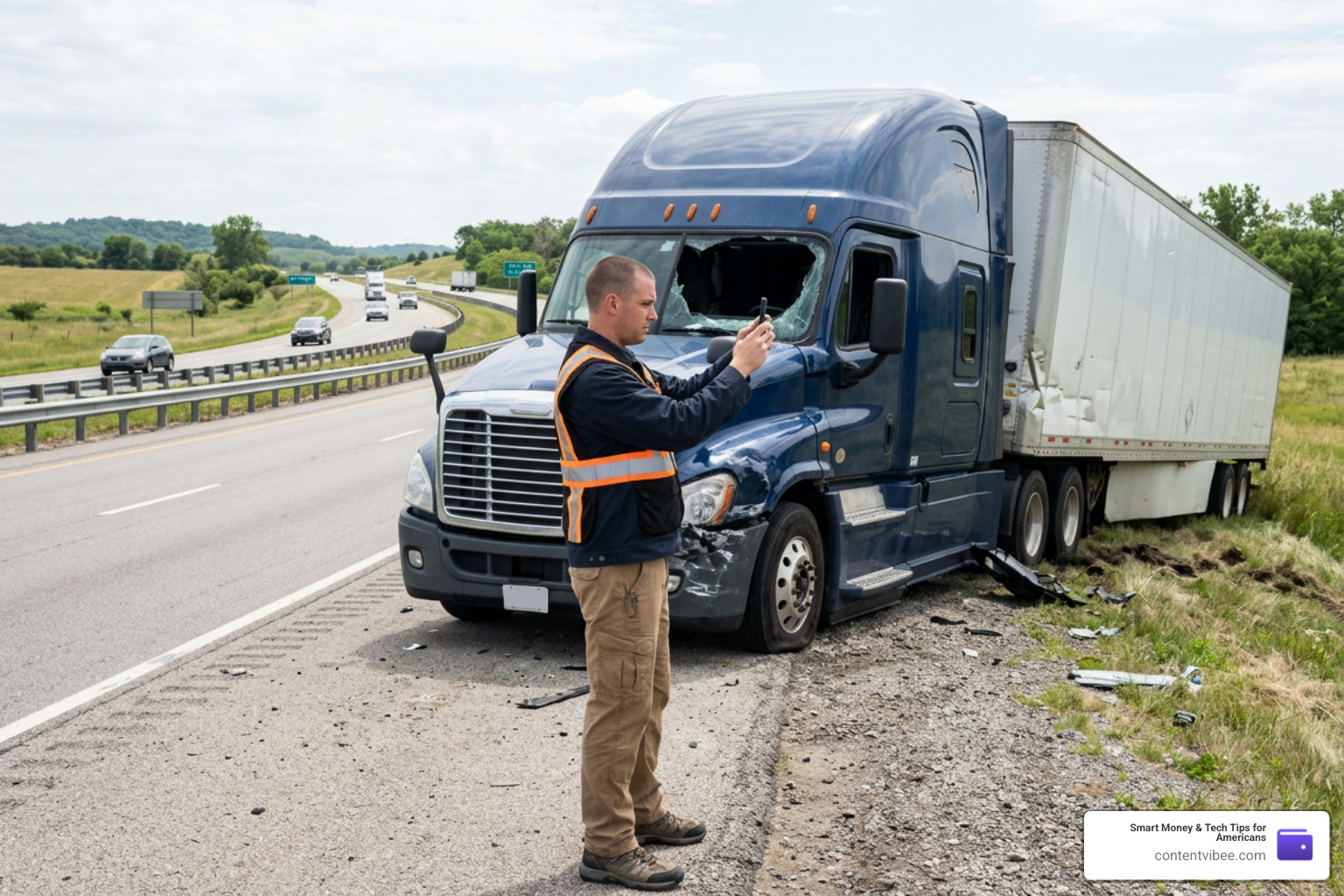
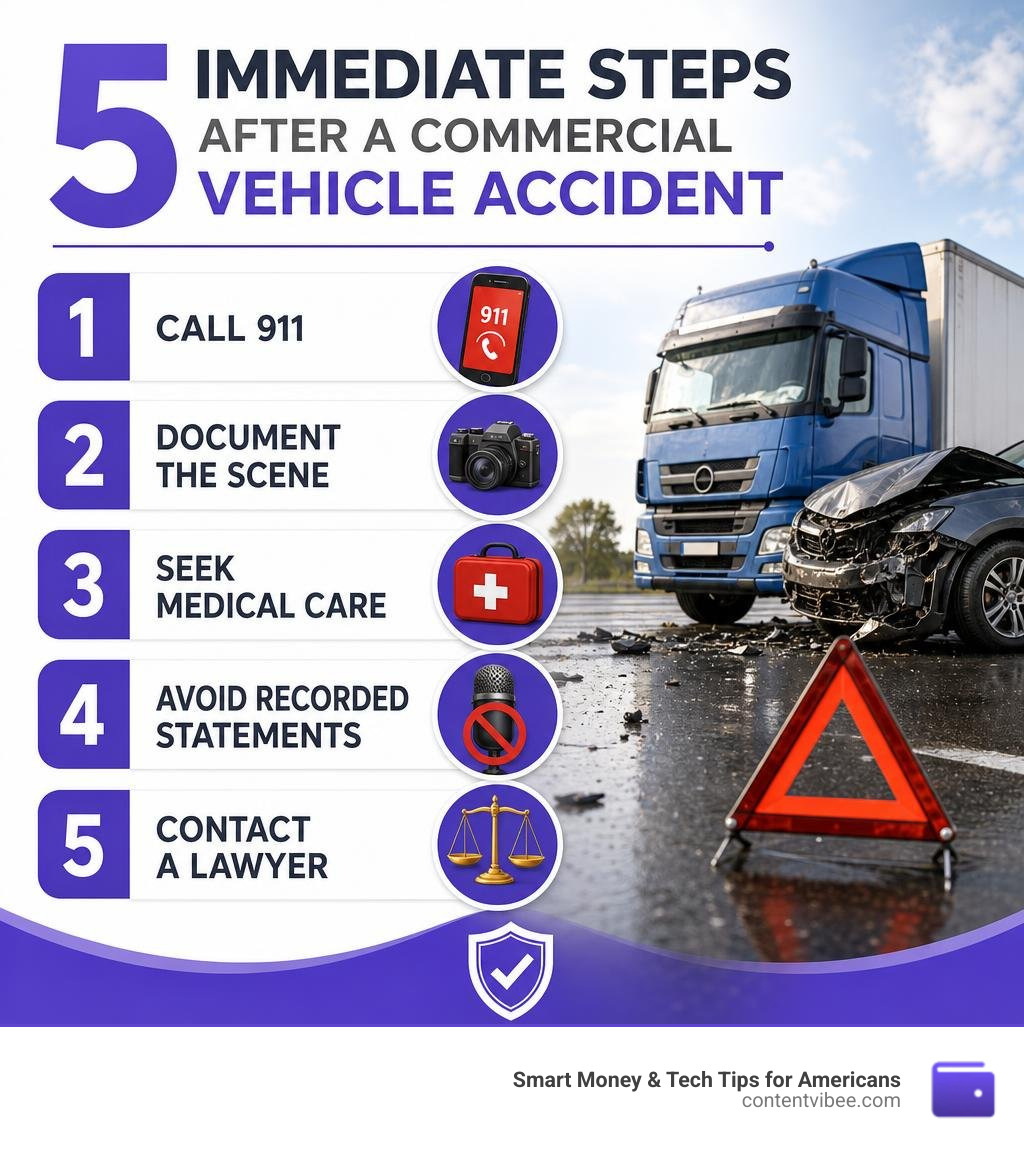
What you do in the minutes and days following a commercial vehicle accident can make or break your personal injury claim. Because trucking companies often dispatch their own accident reconstruction teams and insurance adjusters to the scene of a crash immediately, you must act quickly to protect your rights.
For a step-by-step roadmap on navigating this critical period, refer to our az guide to hiring a commercial vehicle accident attorney. At the crash scene and immediately after, focus on these essential steps:
- Prioritize Safety First: If possible, move your vehicle to the side of the road to avoid secondary collisions. Turn on your hazard lights.
- Call 911: Request both police and emergency medical services. Ensure the responding officer files an official police accident report, and make sure your version of the events is accurately recorded.
- Document the Scene thoroughly: If you are physically able, use your phone to take photos and videos of the damage to all vehicles, skid marks on the road, traffic signs, weather conditions, and any identifying logos or DOT numbers on the commercial truck.
- Gather Witness Contact Information: Bystanders often provide the most unbiased accounts of what happened. Get their names, phone numbers, and email addresses before they leave.
- Seek Immediate Medical Attention: Even if you feel fine, go to an emergency room or urgent care clinic. Adrenaline can mask severe injuries, and having a medical record established on the day of the crash is vital for your case.
Dealing with Insurance Adjusters
Within days of the accident, you will likely receive a phone call from an insurance adjuster representing the trucking company. They may sound incredibly friendly, warm, and helpful, but make no mistake: their primary goal is to pay you as little as possible.
Adjusters are highly trained negotiators. They will often ask you to provide a “recorded statement” to explain what happened in your own words. They may also offer you a quick, lump-sum settlement to help cover your immediate medical bills.
Do not fall for these traps. Before you sign anything or accept any money, read our guide: dont cash that check yet how to evaluate an insurance settlement offer.
Giving a recorded statement gives the insurance company a chance to twist your words and use them against you later. Accepting an early settlement offer almost always means giving up your right to pursue further compensation—even if you discover weeks later that you need a major surgery that your initial payout doesn’t cover. Always let your lawyer handle all communications with the insurance company.
Liability and Compensation in Commercial Vehicle Claims
Determining who is legally responsible for a commercial vehicle accident is rarely straightforward. Under the legal doctrine of respondeat superior (also known as vicarious liability), an employer is held liable for the negligent actions of their employees while they are working.
However, trucking companies often try to bypass this rule by classifying their drivers as “independent contractors” rather than employees. Fortunately, federal regulations often close this loophole by holding the motor carrier responsible for any vehicle operating under their DOT authority, regardless of the driver’s employment status.
To understand how liability is structured under Texas law, the Commercial Vehicle Accident Lawyer in Dallas | Hernandez Law Group, P.C. explains that multiple third parties can also share fault. For example, if a third-party logistics company improperly loaded a trailer, or if a manufacturer installed a defective braking system, they can be dragged into the lawsuit as co-defendants.
Types of Recoverable Damages
If you have been injured in a commercial vehicle crash, you have the right to pursue compensation for both your financial losses and the personal toll the accident has taken on your life. These damages are generally split into three categories:
- Economic Damages: These are measurable financial losses, including past and future medical bills, lost wages, loss of earning capacity (if you can no longer work at your previous level), rehabilitation costs, and property damage.
- Non-Economic Damages: These compensate you for subjective, non-financial losses, such as physical pain and suffering, emotional distress, loss of enjoyment of life, and loss of consortium (the impact of your injuries on your relationship with your spouse).
- Punitive Damages: In rare cases where the trucking company or driver acted with extreme recklessness or intentional malice (such as driving under the influence or knowingly operating a truck with failed brakes), a court may award punitive damages to punish the wrongdoer and deter others from similar behavior.
To get an idea of what your claim might be worth based on your specific injuries, you can check out our ultimate guide to truck accident settlement amounts. You can also use our interactive tools settlement calculators realistic settlement calculator to estimate your potential recovery based on your medical bills, lost income, and state-specific laws.
Understanding the Statute of Limitations
You do not have forever to file a lawsuit after a commercial vehicle crash. Every state enforces a strict deadline known as the statute of limitations. If you fail to file your lawsuit before this window closes, you lose your right to seek compensation forever.
These deadlines vary significantly depending on where the accident occurred:
- New Jersey: Personal injury and wrongful death claims must generally be filed within two years of the accident date.
- Texas: Victims also have a strict two-year deadline to file a lawsuit.
- New York: Personal injury claims typically have a three-year statute of limitations, but wrongful death claims must be filed within two years.
- Public Entities: If your accident involved a government-owned commercial vehicle (such as a city bus or a municipal sanitation truck), you must file a formal administrative claim within a much shorter window—often just 90 days to 6 months depending on the jurisdiction.
Because of these tight deadlines and the speed at which electronic evidence can disappear, consulting a specialist early is vital. As the team at Las Vegas Commercial Vehicle Accident Attorney | Jack Bernstein Injury Lawyers advises, launching an investigation immediately ensures that critical witness memories are fresh, physical evidence is preserved, and your lawsuit is filed well ahead of any state deadlines.
Frequently Asked Questions About Commercial Vehicle Accidents
How much do commercial vehicle accident lawyers cost?
Most commercial vehicle accident lawyers operate on a contingency fee basis. This means you do not pay any upfront legal fees or hourly rates. Instead, the law firm covers all the costs of investigating and litigating your case. If they win your case, their fee is paid as a pre-agreed percentage of your final settlement or jury verdict (typically between 33% and 40%). If they do not win, you owe them absolutely nothing.
To learn more about how these fees work and what to expect, read our detailed guides on how much do lawyers charge for accident claims and how much does a personal injury lawyer cost.
Who can be held liable in a commercial truck accident?
Liability in a commercial truck accident can extend far beyond the driver. Depending on the details of the crash, you can hold the truck driver, the trucking company (carrier), the cargo loading company, the vehicle or parts manufacturer, or even the third-party logistics broker liable.
As the experts at Commercial Truck Accident Lawyer – Johnston | Martineau PLLP explain, identifying all potentially liable parties is the key to maximizing your compensation, especially when multiple insurance policies are involved.
What is the MCS-90 endorsement and why does it matter?
The MCS-90 endorsement is a federal public protection requirement for commercial motor carriers. It is an endorsement attached to a commercial auto liability policy that guarantees the insurance company will pay an injured victim up to the federal minimum limit (usually $750,000 for general freight, and up to $5 million for hazardous materials) even if the trucking company violated their policy terms or committed fraud. This ensures that victims are protected and compensated even if a negligent carrier tries to dodge their financial responsibilities.
Conclusion
Getting hit by a commercial vehicle can throw your life into chaos, leaving you with physical pain, emotional trauma, and mounting financial stress. But you do not have to navigate this complex legal journey alone. By hiring a specialized commercial vehicle accident lawyer, you can protect your rights, preserve critical evidence, and hold negligent corporations accountable while you focus on what matters most—your recovery.
Here at Smart Money & Tech Tips for Americans, we want to make sure you have the practical financial and legal knowledge you need to make smart decisions when life gets tough. If you are a business owner or a driver looking to protect yourself before you ever hit the road, make sure you have the right coverage in place by reading our guide on How to Get a Commercial Auto Insurance Quote. Stay safe out there, and remember that professional legal help is always just a phone call away!


