


What It Really Costs to Hire a Personal Injury Lawyer (And What You Keep)
How much does a personal injury lawyer cost is one of the first questions injured people ask — and the answer is simpler than most expect.
The short answer:
| Case Stage | Typical Contingency Fee |
|---|---|
| Settles before filing a lawsuit | ~33% (one-third) of recovery |
| Settles after filing, before trial | ~36% of recovery |
| Goes to trial | ~40% of recovery |
| You lose the case | $0 in attorney fees |
- No upfront payment. Almost all personal injury lawyers work on a contingency fee basis.
- No hourly rates, no retainers — the lawyer only gets paid if you win.
- Additional case costs (filing fees, expert witnesses, depositions) are separate from the attorney’s fee and are deducted from your settlement.
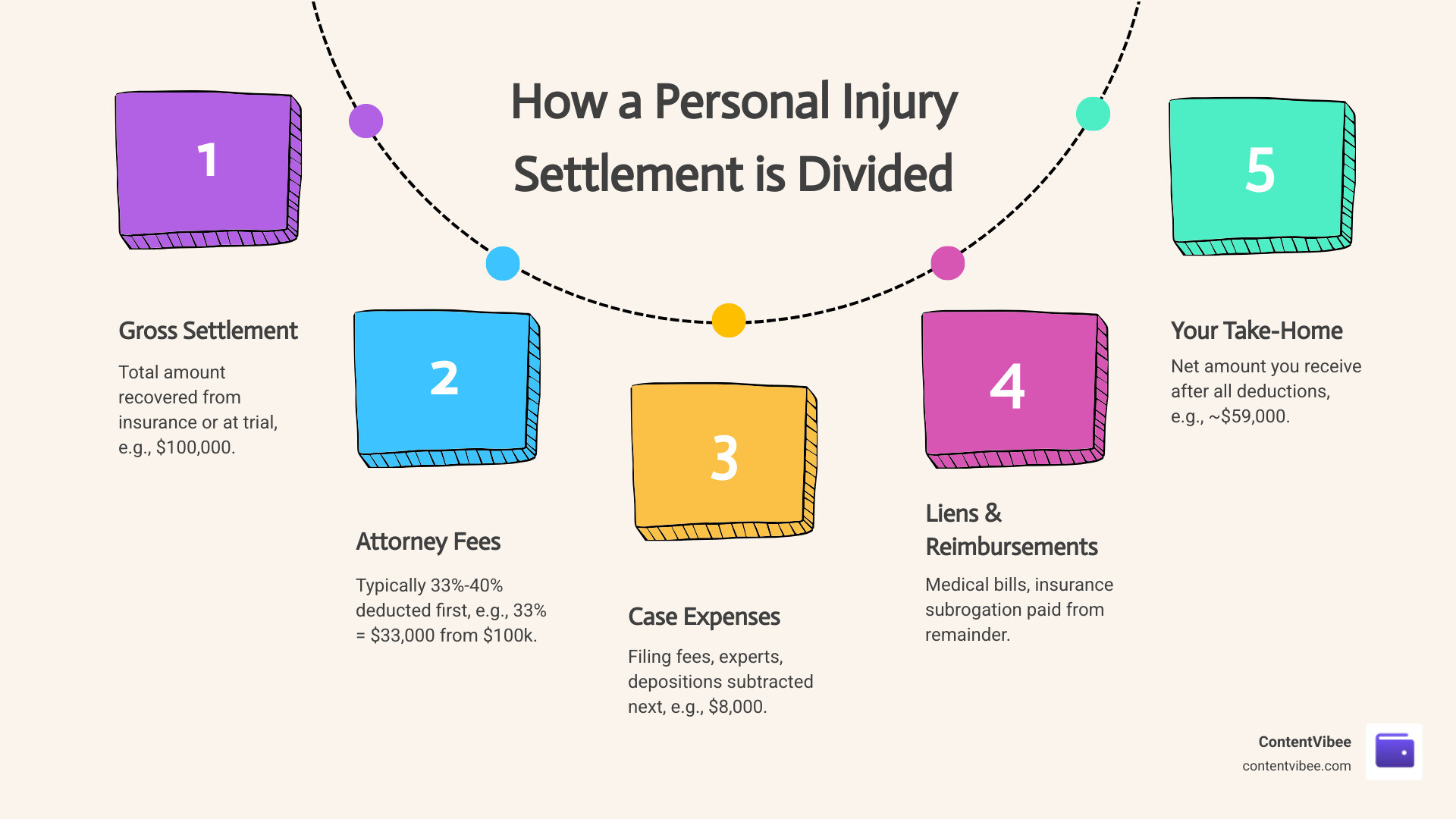
So on a $100,000 settlement, a 33% contingency fee means your lawyer takes $33,000. Subtract another ~$8,000 in case expenses, and your take-home is roughly $59,000.
That math surprises people. But here’s the other side: represented claimants recover 3.5 times more than those who go it alone, according to the Insurance Research Council. For most cases, hiring a lawyer still puts more money in your pocket — not less.
This guide breaks down exactly how the fees work, what gets deducted from your settlement, and what to ask before you sign anything.
How Much Does a Personal Injury Lawyer Cost in 2026?
As we move through 2026, the personal injury market has stabilized, but the complexity of litigation means that understanding fee structures is more important than ever. In Virginia and across the country, the standard remains the contingency fee. Unlike a divorce attorney or a criminal defense lawyer who might demand a $5,000 retainer upfront, we personal injury experts operate on a “pay-later” model.
The typical range for how much does a personal injury lawyer cost falls between 25% and 40% of the final award. If you are dealing with a straightforward car accident that settles quickly, you’ll likely see the “one-third rule” (33.3%) applied. However, if the case requires a full-blown trial, that percentage often climbs to 40% to account for the hundreds of hours of additional labor.
What “contingency fee” means and how personal injury lawyers get paid
A contingency fee is essentially a “no win, no fee” agreement. It is a risk-sharing contract: we invest our time, staff resources, and money into your case. If we don’t secure a settlement or a jury verdict for you, you owe us nothing in attorney fees.
This model is the great equalizer in the American legal system. It allows someone living paycheck-to-paycheck to go head-to-head with a multi-billion dollar insurance company. Because our payment is a percentage of your recovery, our incentives are perfectly aligned with yours. We want the highest settlement possible because that means we also get paid more.
How much does a personal injury lawyer cost before filing, after filing, and at trial?
Fees aren’t always static; they often follow a “sliding scale” based on how far the case progresses.
- Pre-Suit (33.3%): Most cases settle here. We send a demand letter, negotiate with the adjuster, and reach a deal without ever stepping into a courtroom.
- Post-Filing (36% – 40%): If the insurance company plays hardball and we have to file a formal lawsuit, the workload explodes. We have to manage “discovery,” which involves thousands of pages of documents.
- Trial (40% – 45%): Taking a case to a jury is an immense undertaking. Between expert testimony and trial prep, the fee increases to reflect the high-stakes nature of the work.
| Litigation Stage | Percentage | Why the Increase? |
|---|---|---|
| Settlement before lawsuit | 33.3% | Lower overhead, faster resolution. |
| After filing / Discovery | 36% | Court deadlines, depositions, and motions. |
| Jury Trial / Appeals | 40%+ | Maximum labor, expert coordination, and risk. |
Attorney fees vs. case costs: the charges clients confuse most
This is where many people get tripped up. There is a big difference between attorney fees (payment for our time) and case costs (reimbursement for expenses paid to third parties).
Even if we don’t charge you a dime upfront, we are spending money behind the scenes to build your case. Common expenses include:
- Court Filing Fees: Usually $150 to $400 to start the lawsuit.
- Medical Records: Doctors often charge a fee to print and send your history.
- Expert Witnesses: In a complex medical malpractice or crash reconstruction case, experts can charge $500 to $3,000+ per hour.
- Depositions: Court reporters charge $100 to $300 per session to transcribe testimony.
For a deeper dive into these specific line items, check out How Much Will My Personal Injury Case Cost? to see how these expenses can add up in a high-stakes claim.

Hidden Deductions That Change Your Net Settlement
You might hear a lawyer talk about a “$100,000 win,” but that isn’t the amount that lands in your bank account. To understand the “net recovery,” we have to look at the deductions that happen after the check arrives.
Are costs deducted before or after the lawyer’s fee is calculated?
This is a “million-dollar question” (sometimes literally). There are two ways to calculate the fee:
- The Gross Method: The lawyer takes their 33% from the total $100,000 ($33,000), then subtracts the $5,000 in costs. You get $62,000.
- The Net Method (Client Favorable): The $5,000 in costs is subtracted first. The lawyer then takes 33% of the remaining $95,000 ($31,350). You get $63,650.
Always look for the “Net Method” or ask if costs are deducted before the fee is calculated. It can put thousands of extra dollars in your pocket.
Do you owe anything if you lose, and how are liens handled if you win?
Under most “no win, no fee” structures, if we lose, you owe $0 in attorney fees. However, you must read your contract carefully regarding costs. Some firms expect you to reimburse them for the filing fees and expert costs even if you lose, though many reputable firms waive these if there is no recovery.
If you win, we have to deal with medical liens. If your health insurance (like BlueCross or Medicare) paid for your surgery after the accident, they often have a legal right to be paid back from your settlement. This is called subrogation. A major part of our job is negotiating these liens down. We can often get providers to take 30% to 60% less than what they originally asked for, which directly increases your take-home pay.
For more details on the nuances of these percentages, see How Much Does A Personal Injury Lawyer Cost? Attorney Fees & Percentages Explained.
Real examples: how much does a personal injury lawyer cost out of a $25,000, $100,000, or $250,000 settlement?
Let’s look at some hypothetical 2026 scenarios to see how the math plays out in the real world.
Scenario A: The $25,000 Settlement (Minor Car Accident)
- Attorney Fee (33%): $8,250
- Medical Records/Filing: $750
- Medical Liens: $5,000
- Client Take-Home: $11,000
Scenario B: The $100,000 Settlement (Moderate Injury)
- Attorney Fee (33%): $33,000
- Costs (Experts/Depositions): $8,000
- Medical Liens: $15,000
- Client Take-Home: $44,000
Scenario C: The $250,000 Settlement (Post-Filing)
- Attorney Fee (36% due to filing): $90,000
- Costs (Heavy Litigation): $20,000
- Medical Liens: $40,000
- Client Take-Home: $100,000
To run your own numbers, you can use our Personal Injury Settlement Calculator or specifically for vehicle issues, our Car Accident Settlement Calculator.
Is Hiring a Lawyer Worth It, and What Should You Ask Before Signing?
We’ll be honest: if you have a “fender bender” with no injuries and the insurance company offers you $2,000, you might be better off taking it yourself. Once you hire us, our 33% fee might leave you with less than the original $2,000.
However, for anything involving surgery, missed work, or disputed fault, the data is clear. The Insurance Research Council has found that people with lawyers receive significantly higher settlements—often 3.5 times more than those without representation. Even after our fee is paid, you are usually left with a much larger “net” amount than you would have secured on your own.
Questions to ask before signing a personal injury fee agreement
Don’t just sign the first piece of paper put in front of you. Ask these questions to ensure you’re getting a fair deal:
- Is the fee calculated on the gross or net recovery? (Remember: Net is better for you!)
- What is your fee if we settle tomorrow versus if we go to trial?
- If we lose the case, will I be responsible for out-of-pocket expenses?
- Will you help me negotiate my medical bills and liens after the settlement?
- Who will be my primary point of contact?
Getting these answers in writing within the “Retainer Agreement” is vital. Transparency is the hallmark of a great Virginia law firm.
Can you negotiate personal injury lawyer fees, and when is it worth hiring one?
Yes, you can negotiate! While 33% is the industry standard, if you have a very strong case with clear liability (e.g., you were hit by a commercial truck while stopped at a red light) and high damages, a lawyer might be willing to drop their fee to 25% or 30% to secure the case.
Hiring a lawyer is absolutely worth it when:
- Liability is disputed: The other driver says it was your fault.
- Serious injuries: You have broken bones, surgery, or permanent scarring.
- The insurance company lowballs you: They offer a “final” settlement that doesn’t even cover your ER bill.
For those curious about how much their specific case might be worth before they even talk to a lawyer, our Realistic Settlement Calculator can provide a baseline. And remember, managing your finances during a legal battle is tough—we’ve also got resources on other financial hurdles like average refi closing costs to help you stay on top of your money.
At ContentVibee, we believe that legal costs shouldn’t be a mystery. By understanding how much does a personal injury lawyer cost, you can walk into a consultation with confidence, knowing that you aren’t just “hiring a bill”—you’re hiring a partner to fight for your future.