A social security spousal benefit is a monthly payment you can receive based on your spouse’s (or ex-spouse’s) earnings record — even if you have little or no work history of your own.
Quick answers:
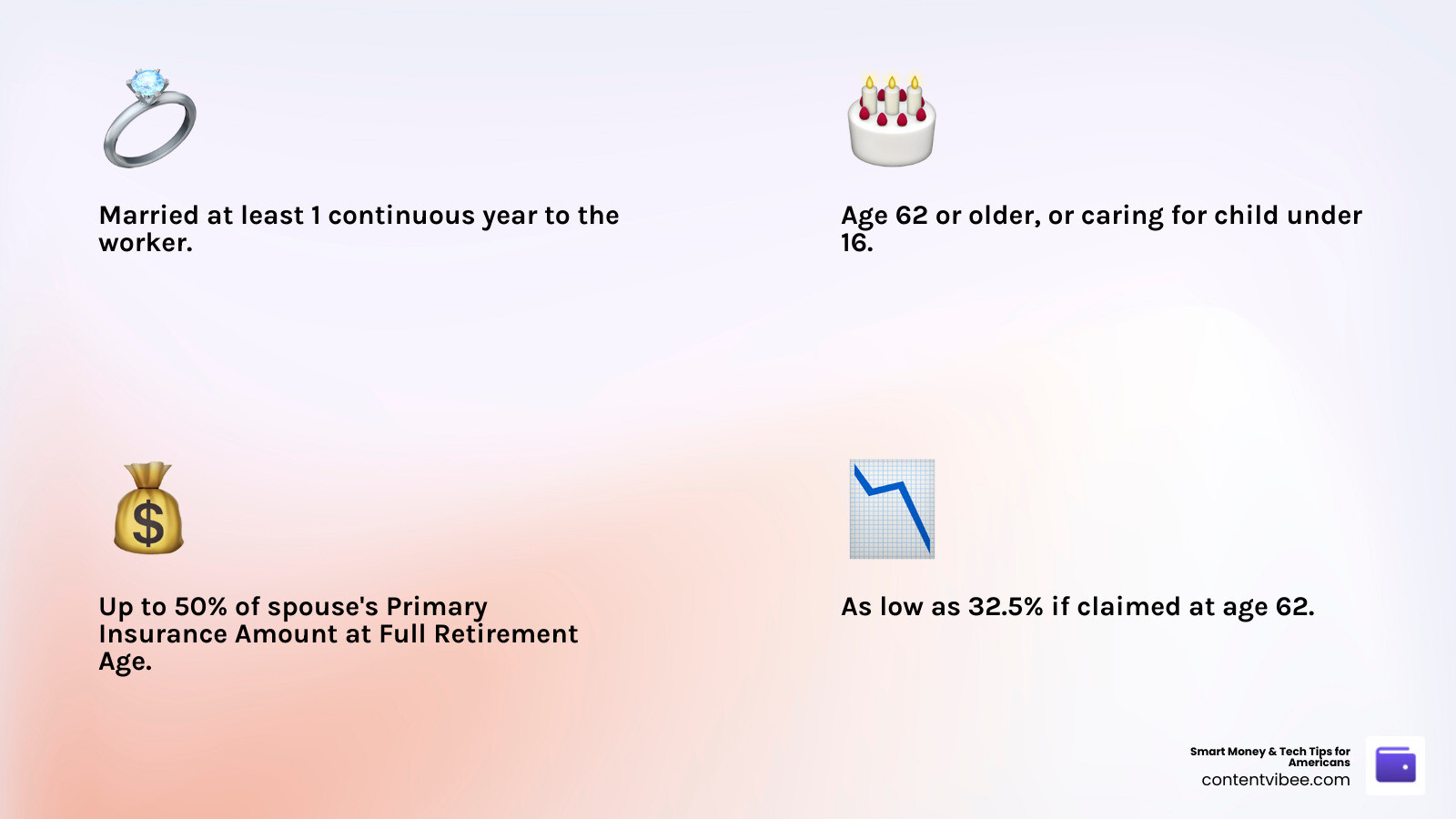
- Who qualifies: Married spouses age 62+, or any age if caring for a qualifying child under 16
- Maximum amount: Up to 50% of the worker spouse’s Primary Insurance Amount (PIA) at Full Retirement Age
- Minimum amount: As low as 32.5% of the worker’s PIA if you claim at age 62
- Average monthly payout: About $955 (as of August 2025)
- Does it reduce your spouse’s benefit? No — their payment stays the same
- Divorced? You may still qualify if the marriage lasted 10+ years and you haven’t remarried
Millions of Americans — especially those who spent years raising children or earning less than a spouse — are leaving money on the table by not understanding these rules.
The rules around spousal benefits can feel confusing. When do you qualify? How much will you actually get? What if you’re divorced? What if you’re already receiving your own retirement benefit?
This guide breaks it all down in plain language, so you can make confident decisions about when and how to claim.
Eligibility and Requirements for Spouses
Understanding the social security spousal benefit begins with knowing if the door is open for you to apply. The Social Security Administration (SSA) has specific gatekeepers: marriage duration, your age, and the status of your spouse’s own claim.
Generally, to collect on a spouse’s record, you must have been married for at least one continuous year. Additionally, your spouse must already be receiving their own retirement or disability benefits for you to be eligible to file. While the standard age to start collecting is 62, there are exceptions if you are caring for a child.
It is also important to note that these benefits are available to residents across the country, including those in our service areas like Michigan, New York, and California. If you are wondering about your specific situation, the official SSA blog post Do You Qualify for Social Security Spouse’s Benefits? provides a great deep dive into these fundamental requirements.
Eligibility Requirements for a Social Security Spousal Benefit
The “one-year rule” is the most common hurdle for currently married couples. However, if you are the parent of your spouse’s child, that one-year requirement may be waived.
Another critical concept we must discuss is deemed filing. In the past, some people could “split” their claims—taking a spousal benefit first and letting their own retirement benefit grow. As of May 2026, those days are largely gone for most retirees. When you apply for one benefit, the SSA “deems” you to be applying for all benefits for which you are eligible. They will then pay you the higher amount of the two, rather than letting you double-dip or choose a specific sequence.
If you have questions about the timing of your spouse’s filing, you can find more details at When can my spouse get Social Security benefits on my record?.
Caring for a Qualifying Child
There is a significant “loophole” to the age 62 rule: caring for a qualifying child. If you are caring for your spouse’s child who is under age 16, or a child who was disabled before age 22, you can receive a social security spousal benefit at any age.
The best part? If you qualify because you are caring for a child, your benefit is not reduced for “early” claiming, even if you are well below your Full Retirement Age (FRA). This protection ensures that the primary caregiver has financial support without being permanently penalized for starting benefits early to manage family needs.
Calculating the Payout: What to Expect
How much will you actually see in your bank account? The magic number is 50%. A social security spousal benefit can be as much as 50% of your spouse’s “Primary Insurance Amount” (PIA).
The PIA is the amount your spouse is entitled to receive at their Full Retirement Age. As of August 2025, the average monthly spousal benefit payout was approximately $955, while the average for all retired workers sat at $2,008. To get a personalized estimate based on your specific numbers, we recommend using a Social Security Spousal Benefit Calculator.
Calculating Your Social Security Spousal Benefit Amount
To get that full 50% payout, you must wait until your own Full Retirement Age (usually 66 and 10 months or 67, depending on your birth year) to claim.
One common point of confusion we see is the impact of “Delayed Retirement Credits.” If your spouse waits until age 70 to claim their own benefit, their monthly check increases by 8% each year past their FRA. However, this increase does not pass on to you for a spousal benefit. Your spousal benefit is strictly capped at 50% of their FRA amount.
For more technical details on the reduction formulas, you can visit the SSA’s page on Benefits for Spouses.
The Impact of Your Own Earnings Record
The SSA always looks at your own work record first. If your own retirement benefit is higher than the spousal benefit, you will receive your own amount. If the spousal benefit is higher, you get a combination of payments that equals the higher spousal amount.
Consider “Sandy,” a hypothetical retiree. Sandy is eligible for $1,000 on her own work record. Her husband’s PIA is $2,500, making her potential spousal benefit $1,250 (50%). Sandy will receive her $1,000, plus a $250 “supplemental” spousal benefit, totaling $1,250. You don’t get both the full $1,000 and the full $1,250!
The Cost of Claiming Early
Patience is a virtue—and in Social Security, it’s a literal paycheck. If you claim your social security spousal benefit as soon as you turn 62, the amount is permanently reduced.

The reduction is calculated using a specific formula:
- For the first 36 months before your FRA, the benefit is reduced by 25/36 of 1% per month.
- If you claim even earlier (beyond 36 months), the reduction is 5/12 of 1% per month.
Reduction Percentages by Age
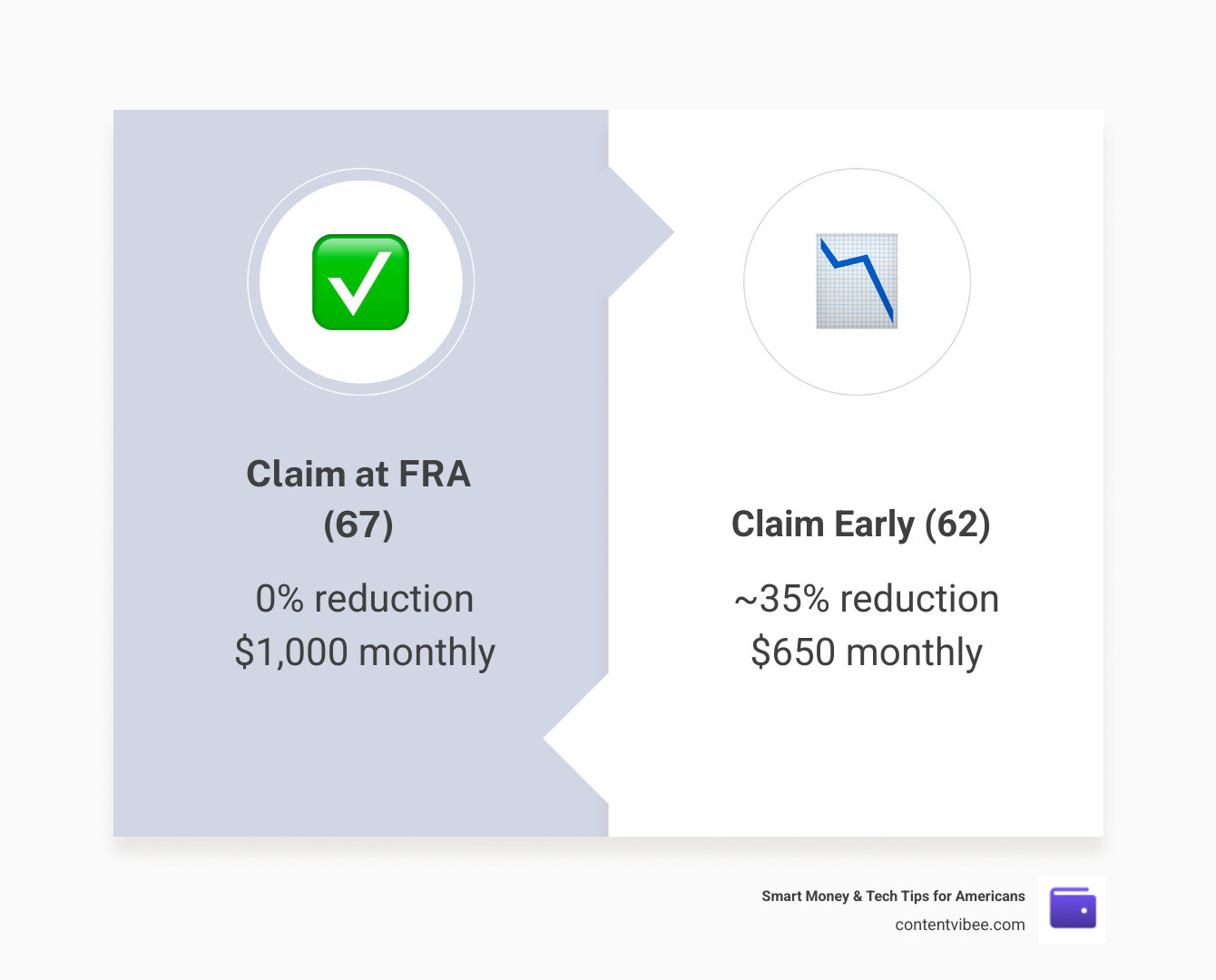
If your Full Retirement Age is 67 and you claim at 62 (60 months early), your benefit is reduced by about 35% total. This leaves you with just 32.5% of your spouse’s PIA.
Here is a quick breakdown of how claiming early affects a $1,000 potential (50% of spouse’s $2,000 PIA) benefit:
| Age Claimed | Reduction % | Monthly Amount |
|---|---|---|
| 67 (FRA) | 0% | $1,000 |
| 66 | ~6.7% | $933 |
| 65 | ~13.3% | $867 |
| 64 | ~20% | $800 |
| 62 | ~35% | $650 |
Rules for Divorced Spouses and Survivors
Divorce doesn’t necessarily end your access to Social Security. If you were married for at least 10 years and have been divorced for at least two years, you can claim a social security spousal benefit on your ex’s record even if they haven’t filed for their own benefits yet!
The best part for those who prefer to avoid awkward conversations? Your ex-spouse is never notified, and your claim has absolutely zero impact on their benefit amount or the amount their current spouse might receive. For residents in Michigan, legal experts often highlight these rules during estate planning, as seen in Social Security Benefits for Spouses – Michigan Elder Law.
Survivor Benefits vs. Spousal Benefits
It is vital to distinguish between a “spousal” benefit and a “survivor” benefit. While a spousal benefit is capped at 50%, a survivor benefit (for widows or widowers) can be up to 100% of the deceased worker’s benefit.
Survivor benefits can also be claimed as early as age 60 (or age 50 if you are disabled). Unlike spousal benefits, survivor benefits do include any delayed retirement credits the deceased spouse earned by waiting until age 70 to claim.
Strategies to Maximize Your Social Security Spousal Benefit
Maximizing your household income requires a bit of teamwork. One of the most effective strategies is for the higher earner to delay their claim until age 70. While this doesn’t increase the spousal benefit, it maximizes the worker’s benefit and, crucially, maximizes the future survivor benefit for the lower-earning spouse.

Avoiding Common Claiming Mistakes
We see many Americans fall into the same traps. Here are three to avoid:
- The “Notification Myth”: Thinking your ex-spouse will be “mad” or lose money if you claim on their record. They won’t even know.
- The “Double-Dipping” Dream: Expecting to get your full check plus a full spousal check. You only get the higher of the two.
- Working While Claiming: If you are under your FRA and earn more than the annual limit ($23,400 in 2026), the SSA will temporarily withhold $1 for every $2 you earn over the limit. Once you hit FRA, the earnings test disappears.
Frequently Asked Questions about Spousal Benefits
Does my claim reduce my spouse’s monthly benefit?
Absolutely not. Your social security spousal benefit is an independent entitlement. Whether you claim $500 or $1,000, your spouse’s check remains exactly what they earned based on their work history. Even if there are multiple ex-spouses claiming on one worker’s record, the worker’s benefit is never touched.
Can I receive both my own retirement and a spousal benefit?
In a way, yes, but not as two separate full checks. As mentioned in the Sandy example, the SSA pays your own benefit first. If the spousal amount is higher, they add a “top-off” to bring you up to that higher amount. You receive the maximum amount you are entitled to, but it is often processed as one combined payment.
What happens to my benefit if I remarry?
If you are receiving benefits as a divorced spouse and you remarry, your eligibility for that benefit generally ends. However, if your new marriage ends (via death or divorce), you may be able to regain eligibility on your first spouse’s record, or potentially claim on your second spouse’s record if that marriage lasted at least a year.
Conclusion
Navigating the maze of Social Security doesn’t have to be a solo mission. At Smart Money & Tech Tips for Americans, we believe that every American deserves a retirement built on a foundation of clear, actionable facts. Whether you’re in Denver, Los Angeles, or New York, the rules for your social security spousal benefit remain a powerful tool for your financial security.
Don’t leave your hard-earned (or your spouse’s hard-earned) money on the table. Take the first step toward a smarter retirement and Estimate your future payments today. By understanding these rules now, you can ensure that you and your loved ones are protected for the years to come.