

The Backdoor Roth IRA 2026 Tax Loophole Explained for High Earners

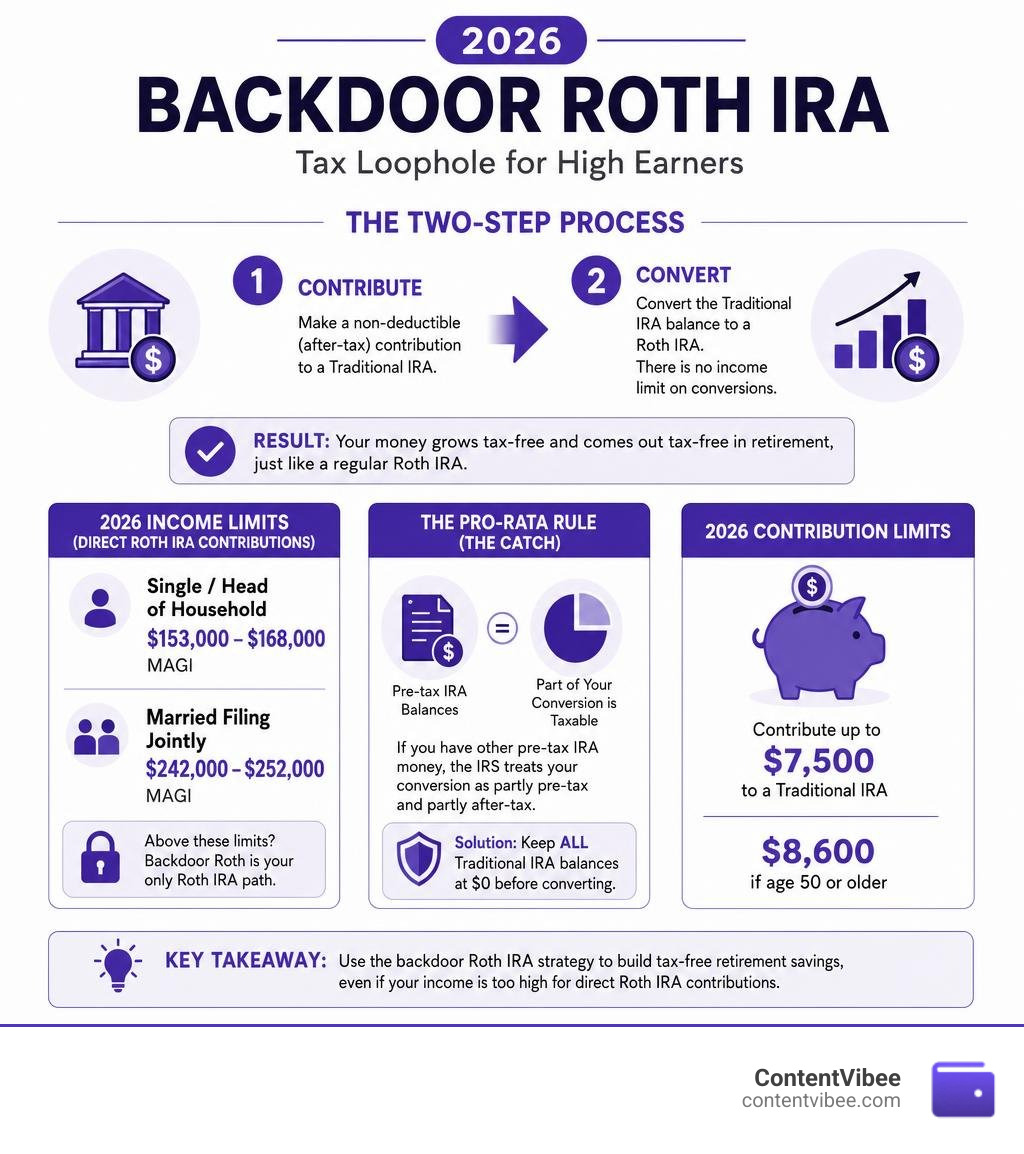
The Backdoor Roth IRA 2026 Tax Loophole is a fully legal two-step strategy that lets high-income earners fund a Roth IRA even when their income exceeds the IRS direct contribution limits.
Here’s the quick answer:
- Contribute up to $7,500 ($8,600 if age 50+) to a Traditional IRA as a non-deductible (after-tax) contribution
- Convert that Traditional IRA balance to a Roth IRA — there is no income limit on conversions
- Result: Your money grows tax-free and comes out tax-free in retirement, just like a regular Roth IRA
Who needs this strategy in 2026?
| Filing Status | Direct Roth Contribution Phased Out Between |
|---|---|
| Single / Head of Household | $153,000 – $168,000 MAGI |
| Married Filing Jointly | $242,000 – $252,000 MAGI |
| Above these limits | Backdoor Roth is your only Roth IRA path |
If your income lands above those ceilings, you cannot contribute directly to a Roth IRA. The backdoor strategy works around that — legally.
But there’s a catch. A tax rule called the pro-rata rule can turn what should be a tax-free move into an unexpected tax bill — and most people don’t see it coming until they’ve already made the mistake.
This guide walks you through exactly how the strategy works in 2026, how to dodge the pro-rata trap, and how to file everything correctly so you don’t get taxed twice.
Understanding the Backdoor Roth IRA 2026 Tax Loophole
To understand why the Backdoor Roth IRA 2026 Tax Loophole is such a powerful tool in our financial planning arsenal, we have to look at the unique benefits of Roth accounts. Unlike Traditional IRAs, which offer an upfront tax deduction but subject your future withdrawals to ordinary income tax, a Roth IRA flips the script. You pay taxes on your contributions today, but in exchange, you secure tax-free growth and completely tax-free withdrawals in retirement.
Furthermore, Roth IRAs do not have Required Minimum Distributions (RMDs) during the original owner’s lifetime. This gives us ultimate flexibility over when and how we draw down our retirement wealth.
By utilizing the backdoor strategy, high earners can achieve true tax diversification. Having a healthy mix of pre-tax accounts (like a Traditional 401(k)), tax-free accounts (like a Roth IRA), and taxable brokerage accounts allows us to strategically manage our tax brackets in retirement.
There is also great news regarding the legislative status of this strategy. Over the last several years, various legislative proposals have threatened to eliminate the backdoor Roth. However, the passage of the One Big Beautiful Bill Act (OBBBA) left the rules governing Roth conversions completely intact. As we navigate the 2026 tax year, the backdoor Roth remains a fully legal, IRS-permissible wealth-building tool.
Why High Earners Need the Backdoor Roth IRA 2026 Tax Loophole
As our household income grows, the IRS begins locking the front door to various tax advantages. For direct Roth IRA contributions, the locks are based on your Modified Adjusted Gross Income (MAGI).
For the 2026 tax year, the phase-out range for single filers is $153,000 to $168,000. If your MAGI is below $153,000, you can make a full, direct contribution to a Roth IRA. If it falls within the phase-out range, you can only make a partial contribution. Once your MAGI crosses $168,000, you are completely locked out.
For married couples filing jointly, the phase-out range for 2026 is $242,000 to $252,000. Any joint income above $252,000 means a direct contribution is completely off the table.
Below is a clear comparison of how the rules differ between direct contributions and the backdoor strategy:
| Feature | Direct Roth IRA Contribution | Backdoor Roth IRA Strategy |
|---|---|---|
| 2026 Single Income Limit | Fully phased out at $168,000 MAGI | No Income Limit |
| 2026 Joint Income Limit | Fully phased out at $252,000 MAGI | No Income Limit |
| 2026 Contribution Limit | $7,500 ($8,600 if age 50+) | $7,500 ($8,600 if age 50+) |
| Tax Deductibility | None (made with after-tax dollars) | None (nondeductible contribution) |
| Growth & Withdrawals | Tax-Free | Tax-Free |
Because the backdoor strategy has no income caps, it is the primary method for high earners to build tax-free wealth outside of workplace retirement plans.
How the Backdoor Roth IRA 2026 Tax Loophole Works: The Two-Step Strategy
The mechanics of this strategy are beautifully simple in theory. It relies on a two-step sequence:
- The Nondeductible Contribution: We open a Traditional IRA and make a contribution. Because our income is high, we cannot deduct this contribution on our taxes. This means we are making a “nondeductible” contribution with after-tax money.
- The Roth Conversion: Shortly after the funds settle in our Traditional IRA, we instruct our custodian to convert the entire balance into our Roth IRA.
Because we already paid income tax on the money we contributed to the Traditional IRA, we do not owe income tax again when we convert that principal to the Roth IRA.
Historically, some tax professionals worried about the “step-transaction doctrine” — a legal concept where the IRS collapses multiple steps of a transaction to tax it based on its ultimate economic substance. However, the backdoor Roth was effectively codified and recognized by Congress in the conference report of the 2017 Tax Cuts and Jobs Act (TCJA). The IRS has since clarified that as long as the steps are permitted under the tax code, the sequence is perfectly legal. There is no legally mandated waiting period between your contribution and your conversion.
Navigating the Pro-Rata Rule and the Aggregation Trap
While the backdoor Roth sequence sounds incredibly straightforward, the IRS has set a major trap for the unwary. It is called the pro-rata rule, and it is the single most common reason high earners end up with an unexpected tax bill.

When you convert funds from a Traditional IRA to a Roth IRA, the IRS does not allow you to say, “I am only converting the after-tax, nondeductible $7,500 I just put in.” Instead, under the IRC Section 408(d)(2) guidelines, the IRS views all of your Traditional IRAs as one single, aggregated pool of money.
The Mechanics of IRC Section 408(d)(2)
Under the aggregation principle, the IRS looks at the ratio of your pre-tax IRA assets to your after-tax IRA assets across all of your Traditional IRAs, SEP-IRAs, and SIMPLE IRAs. Your employer-sponsored 401(k) or 403(b) plans are excluded from this calculation, but any rollover IRAs from old employer plans are included.
The calculation is based on your total balances as of December 31 of the year in which the conversion occurs, not the date on which you execute the conversion.
Let’s look at a quick mathematical example of how this trap snaps shut:
Imagine you make a $7,500 nondeductible contribution to a new Traditional IRA, intending to convert it immediately. However, you also have an old rollover IRA from a previous employer containing $92,500 of pre-tax money.
Your total IRA balance across all accounts is now $100,000 ($92,500 pre-tax + $7,500 after-tax).
When you convert your $7,500 to a Roth IRA, the IRS determines the tax-free percentage of your conversion as follows:
- After-Tax Ratio: $7,500 / $100,000 = 7.5%
- Tax-Free Portion: 7.5% of your $7,500 conversion = $562.50
- Taxable Portion: 92.5% of your $7,500 conversion = $6,937.50
Even though you converted the exact $7,500 you just contributed with after-tax cash, you will owe ordinary income tax on $6,937.50 of the conversion! If you are in the 32% tax bracket, this mistake will cost you over $2,200 in unexpected taxes.
Four Strategies to Avoid the Pro-Rata Landmine
Fortunately, we can easily bypass the pro-rata rule if we plan ahead. Here are the four best strategies to maintain a “clean slate” and ensure your conversion is 100% tax-free:
- The Reverse Rollover: If you have an active employer 401(k) or 403(b) plan that accepts incoming rollovers, you can roll your pre-tax Rollover, Traditional, SEP, or SIMPLE IRA balances into your workplace plan. Because 401(k) balances do not count toward the pro-rata calculation, this completely clears your IRA slate. Be sure to initiate this process by mid-November to ensure it fully processes before the December 31 deadline.
- The Solo 401(k) for Self-Employed Individuals: If you have any self-employment income (even from a side hustle), you can set up a Solo 401(k). You can then roll your pre-tax IRAs into the Solo 401(k), clearing your IRA balances.
- Spousal Separation: IRAs are individual retirement accounts. If you have a large pre-tax IRA but your spouse does not, your spouse can still execute a perfectly clean backdoor Roth IRA. Your pre-tax balances have zero impact on their pro-rata calculation.
- Full Conversion: If your pre-tax IRA balances are very small (e.g., a few hundred dollars), it may be easiest to simply convert the entire balance to a Roth IRA, pay the small tax bill once, and enjoy a lifetime of clean backdoor conversions moving forward.
Step-by-Step Guide to Executing the Backdoor and Mega Backdoor Roth
Now that we understand how to protect ourselves from the pro-rata rule, let’s look at how to execute the transaction. Timing is crucial. To minimize taxes on any earnings, we want to convert the funds as soon as they settle in our Traditional IRA.

During the brief settlement period (typically 1 to 3 business days), we recommend keeping the contribution in a cash equivalent, such as a money market fund. This prevents the money from fluctuating in value. If the funds grow even by a few dollars before the conversion, those earnings will be subject to ordinary income tax upon conversion.
Step-by-Step Instructions for the Standard Backdoor
Let’s walk through the exact sequence to execute a standard backdoor Roth IRA in 2026:
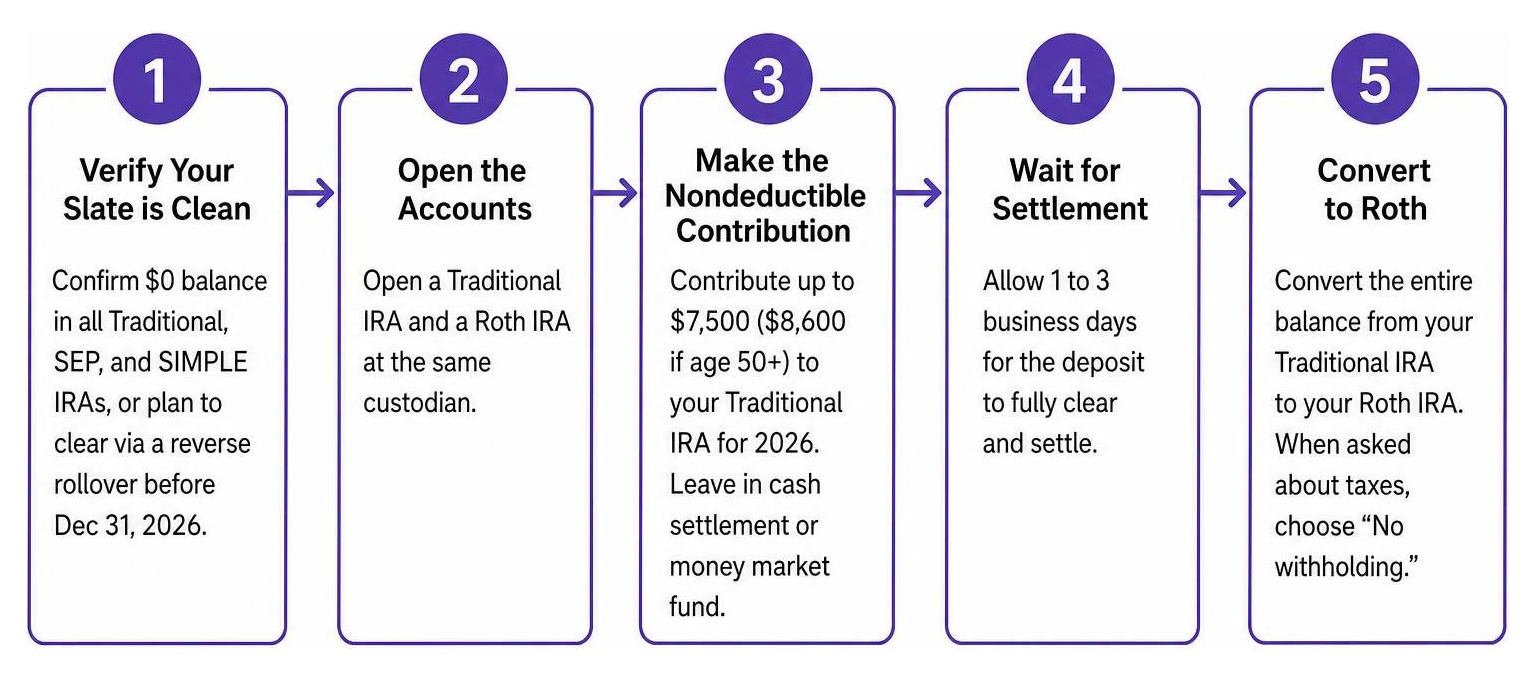
- Verify Your Slate is Clean: Confirm that you have a $0 balance in all Traditional, SEP, and SIMPLE IRAs, or plan to clear them via a reverse rollover before December 31, 2026.
- Open the Accounts: If you don’t already have them, open both a Traditional IRA and a Roth IRA at the same financial custodian. This makes the transfer process much faster and easier.
- Make the Nondeductible Contribution: Deposit up to $7,500 ($8,600 if you are age 50 or older in 2026) into your Traditional IRA. When prompted, designate this as a current-year (2026) contribution. Leave the money in the default cash settlement or money market fund.
- Wait for Settlement: Allow 1 to 3 business days for the deposit to fully clear and settle in the account.
- Convert to Roth: Log into your custodian’s platform and select the option to convert your Traditional IRA to a Roth IRA. Choose to convert the entire balance. Crucial: When asked if you want to withhold taxes from the conversion, select “No withholding.” Withholding taxes from the conversion is a major mistake because it reduces the amount of money moving into your tax-free Roth bucket and can trigger early withdrawal penalties if you are under age 59½.
- Invest the Funds: Once the money lands in your Roth IRA, do not leave it in the settlement fund! Invest it immediately according to your long-term asset allocation.
- File Form 8606: When you file your 2026 tax return (in early 2027), you must file IRS Form 8606. Part I tracks your nondeductible basis so the IRS knows you already paid taxes on the contribution, and Part II calculates the tax-free conversion. Skipping this form is a common mistake that can lead to double taxation down the road.
The Mega Backdoor Roth and SECURE 2.0 Rules
For super-savers who want to maximize their Roth contributions, the standard backdoor is only the beginning. If your employer’s 401(k) plan allows for after-tax contributions (which are different from Roth 401(k) contributions) and in-service withdrawals or in-plan Roth conversions, you can execute a Mega Backdoor Roth.
Under Section 415(c), the total 401(k) annual additions limit for 2026 is $72,000 (or $80,000 if age 50+, and $83,250 if age 60-63 due to SECURE 2.0’s enhanced catch-up limits).
By subtracting your normal employee deferrals ($24,500 in 2026) and any employer matching contributions from this total limit, you can contribute up to an additional $47,500+ in after-tax dollars to your workplace plan and convert them to a Roth IRA or Roth 401(k).
We must also keep in mind a key SECURE 2.0 change that is active in 2026: if your prior-year FICA wages exceeded $150,000, any catch-up contributions you make to your employer’s 401(k) plan must be made on a Roth basis. This aligns perfectly with a high-income Roth accumulation strategy.
Frequently Asked Questions About the Backdoor Roth
Is the backdoor Roth IRA legal in 2026?
Yes, it is 100% legal. The strategy was effectively codified by the 2017 Tax Cuts and Jobs Act, which eliminated the income caps on Roth conversions. Subsequent legislative efforts to eliminate the strategy have failed, and the One Big Beautiful Bill Act of 2025 left these conversion rules completely untouched for 2026.
What is the deadline for a 2026 backdoor Roth conversion?
While you have until the tax-filing deadline (April 15, 2027) to make your $7,500 Traditional IRA contribution for the 2026 tax year, conversions are always reported in the calendar year in which they occur. To keep your tax reporting clean and simple, we highly recommend completing both the contribution and the conversion before December 31, 2026.
Can my non-working spouse also do a backdoor Roth?
Yes! Under the Kay Bailey Hutchison Spousal IRA rules, as long as one spouse has enough earned income to cover both contributions, you can fund a separate backdoor Roth IRA for your non-working spouse. This effectively allows a married couple to double their annual tax-free savings to $15,000 (or up to $17,200 if both are age 50 or older) in 2026.
Conclusion
The Backdoor Roth IRA 2026 Tax Loophole is one of the most effective strategies available for high earners to build tax-free wealth. By understanding the mechanics of the pro-rata rule and taking steps to clear out pre-tax IRA balances, we can execute this strategy smoothly year after year without triggering unexpected tax bills.
To maximize your long-term wealth, the backdoor Roth should be utilized as part of a comprehensive, multi-layered savings strategy alongside your workplace 401(k), Health Savings Accounts (HSAs), and taxable accounts.
If you are ready to take your retirement planning to the next level, read our comprehensive guide on how to maximize your retirement nest egg with after-tax contributions to discover more advanced strategies for securing your financial future.


