


Why Hiring a Motorcycle Accident Injury Lawyer Protects Your Recovery
Hiring an experienced motorcycle accident injury lawyer is the most effective way to protect your legal rights and secure fair financial compensation after a crash.
A dedicated attorney handles three critical priorities immediately:
- Stops predatory insurer tactics: Prevents adjusters from taking recorded statements or pushing lowball settlement offers before your medical prognosis is clear.
- Proves liability and counters bias: Gathers crash data, traffic footage, and witness testimony to overcome unfair stereotypes that blame riders by default.
- Maximizes your total recovery: Calculates the true cost of emergency treatment, future medical care, lost wages, and pain and suffering.
Most reputable motorcycle attorneys work on a contingency fee basis, meaning you pay zero upfront costs and owe no legal fees unless they win your case.
There is no such thing as a minor fender-bender on a motorcycle. Government safety data shows that roughly 79% of motorcycle collisions result in physical injury, compared to just 37% of passenger vehicle crashes. When severe injuries occur, insurance companies move fast to minimize payouts and shift blame to protect their bottom line.
Whether you are navigating shared fault rules, mounting medical debt, or lost income, choosing the right legal advocate ensures your financial future remains protected while you focus on healing.
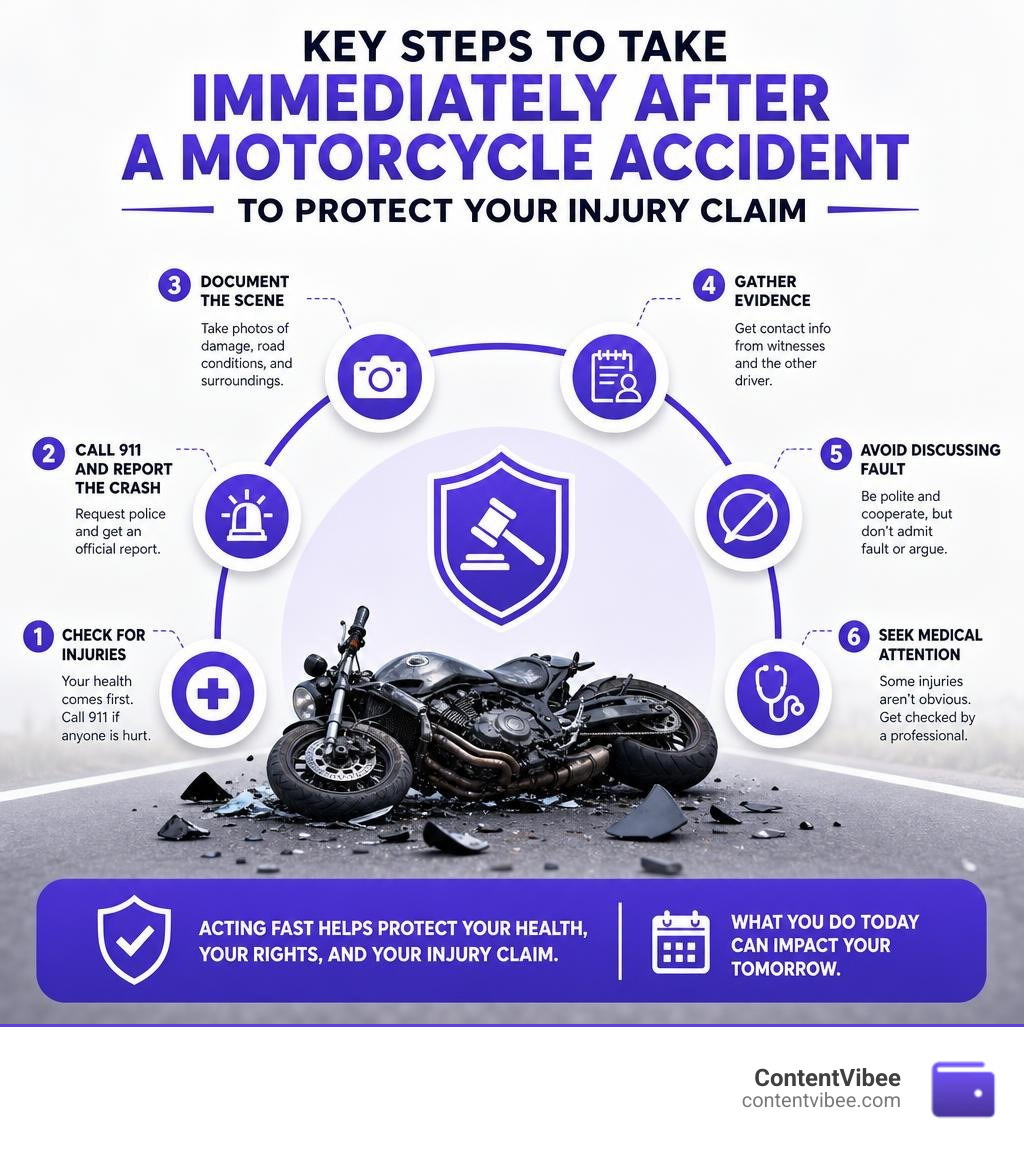
Critical Steps to Take Immediately After a Motorcycle Collision
The moments following a crash are chaotic, but the actions you take immediately will shape both your physical recovery and your legal claim. When a multi-ton passenger car collides with a two-wheeled machine, the human body absorbs the impact. While passenger car accidents result in fatal injuries in approximately 0.25% of incidents, motorcycle crashes cause fatalities in roughly 4.6% of collisions. According to the Insurance Institute for Highway Safety (IIHS), motorcycle deaths account for 13% of all motor vehicle fatalities nationwide.

To protect yourself physically and legally, follow these crucial steps at the scene:
- Move to safety and call 911: If you are physically capable, get out of the direct path of moving traffic. Request both police and emergency medical services immediately. An official police collision report is fundamental when establishing the timeline of events.
- Never apologize or admit fault: In the shock of an impact, many people reflexively say “I’m sorry.” Insurance defense teams love to twist casual polite statements into legal admissions of liability. Stick strictly to basic facts when speaking with responding officers.
- Undergo a complete medical evaluation: Adrenaline masks severe trauma. Conditions like internal organ bleeding, spinal disc herniations, and traumatic brain injuries (TBIs) may not show acute symptoms right away. Even though wearing a DOT-compliant helmet reduces traumatic brain injury risk by up to 67%, concussions and closed-head injuries still occur frequently. Contemporaneous medical records establish a clear causal link between the crash and your physical injuries.
- Exchange essential information: Collect the driver’s full name, phone number, address, driver’s license number, auto insurance policy details, and vehicle license plate.
- Collect independent witness details: Bystanders and fellow motorists who saw the crash can provide objective testimony before their memories fade. Obtain their full names and phone numbers.
Preserving Physical Evidence and Accident Scene Telemetry
Winning a personal injury claim requires cold, hard physical evidence. Physical proof prevents insurance carriers from inventing alternative narratives about how the crash occurred.
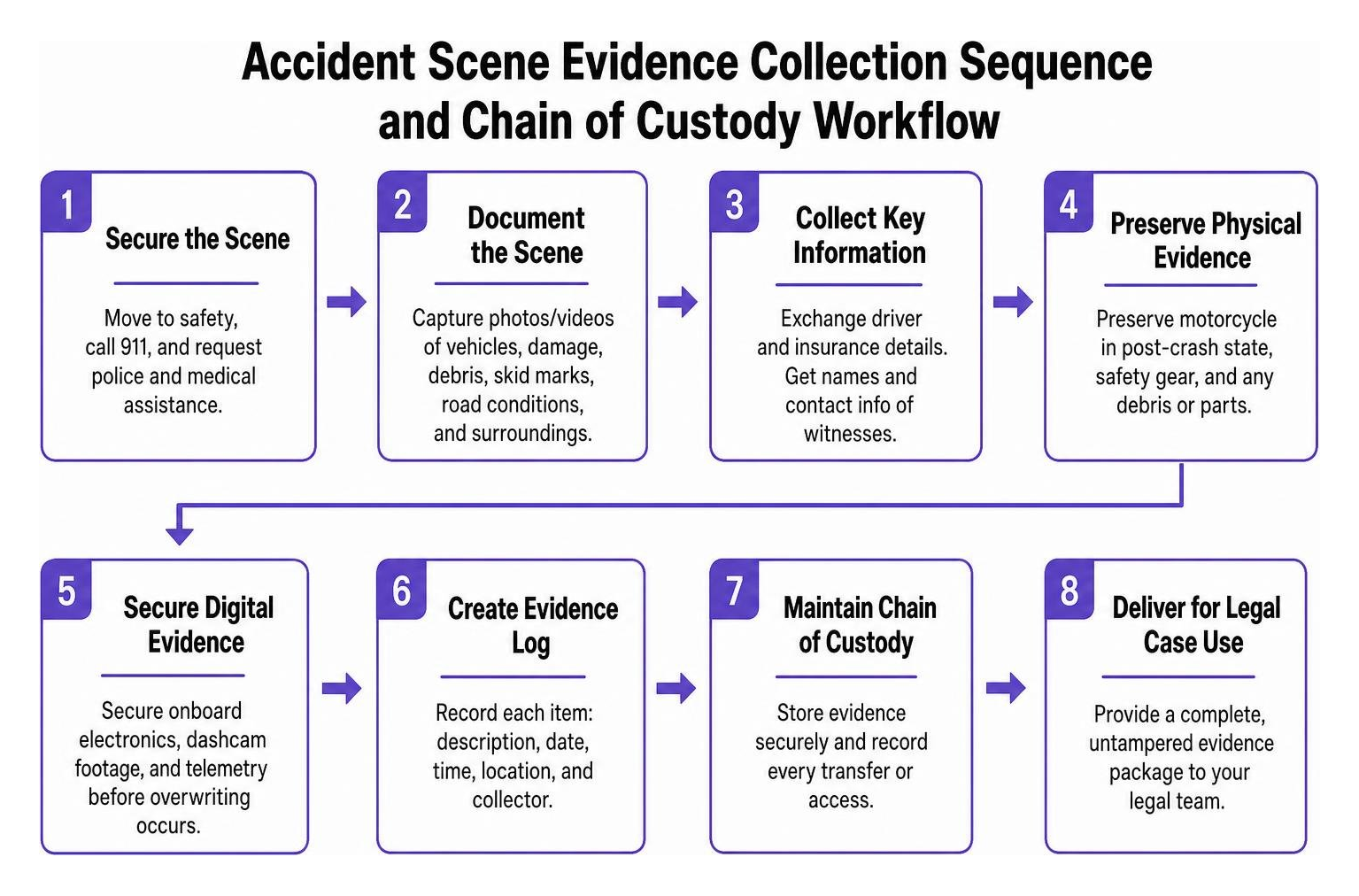
Make sure you or your representatives preserve:
- Your motorcycle in its post-crash state: Do not send your motorcycle to a salvage yard or authorize repairs until an independent forensic investigator has inspected it. Crush profiles, paint transfers, and handlebar damage prove the angle and force of impact.
- Safety gear and apparel: Never throw away or wash your torn jacket, scuffed boots, shredded gloves, or damaged helmet. Your protective gear illustrates the violent physical forces involved in the collision.
- Scene photographs and video footage: Take comprehensive, high-resolution photos of skid marks, fluid trails, debris fields, road construction signs, visual obstructions (like overgrown hedges), and weather conditions.
- Onboard electronics and dashcam footage: Many modern bikes and helmets feature camera mounts or telemetry tracking. Secure this digital media immediately before automated recording loops overwrite it.
Navigating Insurance Adjusters and Avoiding Recorded Statements
Within days of the collision, the at-fault driver’s insurance adjuster will call you. They will sound warm, sympathetic, and eager to “help you get your medical bills paid quickly.”
Do not fall into this trap. Adjusters are trained corporate negotiators whose primary metric of job performance is minimizing settlement payouts. They will routinely ask you to give a “brief recorded statement to finalize the paperwork.”
You are under no legal obligation to provide a recorded statement to the third-party insurer. Adjusters use open-ended, leading questions designed to elicit statements like “I didn’t see the car until the last second” or “I’m feeling a little better today,” which are later used in court to assign you comparative negligence or claim your injuries are minor. Understanding how motorcycle injury attorneys can help you will help you shield yourself from these predatory tactics and protect your right to fair compensation.
Why Hiring an Experienced Motorcycle Accident Injury Lawyer Matters
Motorcycle claims are not standard auto accident claims. The physical dynamics, severe injury profiles, and pervasive social biases surrounding riding require an attorney with dedicated courtroom experience and technical understanding.

Relying on a general practitioner who primarily handles soft-tissue fender benders often leads to undervaluation. When you consult an experienced buyers guide best motorcycle accident lawyers resource, you quickly realize that top advocates bring extensive trial resources, relationships with renowned medical specialists, and proven negotiation leverage against multi-billion-dollar insurance carriers.
How a Motorcycle Accident Injury Lawyer Counters Anti-Rider Bias
The biggest hurdle injured riders face is anti-motorcyclist bias. Insurance adjusters, defense attorneys, and conservative jurors frequently harbor the subconscious belief that anyone who rides a motorcycle is an inherent risk-taker who was likely speeding, weaving through traffic, or acting recklessly.
A skilled advocate dismantles this bias through:
- Presenting clean driving records and rider safety credentials: Showing formal motorcycle safety course completions and endorsements highlights your commitment to safe riding.
- Proving equipment compliance: Demonstrating proper use of DOT-certified helmets, high-visibility clothing, and functional headlight modulators shows careful road conduct.
- Filing targeted motions in court: Pre-trial motions (motions in limine) prevent defense attorneys from introducing irrelevant, prejudicial arguments about motorcycle stereotypes.
Accident Reconstruction and Establishing Liability
In many collisions, drivers claim: “The motorcycle came out of nowhere!” Under traffic safety laws, claiming you failed to see an approaching vehicle is an open admission of failing to keep a proper lookout.
The federal government estimates that drunk drivers cause 34% of fatal motorcycle crashes, while countless other wrecks stem from distracted motorists turning left directly across an oncoming rider’s right-of-way. To prove liability, your legal team will work with top-tier accident reconstructionists who analyze:
- Event Data Recorders (EDRs): Extracting vehicle “black box” data shows the other driver’s pre-impact speed, steering input, and braking patterns.
- Skid mark and friction coefficient analysis: Technical calculations prove approach speeds, evasive maneuvers, and point of impact.
- Objective causal nexus in non-contact wrecks: If a careless driver cuts you off and forces you to lay down your bike to avoid a lethal broadside crash, you do not need physical vehicle-to-vehicle contact to establish legal liability. Demonstrating that their illegal action created an immediate, objective need for evasive action makes the driver liable for your damages.
For a comprehensive breakdown of the entire legal process from crash scene to courtroom verdict, consult our motorcycle accident lawyer complete guide.
Understanding Motorcycle Accident Damages, Fault, and Statutory Deadlines
Evaluating the financial worth of a catastrophic injury claim is complex. A proper claim valuation must account for immediate out-of-pocket costs, lifetime care needs, and intangible emotional suffering. Reviewing insights on how to choose the best motorcycle accident lawyer will help you find a firm with the financial accounting resources necessary to calculate these damages accurately.
| Fault System | Legal Standard | Impact on Your Financial Recovery | Example Claim Outcome |
|---|---|---|---|
| Pure Comparative Negligence (e.g., California) | You can recover damages regardless of your fault percentage. | Payout is reduced by your exact percentage of fault (even at 90% fault). | Claim valued at $100,000; you are 20% at fault; you receive $80,000. |
| Modified Comparative Fault (e.g., Florida, Nevada) | You can recover compensation as long as your fault does not exceed 50%. | Payout reduced by your fault share. If you are 51% at fault, you recover $0. | Claim valued at $100,000; you are 30% at fault; you receive $70,000. |
| Pure Contributory Negligence (e.g., North Carolina) | If you share any fault whatsoever, recovery is completely barred. | Being found even 1% at fault prevents you from recovering a single penny. | Claim valued at $100,000; you are 1% at fault; you receive $0. |
Calculating Economic and Non-Economic Damages
Compensatory damages fall into two main categories:
1. Economic Damages (Tangible Financial Losses)
- Past and future medical treatment: Emergency room surgeries, intensive care stays, diagnostic imaging, skin grafts for third-degree road rash, physical therapy, and durable medical hardware.
- Long-term care and home modifications: Wheelchair ramps, specialized transportation, and in-home nursing care for spinal cord injuries or limb amputations.
- Lost income and diminished earning capacity: Compensation for missed shifts during recovery and the projected lifetime difference in earnings if a permanent disability prevents you from returning to your trade.
- Property damage: Complete replacement value of your motorcycle, aftermarket upgrades, riding gear, and helmet.
2. Non-Economic Damages (Intangible Losses)
- Physical pain and suffering: Calculated based on the severity and duration of the physical trauma.
- Emotional distress and PTSD: Anxiety, severe depression, sleep disturbances, and driving phobias following a catastrophic crash.
- Loss of enjoyment of life: Compensation for the inability to participate in hobbies, sports, and daily activities.
- Loss of consortium: Damages awarded to compensate a spouse for the loss of companionship, intimacy, and emotional support.
Attorneys typically value non-economic harm using a multiplier method (multiplying economic damages by a factor between 1.5 and 5, depending on the injury’s permanence) or a per diem method (assigning a daily monetary rate throughout your physical recovery).
Comparative Negligence Rules and the Statute of Limitations
State laws determine how shared liability and filing deadlines affect your lawsuit:
- Pure Contributory Negligence: Under the strict rules enforced in states like North Carolina, an insurance company that proves you were even 1% responsible for a collision can bar your recovery entirely.
- Modified Comparative Negligence: States like Nevada and Florida enforce a strict 50% bar. You can recover damages as long as you are 50% or less at fault, but your financial award is reduced proportionately by your assigned percentage of blame. Exceeding 50% fault wipes out your claim.
- Statute of Limitations: Every state establishes a strict deadline to file a personal injury or wrongful death lawsuit. In states like California, Nevada, and Florida, the statute of limitations for personal injury is typically two years from the date of the incident. In Michigan, the standard third-party personal injury limit is three years. If you miss this statutory filing deadline, the court will dismiss your case permanently, regardless of how severe your injuries are.
Essential Criteria for Selecting Top Motorcycle Legal Representation
Selecting the right legal advocate can mean the difference between financial recovery and lifelong debt. When evaluating prospective firms, look for specific credentials, trial capabilities, and client protections.
Before making your choice, review reputable guides like the 7 best motorcycle personal injury attorneys to compare leading practitioners in your area.
Key qualifications to prioritize include:
- Demonstrated trial experience: Insurers track which lawyers settle quickly and which ones take cases to a jury verdict. High-value trial verdicts force insurance companies to offer realistic policy-limit settlements.
- Deep technical understanding of motorcycles: Attorneys who ride understand counter-steering dynamics, braking distances, road surface hazards, and specialized protective gear. They can cross-examine defense accident reconstructionists effectively.
- Contingency fee structures with transparent terms: Look for a strict “no fee unless you win” agreement, where legal fees and litigation expenses are deducted only from the final settlement or verdict.
- In-house investigative resources: Elite firms retain accident reconstructionists, biomechanical engineers, forensic toxicologists, and vocational life-care planners immediately.
- Direct attorney accessibility: You should have clear communication channels with your lead trial attorney rather than being handed off entirely to paralegals or intake case managers.
Questions to Ask a Prospective Motorcycle Accident Injury Lawyer
During your initial consultation, ask these direct questions:
- What percentage of your active caseload is dedicated exclusively to motorcycle accident injury claims?
- How do you approach overcoming anti-motorcyclist bias during settlement negotiations and jury selection?
- Have you successfully tried motorcycle accident cases to verdict in civil court, and what were the outcomes?
- Who will manage my case day-to-day, and how often will I receive updates on my medical records collection and insurance discussions?
- Do you front all upfront litigation expenses (expert fees, deposition court reporter costs, medical records retrieval), and what happens to those costs if the case is unsuccessful?
Frequently Asked Questions About Motorcycle Accident Injury Claims
How long do I have to file a lawsuit after a motorcycle crash?
Your filing window depends on the statute of limitations in the state where the collision occurred. Most states enforce a statutory deadline between two and three years from the exact date of the accident. If you are pursuing a claim against a government entity for hazardous road design or unmaintained potholes, strict administrative notice rules often require filing a formal notice of claim within six months. Failing to meet these deadlines bars you from recovering compensation.
Can I recover compensation if I was partially at fault for the crash?
In most jurisdictions, yes. Under pure comparative negligence and modified comparative fault systems, you can recover damages as long as your fault level remains within state statutory limits (usually 50% or below). Your total financial award will be reduced in direct proportion to your share of liability. For instance, if a court determines your damages total $200,000 but assigns you 20% comparative fault for riding slightly above the posted speed limit, you will receive $160,000. In pure contributory negligence states, however, any assigned fault prevents recovery.
What should I do if the at-fault driver is uninsured or underinsured?
If the negligent driver carries state-minimum liability insurance (often as low as $10,000 to $30,000) or has no insurance at all, you must turn to your own insurance policy. If you carry Uninsured/Underinsured Motorist (UM/UIM) coverage or Medical Payments (MedPay) protection, you can file a first-party claim with your insurer to cover remaining medical bills, lost income, and pain and suffering up to your policy limits. An attorney can help identify stacked insurance policies and secondary third-party claims (such as vehicle component manufacturers or negligent road maintenance contractors).
Conclusion
A serious motorcycle collision can change your life in seconds. As medical bills accumulate and missed paychecks create financial stress, you should not have to fight aggressive insurance defense teams alone. At ContentVibee, we are committed to providing clear, actionable legal and financial insights that help injured victims protect their rights and maximize their financial recovery.
By hiring an experienced advocate who understands motorcycle mechanics, disproves anti-rider bias, and accurately calculates long-term damages, you level the playing field against insurance carriers. If you are looking for localized legal insights, explore our comprehensive motorcycle accident lawyer los angeles guide to learn how top-tier injury attorneys secure full justice for riders. Protect your health, secure your evidence, and choose an advocate who will fight for the maximum compensation you deserve.


