


Why the RMD Tax Bomb Is Every Airline Pilot’s Hidden Retirement Risk
Understanding RMD rules for airline pilots’ retirement is one of the most critical — and most overlooked — parts of financial planning in this profession. Here is a quick-reference summary of what pilots need to know right now:
Key RMD Rules for Airline Pilots at a Glance:
| Rule | Detail |
|---|---|
| Current RMD starting age | 73 (for those who turned 72 after Dec. 31, 2022) |
| Future RMD starting age | 75 (beginning in 2033) |
| Mandatory FAA retirement age | 65 (Part 121 commercial pilots) |
| Tax planning window | Ages 65 to 73 — up to 8 years |
| Typical employer 401(k) contribution | 16% to 19% of pilot pay (non-elective) |
| Missed RMD penalty (post-SECURE 2.0) | 25% excise tax (reduced to 10% if corrected promptly) |
| Roth 401(k) RMD requirement | None (as of SECURE 2.0) |
| Inherited IRA rule for non-spouse heirs | Must fully distribute within 10 years |
The FAA does not negotiate with calendars. A captain who turns 65 stops flying revenue passengers under Part 121 the next morning — no matter their seniority, medical record, or simulator scores. That hard stop creates a financial situation most other professionals never face.
At the same time, airline 401(k) plans are unusually generous. Employer non-elective contributions — often called B-funds — can reach 16% to 19% of a pilot’s pay. On a $300,000 salary, that alone can mean nearly $60,000 flowing into pre-tax retirement accounts every single year. Compounded over a career, this builds balances that most Americans never come close to.
That sounds like great news. And it is — until the IRS shows up at age 73 and tells you exactly how much you must withdraw, whether you need the money or not.
The real problem is the gap between what pilots expect their tax burden to be in retirement and what it actually turns out to be once Required Minimum Distributions (RMDs) kick in. Large forced distributions can push income into higher tax brackets, trigger Medicare surcharges, and cause up to 85% of Social Security benefits to become taxable — all at once.
The good news: pilots who retire at 65 have a rare and valuable window — up to eight years — before RMDs begin. Used wisely, that window can save hundreds of thousands of dollars in lifetime taxes.
This guide walks through 15 things every pilot approaching retirement needs to know to navigate RMD rules and protect the wealth they worked decades to build.
1. Understanding the Core RMD Rules for Airline Pilots Retirement
The SECURE 2.0 Timeline
For many years, the magic age for starting Required Minimum Distributions was 70½. Then the SECURE Act bumped it to 72. Today, under the SECURE Act 2.0, the rules have shifted yet again.
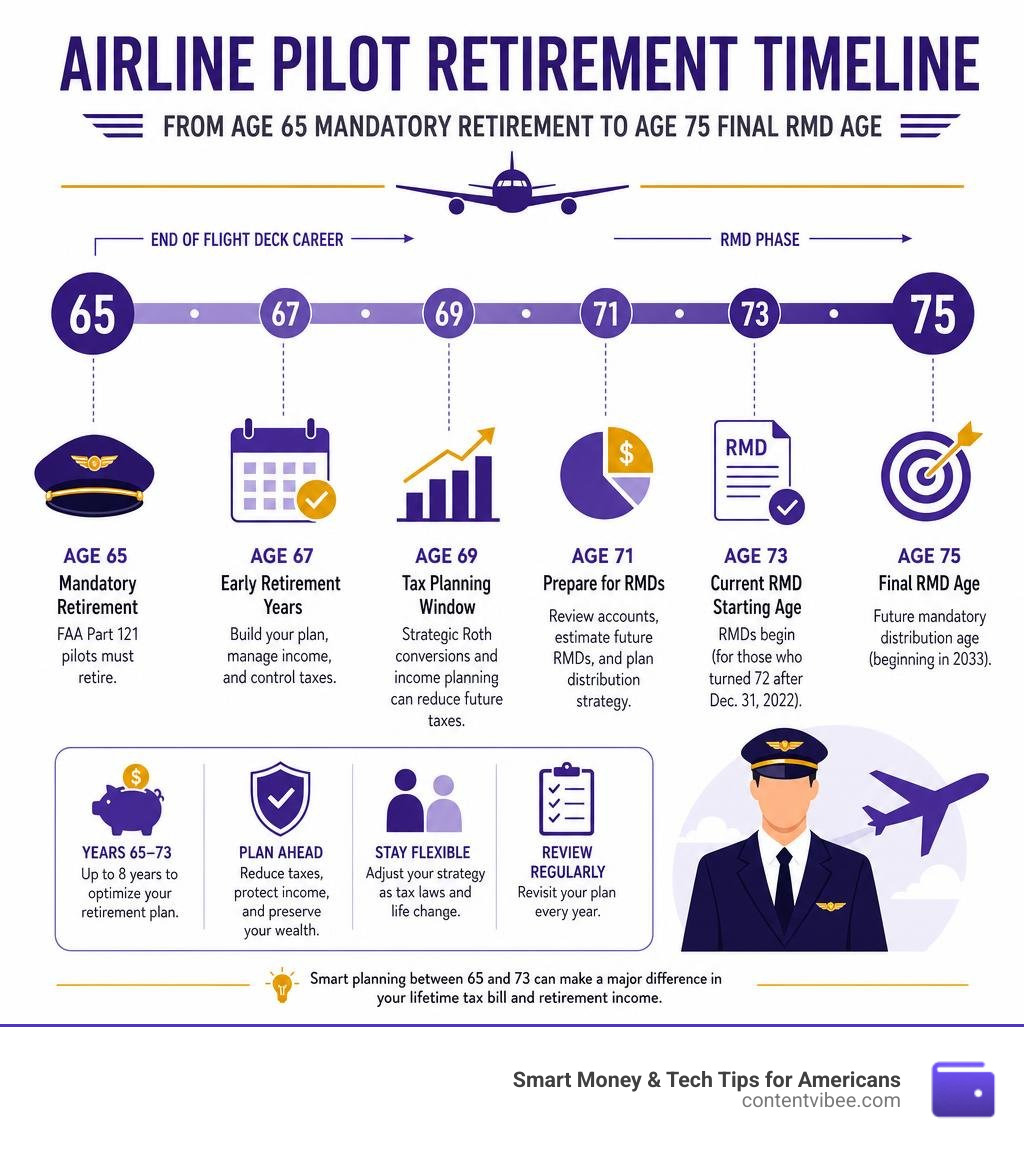
As we navigate through July 2026, the current starting age for RMDs is 73 for anyone who reached age 72 after December 31, 2022. But the goalposts are moving one more time. If you were born in 1960 or later, your RMD starting age will jump to 75 starting in the year 2033.
To help you keep track of these changing goalposts, we have put together comprehensive resources on Mastering the SECURE Act 2.0 RMD Age Shifts to ensure you do not get caught off guard by these legislative transitions.
Calculating the Drawdown
Your RMD is not a number you can simply guess. The IRS calculates your mandatory distribution using a straightforward but strict formula:
$$\text{RMD Amount} = \frac{\text{Account Balance as of Dec. 31 of the Prior Year}}{\text{Life Expectancy Factor}}$$
The IRS determines your “Life Expectancy Factor” using the Uniform Lifetime Table. As you age, this factor decreases, which means the percentage of your account you are forced to withdraw increases every year. For example, at age 73, the distribution factor is 26.5, requiring you to withdraw roughly 3.77% of your pre-tax assets. By age 80, the factor drops to 20.2, pushing your mandatory withdrawal up to nearly 5%.
If your pre-tax portfolio has grown to $2.5 million due to decades of high pilot pay and airline contributions, your very first RMD at age 73 would be over $94,000. This mandatory distribution is treated as ordinary taxable income.
To see exactly how these numbers scale over your lifetime, you can check out The Essential RMD Age Table Guide for Smart Retirees for a year-by-year breakdown of the IRS distribution factors.
2. The Mandatory Retirement Age vs. The RMD Timeline

The FAA Part 121 Rule
While most corporate employees can choose to work well into their late 60s or 70s to delay drawing down their portfolios, commercial airline pilots do not have that luxury. Under the FAA’s strict Part 121 regulations, commercial pilots face a mandatory retirement age of 65.
While there are ongoing industry discussions about potentially raising this limit to 67, the law in 2026 remains firmly set at 65. Historically, this is an evolution from the older, even stricter era of The “Age 60 Rule” – Pilot Medical Solutions, but it still forces a highly compressed career timeline.
Because of this hard stop, pilots must carefully balance their transition out of the cockpit, as detailed in Airline Pilot Retirement: What to Know – SmartAsset.com.
The 8-to-10-Year Gap Window
This age 65 retirement mandate creates a unique financial layout. You are forced to stop earning a high W-2 active flying income at 65, but you are not required to take RMDs until age 73 (or 75 if you retire after 2033).
This 8-to-10-year gap is what we call the “Golden Window” for pilot tax planning. During these years, your taxable income might drop to its lowest level in decades, especially before you begin claiming Social Security or drawing down corporate pensions.
Instead of doing nothing and letting your pre-tax accounts compound untouched, this gap allows us to systematically convert pre-tax funds to Roth accounts at historically low tax brackets.
Early Distribution Exceptions
What if you decide to step away from the airline before age 65, or a medical issue forces you out of the cockpit early? Normally, the IRS imposes a hefty 10% early withdrawal penalty on retirement account distributions taken before age 59½.
However, pilots can take advantage of the “Rule of 55.” This IRS exception allows employees who leave their employer in or after the calendar year they turn 55 to take penalty-free withdrawals from their most recent employer’s 401(k) plan.
To understand how to safely utilize this exception without triggering unnecessary taxes, read our guide on Retirement Topics: Exceptions to Tax on Early Distributions at 55.
3. How B-Funds and Non-Elective Contributions Create an RMD Tax Bomb
The Power of Airline Contributions
Airline pilot contracts are famous for their retirement benefits. Following the industry-wide transition away from traditional defined-benefit pensions, airlines began offering incredibly strong defined-contribution plans.
Most major airlines contribute between 16% and 19% of a pilot’s compensation directly into a non-elective 401(k) account, often referred to as a B-Fund. The beauty of non-elective contributions is that they do not require any matching employee contributions. The airline deposits this money whether you save a dime of your own or not.
With senior captain salaries easily exceeding $300,000 to $400,000, these employer contributions can quickly max out the IRS annual additions limits (which sit at $72,000 for 2026, or even higher for those utilizing catch-up provisions).
The Pre-Tax Accumulation Trap
While these B-Fund contributions are an incredible wealth-building tool, they come with a major catch: they are almost always 100% pre-tax.
Over a 25-to-30-year career, a pilot who consistently receives $50,000+ in annual employer contributions will easily build a pre-tax 401(k) balance of $2 million to $4 million. Because this money has never been taxed, it acts as a ticking tax time bomb.
If you leave this money to grow untouched until age 73, your mandatory RMDs will be massive. When added to other income sources, these forced distributions can easily push you right back into the highest federal tax brackets.
To prepare for how these rules continue to shift, you can read our analysis on how to avoid being caught off guard in Don’t Let Uncle Sam Catch You Napping with These 2026 RMD Changes.
Comparing the Impact: Pre-Tax vs. Roth Accumulation
To illustrate how the choice of contribution types affects your future retirement, let us look at a comparison of two pilots over a 20-year retirement horizon, assuming a starting balance of $2 million at age 65 with a 6% average annual growth rate:
| Financial Metric | Pilot A: 100% Pre-Tax Portfolio | Pilot B: 100% Roth Portfolio |
|---|---|---|
| Balance at Age 65 | $2,000,000 | $2,000,000 |
| Balance at Age 73 (Projected) | ~$3,180,000 | ~$3,180,000 |
| First Year RMD (Age 73) | $120,000 (Mandatory) | $0 (No RMDs) |
| Tax Treatment of Distributions | Taxed as Ordinary Income (up to 37%) | 100% Tax-Free |
| Impact on Medicare Premiums (IRMAA) | High risk of triggering premium surcharges | Zero impact on MAGI |
| Legacy Tax Burden on Heirs | Beneficiaries pay ordinary income tax within 10 years | Beneficiaries inherit tax-free assets |
4. Strategic Tax Diversification and Mitigation Strategies
Leveraging Roth Conversions Under RMD Rules for Airline Pilots Retirement
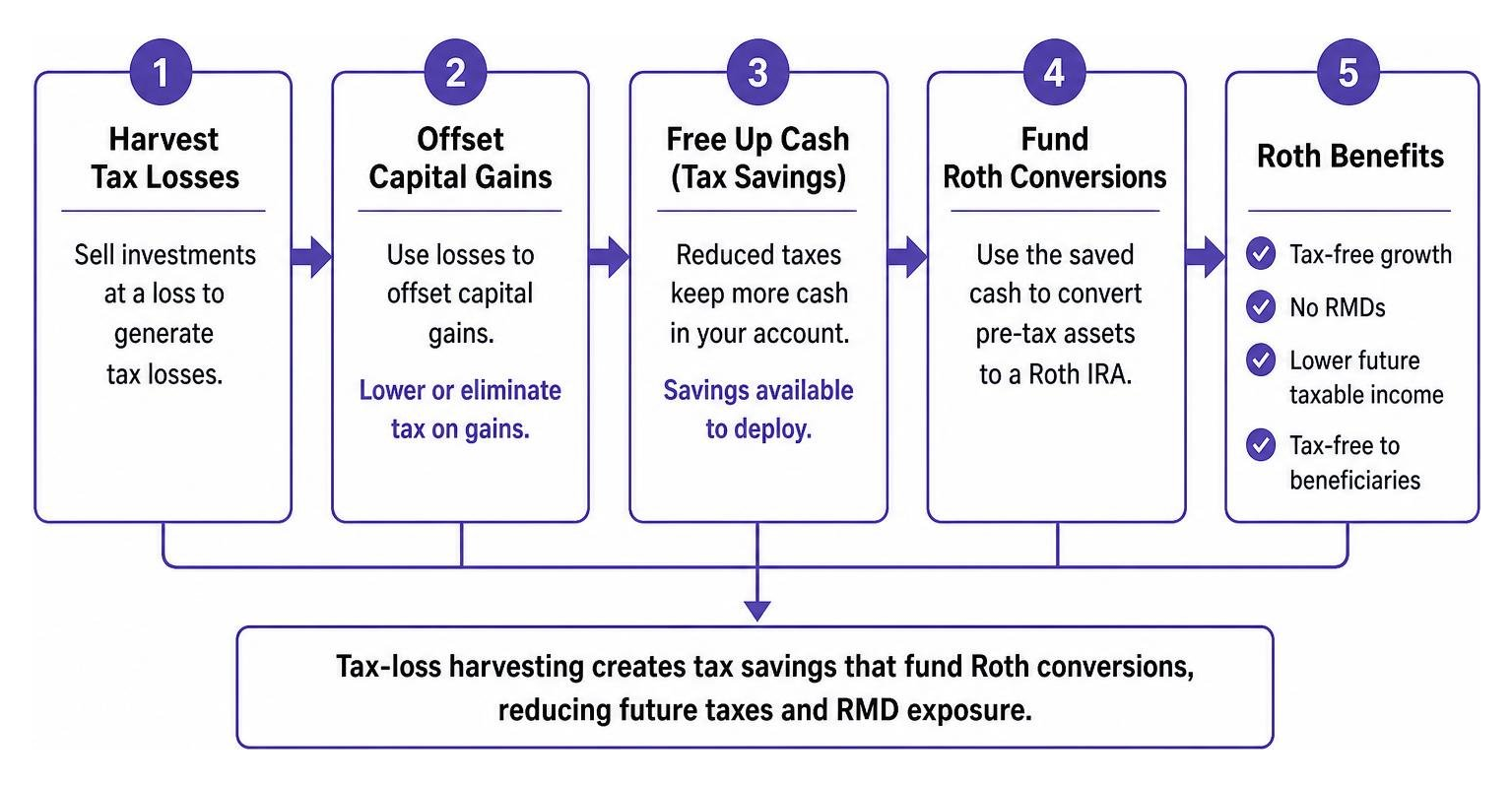
The most effective way to defuse the pre-tax tax bomb is through a series of partial Roth conversions during your gap years (ages 65 to 73). By systematically moving money from a traditional 401(k) or traditional IRA into a Roth IRA, you pay taxes on the converted amount now at a controlled, lower rate.
For example, a married pilot retiring at 65 might have very little taxable income before claiming Social Security. In 2026, the 24% federal tax bracket for joint filers extends all the way up to approximately $403,900.
By converting $150,000 to $200,000 of pre-tax assets to a Roth IRA annually, you “fill” those lower tax brackets. Once the money is inside the Roth IRA, it grows tax-free, and more importantly, Roth IRAs are completely exempt from RMDs during your lifetime.
Utilizing the Mega Backdoor Roth to Bypass Contribution Limits
If you are still a few years away from retirement, you should check if your airline’s 401(k) plan supports the Mega Backdoor Roth strategy.
While standard elective deferrals are capped ($24,500 in 2026, plus catch-up limits), the overall IRS limit for all contributions to a defined contribution plan (including employer B-fund money) is much higher — up to $72,000 in 2026.
If your airline’s plan allows after-tax (non-Roth) contributions and supports in-service distributions or automated in-plan Roth rollovers, you can contribute extra after-tax dollars and immediately convert them to Roth. This allows high-earning pilots to supercharge their tax-free accounts, bypassing traditional IRA income limits entirely.
For more details on making the most of your late-career years, we recommend reviewing the guide on 15 Things Pilots Approaching Retirement Should Know – ALPA.
Tax-Loss Harvesting and Taxable Brokerage Accounts
While tax-advantaged retirement accounts are excellent, do not underestimate the power of a standard, taxable brokerage account. Having a robust taxable brokerage account gives us incredible flexibility during the early retirement gap years.
If you need cash to fund your lifestyle between ages 65 and 73, pulling money from a taxable brokerage account only triggers capital gains taxes (which have much lower rates than ordinary income tax rates) rather than ordinary income taxes.
Furthermore, we can use tax-loss harvesting in taxable accounts to intentionally realize investment losses, offsetting up to $3,000 of ordinary income each year and wiping out capital gains from rebalancing.
Best of all, assets held in taxable brokerage accounts receive a “stepped-up basis” at your death. This means your heirs can inherit these investments and sell them immediately with virtually zero capital gains tax liability.
To master these distribution strategies, explore The Ultimate Guide to Retirement Money Management.
5. Coordinating RMDs with Social Security, Medicare, and Other Income

Managing the Medicare IRMAA Surcharge Cliff
One of the most painful surprises for retired pilots is the Income Related Monthly Adjustment Amount (IRMAA). Medicare Part B and Part D premiums are not flat rates; they are based on your Modified Adjusted Gross Income (MAGI) from a two-year lookback period.
In 2026, the standard Medicare Part B premium sits around $203 per month. However, if your MAGI as a married couple filing jointly exceeds $218,000, you will trigger the first IRMAA bracket, raising your monthly premiums. If your MAGI exceeds $410,000 — which can easily happen if a pilot is forced to take a large RMD on top of a corporate pension — your Medicare premiums can more than double.
Because of the two-year lookback, an RMD taken at age 73 will directly dictate your Medicare premiums at age 75. Proper tax-bracket smoothing during your late 50s and 60s is essential to keep your income below these costly cliffs.
Optimizing Social Security Claiming Ages Under RMD Rules for Airline Pilots Retirement
When you retire at age 65, you might feel tempted to claim Social Security immediately to replace your flying income. However, claiming early can permanently reduce your lifetime benefits. For pilots born in 1960 or later, the Full Retirement Age (FRA) is 67. Claiming at 65 reduces your monthly benefit to roughly 91.11% of your full amount.
Conversely, delaying your claim past your FRA up to age 70 earns you delayed retirement credits of 8% per year.
By delaying Social Security to age 70, you not only maximize your guaranteed, inflation-protected lifetime income, but you also keep your taxable income lower during your early retirement years. This leaves more “room” in your tax brackets to execute high-value Roth conversions.
To map out your optimal timeline, read The Ultimate Guide to Social Security Benefit Optimization and The Complete Guide to Social Security Full Retirement.
Integrating Market-Based Cash Balance and Deferred Compensation Plans
Many commercial airlines offer specialized retirement plans beyond standard 401(k)s:
- Nonqualified Deferred Compensation (NQDC) Plans: These plans allow senior pilots to defer a portion of their peak-earning salaries to avoid high tax brackets during active years. However, NQDC distributions are typically paid out on a fixed schedule starting immediately after retirement. This cash influx can temporarily spike your tax bracket between ages 65 and 70, meaning we must carefully coordinate NQDC payouts with the timing of any planned Roth conversions.
- Market-Based Cash Balance Plans: Increasingly common at carriers like Delta, American, and FedEx, these plans function as hybrid pensions. While they provide excellent guaranteed growth, they are pre-tax vehicles. When you retire, rolling these cash balance plans into a traditional IRA adds to your overall pre-tax balance, further increasing your future RMD obligations.
6. Penalties, Form 1099-R, and Estate Planning for Beneficiaries
The Cost of Missed RMDs and Reporting Requirements
Failing to take your RMD on time used to carry one of the most brutal penalties in the entire tax code: a 50% excise tax on the amount that should have been withdrawn but wasn’t.
Thankfully, the SECURE Act 2.0 provided some much-needed relief. The penalty has been reduced to 25%, and if you correct the mistake and file an updated return in a timely manner, the penalty drops further to 10%.
Even with this reduction, leaving money in your account is an expensive mistake. When you do take your distributions, your custodian will issue a Form 1099-R detailing the gross distribution and the taxable amount.
To ensure you report these distributions correctly and avoid unnecessary penalties, review our step-by-step breakdown in Demystifying Form 1099-R and Your Retirement Distributions.
Legacy Planning and the 10-Year Inherited IRA Rule
If you plan to leave your remaining retirement assets to your children or other non-spouse heirs, estate planning has become significantly more complex. The original SECURE Act eliminated the “Stretch IRA,” which previously allowed beneficiaries to draw down inherited IRAs slowly over their own lifetimes.
Today, most non-spouse beneficiaries must fully distribute the entire inherited traditional IRA within 10 years of the original owner’s death.
For the children of successful airline pilots, this is a massive tax problem. Heirs are often in their peak earning years (their 40s or 50s) when they inherit these accounts. Forcing them to withdraw a $2 million inherited IRA over a decade can push them into the highest federal tax brackets, effectively handing a massive portion of their inheritance back to the government.
Converting pre-tax assets to a Roth IRA during your lifetime allows your heirs to inherit a Roth IRA that is still subject to the 10-year rule, but all withdrawals they make will be 100% tax-free.
Frequently Asked Questions About Pilot RMDs
What is the mandatory retirement age for commercial airline pilots in 2026?
Under current FAA Part 121 regulations in 2026, the mandatory retirement age for commercial airline pilots remains 65. While there have been legislative proposals to raise this age limit to 67, no changes have been finalized. Pilots can, however, continue working in non-Part 121 roles, such as private charter flying, flight instruction, or ferry flights, after age 65.
Do Roth 401(k) plans have RMD requirements under the new rules?
No. Thanks to the SECURE Act 2.0, designated Roth accounts within employer-sponsored retirement plans — including Roth 401(k)s — are completely exempt from RMD requirements. This aligns them with Roth IRAs, which have always been exempt from lifetime RMDs. If you have pre-tax funds in your airline 401(k), converting them to a Roth account eliminates future mandatory distributions on those assets.
How do airline non-elective contributions affect future RMDs?
Because airline non-elective contributions (B-funds) are made on a pre-tax basis, they grow tax-deferred. Over a 30-year career, these generous 16% to 19% company contributions build very large pre-tax balances. Since your future RMD calculations are directly based on your total pre-tax account balances, these employer contributions significantly increase the size of your mandatory taxable distributions in retirement.
Conclusion
The very benefits that make an airline pilot career so financially rewarding — high salaries and industry-leading 401(k) B-fund contributions — can easily turn into an RMD tax trap if left unmanaged.
With mandatory retirement at age 65 and RMDs delayed until age 73 or 75, we have a rare, highly valuable window to take control of our tax future. By implementing strategic Roth conversions, utilizing the Mega Backdoor Roth, and coordinating our income sources, we can protect our hard-earned wealth from unnecessary taxation.
To stay ahead of changing tax laws and build a rock-solid distribution strategy, keep exploring our library of expert retirement guides at The Essential RMD Age Table Guide for Smart Retirees.