


What Are Structured Settlement Annuity Companies — and Which Ones Should You Know?
The leading structured settlement annuity companies in the U.S. include:
| Company | Key Strength |
|---|---|
| Prudential | 40+ years in structured settlements, offers indexed options |
| MetLife | 40 years of experience, strong financial ratings |
| Pacific Life | 160-year financial history, NSSTA member |
| Athene | $429.9 billion in total GAAP assets |
These companies issue annuity contracts that convert a legal settlement into a stream of guaranteed, periodic payments — typically tax-free under IRC Section 104(a).
If you’ve recently settled a personal injury case — or you’re in the middle of a costly legal dispute — the question of what to do with a settlement matters a lot. A lump sum can disappear fast. Medical bills, legal fees, and everyday expenses add up quickly.
That’s where structured settlement annuity companies come in.
Instead of handing you one large check, these companies turn your settlement into a steady, long-term income stream. Payments can be monthly, annual, or timed around major life events like college or retirement. And under federal law, those payments are generally income tax-free.
The industry has been around for over 40 years. One major provider’s senior vice president described their mission simply: fulfilling promises to customers through guaranteed financial security. That’s the core idea — and it’s why structured settlements remain a widely used tool in personal injury, wrongful death, and workers’ compensation cases.
Understanding Structured Settlement Annuity Companies and How They Work
At its heart, a structured settlement is a specialized insurance contract. When a legal case is resolved, instead of receiving a one-time cash payout, the claimant agrees to receive a series of periodic payments over time. This arrangement is facilitated by structured settlement annuity companies that take on the obligation to make those payments.
The legal foundation for this dates back to the Periodic Payment Settlement Act of 1982. Before this legislation, most settlements were awarded as a single lump sum, and any investment earnings on that money were fully taxable. Congress recognized that injury victims often needed long-term financial support and shouldn’t be burdened with the high-stakes task of managing a massive, taxable windfall.
To see how these numbers play out in real-time, you can use a Structured Settlement Calculator to estimate potential payouts based on different investment amounts.
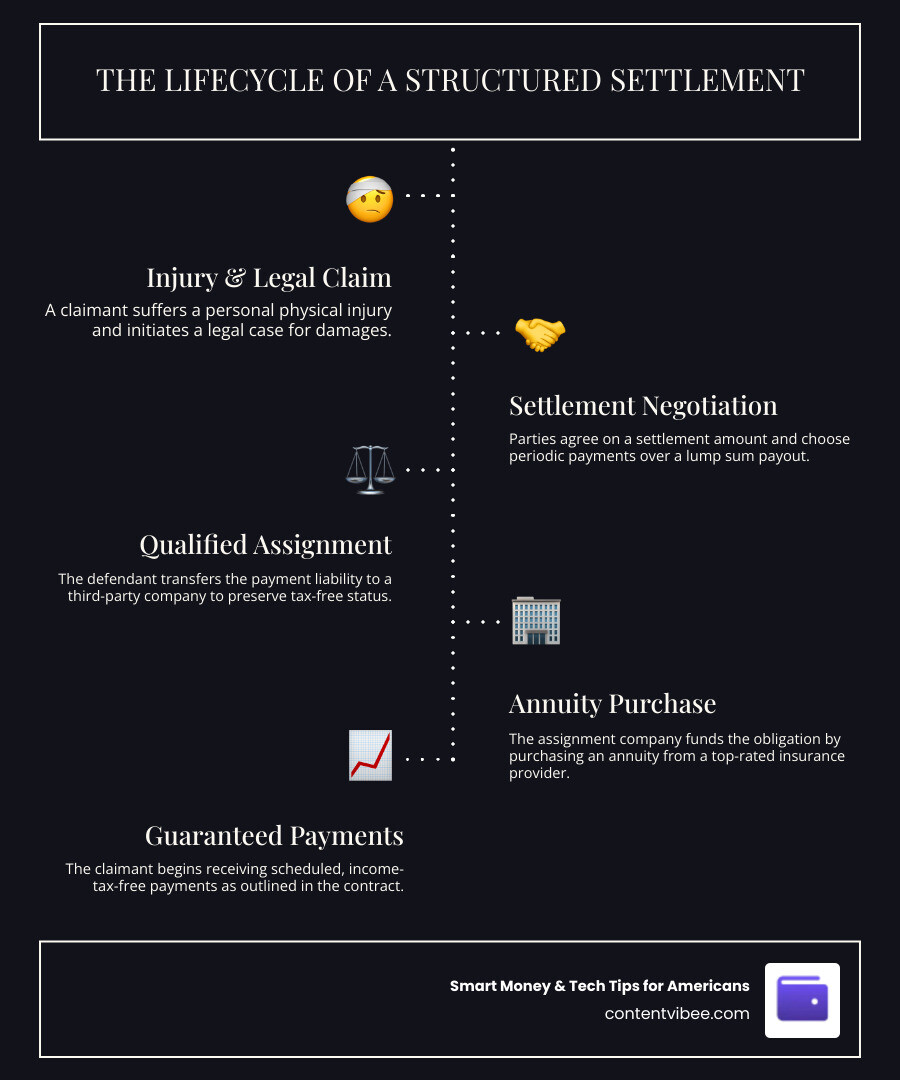
How does the process actually work? It usually follows a specific path called a “qualified assignment”:
- The defendant (or their insurance company) agrees to pay a specific amount to settle the case.
- The defendant transfers the obligation to pay the claimant to a third-party assignment company.
- This assignment company then purchases an annuity from one of the major structured settlement annuity companies like Prudential Financial.
- The annuity company then sends the periodic payments directly to the claimant.
This “third-party assignment” is a crucial step because it removes the liability from the defendant’s books while ensuring the claimant receives payments from a highly-rated, stable insurance carrier.
The Role of Structured Settlement Annuity Companies in Personal Injury Cases
In personal injury law, these companies act as the “financial backbone” for the injured party. Their primary role is claimant protection. We often see cases where individuals, overwhelmed by a sudden influx of cash, spend through their settlement too quickly—a phenomenon sometimes called “dissipation.” By locking funds into a structured annuity, the claimant is protected from market volatility and their own spending impulses.
For defendants, using structured settlement annuity companies offers a “strategic exit.” It allows them to settle a case for a lower present-day cost while still providing the claimant with a much higher total payout over time. This often leads to quicker outcomes, reducing the legal costs associated with lengthy trials. It’s a win-win: the claimant gets long-term security, and the defendant avoids the unpredictability of a jury verdict.
Tax Advantages Under the Internal Revenue Code
The biggest “selling point” of these arrangements is the tax treatment. Under Section 104(a)(2) of the Internal Revenue Code, payments received on account of personal physical injuries or physical sickness are 100% income tax-free.
This is a massive advantage over taking a lump sum and investing it yourself. If you take $1,000,000 in cash and put it in a high-yield savings account or the stock market, every dollar of interest or capital gains you earn is taxable. However, if that $1,000,000 is placed with structured settlement annuity companies, the entire amount—including the growth that happens inside the annuity—comes to you tax-free.
This benefit also extends to beneficiaries. If the claimant passes away before all “guaranteed” payments are made, their heirs can continue to receive those payments income tax-free. For non-physical injury cases (like certain employment disputes), settlements can still be structured, but they are typically “non-qualified,” meaning they offer tax deferral rather than a total tax exemption.
Key Benefits of Choosing Structured Settlements Over Lump Sums
Why would someone choose a slow drip of money over a big bucket of cash? In our experience helping Americans manage their finances, the answer usually comes down to “peace of mind.”
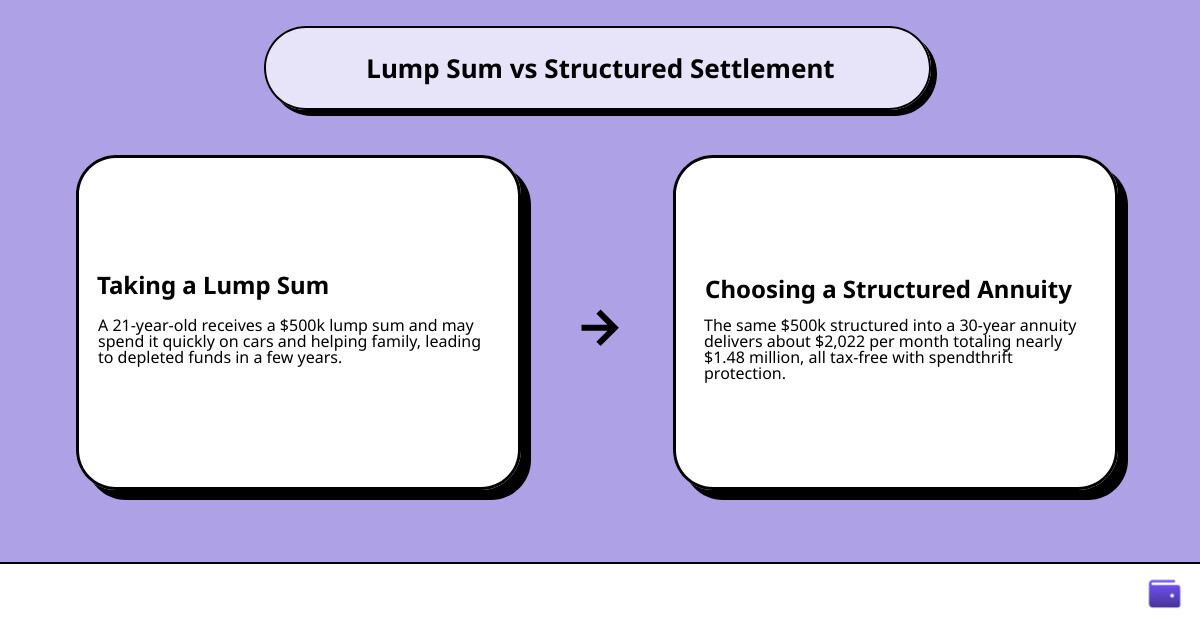
Consider a 21-year-old male who receives a $500,000 settlement. If he takes the lump sum, he might buy a car, help family, and see the money vanish in a few years. However, if he works with Pacific Life or a similar provider to structure that $500,000 into a 30-year certain annuity, he could receive approximately $2,022 per month. Over 30 years, his total payout could reach $1,478,661—nearly triple the original amount, all tax-free.
Statistics show that the legal industry itself is aging; roughly 67% of the U.S. attorney population is over the age of 40. These seasoned professionals often recommend structured settlements because they’ve seen how quickly lump sums can be mismanaged.
Customizing Your Payout with Structured Settlement Annuity Companies
One of the best tech-forward features of modern annuities is their flexibility. You don’t have to settle for equal monthly checks. You can build a “ladder” of payments to meet specific life milestones.
- College Funding: You can schedule large “lump sum” payments to drop exactly when tuition bills are due.
- Minor Protection: Courts in California and across the U.S. often mandate structures for minors to ensure the money is preserved until they reach adulthood.
- Workplace Injuries: Payments can be designed to cover ongoing medical costs or replace lost wages.
- Attorney Fee Structuring: Attorneys can also structure their contingency fees. This allows them to defer taxes on their income and create a personal pension-like stream of payments for their own retirement.
Providers like Sage Settlement Consulting specialize in designing these custom flows to maximize Social Security benefits and other government assistance programs.
Traditional vs. Indexed Market-Linked Options
In the past, structured settlements were always “fixed,” meaning you knew exactly what you would get to the penny. While that’s great for stability, it doesn’t account for inflation.
Enter the indexed structured settlement, such as Prudential’s “Income Advantage.” These products offer a hybrid approach:
- Market-Linked Growth: Your payments can increase based on the performance of an index like the S&P 500.
- Principal Protection: Even if the stock market crashes, your principal is 100% protected. You get the “upside” of the market without the “downside” risk.
This is a game-changer for younger claimants who might be worried about the cost of living rising over the next 40 or 50 years.
Comparing Leading Structured Settlement Annuity Companies
When you are choosing a company to hold your money for the next several decades, their financial “health” is the only thing that matters. These guarantees are backed solely by the insurance company, not by the broker or the government (they are not FDIC insured).
Here is a look at the heavy hitters in the industry as of May 2026:
| Company | Financial Strength Rating (AM Best/S&P) | Assets / History |
|---|---|---|
| Prudential | A+ / AA- | 40+ years of experience |
| MetLife | A+ / AA- | 40 years in structured settlements |
| Pacific Life | A+ / AA- | 160-year history |
| Athene | A / A+ | $429.9 billion in GAAP assets |
As you can see, these companies are massive. Athene, for example, reports $20.4 billion in total GAAP stockholders’ equity. This level of capitalization provides the security needed to ensure that even in a rocky economy, your checks will keep arriving. Agencies like Atlas Settlement Group help navigate these ratings to find the best fit for a specific case.
Evaluating Financial Strength and Stability
We always tell our readers: don’t just look at the monthly payment amount. Look at the company behind it. Most major providers are members of the National Structured Settlements Trade Association (NSSTA), which sets high ethical and financial standards for the industry.
Companies like MetLife and Prudential have been fulfilling these promises for four decades. That longevity matters. When you are 25 years old and looking at a 50-year payout plan, you want a company that has already proven it can survive world wars, depressions, and tech bubbles.
Support Resources for Claimants and Attorneys
The major structured settlement annuity companies offer more than just checks; they provide a suite of educational tools. For example, Arcadia Structured Settlements has assisted in the settlement of half a million cases, producing $150 billion in future benefits. They offer continuing education for attorneys and “Broker Manuals” that help legal teams understand the tax implications of different settlement designs.
Many providers also maintain “Resource Centers” where you can find videos and slipsheets explaining how to name beneficiaries or how to update your address—small tech details that make a big difference over a 30-year relationship.
The Strategic Role of Brokers and Consultants in 2026
You don’t just call an insurance company and buy a structured settlement over the phone. You work with a specialized consultant or broker. These professionals are the intermediaries who negotiate the “structure” between the claimant and the defendant.
Brokers from firms like Peachtree Financial Solutions or Atlas Settlement Group provide independent advice. They use sophisticated software to model different scenarios—showing you how a cost-of-living adjustment (COLA) might affect your long-term purchasing power.
In 2026, technology has made this process even more transparent. Brokers can now provide real-time quotes from multiple structured settlement annuity companies simultaneously, ensuring that the claimant gets the best possible internal rate of return (IRR) on their settlement funds.

Frequently Asked Questions about Structured Settlements
Are payments from structured settlement annuity companies taxable?
For personal physical injury, physical sickness, and wrongful death cases, the payments are 100% income tax-free under IRC Section 104(a). This includes both the principal and the interest earned over time.
Can I sell my structured settlement for a lump sum?
Yes, this is known as a “secondary market” transaction. Companies like DRB Capital buy future payments in exchange for a lump sum today. However, this process usually requires court approval to ensure it is in your best interest, and you will receive significantly less than the total value of the future payments. It’s generally considered a “last resort” for emergency expenses like avoiding foreclosure or paying for life-saving surgery.
How do structured settlements protect minors?
When a child receives a legal settlement, there is a risk that the parents might mismanage the funds or the child might spend it all at age 18. A structured settlement can be designed to pay out in “blocks”—for example, $50,000 at age 18 for college, $100,000 at age 25 for a home down payment, and monthly income thereafter. This ensures the money serves its intended purpose: providing for the child’s future.
Conclusion
Navigating structured settlement annuity companies can feel like a riddle, but it’s one of the most powerful tools available for long-term financial health. By choosing a highly-rated provider and working with a skilled consultant, you can turn a moment of personal tragedy into a lifetime of financial security.
In an era of economic uncertainty, the “guaranteed” nature of these annuities offers a rare form of stability. Whether you are an attorney looking to structure fees or a claimant trying to protect your family’s future, these companies provide the peace of mind that a lump sum simply cannot match.
For more information on managing legal-related financial hurdles, check out our guide on Navigating the Financial Maze of Family Law Costs. At Smart Money & Tech Tips for Americans, we believe that with the right data and a little bit of tech, anyone can master their financial future.