


Understanding Liability and Federal Regulations in Big Rig Crashes
Commercial big rig collisions demand a specialized 18 wheeler accident lawyer because recovering full compensation requires securing critical ECM black box telemetry before evidence spoliation, navigating complex federal safety regulations, and establishing liability across multi-party corporate supply chains. Unlike standard car accidents, resolving a semi-truck crash involves taking on aggressive corporate defense teams, high-limit commercial insurance policies, and strict transportation mandates.
| Claim Element | Standard Passenger Car Accident | Commercial 18-Wheeler Crash |
|---|---|---|
| Typical Vehicle Weight | 2,500 to 4,500 lbs | Up to 80,000 lbs (loaded) |
| Primary Regulatory Body | State Motor Vehicle Codes | FMCSA & State DOT Regulations |
| Potentially Liable Parties | Negligent driver, vehicle owner | Driver, carrier, broker, cargo loader, mechanic, manufacturer |
| Typical Insurance Coverage | $25,000 to $100,000 policy limits | $750,000 to $5,000,000+ commercial policies |
| Primary Digital Evidence | Dashcams, basic crash sensors | ECM black box data, ELD logs, GPS telematics, dispatch records |
| Defense Strategy | Insurance claims adjuster negotiation | Rapid-response corporate defense teams & corporate legal counsel |
When commercial vehicles cross state lines, they fall under interstate commerce laws governed by the Federal Motor Carrier Safety Administration (FMCSA). These regulations create legal duties for trucking companies that do not exist for regular drivers. Understanding how these standards apply to your collision is essential, which is why reviewing an essential guide to tractor trailer accident attorneys can provide helpful clarity on navigating complex corporate liability structures.
Identifying Liable Parties Across the Supply Chain
In a standard auto wreck, liability typically rests entirely on the driver who ran the red light or failed to brake in time. In a commercial trucking crash, the driver sitting behind the wheel is often just one link in a lengthy supply chain. Multiple independent business entities may share legal responsibility for the conditions that caused the crash.
- The Motor Carrier (Trucking Company): Under the legal doctrine of respondeat superior, employers are vicariously liable for the negligent actions of their employees acting within the scope of employment. Even when carriers classify drivers as independent owner-operators, federal statutory employment rules frequently treat the carrier as legally responsible if the vehicle displayed the company’s USDOT number and placards. Motor carriers can also be sued directly for negligent hiring, improper training, or pressuring drivers to violate safety rules.
- Freight Brokers and Shippers: Third-party logistics brokers arrange freight transportation. If a broker knowingly hires an unsafe motor carrier with a history of safety violations, poor vehicle maintenance, or inadequate insurance, they can be held liable for negligent selection.
- Cargo Loading Companies: When freight inside a trailer is improperly distributed, overloaded beyond legal axle limits, or poorly secured, it can shift during transit. Shifting cargo causes sudden center-of-gravity changes, leading to jackknife incidents, tip-overs, and rollovers. Third-party loading docks and warehouse crews that pack these loads are liable when their failures cause a crash.
- Maintenance Contractors and Mechanics: Commercial rigs travel hundreds of thousands of miles annually, requiring constant mechanical upkeep. If an outsourced maintenance shop fails to properly adjust air brakes, ignores worn steering components, or signs off on defective tires, they share legal liability for mechanical failures.
- Parts and Equipment Manufacturers: If a catastrophic crash results from a sudden component failure—such as a defective steering gearbox, structural coupling failure at the fifth wheel, or tire tread separation—the parts manufacturer may be held strictly liable under product liability laws.
Impact of Federal Motor Carrier Safety Regulations on Fault
The FMCSA sets strict safety standards under Title 49 of the Code of Federal Regulations (49 CFR). When a trucking company or driver violates these federal rules, it can serve as powerful evidence of negligence in a civil claim.
Federal safety rules focus heavily on preventing driver fatigue through strict Hours of Service (HOS) limits. Under current FMCSA standards, property-carrying drivers cannot drive more than 11 hours within a 14-hour on-duty window, and they must have at least 10 consecutive hours off duty before starting a shift. Furthermore, drivers must take a 30-minute break after eight cumulative hours of driving.
To prevent log falsification, commercial trucks must use Electronic Logging Devices (ELDs) that sync with the vehicle’s engine to record driving time, engine hours, vehicle motion, and miles driven.
Federal regulations also enforce strict driver qualification standards. Commercial drivers must maintain a valid Commercial Driver’s License (CDL), pass regular Department of Transportation (DOT) physical examinations, and undergo mandatory pre-employment, random, and post-accident drug and alcohol screenings.
For commercial drivers, the federal legal limit for Blood Alcohol Concentration (BAC) is 0.04%—half the standard limit for passenger vehicle drivers. Carriers that fail to maintain complete Driver Qualification Files (DQFs) or skip mandatory vehicle inspection reports face direct liability when preventable collisions occur. For a deeper look into how legal teams systematically uncover these corporate violations, explore our truck accident law firm complete guide.
Common Causes, Catastrophic Injuries, and Recoverable Damages
Large commercial trucks are massive machines that require significant stopping distance—up to the length of two football fields when fully loaded at highway speeds. When something goes wrong, the outcome is rarely a simple dented bumper.
According to federal data, large commercial vehicle crashes are frequently triggered by preventable operational failures:
- Driver Fatigue and Drowsiness: Tight delivery deadlines set by corporate dispatchers push drivers to stay behind the wheel past safe limits, leading to micro-sleeps and delayed reaction times.
- Distracted Driving: Texting, adjusting navigation devices, or dispatch communications divert driver attention during highway travel.
- Brake and Tire Failures: Commercial braking systems use complex compressed-air networks. Poorly adjusted brakes, worn pads, or retread tire blowouts leave drivers unable to stop in emergencies.
- Jackknifing and Rollovers: Sudden braking or taking curves too fast causes the trailer to swing perpendicular to the cab or roll onto nearby lanes.
- Underride Collisions: Passenger vehicles slide beneath the side or rear of a commercial trailer due to missing or defective underride guards, often shearing off the passenger cabin.
Due to the extreme size and weight disparities, passenger vehicle occupants suffer the vast majority of severe injuries in truck accidents. Common injuries include traumatic brain injuries (TBIs), spinal cord damage resulting in partial or complete paralysis, compound bone fractures, internal organ lacerations, severe crush injuries requiring amputation, and third-degree friction or chemical burns.
Navigating the aftermath of these life-changing injuries requires comprehensive case valuation. Reading the essential guide to hiring a lawyer for trucking accident cases offers practical perspective on organizing your medical and financial documentation early.
Evaluating Economic, Non-Economic, and Punitive Damages
When an 18-wheeler causes severe physical and emotional harm, the legal system allows injured victims to pursue several categories of compensatory damages to restore their financial standing.
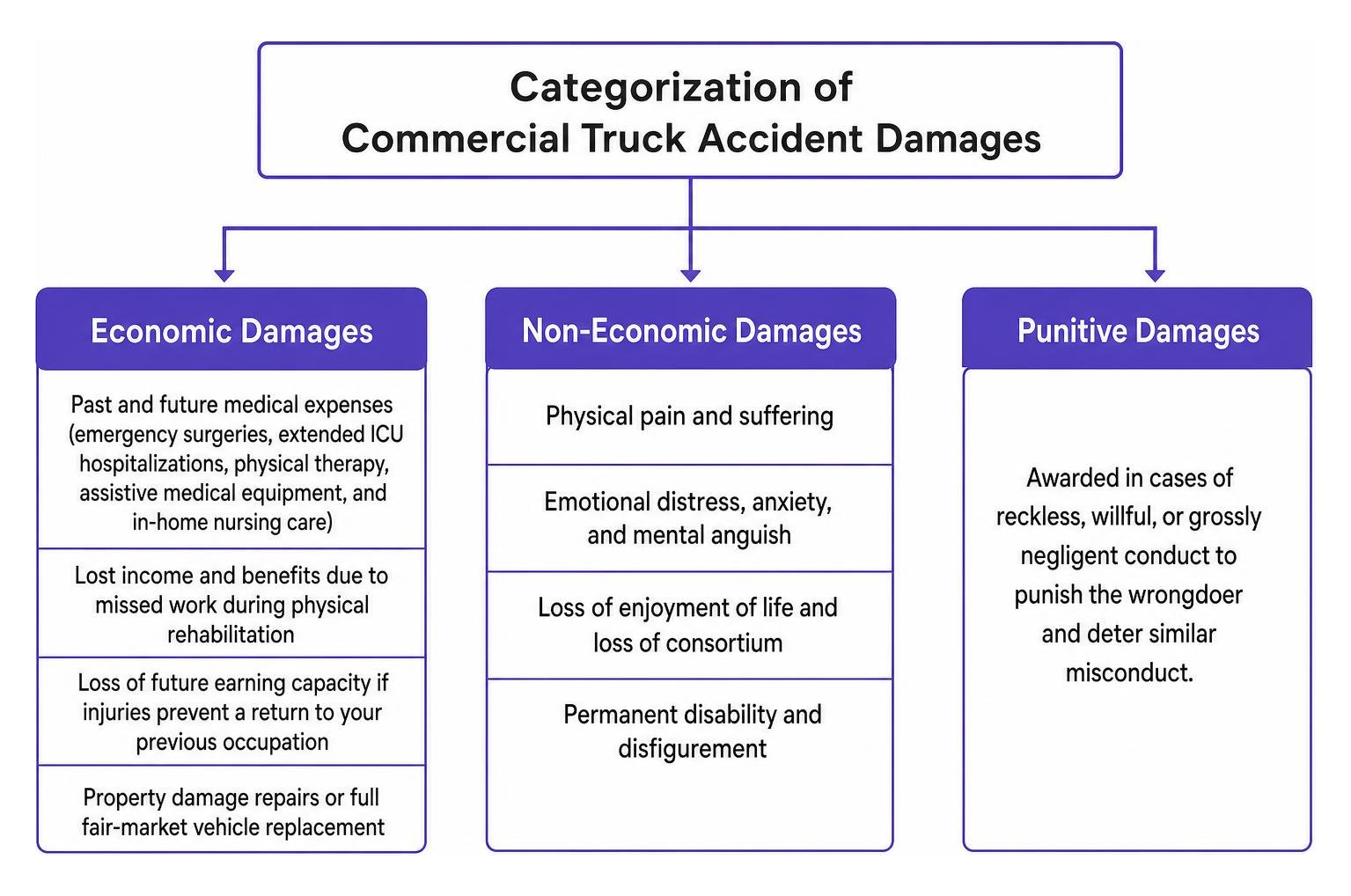
Economic Damages represent the quantifiable financial losses directly caused by the crash:
- Past and future medical expenses (emergency surgeries, extended ICU hospitalizations, physical therapy, assistive medical equipment, and in-home nursing care).
- Lost income and benefits due to missed work during physical rehabilitation.
- Loss of future earning capacity if injuries prevent a return to your previous occupation.
- Property damage repairs or full fair-market vehicle replacement.
Non-Economic Damages address the intangible, human impact of the crash:
- Physical pain and chronic suffering.
- Emotional distress, post-traumatic stress disorder (PTSD), and anxiety.
- Loss of enjoyment of life and inability to participate in family or recreational activities.
- Permanent physical impairment, scarring, or disfigurement.
In legal negotiations, non-economic damages are often calculated by applying a multiplier (typically between 1.5x and 5x) to the total economic losses, depending on the permanence and severity of the disability.
Punitive Damages (also known as exemplary damages) are awarded in cases involving gross negligence, intentional misconduct, or malice. Rather than compensating the victim for a specific loss, punitive damages are designed to punish the wrongdoer and deter similar conduct across the trucking industry. Examples include cases where a motor carrier knowingly forced a driver to violate HOS rules after exceeding safe hours, hired a driver with multiple active DUI convictions, or ignored known, dangerous brake failures.
Comparative Negligence and State Statutes of Limitations
When pursuing compensation, how much you can recover depends heavily on your state’s fault laws and statutory filing deadlines. States generally follow one of three legal doctrines regarding comparative fault:
- Modified Comparative Negligence (50% or 51% Bar Rules): In states using a modified system (such as Texas or Florida), you can recover damages as long as your share of responsibility does not exceed the legal threshold (50% or 51%, depending on the state). However, your financial recovery is reduced proportionally by your percentage of fault. For example, if your total damages are $1,000,000 and a jury finds you were 20% responsible for speeding, your final payout is reduced to $800,000. If your fault exceeds the state threshold, you recover nothing.
- Pure Comparative Negligence: In pure comparative fault states (such as California or Mississippi), an injured party can recover damages even if they are 90% at fault, though the recovery is reduced by their 90% share of liability.
- Pure Contributory Negligence: In a small handful of jurisdictions (such as Virginia, North Carolina, and Maryland), contributing even 1% to the cause of the crash completely bars you from recovering any financial compensation.
Statutes of limitations also impose strict legal deadlines for filing a lawsuit. Most states allow between two and three years from the date of the collision to initiate formal litigation. If you fail to file your lawsuit before the statute of limitations expires, the court will dismiss your case, permanently extinguishing your right to financial compensation.
How to Protect Your Claim Immediately After a Semi-Truck Crash
The actions you take in the hours and weeks following a collision with an 18-wheeler directly influence the success of your legal claim. Commercial carriers and their insurance companies often deploy specialized crash-investigation teams to the scene within hours. Their primary objective is simple: secure evidence that minimizes their company’s financial liability.
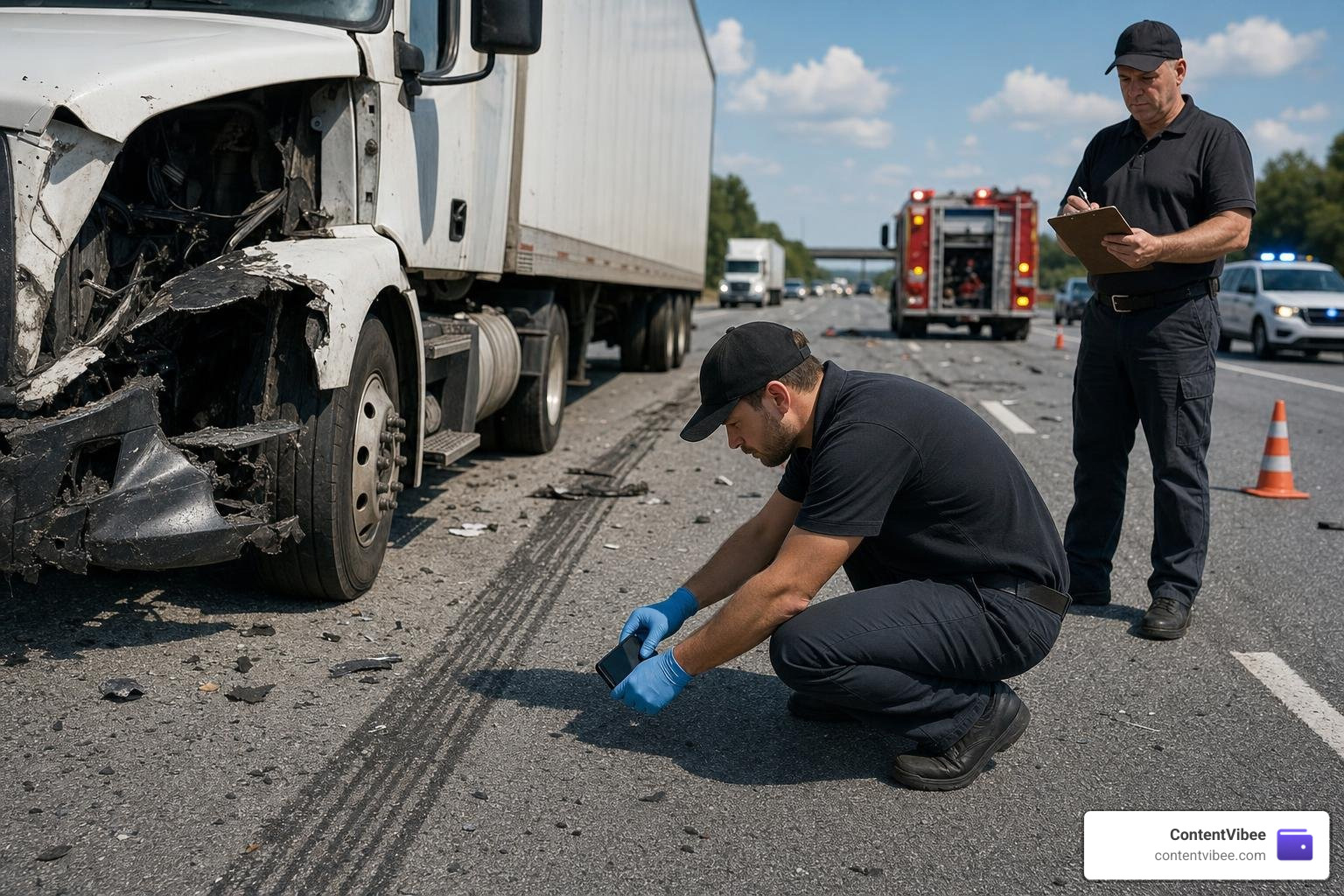
Taking proactive, systematic steps helps safeguard your physical health and preserve the integrity of your claim.
Step-by-Step Actions to Take at the Scene and at Home
- Call 911 Immediately: Report the crash, request emergency medical assistance, and ensure responding police officers document the incident in an official accident report.
- Document Scene Evidence: If you are physically capable and it is safe to do so, capture high-resolution photos and videos of all vehicles, skid marks, road conditions, traffic signals, and weather conditions.
- Record Commercial Identifiers: Photograph the truck cab doors to capture the motor carrier’s name, USDOT number, and MC/ICC license numbers. Take photos of the trailer license plate and cargo placards.
- Identify Eyewitnesses: Collect names, phone numbers, and addresses of all neutral witnesses before they leave the scene.
- Seek a Comprehensive Medical Evaluation: Adrenaline often masks severe injuries like concussions, internal bleeding, and soft-tissue trauma. Visit an emergency room or physician immediately to establish a medical record directly connecting your injuries to the collision.
- Decline Recorded Statements: Insurance adjusters representing the trucking company may contact you offering direct bill payments or asking for recorded interviews. Politely decline to give statements or sign medical releases until you have legal guidance.
- Maintain a Detailed Recovery Journal: Keep a daily log tracking physical pain levels, sleep disturbances, missed work days, and activities you can no longer perform. Keep all medical discharge instructions, invoices, and out-of-pocket receipts in an organized folder.
- Maintain Complete Social Media Silence: Do not post photos, status updates, or comments about the crash or your daily activities on social platforms. Insurers routinely monitor social profiles to argue that injuries are exaggerated.
For additional guidance on building a solid evidentiary foundation, read our in depth guide to serious truck accident lawyer.
Why You Need an 18 Wheeler Accident Lawyer to Preserve Black Box Data
One of the biggest risks in a commercial truck claim is the loss or destruction of critical digital evidence. Modern commercial tractors contain sophisticated onboard computers known as Electronic Control Modules (ECMs) or Event Data Recorders (EDRs), commonly referred to as “black boxes.”
These devices record key operational metrics in the seconds leading up to a collision:
- Vehicle speed and engine RPM.
- Throttle position and cruise control status.
- Steering inputs and sudden lane changes.
- Exact brake application and anti-lock brake system (ABS) activation.
- Seatbelt usage status.
Under federal rules, motor carriers are only required to retain certain operational and maintenance records for limited periods—sometimes as short as six months. Furthermore, ECM data can be overwritten automatically as the truck is driven or repaired.
A formal Spoliation Letter puts the carrier, driver, maintenance shop, and insurer on written legal notice that all physical and digital evidence related to the crash must be preserved. If a trucking company destroys or alters records after receiving a spoliation letter, courts can issue severe legal penalties against them, including fines, striking defense claims, or instructing the jury to presume the destroyed evidence proved the trucking company’s fault.
When and How to Hire an Experienced 18 Wheeler Accident Lawyer
Handling an 18-wheeler claim without dedicated legal experience can leave you at a severe disadvantage against well-funded corporate defense teams. Commercial insurers are skilled at shifting blame, delaying payouts, and making lowball settlement offers that fail to cover long-term medical care or disability needs.

Retaining an attorney who understands federal transportation regulations, commercial insurance policies, and technical crash reconstruction ensures that your claim is properly evaluated and pursued. For a complete look at selecting legal representation, see the ultimate guide to finding an 18 wheeler injury lawyer before its too late.
Critical Questions to Ask Your 18 Wheeler Accident Lawyer
Before signing a representation agreement, schedule a consultation and ask targeted questions to assess the lawyer’s experience with commercial trucking litigation:
- What percentage of your practice focuses specifically on commercial truck accidents? (You want an attorney familiar with FMCSA regulations, not just standard car wrecks.)
- Have you successfully taken trucking companies to trial? (Insurers know which lawyers settle quickly and which ones are prepared to go to court, which directly impacts settlement leverage.)
- Do you work with leading accident reconstructionists and medical experts? (Complex claims require qualified technical experts who can explain digital telematics and medical prognoses to a jury.)
- How are litigation expenses handled? (Confirm whether the firm advances all upfront costs for expert witnesses, depositions, and trial preparation.)
- What is your fee structure if we do not win? (Ensure the firm operates on a true contingency fee agreement where you owe nothing unless a recovery is secured.)
Understanding the Truck Accident Settlement and Litigation Timeline
Resolving a commercial truck accident claim involves several structured phases. While some cases settle within months, catastrophic injury claims involving disputed liability can take a year or more to reach a resolution.

- Initial Investigation and Evidence Preservation (Weeks 1–4): The legal team visits the crash site, photographs vehicle damage, issues formal spoliation letters, downloads black box ECM telematics, and secures the driver’s qualification file and ELD logs.
- Medical Treatment and Maximum Medical Improvement (Months 1–6+): Your primary focus remains on physical recovery. Legal settlement demands are generally deferred until you reach Maximum Medical Improvement (MMI)—the point where your long-term medical needs and permanent limitations are clearly understood.
- Comprehensive Demand Package and Negotiations (Months 6–9): Your attorney compiles all medical bills, lost wage records, life care plans, and expert reports into a formal demand package submitted to the commercial insurer. Settlement negotiations begin.
- Lawsuit Filing and Formal Discovery (Months 9–15): If the insurance company refuses to make a fair offer, a formal complaint is filed in state or federal court. Both sides enter the discovery phase, exchanging documents, conducting depositions of drivers and corporate executives, and submitting expert witness reports.
- Mediation and Alternative Dispute Resolution (Months 12–18): Courts frequently require parties to attend formal mediation sessions supervised by a neutral third-party mediator to attempt a settlement before trial.
- Trial Verdict and Recovery (Months 18–24+): If negotiations fail, the case proceeds to trial, where evidence and expert testimony are presented to a jury to secure a binding verdict.
Frequently Asked Questions About Commercial Truck Accident Claims
How long do I have to file a commercial truck accident lawsuit?
The deadline to file a lawsuit is determined by your state’s personal injury statute of limitations. In most states, victims have between two and three years from the date of the accident to file a formal court complaint. For claims against government-owned vehicles or public transportation authorities, notice requirements can be as short as 60 to 180 days. Missing these statutory deadlines permanently forfeits your right to recover damages.
Can I recover compensation if I was partially at fault for the crash?
Yes, in most states you can still recover compensation under comparative negligence laws. Under modified comparative fault rules (the standard in most states), you can recover damages as long as your share of fault is 50% or less (or 51% or less, depending on the jurisdiction). Your financial award will simply be reduced by your percentage of responsibility. In pure comparative negligence states, you can recover damages regardless of your fault percentage, though your recovery is reduced accordingly.
How much does it cost to retain specialized legal representation?
Reputable truck accident attorneys handle personal injury and wrongful death cases on a contingency fee basis. This means:
- You pay zero upfront retainers or out-of-pocket legal fees.
- The law firm covers all investigation, expert witness, deposition, and filing expenses.
- Attorney fees are paid as an agreed-upon percentage (typically 33.3% to 40%) deducted directly from the final settlement or court verdict.
- If the legal team fails to recover compensation for your case, you owe nothing in attorney fees.
Conclusion
A collision with a commercial big rig can disrupt your physical health, financial security, and daily life in an instant. Standing up to multi-billion-dollar trucking enterprises, freight logistics brokers, and aggressive corporate insurance defense teams requires extensive evidence, detailed knowledge of federal safety regulations, and trial-ready legal advocacy.
At ContentVibee, we are dedicated to helping injury victims understand their legal rights and make informed financial decisions following life-altering accidents. By acting quickly to preserve black box telemetry, documenting every aspect of your recovery, and holding negligent corporations accountable, you can secure the financial resources needed for long-term healing and rehabilitation.
If you or a family member is dealing with the aftermath of a catastrophic semi-truck collision, explore legal support from our dedicated truck accident team to evaluate your case and start protecting your recovery today.