


A Truck Accident Injury Claim Starts With Fast, Careful Action
A truck accident injury claim is the process of seeking payment from the responsible driver, trucking company, insurer, or another liable party after a commercial truck crash causes harm or financial loss.
The quick answer: protect your health first, document what you can, report the crash, and avoid rushing into an insurance settlement. Truck claims can involve several companies, federal safety rules, and time-sensitive evidence such as driver logs and truck data.
- Get medical care and call 911. Some serious injuries are not obvious at the scene.
- Collect basic evidence if it is safe. Take photos, note the truck company name and DOT number, and get witness contact details.
- Do not admit fault or accept a quick offer. Commercial insurers may look for statements they can use to reduce or deny the claim.
- Preserve truck-specific records quickly. Electronic logging device data, onboard computer data, dash camera video, maintenance files, and dispatch records may not be kept forever.
- Learn your state’s deadline and fault rules. These vary sharply by state. In Virginia, for example, even a small finding of fault can block recovery under contributory negligence rules.
A fully loaded tractor-trailer can weigh up to 30 times more than a passenger vehicle. That gap helps explain why these crashes often cause severe injuries – and why the resulting claims are rarely as simple as a standard car insurance case.
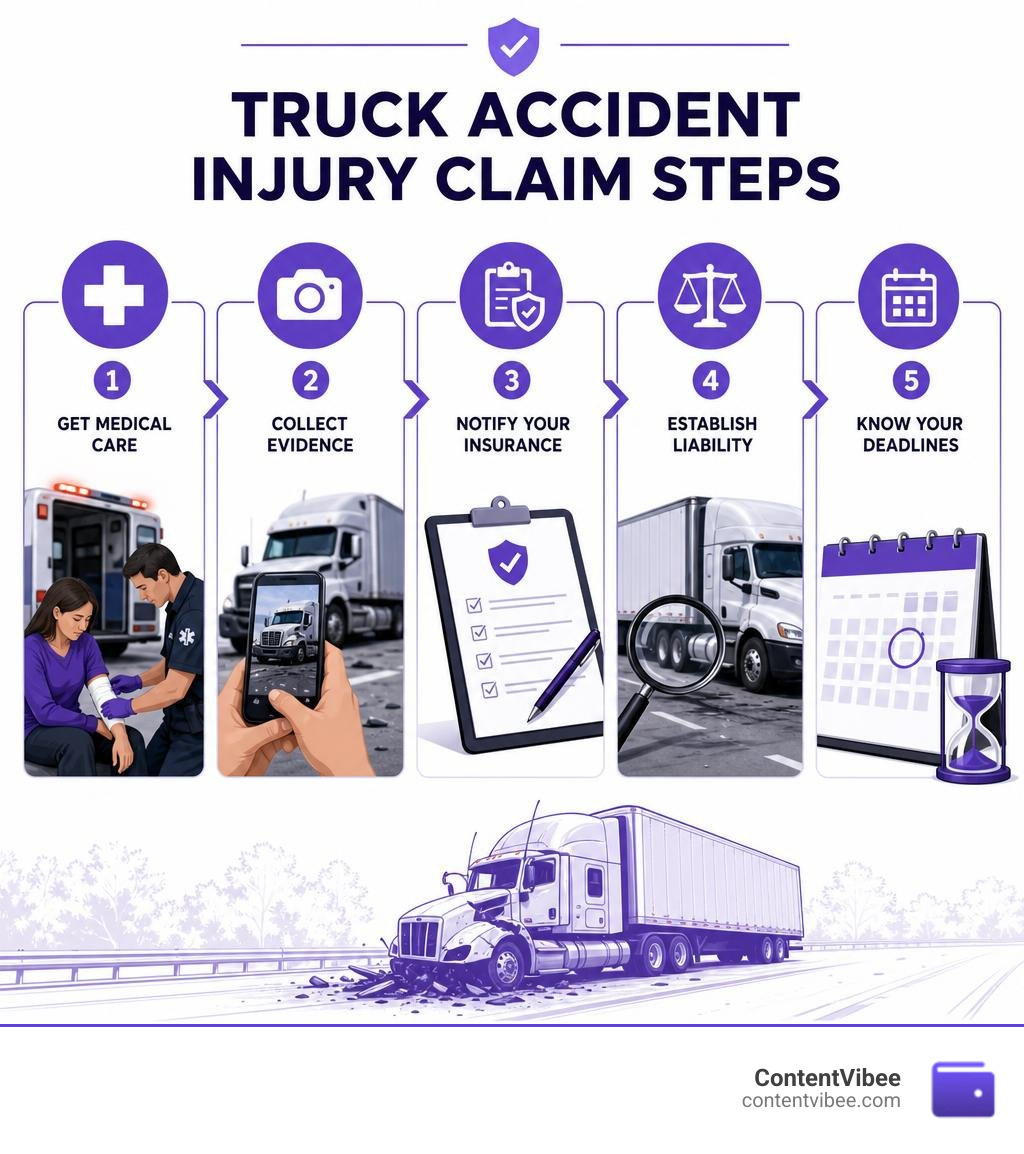
Step-by-Step Guide: What to Do Immediately After a Semi-Truck Crash
When an 80,000-pound commercial rig collides with a standard passenger car, the immediate aftermath is overwhelming. While your main priority must always be physical safety and medical care, the steps you take in the first hours and days directly dictate whether your truck accident injury claim succeeds or gets dismantled by defense representatives.

First, call 911 immediately. Request emergency medical medical responders and insist that law enforcement creates an official accident report. Even if you believe you only suffered mild soreness, accept an ambulance transport or visit an emergency room right away. Internal bleeding, traumatic brain injuries (TBIs), and spinal trauma frequently hide behind initial adrenaline. Consistent medical documentation established immediately after the crash blocks defense adjusters from arguing that your injuries were pre-existing or caused by an unrelated event.
If you are physically able and it is safe to move, take detailed photographs and videos of the scene. Capture all involved vehicles from multiple angles, skid marks, broken vehicle parts scattered on the road, traffic signals, weather conditions, and visible injuries. Be sure to photograph the commercial truck’s cab, trailer, license plates, and US DOT identification numbers printed on the side of the vehicle. Collect full names, phone numbers, and addresses of all eyewitnesses before they leave the scene.
Securing Critical Scene Evidence and ELD Black Box Data
Commercial truck accident claims rely heavily on technical digital evidence that standard automobile collisions do not feature. Modern semi-trucks function as complex data centers on wheels, storing essential operational details within two main digital systems:
- Heavy Vehicle Event Data Recorders (HVEDR): Frequently called the truck’s “black box,” this module records crash metrics including vehicle speed, braking application, engine RPM, steering inputs, and seatbelt usage right before impact.
- Electronic Logging Devices (ELD): Mandated by federal safety rules, ELDs automatically log a driver’s active driving hours, rest breaks, and duty status to verify compliance with hours-of-service mandates.
Crucially, trucking companies are generally only required to preserve certain electronic telemetry data for 30 to 90 days before system cycles overwrite or erase it. In some instances, unprincipled motor carriers allow vehicle repairs or data purges that destroy vital proof of driver fatigue or mechanical failure.
To halt this, you or your legal representative must send a formal spoliation of evidence letter via certified mail within 14 days of the crash. This legal notice obligates the motor carrier, their safety director, and their insurance carrier to immediately freeze and preserve all digital files, driver qualification files, dispatch messages, fuel receipts, dashcam video, and fleet maintenance records.
Protecting Your Truck Accident Injury Claim from Adjuster Tactics
Commercial trucking insurers do not wait around after a major collision. Large transport fleets routinely dispatch rapid-response defense teams—including field investigators, accident reconstruction experts, and defense attorneys—directly to the crash site within hours. Their clear objective is to minimize corporate financial liability.
When commercial insurance adjusters reach out to you, keep these defensive rules in mind:
- Refuse Recorded Statements: You are under no legal obligation to provide a recorded statement or answer detailed interview questions from the opposing insurer without legal counsel present. Adjusters are trained to ask open-ended or leading questions designed to extract statements that shift partial blame onto you.
- Decline Early Lowball Settlement Offers: Insurers frequently offer quick, lump-sum checks shortly after a crash. These early offers usually pay a fraction of the real claim value, hoping you will sign a full liability release before you realize the true cost of future surgeries, physical therapy, or lost long-term earning capacity.
- Do Not Sign Blanket Medical Releases: Defense adjusters may ask you to sign broad authorization forms to “verify your injuries.” In reality, these releases allow them to dig through decades of your private medical history to claim your current symptoms stem from old athletic injuries or degenerative age changes.
- Control All Communications: Direct all insurance phone calls, letters, and emails to your attorney. Establishing a single buffer zone prevents insurance adjusters from wearing you down while you focus on medical healing.
Why Commercial Trucking Claims Are Far More Complex Than Car Collisions
It is a mistake to treat a commercial truck collision like a standard automobile accident claim. There are approximately 15.5 million commercial trucks operating across the United States—including over 2 million semi-trucks. Federal Motor Carrier Safety Administration (FMCSA) data reveals that thousands of large trucks are involved in fatal and injury crashes annually. Notably, in crashes involving heavy commercial rigs, roughly 82% of fatalities are not occupants of the truck, but rather drivers and passengers in smaller vehicles.
Because of this physical disparity, collisions with tractor-trailers disproportionately cause catastrophic, permanent injuries such as traumatic brain injury, spinal cord damage leading to paralysis, crushed limbs, and severe internal organ harm.
| Feature / Factor | Standard Automobile Crash | Commercial Semi-Truck Crash |
|---|---|---|
| Vehicle Weight | 3,000 – 4,000 lbs. | Up to 80,000 lbs. (30x heavier) |
| Governing Rules | Local and state traffic codes | Federal FMCSA rules + state/local laws |
| Potential Defendants | Typically 1 driver | 4 to 6 corporate entities |
| Primary Insurance Limits | State baseline ($15k – $50k) | Federal minimums ($750k – $5M+) |
| Critical Evidence | Police report, photos, basic statements | HVEDR black box, ELD logs, maintenance logs |
| Defense Resources | Local insurance claims adjuster | On-scene corporate defense response teams |
Uncovering Multi-Party Liability Beyond the Truck Driver
In a standard passenger car accident, liability usually begins and ends with the negligent driver. In a commercial truck injury claim, a single crash frequently involves multiple corporate defendants who share legal responsibility:
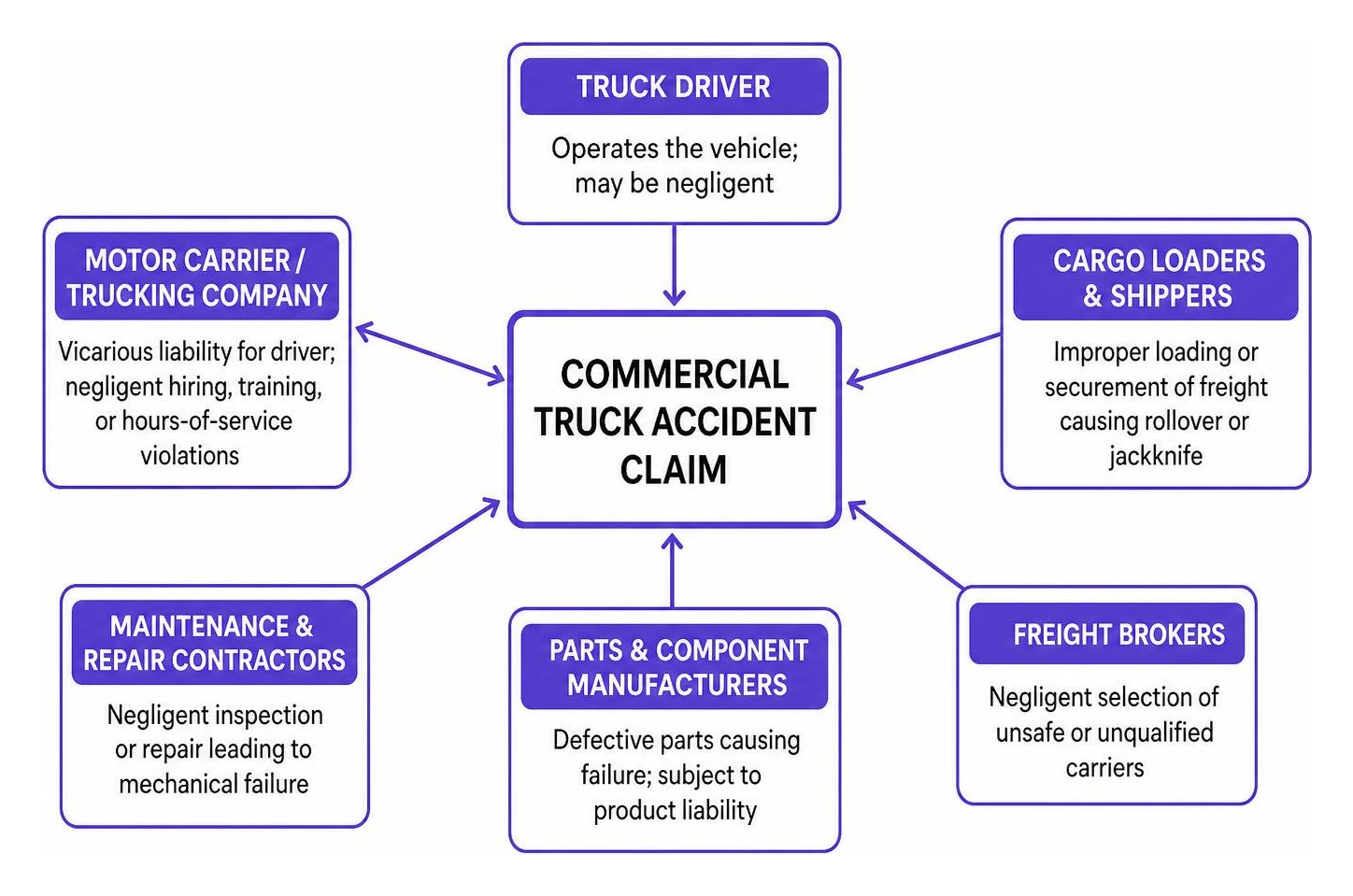
- The Motor Carrier / Trucking Company: Motor carriers are vicariously liable for the actions of their employee drivers under the legal doctrine of respondeat superior. Additionally, carriers face direct liability claims for negligent hiring, improper driver training, or forcing drivers to exceed FMCSA hours-of-service limits to hit tight delivery deadlines. Research indicates that driver error contributes to roughly 90% of semi-truck crashes, while a landmark Harvard study revealed that 50% of commercial truck drivers admitted to drifting off while driving and 25% admitted to actually falling asleep behind the wheel.
- Cargo Loaders and Shippers: Third-party loading dock facilities that improperly secure, under-strap, or unevenly distribute heavy freight can cause catastrophic rollover accidents or jackknife events on major interstate corridors.
- Maintenance and Repair Contractors: Trucking fleets often contract out brake systems, steering assembly, and tire inspections to third-party mechanics. If poor maintenance work or ignored brake wear leads to mechanical failure, those service providers become primary targets for negligence claims.
- Parts and Component Manufacturers: If a catastrophic highway wreck is caused by a tire blowout from tread separation or a defective steering linkage, the parts manufacturer can be held strictly liable under product liability laws.
- Freight Brokers: Logistics brokers who hire sub-standard, unverified trucking fleets with long records of FMCSA safety violations can face independent legal claims for negligent selection of an unsafe carrier.
Navigating High Commercial Insurance Policy Limits and Coverage Layers
Because commercial trucks carry immense destructive potential, federal regulations enforced under Title 49 of the Code of Federal Regulations (49 CFR 387.9) mandate that interstate commercial motor carriers carry high public liability coverage:
- Non-Hazardous Freight (Vehicles over 10,000 lbs): Minimum $750,000 public liability coverage.
- Oil and Hazardous Materials Transport: Minimum $1,000,000 to $5,000,000 depending on freight classification.
To fully protect their corporate assets, major transport fleets layer their insurance coverage using complex corporate structures:
Because millions of dollars are routinely at stake, commercial insurance providers defend these claims aggressively. Reaching excess umbrella layers requires building an airtight evidentiary case that proves clear regulatory non-compliance, clear corporate liability, and precise medical accounting of long-term injuries. For a complete look at how multi-million dollar trucking cases progress through the legal pipeline, read our detailed Truck Accident Lawsuit: Full Guide to Settlements 2026.
Calculating Total Valuation in a Truck Accident Injury Claim
One of the most common questions injured victims ask is: How much is my claim worth? Because every truck collision involves different injury severities, wage losses, and policy limits, there is no single “average” payout. Financial recoveries range from tens of thousands of dollars for minor injuries to multi-million dollar payouts for permanent disabilities or catastrophic losses. Comprehensive state-by-state data provided in the Truck Accident Lawsuit Recovery Amounts by State: 2026 Guide highlights how location, venue, and state-specific comparative fault laws shape final recovery ranges.
Accurately calculating claim value requires categorizing recoverable losses into two main categories: economic damages and non-economic damages.
Economic vs. Non-Economic Damages in Severe Truck Crashes
Economic Damages are concrete, measurable financial losses backed by receipts, invoices, and payroll records. In major commercial truck cases, economic damages often include:
- Past and Future Medical Costs: ER visits, surgeries, intensive care stays, prescription medications, extended inpatient rehabilitation, physical therapy, and home medical equipment.
- Life-Care Planning Costs: In cases involving quadriplegia, permanent brain damage, or limb amputation, medical care planners draft detailed life-care plans projecting long-term nursing assistance, home modifications, and specialized transport over the victim’s full life expectancy.
- Lost Income and Earning Capacity: Compensation for lost paychecks while recovering, plus calculated losses in future earning potential if a permanent impairment prevents you from returning to your trade or profession.
Non-Economic Damages compensate you for the profound personal, non-financial consequences of a collision:
- Physical pain and severe suffering
- Mental anguish, depression, and Post-Traumatic Stress Disorder (PTSD)
- Permanent disfigurement, scarring, or loss of mobility
- Loss of enjoyment of life and inability to participate in family activities
- Loss of consortium (damage to marital relationships and intimacy)
Insurance adjusters frequently rely on automated software programs or basic multiplier formulas (multiplying economic damages by a number between 1.5 and 5) to undervalue non-economic harm. However, in catastrophic truck injury cases, presenting medical expert testimony and personal impact narratives is what compels insurers to offer fair settlements for personal suffering.
Wrongful Death and Punitive Damage Considerations
When a heavy commercial truck collision results in a fatality, surviving immediate family members (such as spouses, children, or parents) can file a wrongful death lawsuit alongside survival actions brought by the decedent’s estate. Recoverable wrongful death damages typically encompass funeral and burial expenses, loss of expected financial support, loss of prospective inheritance, and loss of emotional guidance, companionship, and care.
Additionally, in cases involving egregious reckless behavior, courts may award punitive damages. Unlike standard economic damages, punitive damages are intended specifically to punish the wrongdoing party and deter similar corporate misconduct. Examples of conduct that can justify punitive damage awards include:
- A trucking company forcing drivers to operate vehicles despite knowing their brakes or steering components were actively failing.
- A fleet systematically encouraging or falsifying driver ELD logbooks to violate federal rest requirements.
- A carrier knowingly hiring a truck driver with a record of severe substance abuse or prior DUIs while operating heavy rigs.
State Legal Rules That Can Make or Break Your Claim
While federal FMCSA rules govern commercial truck safety across the nation, state laws dictate how, when, and where you can pursue an injury lawsuit. Understanding these local legal frameworks is essential, as subtle differences in state statutes can completely alter your financial recovery.
Strict Contributory Negligence Laws (Virginia and North Carolina)
The strict legal environment in states that follow pure contributory negligence doctrines—such as Virginia and North Carolina—presents major hurdles for crash victims. Under pure contributory negligence, if a injured party is found to bear even 1% of fault for an accident, they are completely barred from recovering any financial compensation whatsoever.
In commercial truck claims across these jurisdictions, defense insurers focus heavily on establishing minor fault against the crash victim. They may claim you were driving slightly over the speed limit, failed to signal early enough during a lane change, or failed to take evasive action quickly enough to avoid the truck.
Overcoming these defenses requires immediate, expert-led accident reconstruction work. If you are dealing with a crash in these strict jurisdictions, reviewing specialized legal resources like the Wilmington Truck Accident Lawyer | Meirowitz & Wasserberg guide offers critical perspective on overcoming contributory negligence defenses.
State Statutes of Limitations and PIP Thresholds
Every state establishes strict legal deadlines, known as statutes of limitations, within which you must file a lawsuit or forever forfeit your legal right to compensation:
- California & Virginia: Generally 2 years from the date of the accident for personal injury.
- North Carolina: Generally 3 years for personal injury, but 2 years for wrongful death claims.
- Nebraska: Provides a longer 4-year statute of limitations for personal injury claims.
- Florida: In 2023, Florida reformed its tort system, reducing its personal injury negligence deadline from 4 years down to 2 years. Additionally, Florida shifted to a modified comparative fault standard with a strict 51% bar rule, meaning any plaintiff found more than 50% at fault recovers nothing. For a deeper breakdown of these legislative updates, consult the Truck Accident Laws in Florida (2026): Deadlines & Liability | Recording Law resource.
In “no-fault” auto insurance states like Florida, injured drivers must also satisfy the statutory serious injury threshold (such as permanent loss of bodily function, significant disfigurement, or permanent injury) to step outside the basic Personal Injury Protection (PIP) system and sue a motor carrier for full non-economic damages.
Frequently Asked Questions About Truck Accident Claims
What are the most common causes of commercial truck accidents?
Commercial truck collisions are rarely simple random occurrences. Instead, they usually result from traceable safety failures and human error. Research indicates that driver error accounts for roughly 90% of all semi-truck crashes.
Driver fatigue remains a primary factor on major freight routes. Pressured by tight delivery deadlines, drivers may push past federal hours-of-service rules. Other frequent causes include distracted driving (such as checking dispatch monitors or mobile phones), traveling too fast for weather conditions, improper brake maintenance, overloaded trailers, and inadequate driver training.
How long do I have to file a truck accident injury claim?
Your timeline is strictly governed by your state’s statute of limitations. Deadlines typically range between two and four years from the exact date of the crash. However, waiting until near the deadline is a major mistake.
Physical highway evidence fades, skid marks disappear, witnesses forget critical details, and crucial ELD and black box digital records can be routinely overwritten by trucking companies within 30 to 90 days if a formal preservation demand is not sent promptly. Starting your claim process as early as possible ensures that vital evidence is properly preserved.
How does a lawyer help negotiate a truck accident injury claim?
Handling a commercial truck claim independently puts crash victims at a distinct disadvantage against experienced corporate legal teams. A qualified legal representative evens the playing field by:
- Issuing immediate spoliation notices to protect ELD, black box, and maintenance evidence.
- Uncovering all liable corporate entities across the freight and supply chain.
- Partnering with accident reconstruction specialists, medical experts, and life-care planners to calculate the full scope of your future financial losses.
- Handling all communications and settlement negotiations directly with insurance adjusters.
- Preparing every case with trial-ready evidence, which provides significant leverage during settlement discussions.
Conclusion
A truck accident injury claim involves far more than simply exchanging insurance information and sending medical bills to a claims adjuster. Defending your claim requires taking prompt action, securing time-sensitive digital telemetry, identifying every liable entity in the transport chain, and building an airtight evidentiary case that withstands aggressive corporate legal defenses.
At ContentVibee, our primary mission is to provide clear, actionable information that helps everyday Americans handle complex financial and legal challenges. By taking proactive steps—seeking immediate medical evaluation, enforcing strict evidence preservation, and understanding state-specific negligence rules—you can successfully protect your health, defend your financial rights, and pursue the full compensation you deserve. If your crash occurred along major southern shipping hubs, explore our specialized Atlanta Truck Accident Lawyer Guide to learn more about regional litigation strategies and key freight corridors.


