


Why a Semi Truck Accident Claim Needs Fast Action
A semi truck accident claim can help you seek payment for injuries, vehicle damage, lost income, and other losses after a crash with a commercial truck. The most important first moves are simple: get medical help, call 911, document what you can, notify insurers, and preserve evidence before it disappears.
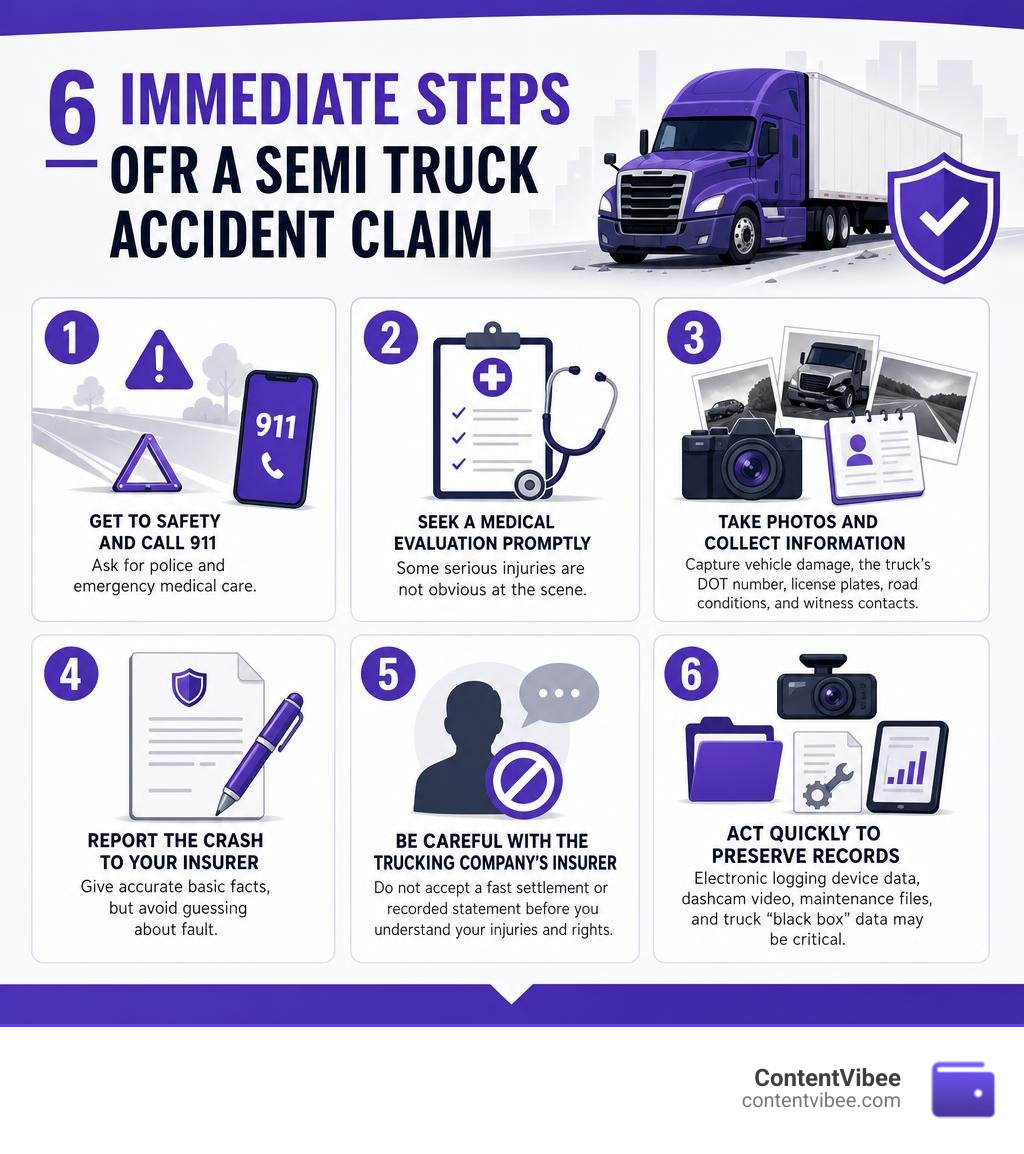
- Get to safety and call 911. Ask for police and emergency medical care.
- Seek a medical evaluation promptly. Some serious injuries are not obvious at the scene.
- Take photos and collect information. Capture vehicle damage, the truck’s DOT number, license plates, road conditions, and witness contacts.
- Report the crash to your insurer. Give accurate basic facts, but avoid guessing about fault.
- Be careful with the trucking company’s insurer. Do not accept a fast settlement or recorded statement before you understand your injuries and rights.
- Act quickly to preserve records. Electronic logging device data, dashcam video, maintenance files, and truck “black box” data may be critical.
A collision with a fully loaded semi can involve a vehicle weighing up to 80,000 pounds – roughly 20 times the weight of a typical passenger car. The injuries can be severe, and the claim may involve the driver, trucking company, cargo loader, maintenance provider, or another party.
That is why these cases are rarely handled like an ordinary car crash. Federal trucking rules, multiple insurance policies, and time-sensitive electronic evidence can all shape what happens next.
Step-by-Step Guide: How to File a Semi Truck Accident Claim
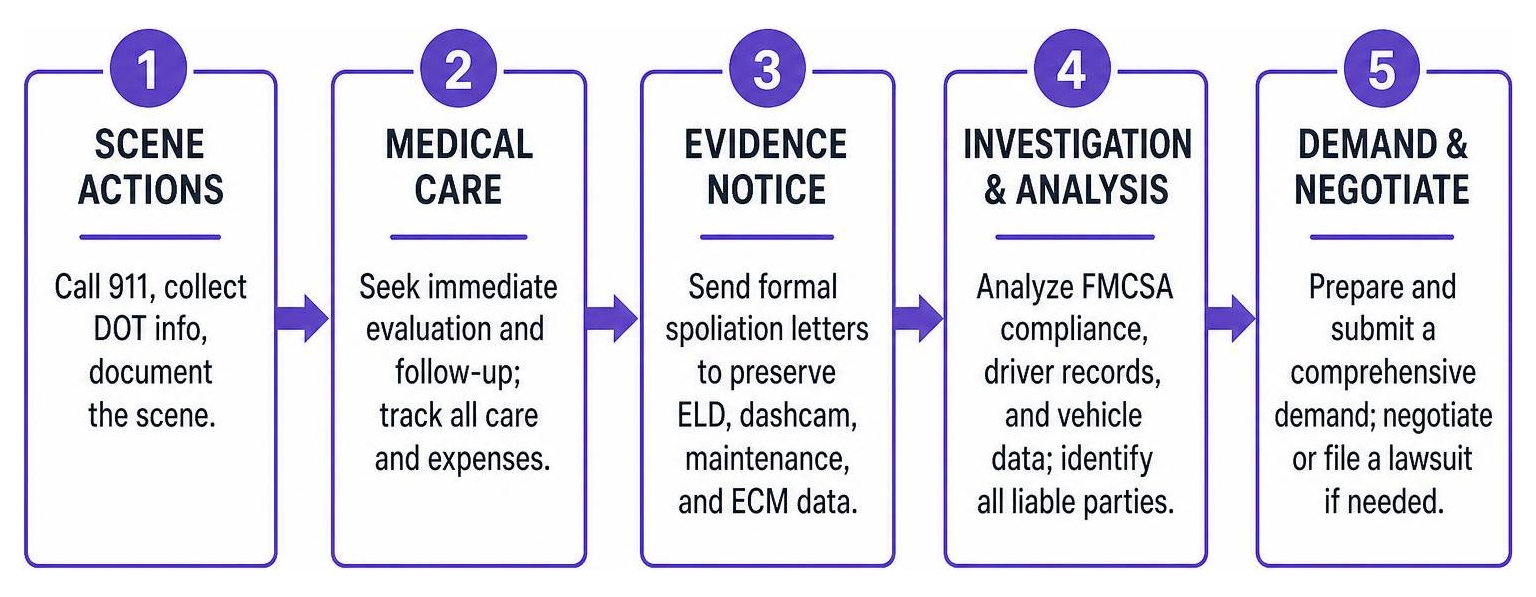
Navigating a semi truck accident claim might feel like being thrown into a crash course on federal freight law, corporate insurance politics, and medical terminology. But when we break the process down into manageable steps, protecting your financial recovery becomes much clearer.
When an 80,000-pound commercial rig collides with a standard 4,000-pound passenger car, physics is not on the passenger car’s side. Neither is time. Filing a claim is not just about filling out standard insurance forms; it is a systematic process of investigating the crash, identifying every responsible party, calculating full economic damages, and negotiating aggressively against corporate defense teams.
Immediate Actions to Take at the Accident Scene
The moments directly following a commercial truck collision are hectic, but what you do in those first 30 minutes can make or break your semi truck accident claim.
- Ensure Scene Safety and Call 911: If possible, move your vehicle off the active travel lane to avoid secondary crashes. Immediately contact emergency services so police officers and paramedics are dispatched.
- Get Law Enforcement Documentation: Make sure responding police officers complete an official crash report. Ask for the responding officer’s name, badge number, and police report confirmation number. If there are minor mistakes or missing facts in the initial report, you can request formal amendments later.
- Exchange Vital Information: Collect the truck driver’s name, Commercial Driver’s License (CDL) number, insurance carrier, and policy details. Crucially, look at the cab door of the tractor and record the motor carrier’s name, legal address, and Department of Transportation (USDOT) or Motor Carrier (MC) identification numbers.
- Document Physical Evidence Thoroughly: Take wide-angle and close-up photos of all vehicle damage, license plates, hazardous material placards, skid marks, road conditions, weather, traffic signs, fluid leaks, and physical injuries.
- Gather Eyewitness Contacts: Neutral third-party witnesses often provide crucial clarity when liability is disputed. Collect names, phone numbers, and brief email addresses from anyone who saw the crash occur.
For a deeper dive into protecting your physical safety and legal options immediately following a collision, check out this guide on what to do if you are hit by a semi truck.
Critical Evidence Needed to Support Your Semi Truck Accident Claim
Commercial trucking companies are highly sophisticated businesses that deploy rapid-response teams to accident scenes. To level the playing field, you must preserve critical physical and digital evidence before it is routinely overwritten, altered, or deleted.
Unlike regular commuter vehicles, heavy commercial trucks are equipped with advanced telemetry systems that act as digital witnesses:
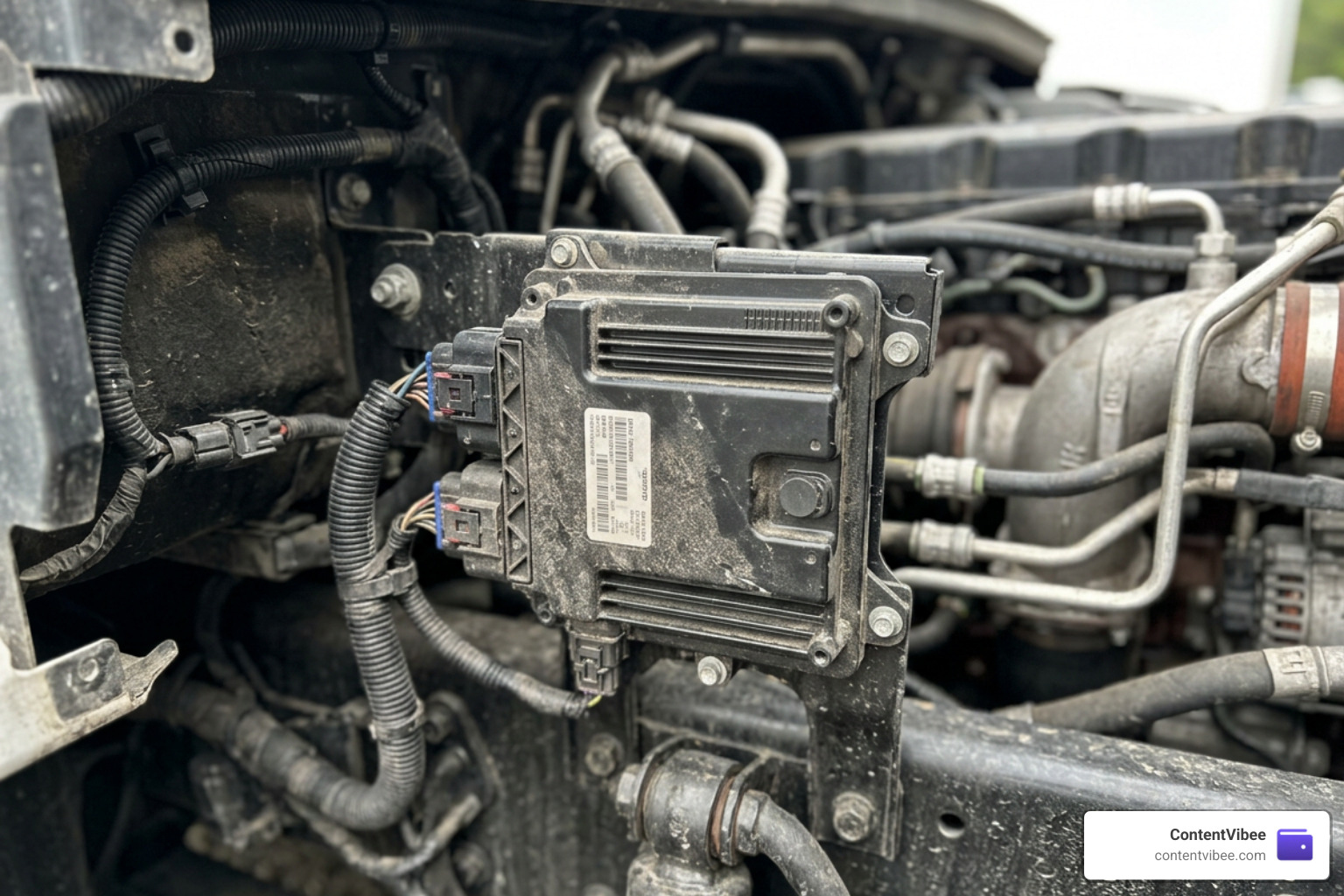
- Event Data Recorders (EDR) / Engine Control Modules (ECM): Often referred to as the truck’s “black box,” this module records vital data in the seconds leading up to a crash, including vehicle speed, engine RPM, brake application, throttle position, and steering inputs.
- Electronic Logging Devices (ELDs): Modern federal rules require interstate commercial drivers to use ELDs. These devices automatically record driving hours, engine movement, location data, and duty status to verify whether the driver complied with federal rest mandates.
- Spoliation Letters: Trucking companies usually purge ELD and black box data after 30 to 90 days as a standard operational practice unless legally notified otherwise. A formal legal document called a spoliation letter must be served promptly on the carrier demanding that all digital files, dashcam video, maintenance logs, and dispatch records be preserved immediately.
- Driver Qualification Files (DQF): Motor carriers are required by law to maintain detailed hiring files for every driver. These files contain background checks, driving histories, drug test results, medical certifications, and safety training logs.
- Maintenance and Inspection Logs: Federal standards require strict routine inspections of heavy vehicle brakes, tires, lighting, and steering assemblies. Gaps in maintenance can prove corporate negligence.
How Liability Is Determined and Who Can Be Held Responsible
To successfully resolve a semi truck accident claim, you must establish that another party’s legal negligence caused your injuries. Under standard tort principles, proving negligence requires establishing four key elements:
- Legal Duty of Care: The commercial driver and motor carrier owed a duty to operate safely on public roads.
- Breach of Duty: The responsible party breached that duty by violating traffic laws, ignoring safety regulations, or driving recklessly.
- Causation: The breach directly caused the collision and resulting injuries.
- Measurable Damages: You suffered real economic or personal losses, such as emergency room bills, property loss, or lost income.
How Federal Regulations Impact Your Semi Truck Accident Claim
The interstate trucking industry is governed by strict rules enforced by the Federal Motor Carrier Safety Administration (FMCSA). Violating these federal safety standards can be strong evidence of negligence per se in a claim.
- Hours-of-Service (HOS) Mandates: To prevent driver fatigue—a major cause of highway crashes—FMCSA rules restrict property-carrying truck drivers to a maximum of 11 hours of driving time within a 14-hour on-duty window after taking 10 consecutive hours off duty. Furthermore, drivers cannot drive after reaching 60 hours on duty over 7 consecutive days (or 70 hours over 8 days).
- Stricter BAC Limits: While non-commercial drivers generally face an explicit legal Blood Alcohol Concentration (BAC) limit of 0.08%, commercial driver’s license (CDL) holders are subject to a strict 0.04% BAC limit while operating commercial vehicles.
- Mandatory Drug & Alcohol Testing: Motor carriers must conduct pre-employment drug screening, random post-accident alcohol and controlled substance testing, and reasonable suspicion tests.
- Cargo Securement Standards: Rules set under 49 CFR Part 393 dictate precise tie-down, balancing, and weight distribution standards to prevent dangerous cargo shifts, jackknifes, or highway spills.
Identifying All Liable Parties Beyond the Driver
One major reason a semi truck accident claim is more complex than a standard automobile case is that multiple corporate entities may share fault for a single collision:
- The Truck Driver: Responsible for direct driving errors such as speeding, distracted driving, tailgating, or operating under the influence.
- The Motor Carrier (Trucking Company): Liable directly for negligent hiring, improper training, coercing drivers to exceed HOS limits, or negligent maintenance. They may also be held vicariously liable (respondeat superior) for the actions of their employed drivers.
- Cargo Loaders and Shippers: Third-party freight loading companies can be held responsible if an unbalanced, overloaded, or improperly secured cargo load causes a rollover or jackknife incident.
- Freight Brokers: Third-party brokers who coordinate shipping logistics can face legal liability if they negligently assign loads to sub-standard, uncertified motor carriers with poor safety track records.
- Parts Manufacturers: If mechanical failure—such as defective air brakes, tire blowouts, or steering assembly breakdowns—caused the crash, the equipment manufacturer can be named in a product liability suit.
- Third-Party Maintenance Facilities: External repair vendors responsible for servicing commercial fleets can be held liable if sloppy repair work contributed to the equipment failure.
Key Differences Between Trucking Crashes and Standard Car Accidents
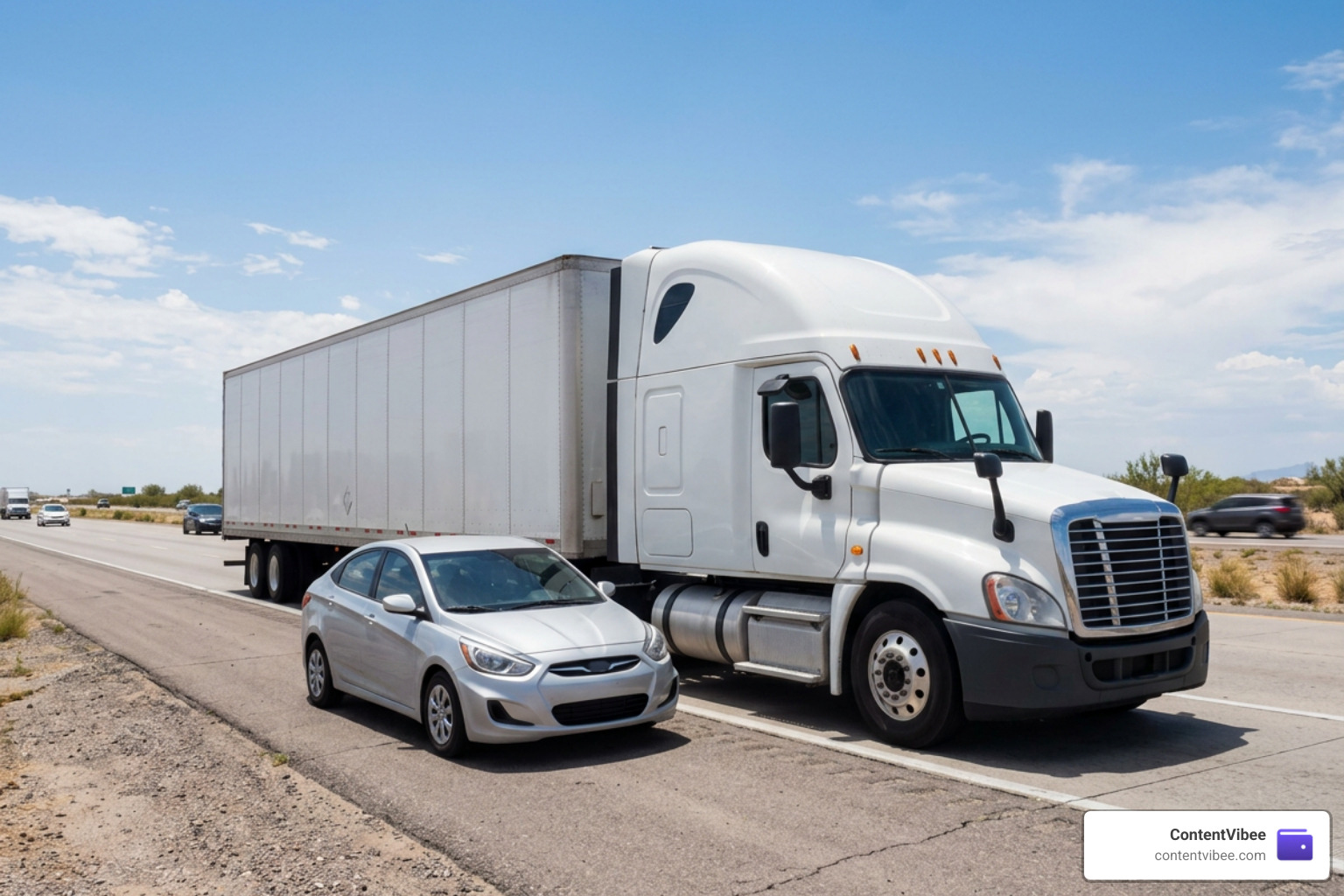
If you have ever been in a minor fender bender with a passenger vehicle, you might assume handling a trucking claim works roughly the same way. That assumption can be a costly mistake.
Commercial truck crashes are vastly different due to structural size disparities, strict regulatory oversight, multi-layered corporate structures, and massive financial liability.
| Key Aspect | Standard Car Accident Claim | Commercial Semi Truck Accident Claim |
|---|---|---|
| Vehicle Weight | 3,000 to 4,000 lbs average | Up to 80,000 lbs fully loaded |
| Minimum Insurance Limits | Typically $15,000 – $50,000 state minimums | $750,000 to $5,000,000+ federally mandated |
| Governing Law | Local state motor vehicle traffic laws | State laws combined with Federal FMCSA rules |
| Potentially Liable Parties | Usually just the driver(s) involved | Driver, carrier, shipper, broker, manufacturer, maintenance |
| Investigative Evidence | Driver statement, basic police report, photos | Black box (ECM/EDR), ELD records, DQF, dispatch logs |
| Corporate Opposition | Single auto adjuster | Corporate defense teams, in-house legal counsel, rapid responders |
To better understand how state insurance rules and federal motor carrier standards intersect to shape financial payouts, review this overview on how to maximize a semi truck accident settlement.
Compensation Types and Dealing with Insurance Adjusters
Commercial freight operations carry policy limits far higher than individual drivers. Federal law mandates that interstate trucks carry at least $750,000 in liability coverage for general freight, increasing to $1,000,000 or $5,000,000 for transport involving oil or hazardous materials.
While higher limits mean greater financial resources are available to cover severe losses, commercial insurance companies fight harder to protect those larger payouts.
Economic, Non-Economic, and Punitive Damages
In a semi truck accident claim, compensation generally falls into three main categories:
Economic Damages (Measurable Financial Losses):
- Emergency medical transport, trauma care, and hospitalization.
- Ongoing rehabilitation, physical therapy, and home modifications.
- Lost wages and missed bonuses during recovery.
- Loss of future earning capacity if injuries prevent you from returning to your prior trade or profession.
- Property loss, towing costs, and vehicle repair or replacement.
Non-Economic Damages (Quality of Life Impacts):
- Physical pain and suffering.
- Emotional distress, anxiety, and Post-Traumatic Stress Disorder (PTSD).
- Permanent physical impairment, scarring, or disfigurement.
- Loss of enjoyment of life and loss of consortium for spouses.
Punitive Damages:
- Awarded in rare cases where the defendant showed gross negligence, conscious disregard for safety, or intentional misconduct (such as a motor carrier forcing an exhausted driver to forge ELD logs or operating a truck with known, broken brakes).
Defense Tactics Used by Commercial Insurance Carriers
Commercial insurance claims adjusters are trained professionals whose primary goal is to minimize company payouts. Here are common strategies they use:
- Pushing for Early Recorded Statements: Adjusters often call soon after a crash while you are still shaken or under the influence of pain medications. They ask leading questions designed to extract casual admissions (e.g., “I’m feeling okay today” or “I didn’t see the truck coming until the last second”) that can be used to shift blame onto you.
- Blaming Pre-Existing Conditions: Insurance teams scrutinize complete medical histories to argue that current back or neck pain stems from aging or prior injuries rather than the crash impact.
- Exploiting Comparative Negligence: In many states, comparative fault rules reduce compensation by your percentage of responsibility. For example, in a modified comparative fault state with a 50% threshold, if an adjuster convinces a court you were 51% at fault for a lane shift, you receive zero recovery.
- Offering Lowball Settlements Before Full Medical Diagnosis: Adjusters know that medical bills stack up fast. They may offer a quick cash settlement within days of the incident. Accepting it requires signing a full release that permanently waives your right to seek additional compensation—even if you later need an expensive spinal surgery.
Frequently Asked Questions About Trucking Accidents
What is the statute of limitations for filing a truck accident claim?
The statutory deadline (statute of limitations) to file a lawsuit varies by state, but typically ranges from one to three years from the date of the collision (two years is standard in many jurisdictions).
However, if a government-owned vehicle or municipality was involved (such as a city maintenance truck), mandatory notice deadlines can be as short as 6 months or 180 days.
Because electronic evidence like ELD records and black box data can be lawfully deleted after a few months, starting the claim process immediately is essential regardless of statutory deadlines.
Do I need an attorney to file a semi truck accident claim?
While you are not legally required to hire an attorney to submit an insurance claim, attempting to negotiate a complex commercial trucking case on your own puts you at a disadvantage.
Adjusters represent the carrier’s bottom line. Handling a claim independently means managing spoliation notices, FMCSA compliance audits, black box data extraction, expert life care planning, and complex multi-party negotiations by yourself while trying to heal.
An experienced injury lawyer understands how to uncover regulatory violations and protect your rights against corporate defense tactics.
What should I do if the trucking company offers an immediate quick settlement?
Politely decline the offer and do not sign any documents or releases.
Initial quick offers made shortly after a collision are structured to resolve liability for a fraction of the claim’s true long-term value. Before considering any settlement, you need to reach Maximum Medical Improvement (MMI)—the point where your treating doctors can fully project your total future medical costs, lifetime physical therapy needs, and long-term lost earning capacity.
Conclusion
Filing a semi truck accident claim is about far more than covering immediate vehicle repairs; it is about protecting your financial stability, physical recovery, and future quality of life after a traumatic collision.
By taking swift action at the scene, securing immediate medical care, issuing critical legal spoliation notices, and uncovering every potential layer of corporate liability, you can level the playing field against well-funded insurance carriers.
At ContentVibee, we break down complex legal processes into clear, step-by-step guides so you can make informed decisions when it matters most.
If you or a loved one are facing the complicated aftermath of a commercial highway crash, read our complete guide on finding an 18-wheeler injury lawyer before it’s too late to take the next confident step toward securing the compensation you deserve.


