


How the Truck Accident Lawsuit Process Works
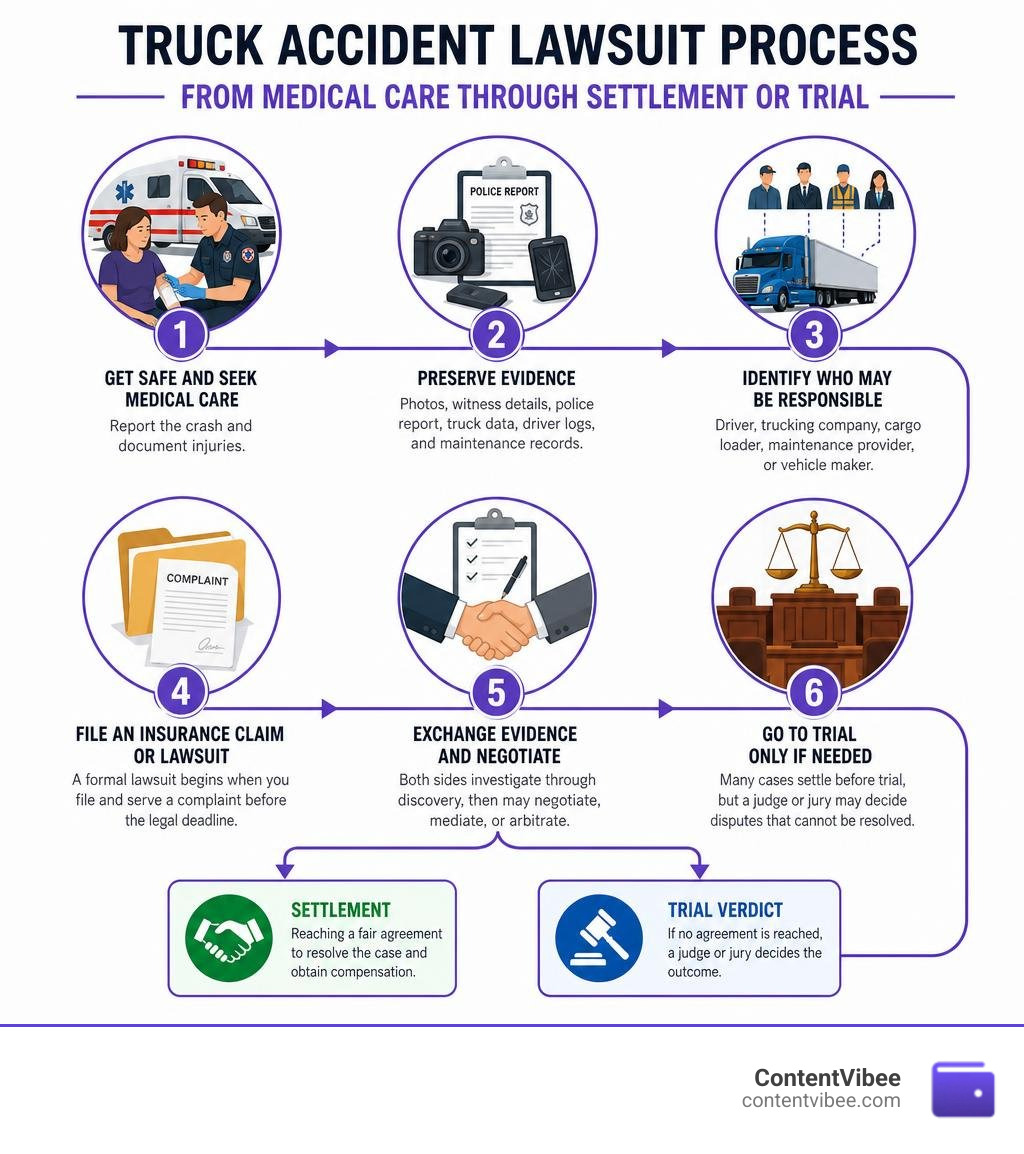
The truck accident lawsuit process usually starts with medical care and evidence preservation, then moves through an insurance claim, investigation, settlement talks, and sometimes a court case.
- Get safe and seek medical care. Report the crash and document injuries.
- Preserve evidence. This can include photos, witness details, the police report, truck data, driver logs, and maintenance records.
- Identify who may be responsible. Liability may involve the driver, trucking company, cargo loader, maintenance provider, or vehicle maker.
- File an insurance claim or lawsuit. A formal lawsuit begins when the injured person files and serves a complaint before the legal deadline.
- Exchange evidence and negotiate. Both sides investigate through discovery, then may negotiate, mediate, or arbitrate.
- Go to trial only if needed. Many cases settle before trial, but a judge or jury may decide disputes that cannot be resolved.
Truck crashes are not simply larger car accident claims. A commercial truck can weigh up to 80,000 pounds, compared with roughly 4,000 pounds for an average passenger vehicle. The injuries can be severe, the insurance coverage may be layered, and several companies may share fault.
That complexity also creates urgency. Important records, such as electronic logging device data, onboard computer data, inspection reports, and maintenance files, can be lost or overwritten if they are not preserved early. State deadlines and comparative-fault rules can also change how much time you have to act and how much compensation may be available.
This guide breaks down the process in plain English, from the first hours after a crash through settlement or trial.
Understanding What Makes Commercial Truck Accidents Unique
Commercial truck collisions stand apart from standard vehicular crashes due to sheer physical force, regulatory oversight, and legal complexity. When an 80,000-pound commercial rig collides with a standard automobile, the resulting damage is rarely minor. Beyond the immediate physical destruction, navigating a commercial trucking claim requires peeling back multiple layers of corporate structure, federal compliance guidelines, and commercial insurance policies.
Key Differences Between Auto Accidents and Truck Claims
The physical disparity between commercial trucks and consumer cars dictates the severity of these cases. While an average passenger car weighs approximately 4,000 pounds, a fully loaded tractor-trailer can weigh up to 80,000 pounds. This dramatic weight differential frequently leads to life-altering or catastrophic injuries, raising the stakes of legal recovery significantly.
In addition to physical scale, commercial trucking is strictly regulated at the national level by the Federal Motor Carrier Safety Administration (FMCSA). Federal safety regulations govern driver hours of service (HOS), mandatory rest breaks, drug testing protocols, vehicle inspection standards, and cargo weight limits. Demonstrating that a driver or motor carrier violated FMCSA rules can be pivotal in establishing negligence.
Furthermore, financial limits are far higher in truck accident claims. Standard private driver policies may carry state minimum liability limits—such as Arizona’s requirement of $25,000 per person for bodily injury, $50,000 per accident for bodily injury, and $15,000 for property damage. Commercial carriers, by contrast, are required to carry substantial commercial liability policies ranging from $750,000 to several million dollars. These multi-layered policies often involve primary insurers, excess liability coverage, and corporate self-insured retentions.
Potential Liable Parties in a Commercial Collision
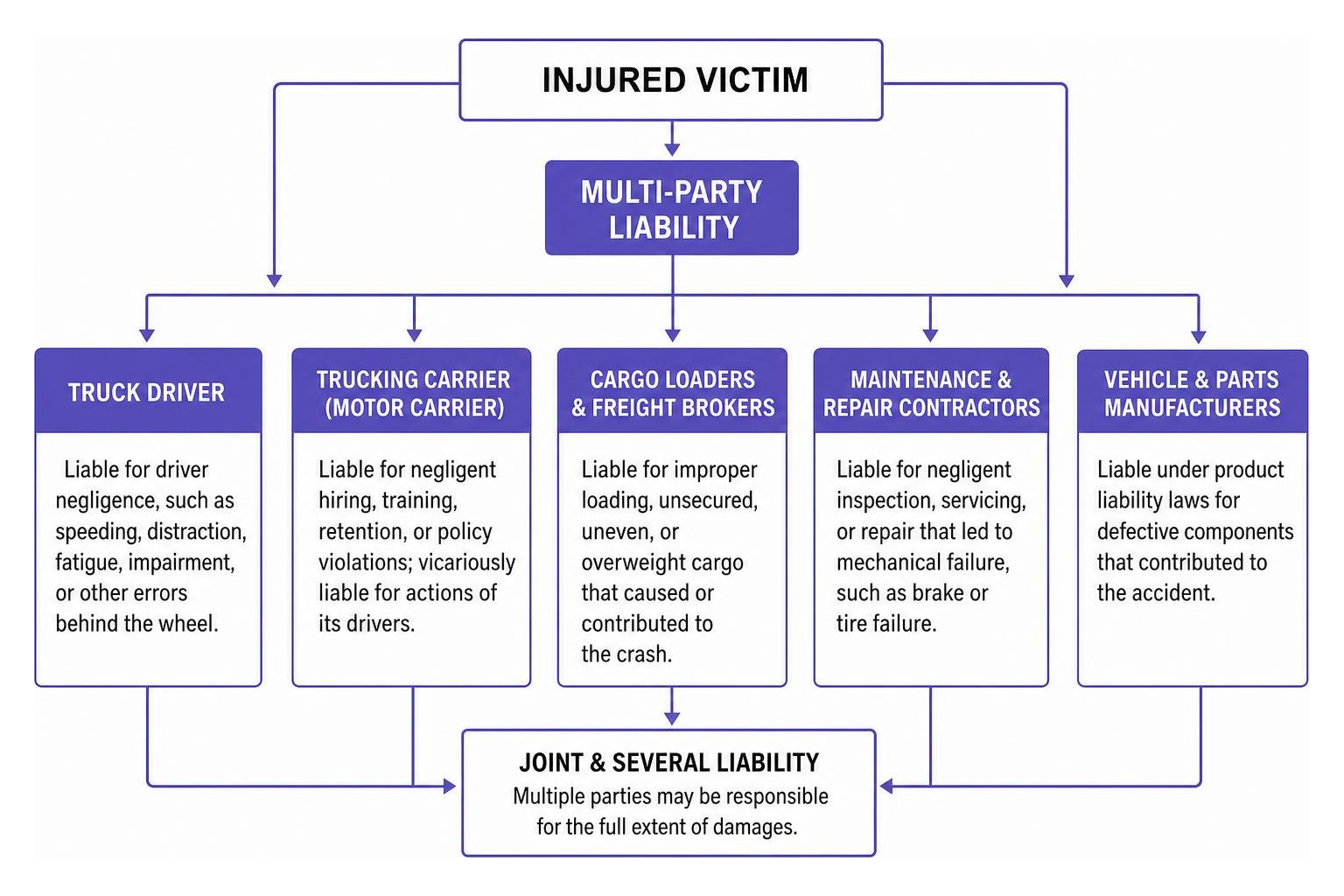
In a basic car crash, fault usually lies between two individual drivers. In a commercial truck accident, liability is frequently distributed across multiple commercial entities. We often look at the following parties during an investigation:
- The Truck Driver: Responsible for driver errors, such as speeding, distracted driving, driving while fatigued, or operating under the influence.
- The Trucking Carrier (Motor Carrier): Liable directly for negligent hiring, improper training, or coercing drivers to exceed legal driving hours, as well as vicariously liable for their employees’ actions on the road.
- Cargo Loaders and Freight Brokers: Responsible if unevenly distributed, improperly secured, or overloaded freight caused the truck to tip, jackknife, or spill cargo across traffic lanes.
- Maintenance and Repair Contractors: Liable if mechanical failure—such as brake malfunction or tire blowouts—stemmed from negligent servicing or failure to complete mandated inspections.
- Vehicle and Parts Manufacturers: Responsible under product liability rules if defective components, such as faulty steering mechanisms or defective tires, contributed to the accident.
Navigating the Step-by-Step Truck Accident Lawsuit Process
Understanding the truck accident lawsuit process helps victims navigate what can otherwise feel like an overwhelming legal maze. While every case has unique facts, standard commercial trucking litigation unfolds through three primary phases.
Phase 1: Immediate Steps and Investigation in the Truck Accident Lawsuit Process
The moments directly following a crash set the foundation for any future legal recovery. The priority must always be obtaining immediate medical care, even if initial injuries appear manageable. Prompt medical evaluation establishes an official paper trail connecting the crash directly to physical injuries, preventing insurance adjusters from claiming injuries were pre-existing or caused by an unrelated event.
Simultaneously, thorough evidence gathering must begin. Beyond securing the official police report, witness statements, and scene photographs, commercial claims require securing specialized digital and corporate evidence.

Crucial evidence unique to commercial trucking includes:
- Event Data Recorder (EDR) / “Black Box” Data: Stores critical metrics right before impact, including vehicle speed, brake application, engine RPM, and steering inputs.
- Electronic Logging Device (ELD) Records: Records precise driving hours to verify compliance with FMCSA hours-of-service rules.
- Driver Qualification Files: Details the driver’s commercial driver’s license (CDL) status, medical certifications, background checks, and prior safety violations.
- Maintenance and Inspection Logs: Documents repair histories and pre-trip inspection reports.
Because trucking companies are permitted under federal rules to routinely overwrite or discard certain digital logs after specified periods, sending a formal spoliation letter early in the process is essential to legally mandate that the carrier preserve all digital and physical records.
Phase 2: Pre-Trial Litigation and Discovery in the Truck Accident Lawsuit Process
If early settlement discussions fail to produce a fair resolution, the formal legal proceeding begins when the injured party (the plaintiff) files a Summons and Complaint in the appropriate civil court. This document outlines the legal allegations, identifies the defendants, and states the financial remedies sought. Once served, the defendants file formal legal answers.
Following the initial pleadings, the case enters the discovery phase. Discovery is often the longest phase of litigation, allowing both sides to formally exchange information and build their arguments.

Key elements of discovery include:
- Written Discovery: Interrogatories (written questions answered under oath) and Requests for Production of Documents (demands for maintenance logs, corporate emails, and policies).
- Depositions: Sworn, out-of-court testimony taken down by a court reporter. Attorneys question the injured party, the truck driver, corporate representatives, eyewitnesses, and treating physicians.
- Pre-Trial Settlement Negotiations: Armed with discovery facts, both sides frequently engage in formal settlement conferences, direct negotiations, or alternative dispute resolution like mediation and arbitration to settle out of court.
Phase 3: Trial Proceedings and Verdict Resolution
If the parties cannot reach a settlement agreement, the lawsuit proceeds to court. Commercial truck accident trials can last anywhere from a few days to several weeks, depending on case complexity.
During the trial, the plaintiff carries the burden of proof to demonstrate by a preponderance of the evidence that the defendants were negligent and that their negligence directly caused the injuries and financial losses.
Both legal teams present opening statements, examine witnesses, present documentary evidence, and deliver closing arguments. Medical professionals and accident reconstruction experts play a key role in explaining technical collision dynamics and long-term disability prognosis to the jury. Once both sides rest, the judge instructs the jury (or acts as the sole finder of fact in a bench trial) to deliberate and render a binding verdict.
How State Laws Impact Your Trucking Injury Claim
While commercial trucks must adhere to federal rules, the actual personal injury lawsuit is governed by state laws. Variations in local statutes of limitations and comparative negligence models can alter case strategy and financial outcomes.
Statutes of Limitations Across Different States
A statute of limitations dictates the strict deadline by which a legal claim must be formally filed in court. Missing this window permanently bars the victim from pursuing financial recovery.
Statute of limitations rules vary significantly by jurisdiction:
- Tennessee: Imposes a strict one-year statute of limitations for personal injury actions under Tennessee Code § 28-3-104, calculated from the date of the collision.
- Kentucky: Permits a two-year filing window for personal injury claims under KRS 304.39-230.
- Arizona: Maintains a standard two-year statute of limitations for general personal injury and wrongful death claims. However, if the truck crash involves a municipal or state government entity (such as a publicly owned utility truck), an injured party must serve a formal Notice of Claim within 180 days, and file the actual lawsuit within one year.
Pure vs. Modified Comparative Negligence
State fault systems determine how financial recovery is affected when an injured plaintiff shares partial responsibility for an accident.
Under a pure comparative negligence standard (used in states like Arizona and Kentucky), a plaintiff can recover damages regardless of their percentage of fault, but their financial award is reduced in direct proportion to their responsibility. For instance, if a court determines an injured motorist suffered $200,000 in damages but was 20% at fault for speeding, their net recovery is reduced by 20% to $160,000. Even if a driver is found 90% at fault, they can technically still recover 10% of their total proven damages.
By contrast, states operating under a modified comparative negligence system enforce a strict threshold. In Tennessee, for example, the state follows a 50% bar rule. An injured plaintiff can recover compensation only if their assigned fault is 49% or lower. If the plaintiff is found 50% or more at fault for the crash, they are completely barred from receiving any monetary compensation.
| State | Statute of Limitations (General Injury) | Fault System Model | Comparative Fault Threshold |
|---|---|---|---|
| Tennessee | 1 Year (TN Code § 28-3-104) | Modified Comparative Fault | Barred if 50% or more at fault |
| Kentucky | 2 Years (KRS 304.39-230) | Pure Comparative Negligence | No bar; reduced proportionally by % fault |
| Arizona | 2 Years (180 days for govt entities) | Pure Comparative Negligence | No bar; reduced proportionally by % fault |
Recoverable Compensation and Factors Influencing Case Timelines
Calculating the value of a truck accident lawsuit requires a detailed assessment of direct financial losses, quality-of-life impacts, and the long-term prognosis of the victim’s health.
Types of Compensation You Can Recover
Damages awarded in personal injury litigation fall into three primary categories: economic damages, non-economic damages, and punitive damages.
1. Economic Damages (Calculable Losses)
- Medical Expenses: Covers emergency care, hospital stays, surgeries, prescription medications, rehabilitation therapies, medical equipment, and estimated future medical expenses.
- Lost Wages: Reimburses income lost while recovering and unable to work.
- Diminished Earning Capacity: Compensates for long-term reduction in future earning power caused by permanent disability or impairment.
- Property Damage: Costs to repair or replace the damaged passenger vehicle and contents destroyed in the crash.
2. Non-Economic Damages (Quality-of-Life Losses)
- Pain and Suffering: Compensation for physical discomfort and ongoing distress.
- Emotional Distress: Addresses anxiety, depression, sleep disturbance, and post-traumatic stress disorder (PTSD) stemming from the collision.
- Loss of Enjoyment of Life: Covers the inability to engage in hobbies, recreational pursuits, or daily activities enjoyed prior to the crash.
- Loss of Consortium: Awarded to spouses for lost companionship, affection, and intimacy.
3. Punitive Damages
Unlike compensatory damages, punitive damages are awarded to punish particularly egregious conduct and deter future misconduct. Proving punitive damages requires clear and convincing evidence that a defendant acted with intentional malice, an “evil mind,” or deliberate indifference to public safety—such as a trucking carrier knowingly forcing a driver to operate a commercial rig with intentionally disabled brakes or after failing multiple drug screenings.
Realistic Case Timelines: From Months to Years
A common question crash victims ask is how long their lawsuit will take to conclude. Timelines vary considerably based on injury severity, fault clarity, and insurance company cooperativeness.
In general, claims move through varying phases depending on complexity:
- Minor Soft-Tissue Cases: Claims involving straightforward recovery without surgical intervention typically resolve in 4 to 8 months. Average settlements for minor injuries frequently range between $10,000 and $30,000.
- Moderate Injury Cases: Claims involving broken bones, extended therapy, or moderate physical injuries often take 8 to 18 months to settle, with typical recovery ranges between $30,000 and $100,000.
- Serious / Catastrophic Injury Cases: Cases involving surgical intervention, spinal cord damage, traumatic brain injuries (TBI), or permanent disability frequently require 18 to 30 months, with case values routinely exceeding $100,000 into seven figures.
- Formal Court Litigation: If an out-of-court settlement cannot be reached and a full trial is necessary, the court process can extend timelines to 2 to 4 years.
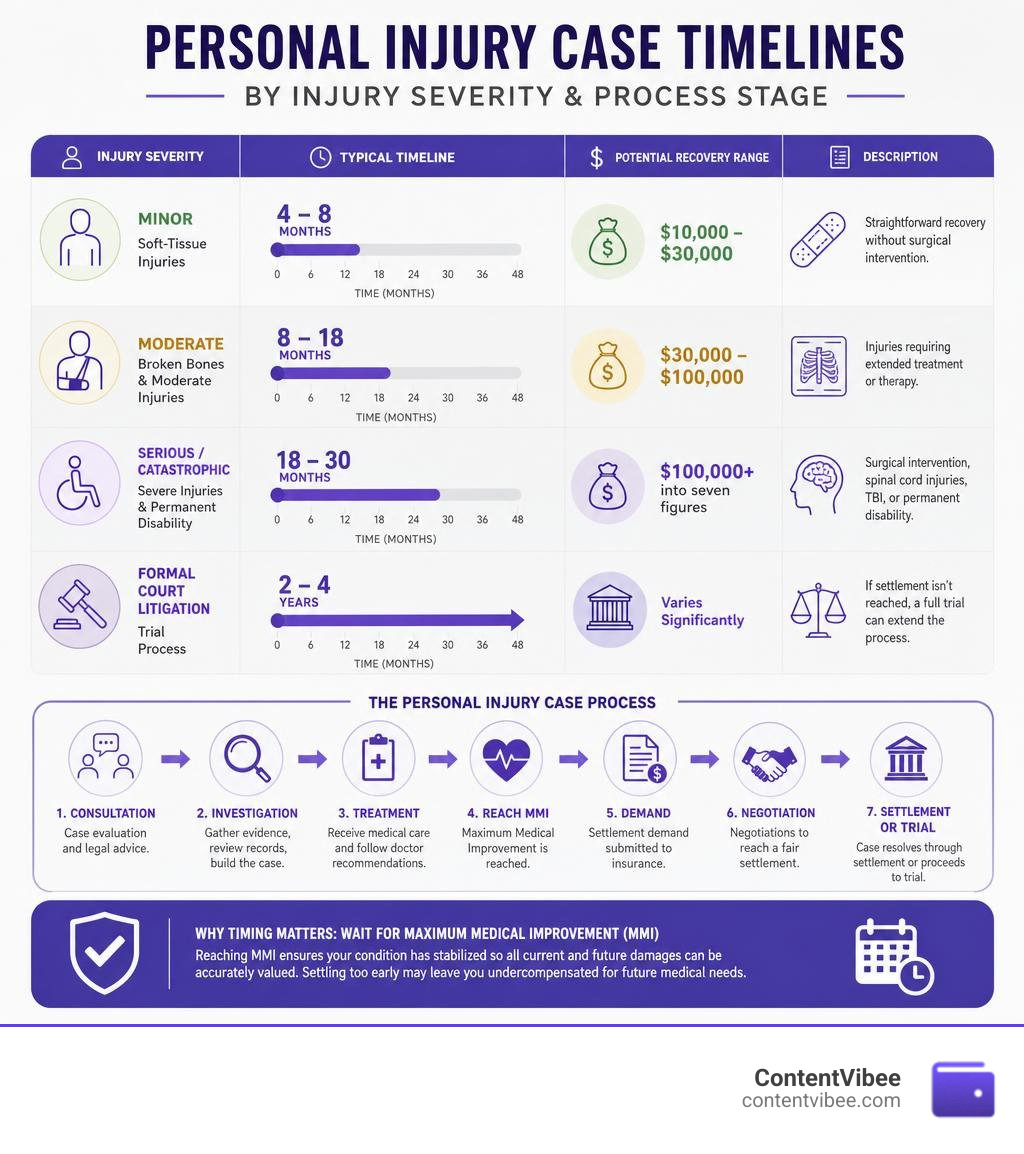
A critical factor governing case timelines is waiting until the injured party reaches Maximum Medical Improvement (MMI). MMI is the point at which a medical doctor certifies that a patient’s condition has stabilized and further recovery is predictable. Demanding a settlement prior to reaching MMI risks significantly undervaluing a claim, as future surgeries or medical complications cannot be properly compensated once a release form is signed.
Frequently Asked Questions About Trucking Lawsuits
Do all truck accident lawsuits go to trial or settle out of court?
The vast majority of commercial truck accident claims are resolved out of court through settlement negotiations, mediation, or arbitration long before reaching a jury verdict. Settlements allow both parties to avoid the uncertainty, high costs, and extended timelines associated with trial litigation.
However, if an insurance carrier refuses to offer fair compensation for long-term medical needs, denies clear liability, or disputes comparative negligence, taking the case to trial becomes necessary to secure full justice.
How long does a typical truck accident lawsuit take to resolve?
While minor injury claims can settle within 4 to 8 months, serious truck accident lawsuits generally take anywhere from 18 months to over 3 years to reach final resolution.
Factors influencing the duration include:
- The time required to complete necessary medical treatments and reach MMI.
- The complexity of evidence gathering from corporate trucking entities.
- Court docket backlogs and scheduling availability.
- The willingness of insurance companies to negotiate reasonably during discovery.
What evidence is most critical for proving liability in a truck crash?
The most critical evidence in commercial truck litigation includes:
- Black Box (EDR) and ELD Data: Provides objective proof of vehicle speed, braking history, and potential hours-of-service violations.
- Driver Qualification and Medical Records: Documents whether the operator was legally permitted and physically fit to drive.
- Fleet Maintenance and Inspection Logs: Proves whether mechanical failures resulted from improper vehicle upkeep.
- Accident Scene Reconstruction: Expert analysis of skid marks, impact points, debris fields, and vehicle damage to establish precise crash dynamics.
Conclusion
Navigating the truck accident lawsuit process requires an understanding of complex corporate liability, federal safety codes, and state-specific legal frameworks. From preserving time-sensitive electronic logging data to carefully documenting medical treatments until reaching maximum medical improvement, taking deliberate legal action protects your rights and ensures fair financial recovery.
If you or a loved one has been involved in a collision with a heavy vehicle, understanding your full legal options is an essential step toward recovery. Explore our comprehensive Truck Accident Lawsuit Guide to learn more about navigating your claim and protecting your financial future after a major accident.


