


When You Need Commercial Vehicle Accident Lawyers: What You Should Know First
Commercial vehicle accident lawyers help victims of truck and large vehicle crashes navigate a legal process that is far more complex than a standard car accident claim.
If you were hit by a commercial truck, here is what matters most:
Quick answers for accident victims:
- Get medical care first — your health and medical records are both critical
- Don’t talk to the trucking company’s insurer — anything you say can reduce your payout
- Hire a lawyer fast — key evidence like black box data can be overwritten within days
- Know your deadline — statutes of limitations range from 1 year (Louisiana) to 3 years (New York) depending on your state
- Expect more money — commercial insurance policies often carry limits of $1 million or more, far above standard auto policies
These cases are not like typical fender-benders. When an 80,000-pound tractor-trailer hits a 3,000-pound passenger car, the results are almost always severe. In 2023, roughly 70% of people killed in large truck crashes were occupants of passenger vehicles — not the truck driver.
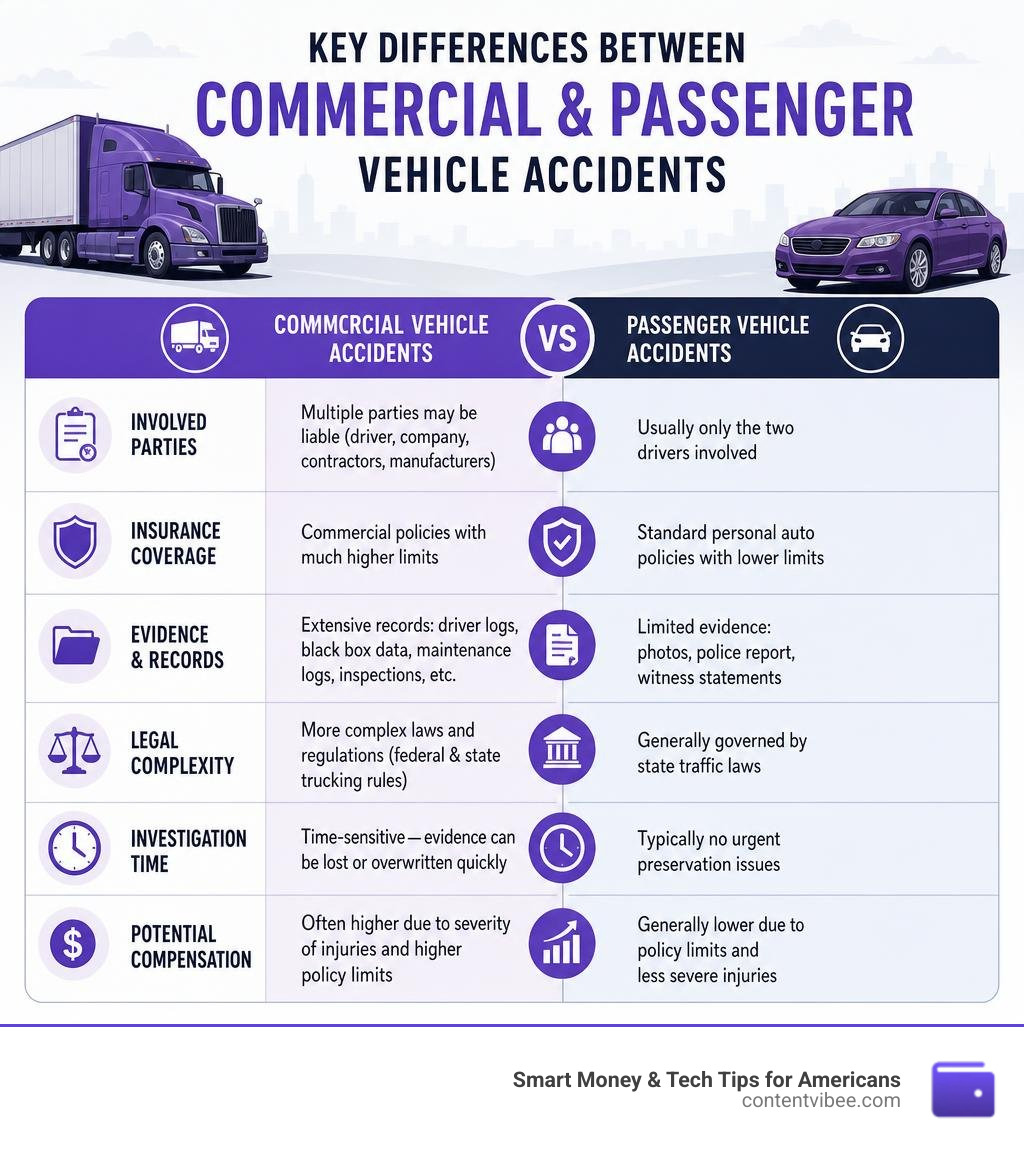
The legal side is just as overwhelming. Unlike a two-car crash, a commercial vehicle accident can involve the truck driver, the trucking company, a cargo loading contractor, a vehicle manufacturer, and multiple insurance policies — all at once.
And the clock starts ticking the moment the crash happens.
The sections below walk you through everything you need to know before making any decisions.
1. How Commercial Vehicle Accidents Differ From Standard Car Crashes
If you have ever been in a minor fender-bender with another passenger car, you might think you know how the insurance claim process works. You exchange insurance cards, call your agent, maybe get a couple of repair estimates, and move on with your life.
With commercial truck accidents, you can throw that playbook completely out the window.
The differences start with basic physics and end with highly complex corporate structures. Let’s look at the stark contrast between these two types of road incidents:
| Feature | Passenger Car Accident | Commercial Truck Accident |
|---|---|---|
| Average Weight | ~3,000 to 4,000 lbs | Up to 80,000 lbs (fully loaded) |
| Primary Defendant | The individual driver | Driver, trucking carrier, cargo loader, manufacturer |
| Regulatory Oversight | State motor vehicle laws | Federal (FMCSA) and state transportation codes |
| Typical Insurance Limit | $15,000 to $100,000+ | $750,000 to $5,000,000+ |
| Evidence Complexity | Police report, photos, basic insurance statements | Black box data, ELD logs, maintenance records, dispatch history |
The massive weight disparity means that when a commercial vehicle collides with a passenger car, the force generated is catastrophic. This physical reality directly impacts the legal complexity. Because the stakes are so high, the financial recovery must match the scale of the harm. If you are curious about what these cases are worth, you can read more about the average settlement for commercial vehicle accidents to understand how insurance companies evaluate these massive claims.
The Complex Web of Multi-Party Liability
In a standard car crash, liability is usually a binary question: Did Driver A or Driver B run the red light? In a commercial vehicle crash, liability is rarely that simple.
Under the legal doctrine of respondeat superior (a fancy Latin phrase meaning “let the master answer”), an employer is generally held liable for the negligent actions of their employees while they are working. However, trucking companies frequently try to bypass this rule by classifying their drivers as independent contractors. Fortunately, federal motor carrier safety regulations often cut through this defense, holding the carrier responsible for drivers operating under their federal authority regardless of their employment contract.
Furthermore, a skilled attorney will look beyond the driver. The blame might lie with:
- The cargo loading company if an imbalanced or improperly secured shipment caused a rollover.
- The maintenance contractor if a third-party mechanic failed to fix a known brake defect.
- The vehicle manufacturer if a defective part, such as a tire blowout or steering failure, triggered the crash.
Catastrophic Damages and Layered Insurance Policies
Because commercial vehicles are so massive, the injuries they cause are frequently life-altering. Victims often suffer traumatic brain injuries (TBIs), spinal cord damage, severe burns, complex fractures, and amputations.
Treating these catastrophic injuries requires extensive medical care, rehabilitation, and sometimes a lifetime of specialized support. To cover these immense costs, commercial vehicle operations carry layered insurance policies. While a standard driver might have a policy capped at $50,000, commercial carriers are required by federal law to maintain liability limits starting at $750,000, often reaching up to $5 million or more.
When damages exceed the primary policy limit, commercial vehicle accident lawyers must identify and pursue excess umbrella coverage to ensure you are fully compensated.
2. Key Federal Regulations That Govern Commercial Trucking
Unlike regular drivers, commercial truck operators and carriers must comply with a strict set of rules established by the Federal Motor Carrier Safety Administration (FMCSA). These Federal Motor Carrier Safety Regulations (FMCSR) cover everything from how many hours a driver can spend behind the wheel to how often the vehicle’s brakes must be inspected.
When a truck driver or trucking company violates these rules and causes a crash, it is not just bad driving—it can be considered negligence per se. This legal concept means that by violating a safety statute, the defendant is automatically presumed to have acted negligently. Knowing how to leverage these regulations is a primary reason to hire specialized legal help. You can learn more about FMCSR and MCS-90 regulations to see how these rules apply to real-world claims.
FMCSA Safety Standards and Hours-of-Service Rules
One of the most common causes of commercial vehicle accidents is driver fatigue. To combat this, the FMCSA enforces strict hours-of-service (HOS) rules. For property-carrying commercial drivers, the limits are highly specific:
- 11-Hour Driving Limit: Drivers may drive a maximum of 11 hours after 10 consecutive hours off duty.
- 14-Hour Limit: Drivers cannot drive beyond the 14th consecutive hour after coming on duty, following 10 consecutive hours off duty.
- 30-Minute Break: Drivers must take a 30-minute break after 8 cumulative hours of driving.
To prove a violation, your legal team will demand the driver’s qualification files. These files contain medical certifications, road test results, drug and alcohol testing history, and employment records. If a carrier hired a driver with a history of safety violations or failed to monitor their hours, they can be held directly liable for negligent hiring and supervision.
The Role of ELD Data and the MCS-90 Endorsement
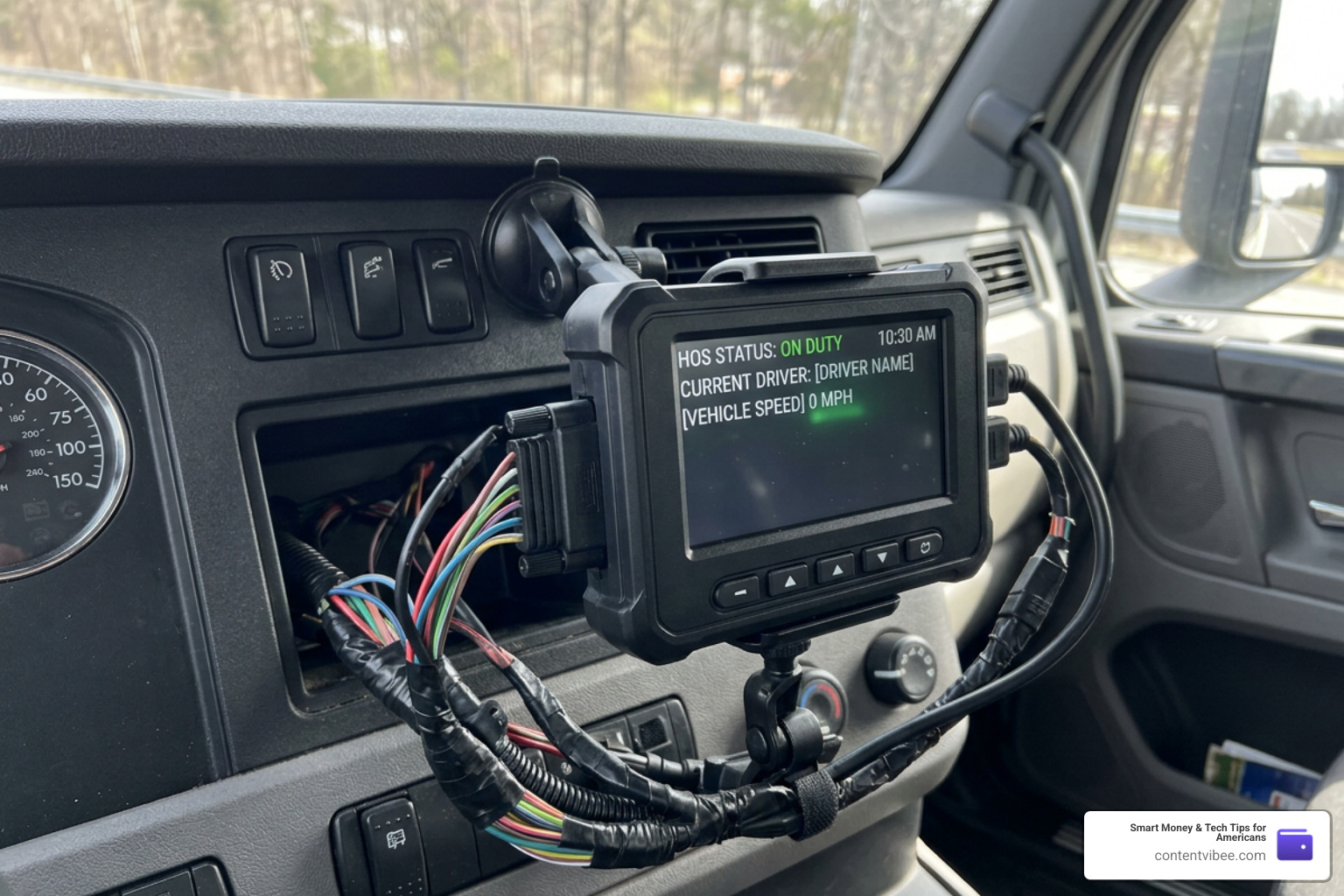
Gone are the days when truck drivers kept paper logs that could easily be altered (historically nicknamed “comic books” by drivers). Today, most commercial trucks must use Electronic Logging Devices (ELDs) that automatically record driving time, engine hours, vehicle movement, and miles driven.
Another critical federal safeguard is the MCS-90 endorsement. This is a special addition required on commercial motor carrier liability policies. It acts as a financial safety net for the public. Even if a trucking company violates its policy terms—or if the insurance company tries to deny coverage based on a policy exclusion—the MCS-90 endorsement forces the insurer to pay the injured victim up to the federally required minimum.
3. Why Immediate Evidence Preservation is Critical
The moments directly following a commercial truck crash are a race against time. While you are focusing on recovering in the hospital, the trucking company is already dispatching its own accident reconstruction team to the scene to protect its financial interests.
To level the playing field, you must take swift action. For a detailed breakdown of how to handle this critical window, check out our ultimate commercial vehicle accident guide.
Securing Black Box Data and Dispatch Logs
Modern commercial trucks are equipped with an Event Data Recorder (EDR) or Electronic Control Module (ECM), commonly known as a “black box.” This device is a goldmine of evidence. It records critical telemetry data in the seconds leading up to a crash, including:
- Speed of the truck
- Braking activity (or lack thereof)
- Throttle position
- Steering angles
- Airbag deployment status
In addition to the black box, your attorney will want to secure the carrier’s dispatch logs, internal communications, and any forward-facing or cabin-facing dashcam footage. This data can prove if a driver was being pressured to meet an unrealistic delivery deadline or if they were distracted at the moment of impact.
Preventing Evidence Destruction with Spoliation Letters
Here is the scary truth: under federal retention rules, trucking companies are only required to keep certain records, like driver logs, for a limited time (often six months). Furthermore, electronic data on black boxes and dashcams can easily be overwritten during the truck’s normal operation if it is put back on the road.
To prevent this, commercial vehicle accident lawyers will immediately send a spoliation letter to the trucking carrier. This is a formal legal notice that demands the preservation of all physical and electronic evidence related to the crash. If the company destroys, alters, or discards evidence after receiving this letter, they can face severe legal penalties in court, including an “adverse inference” instruction where the jury is told to assume the destroyed evidence would have proven the trucking company’s guilt.
4. State-Specific Statutes of Limitations and No-Fault Insurance Rules
While federal regulations govern the trucking industry as a whole, your actual personal injury lawsuit will be filed under state law. This means your case will be heavily influenced by where the accident occurred.
Different states have wildly different rules regarding how long you have to file a claim, how fault is shared, and how insurance payouts are structured. Navigating these regional differences is one of the primary reasons to work with experienced attorneys who understand commercial vehicle accident claims in your specific jurisdiction.
Understanding No-Fault Insurance in New York and New Jersey
If your accident occurs in a “no-fault” state like New York or New Jersey, the initial insurance claims process looks very different. In these states, your own Personal Injury Protection (PIP) coverage pays for your initial medical bills and lost wages, regardless of who caused the accident.
However, because commercial truck accidents often cause catastrophic injuries, victims quickly blow past their PIP limits. To file a lawsuit against the negligent truck driver or carrier, you must meet the state’s “serious injury threshold.” This threshold typically requires proving that the accident resulted in permanent limitation of a body organ, significant disfigurement, bone fractures, or a disability lasting at least 90 days.
Varying Statutes of Limitations Across Key States
The “statute of limitations” is the strict legal deadline you have to file a personal injury lawsuit. If you miss this deadline, you lose your right to pursue compensation forever. These deadlines vary significantly across different states:
- California: 2 years from the date of the accident for personal injury.
- Texas: 2 years from the date of the accident.
- Florida: 2 years from the date of the accident (reduced from 4 years for accidents occurring on or after March 24, 2023).
- Pennsylvania: 2 years from the date of the accident.
- New York: 3 years for personal injury, but only 2 years if it is a wrongful death claim.
- Louisiana: 1 year (known as a “prescriptive period”), which is one of the shortest deadlines in the country.
Because the deadline can be as short as one year, you cannot afford to wait to consult with a legal professional.
5. What to Expect When Hiring Commercial Vehicle Accident Lawyers
Taking legal action against a massive trucking corporation can feel like a classic David vs. Goliath battle. But when you hire the right legal team, you gain an advocate who can handle the heavy lifting while you focus on healing.

To make sure you are choosing the right partner for your case, read our advice on how commercial vehicle accident lawyers can help you and look for the 6 signs your commercial accident lawyer is right for you.
How Contingency Fees and Upfront Costs Work
One of the biggest misconceptions about hiring a lawyer is that it is too expensive. In personal injury law, almost all reputable commercial vehicle accident lawyers work on a contingency fee basis.
This means:
- Your initial consultation is 100% free.
- You pay $0 upfront to start your case.
- The law firm advances all litigation expenses (hiring experts, ordering medical records, filing fees).
- The attorney only gets paid if they successfully recover money for you, typically taking a pre-agreed percentage (usually around 33.3% to 40%) of your final settlement or jury verdict.
- If they don’t win, you owe them nothing for their attorney fees.
Navigating the Commercial Vehicle Accident Lawyers Litigation Timeline
A commercial vehicle lawsuit is a marathon, not a sprint. While some simple car accident claims can resolve in a few months, a complex truck accident case typically takes anywhere from 9 to 18 months for a pre-suit settlement, and 18 to 36 months if the case goes to full litigation.
Here is what that timeline generally looks like:
During the discovery phase, both sides exchange evidence. Your lawyers will work with accident reconstruction specialists, mechanical engineers, and life-care planners to build a bulletproof case showing exactly how the crash happened and how it will impact your financial future.
6. Immediate Steps to Take After a Commercial Vehicle Crash
What you do in the hours and days following a commercial truck accident can make or break your legal claim. Here is a practical checklist to protect your health and your rights.
Prioritizing Medical Care and Scene Documentation
Your very first priority is health and safety. Always call 911 immediately. Even if you feel okay, adrenaline can mask serious internal injuries or concussions. Go to the emergency room or see a doctor as soon as possible to establish an official medical record of your injuries.
If you are physically able to do so safely at the scene:
- Take photos and videos of the vehicle damage, road conditions, skid marks, and traffic signs.
- Photograph the truck’s markings, including the carrier name, logo, license plate, and DOT number on the side of the cab.
- Gather contact details from any eyewitnesses before they leave.
- Keep your comments brief and do not apologize or admit fault to anyone at the scene.
Consulting Commercial Vehicle Accident Lawyers Before Insurance Adjusters
Within hours of the crash, you will likely receive a call from an insurance adjuster representing the trucking company. They may sound friendly, empathetic, and eager to help.
Do not be fooled.
Their primary job is to minimize the amount of money their company has to pay you. They may ask you to give a recorded statement or sign a medical release form. Politely decline and tell them that your lawyer will handle all communications. A recorded statement can be twisted to make it sound like you were at fault, and a broad medical release can be used to dig into your past medical history to claim your injuries were “pre-existing.”
Frequently Asked Questions About Commercial Vehicle Accidents
Who can be held liable in a commercial vehicle accident?
Liability can fall on multiple parties, including the truck driver (for reckless driving or fatigue), the trucking company (for negligent hiring or HOS violations), the cargo loading contractor (for improper loading), the maintenance facility (for faulty repairs), or the manufacturer (for defective parts).
How long do I have to file a lawsuit after a truck accident?
This depends entirely on the state where the accident occurred. It ranges from 1 year in Louisiana to 2 years in states like California, Texas, and Florida, and up to 3 years in New York. If you are filing a wrongful death claim, the deadline is often shorter than a standard personal injury claim.
What damages can I recover in a commercial vehicle accident case?
You can recover economic damages (medical bills, future medical care, lost wages, loss of earning capacity, and property damage) and non-economic damages (pain and suffering, emotional distress, and loss of enjoyment of life). In cases of extreme negligence, you may also be awarded punitive damages.
Conclusion
Recovering from a commercial vehicle accident is physically, emotionally, and financially exhausting. At Smart Money & Tech Tips for Americans, we believe that securing your financial future after a catastrophic event requires both smart planning and strong advocacy.
You do not have to fight massive trucking corporations and their army of insurance adjusters alone. By partnering with dedicated commercial vehicle accident lawyers, you can ensure your rights are protected and secure the maximum compensation you deserve. If you are looking for specific regional legal guidance, check out our ultimate truck accident attorneys San Antonio guide to learn more about navigating the legal landscape.


