


What You Need to Know Before Making Your 403(b) Rollover Move
This 403b rollover guide covers everything you need to move your retirement savings without triggering unnecessary taxes or penalties.
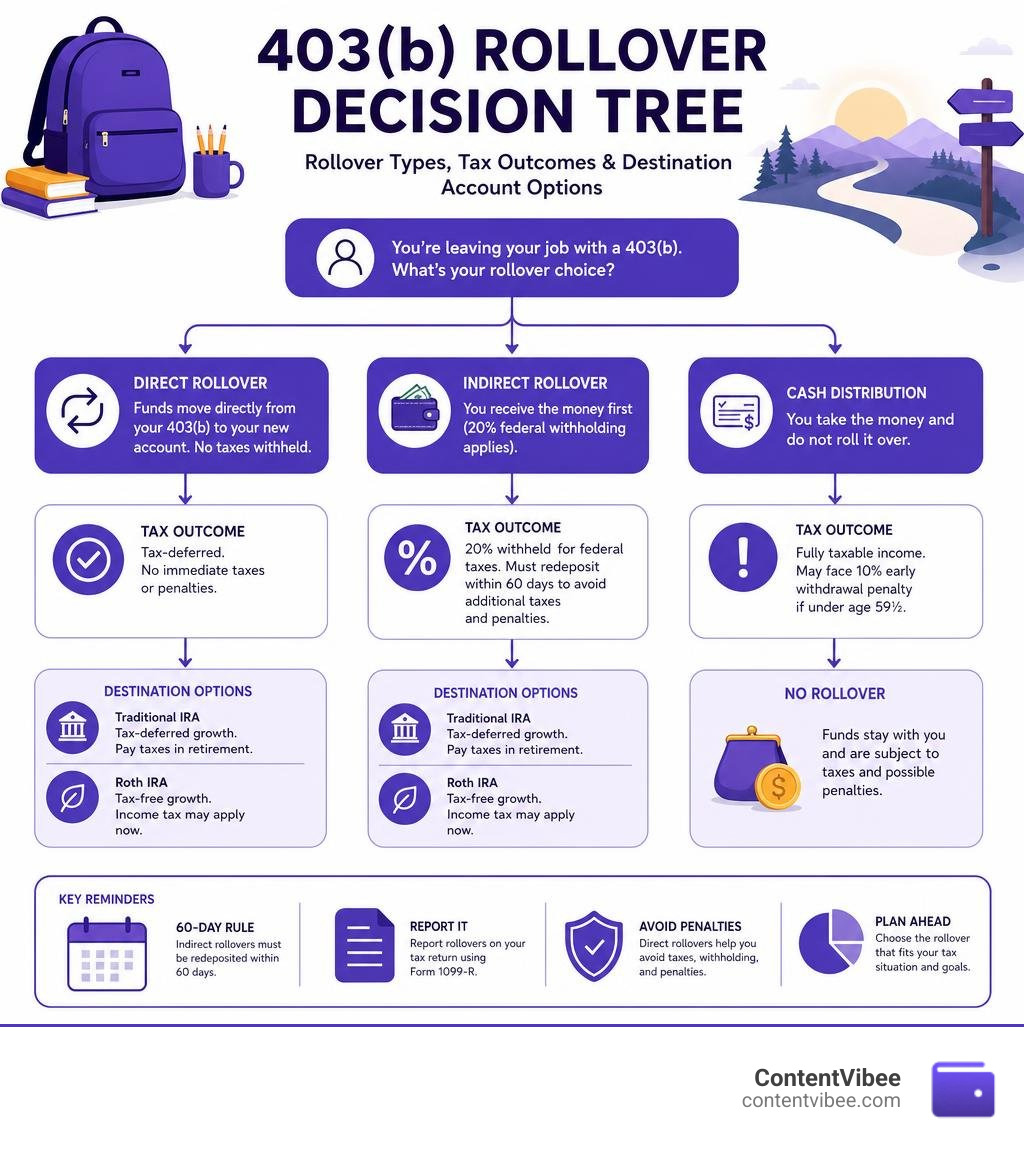
Quick answer — here’s how a 403(b) rollover works:
- Choose your destination account — Traditional IRA (tax-deferred) or Roth IRA (tax-free growth, but you’ll owe income tax now)
- Open the receiving account first — before you contact your plan administrator
- Request a direct rollover — funds go straight from your 403(b) to your new IRA, no withholding, no 60-day clock
- Confirm the deposit — verify the correct balance arrived and direct your investment allocation
- File correctly — report the rollover on your tax return using Form 1099-R, even if no tax is owed
That’s the core process. But the details — tax rules, deadlines, TIAA annuity restrictions, Roth conversions — are where most people get tripped up.
Millions of teachers, nurses, university staff, and nonprofit workers have 403(b) accounts sitting with a former employer. Many don’t touch them for years. The result? Lost statements, outdated account info, limited investment choices, and no clear picture of total retirement savings.
When you leave a job, your 403(b) doesn’t automatically go anywhere. It just sits there — often in a narrow menu of mutual funds or annuities picked by your old employer, sometimes with higher fees than you’d pay elsewhere.
Rolling it over to an IRA can open up a much wider range of investments, lower your costs, and give you more control over your retirement future. But doing it wrong — taking an indirect distribution, missing the 60-day deadline, or mixing up Roth and traditional funds — can trigger a 20% federal withholding and a 10% early withdrawal penalty.
This guide walks you through every step, every scenario, and every mistake to avoid.
Understanding 403(b) Plans vs. 401(k) Plans
To make the most of our 403b rollover guide, we first need to understand what makes a 403(b) plan unique compared to its more famous private-sector cousin, the 401(k).
A 403(b) plan is a tax-advantaged retirement savings plan designed specifically for employees of public schools, universities, religious organizations, and 501(c)(3) nonprofit groups. While they share many characteristics with 401(k) plans, key differences in scale, regulations, and investment structures impact how we manage and roll them over.
| Feature | 403(b) Plan | 401(k) Plan |
|---|---|---|
| Primary Employers | Public schools, universities, hospitals, nonprofits | For-profit companies, private corporations |
| Total Market Assets | ~ $1.26 trillion | Over $8.7 trillion |
| Primary Investments | Mutual funds and insurance annuities | Mutual funds, stocks, ETFs, collective trusts |
| ERISA Status | Often exempt (non-ERISA) if governmental/church | Almost always governed by ERISA |
| 2026 Contribution Limit | $24,500 | $24,500 |
| Special Catch-Up Rules | 15-year service catch-up (up to $3,000/year) | None (standard age-based catch-up only) |
Because 401(k) plans hold over $8.7 trillion in assets compared to an estimated $1.26 trillion in 403(b) plans, private-sector plans often have greater leverage to negotiate lower institutional fees. Furthermore, many 403(b) plans established in the 1980s and 1990s are built entirely around individual annuity contracts with insurance companies, which can carry high administrative costs and surrender charges.
Contribution Limits and Catch-Ups in 2026
For the 2026 tax year, the maximum employee contribution to a 403(b) plan is $24,500 (up from $23,500 in 2025).
Additionally, if you are age 50 or older, you can make a standard catch-up contribution of $8,000 (bringing your total to $32,500). Under the SECURE 2.0 Act, if you are aged 60 to 63 in 2026, you qualify for an enhanced catch-up limit of $11,250, allowing a total contribution of $35,750.
A unique feature of the 403(b) is the “15-year rule.” If you have worked for the same qualified nonprofit or educational employer for at least 15 years, you may be allowed to contribute an additional $3,000 per year (up to a lifetime maximum of $15,000), depending on your plan’s rules.
ERISA vs. Non-ERISA Plans
Many public school and church-sponsored 403(b) plans are exempt from the Employee Retirement Income Security Act (ERISA). While non-ERISA status reduces administrative burdens for employers, it also means these plans lack some of the strict federal fiduciary protections and reporting requirements that govern 401(k) plans. This regulatory exemption is one reason why some non-ERISA 403(b) plans feature complex fee structures and limited investment menus, making a rollover to a self-directed IRA highly attractive.
Why Roll Over Your 403(b) to an IRA?
When we leave an employer, we generally have four choices for our 403(b) balance: leave it where it is, roll it into a new employer’s retirement plan, cash it out (and face heavy taxes and penalties), or roll it into an Individual Retirement Account (IRA).
For most savers, rolling the balance into an IRA is the most financially advantageous move. Here is why:
- Investment Flexibility: Most 403(b) plans restrict you to a narrow menu of mutual funds or annuity products chosen by your former employer. In contrast, a self-directed IRA opened at a major brokerage allows you to invest in virtually any stock, ETF, mutual fund, bond, or real estate asset.
- Lower Fees: IRAs often eliminate the annual administrative fees, recordkeeping charges, and high expense ratios associated with employer-sponsored plans.
- Simplified Management: If you have had multiple jobs, consolidating your retirement accounts into a single IRA makes it much easier to track your asset allocation, calculate future Required Minimum Distributions (RMDs), and manage beneficiary designations.
- Control Over Tax Treatment: You can roll a traditional 403(b) into a Traditional IRA to preserve tax-deferred status, or convert it to a Roth IRA to secure tax-free withdrawals in retirement.
Understanding the Creditor Protection and Age 55 Rule Trade-offs
Before initiating a rollover, we must consider two potential drawbacks:
- Creditor Protection: Funds held in ERISA-governed 403(b) plans enjoy unlimited protection from bankruptcy and civil lawsuits under federal law. IRAs are fully protected in federal bankruptcy up to an inflation-adjusted limit (approximately $1.5 million), but protection from general civil judgments depends entirely on your state’s laws.
- The Age 55 Rule: If you separate from your employer during or after the calendar year you turn 55, the IRS allows you to take penalty-free distributions from that employer’s 403(b) plan. If you roll those funds into an IRA, you lose this privilege; you must wait until age 59½ to access the money penalty-free.
Why You Need a 403b Rollover Guide After Leaving Your Job
Leaving a job is a major life transition. Without a clear plan, old retirement accounts can easily become a “junk drawer” of forgotten assets.
If you leave your money in an old employer’s plan, you may face higher account maintenance fees as a terminated employee. Furthermore, some plans force automatic cash-outs or transfers to default IRAs if your balance is below certain thresholds (typically $5,000 or $7,000).
If you are still employed but unhappy with your current plan, you may be eligible for an in-service distribution. Most plans restrict these until you reach age 59½, but checking your specific plan documents can reveal if you are allowed to move a portion of your active balance to an IRA early.
The Ultimate 403b Rollover Guide: Step-by-Step Process
When moving retirement funds, we must choose between two delivery methods: a direct rollover or an indirect rollover.
We strongly recommend using a direct rollover (also known as a trustee-to-trustee transfer). In a direct rollover, the financial institution holding your 403(b) sends the funds directly to your new IRA custodian. The money never passes through your personal bank account, meaning there are no tax consequences, no withholding, and no risk of missing deadlines.
An indirect rollover is far more dangerous. The plan administrator sends a check made out directly to you. By law, the administrator must withhold 20% of the total balance for federal income taxes. To avoid taxes and penalties, you must deposit 100% of the original gross balance into your new IRA within 60 days. This means you must use your own personal savings to make up for the 20% that was withheld, then wait until you file your taxes to get that withholding back.
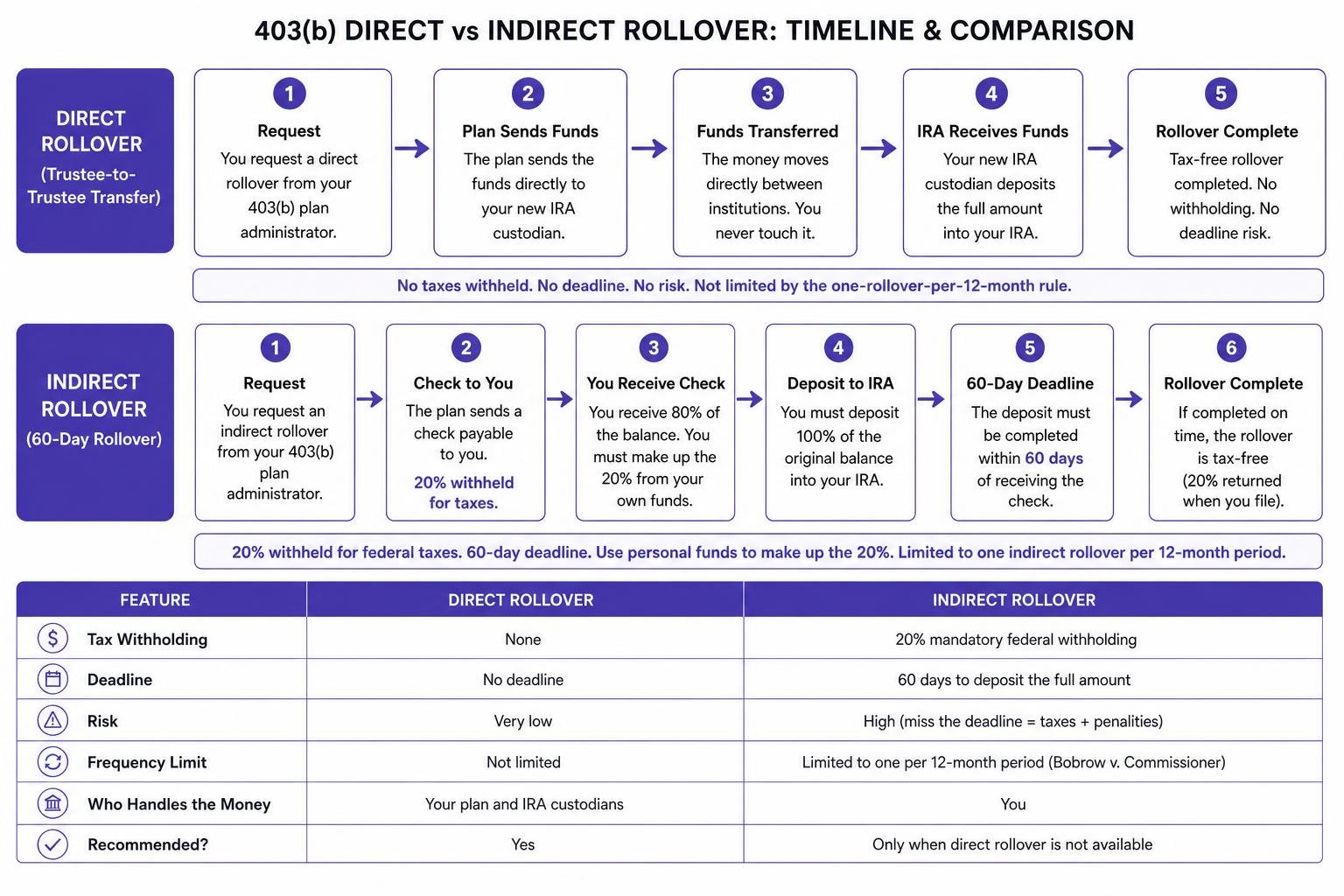
Furthermore, the IRS limits you to only one indirect rollover per 12-month period across all IRAs you own, a rule established by the landmark Bobrow v. Commissioner ruling in 2014. Direct rollovers are not subject to this limit.
To see which accounts can be moved into others under IRS rules, you can consult the official IRS Rollover Chart.
Here is our step-by-step checklist to execute a clean, direct 403(b) rollover:
Step 1: Choose and Open Your Receiving IRA Account
Before contacting your 403(b) provider, you must establish your destination account. Choose a reputable custodian and open the appropriate account type:
- Traditional 403(b) to Traditional IRA: Keeps your savings tax-deferred. No taxes are owed on the transfer.
- Roth 403(b) to Roth IRA: Preserves the tax-free status of your Roth contributions and earnings.
- Traditional 403(b) to Roth IRA (Roth Conversion): You will owe ordinary income taxes on the entire converted amount in the year of the transfer, but all future growth and withdrawals will be tax-free.
Step 2: Request a Direct Transfer from Your Plan Administrator
Contact your former employer’s HR department or the 403(b) plan custodian directly to request distribution paperwork.
When filling out the form, select Direct Rollover and instruct them to make the check payable to your new custodian for your benefit. The standard payee formatting should look like this:
[New Custodian Name] FBO [Your Full Name], Account # [Your New IRA Account Number].
Once submitted, the processing and mailing timeline typically takes 7 to 21 business days.
Step 3: Confirm Deposit and Direct Your Investments
When the check arrives at your new custodian, log into your online portal to confirm the funds have been posted.
Crucial warning: Your rolled-over funds will almost always sit in a default cash position (such as a money market fund) until you manually choose your new investments. Review your asset allocation immediately and buy the index funds, ETFs, or stocks that fit your long-term strategy.
In January of the following year, your old provider will issue a Form 1099-R showing the distribution. Your new custodian will file a Form 5498 confirming the receipt of the rollover. You must report this on your Form 1040, but as long as it was a direct rollover, the taxable amount will be reported as $0.
Special Rollover Scenarios: Expats, TIAA Annuities, and Alternatives
Managing a 403(b) from Abroad (Expats and Non-Resident Aliens)
If you are an expat or a non-resident alien (NRA) who previously worked in the U.S., managing a 403(b) presents unique cross-border tax challenges.
Distributions from a 403(b) are considered U.S.-sourced income. For non-resident aliens, the IRS imposes a mandatory 30% withholding tax on distributions unless a double taxation treaty between the U.S. and your country of residence provides a reduced rate. To claim these treaty benefits, you must submit IRS Form W-8BEN to your plan custodian.
Additionally, many standard U.S. brokerage firms will restrict or freeze accounts if you list a foreign residential address, citing compliance rules under FATCA. Before rolling your 403(b) into an IRA, verify that your chosen custodian permits account management from abroad.
The TIAA Traditional Annuity Lockup
Many educators and university employees hold 403(b) plans with TIAA. If a portion of your balance is held in a TIAA Traditional Annuity, you face a unique liquidity restriction.
By default, TIAA Traditional balances in retirement annuity contracts cannot be withdrawn in a lump sum. Instead, they must be distributed over 84 months (7 years) through a Transfer Systematic Withdrawal (TSW). Alternatively, some contracts allow you to access the funds within 120 days of leaving your job, but you will be charged a 2.5% surrender fee. Be sure to request a surrender value illustration from TIAA before initiating any transfer.
Alternatives to an IRA Rollover
If you do not want to roll your 403(b) into an IRA, you have other paths:
- Roll to a New Employer’s 401(k) or 403(b): If your new employer’s plan has excellent investment options and low fees, this keeps your funds consolidated in an employer plan, maintaining the Age 55 rule and strong federal creditor protection.
- Leave It Alone: If your old plan has a balance over $5,000 (or $7,000, depending on the plan) and features institutional-grade funds with ultra-low fees, keeping it active might be your best choice.
How to Use This 403b Rollover Guide for Self-Directed IRAs
If you want to invest in alternative assets like physical precious metals, real estate, or private equity, you can roll your 403(b) into a specialized Self-Directed IRA (SDIRA).
To do this, you must partner with an SDIRA custodian that permits alternative asset classes. Some savers establish a “Checkbook Control IRA” by forming a dedicated LLC owned entirely by the SDIRA, allowing them to write checks directly for real estate purchases.
However, we must issue a strong warning: SDIRAs require strict adherence to IRS rules. Engaging in a prohibited transaction under IRC Section 4975 — such as renting SDIRA-owned real estate to a family member or paying yourself a management fee — will disqualify the entire account, treating the full balance as a taxable distribution subject to immediate penalties.
Frequently Asked Questions About 403(b) Rollovers
Can I roll over my 403(b) while still employed?
Generally, no. Most employers do not allow “in-service” rollovers of active 403(b) funds. However, exceptions exist. Many plans allow in-service distributions once you reach age 59½, or if you are transferring older, non-matching employer contributions that have fully vested. You must consult your plan’s Summary Plan Description (SPD) to verify your eligibility.
What happens if I miss the 60-day indirect rollover deadline?
If you choose an indirect rollover and fail to deposit 100% of the funds into an eligible retirement account within 60 days, the IRS treats the entire distribution as taxable ordinary income. If you are under age 59½, you will also face a 10% early withdrawal penalty.
Under Revenue Procedure 2016-47, you may qualify for a self-certification waiver if the delay was caused by specific events, such as a financial institution error, a misplaced check, or severe illness.
Will a 403(b) rollover affect my ability to do a backdoor Roth IRA?
Yes, dramatically. If you roll a pre-tax 403(b) into a Traditional IRA, you create a pre-tax IRA balance. When you attempt a backdoor Roth IRA (contributing after-tax money to a Traditional IRA and immediately converting it), the IRS applies the pro-rata rule.
Under this rule, the IRS looks at all of your traditional IRAs combined to determine what percentage of your conversion is taxable. If you have a large rolled-over pre-tax balance, most of your backdoor Roth conversion will be taxed, creating a significant tax complication on Form 8606.
Conclusion
Navigating a 403(b) rollover doesn’t have to be overwhelming. By understanding your options, choosing a direct trustee-to-trustee transfer, and matching your accounts correctly, you can avoid costly tax traps and take complete control of your financial future.
At ContentVibee, we believe that clear, actionable financial education is the foundation of long-term wealth management. Whether you are transitioning to a new job, moving abroad, or preparing for retirement, taking charge of your old accounts is one of the smartest wealth-building moves you can make.
Ready to take control of your retirement savings? Secure your retirement future with ContentVibee and explore our step-by-step wealth management resources today.