


Selling Investment Property Capital Gains Tax and Profit Strategy is the difference between walking away with strong profits — and handing a massive chunk of your gains straight to the IRS.
Here’s the quick answer most investors need:
When you sell an investment property, you may owe:
- Long-term capital gains tax (0%, 15%, or 20%) if held more than one year
- Short-term capital gains tax (10%–37% as ordinary income) if held one year or less
- Depreciation recapture tax at up to 25% on all depreciation previously claimed
- Net Investment Income Tax (NIIT) of 3.8% if your MAGI exceeds $200,000 (single) or $250,000 (married filing jointly)
Combined, these taxes can consume 25–40% of your total gain — before state taxes.
The good news? The U.S. tax code includes legal strategies to reduce, defer, or even eliminate much of that burden — including 1031 exchanges, installment sales, Opportunity Zone investments, and primary residence conversions.
But the single most expensive mistake investors make is waiting until after the sale contract is signed to think about any of this.
This guide walks you through every major tax lever available in 2025 and 2026, with clear numbers and real examples — so you can protect your profits before it’s too late.
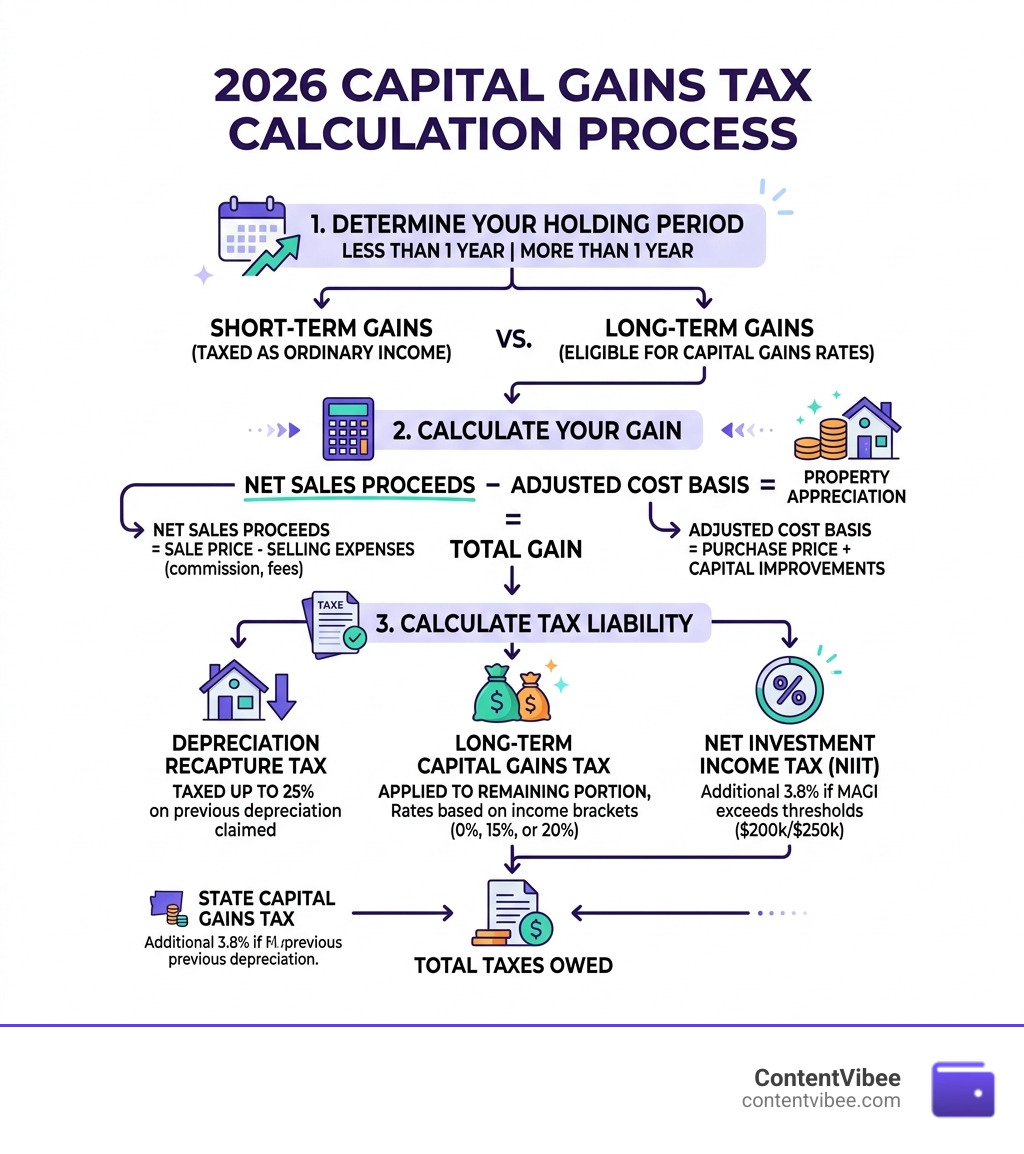
Capital Gains Tax Liability: Calculating Adjusted Cost Basis and Depreciation Recapture Risks
To master your Selling Investment Property Capital Gains Tax and Profit Strategy, we first have to look at the math. The IRS doesn’t just look at your sales price; they look at your “gain,” which is the difference between your net sales proceeds and your adjusted cost basis.

Think of your cost basis as the “starting line.” It begins with what you paid for the property plus closing costs. However, you can move that starting line higher by adding capital improvements. If we spend $50,000 on a new roof and a kitchen remodel, that $50,000 is added to our basis, which directly reduces our taxable gain. We recommend using a Finance Calculator to keep track of these shifts.
According to Scientific research on capital gains mechanics, failing to document these improvements is like leaving money on the table. Every receipt you save for a permanent improvement acts as a shield against future taxes.
Understanding the 25% Depreciation Recapture Trap
Here is where many investors get a nasty surprise. During the years you owned the rental, the IRS allowed (or “deemed”) you to take a depreciation deduction. For residential rentals, this is spread over 27.5 years. While this saves you money on your annual income taxes, the IRS wants that money back when you sell.
This is known as Section 1250 depreciation recapture. Even if you didn’t actually claim the depreciation on your tax returns, the IRS calculates the tax as if you did. This portion of your profit is taxed at a flat federal rate of up to 25%. If you bought a property for $300,000 and claimed $50,000 in depreciation over a decade, you’ll owe tax on that $50,000 at the recapture rate before the standard capital gains rates even kick in.
Selling Investment Property Capital Gains Tax and Profit Strategy: 2026 Recovery Tactics
As we move into 2026, staying ahead of the shifting tax brackets is essential. Your Selling Investment Property Capital Gains Tax and Profit Strategy should be timed to coincide with your overall income levels.
| Filing Status | 0% Rate (Taxable Income) | 15% Rate (Taxable Income) | 20% Rate (Taxable Income) |
|---|---|---|---|
| Single | Up to $49,450 | $49,451 – $545,500 | Over $545,500 |
| Married Filing Jointly | Up to $98,900 | $98,901 – $613,700 | Over $613,700 |
| Head of Household | Up to $66,250 | $66,251 – $579,350 | Over $579,350 |
Note: These 2026 projections are based on Scientific research on 2025/2026 tax thresholds.
If you sell a property in a year where your other income is lower—perhaps during a sabbatical or early retirement—you might push a portion of your gain into the 0% bracket. Conversely, if you sell during a high-earning year, you could be hit with the maximum 20% rate plus the NIIT.
Selling Investment Property Capital Gains Tax and Profit Strategy for High-Net-Worth Portfolios
For our high-earning investors, the Net Investment Income Tax (NIIT) is a persistent hurdle. This is a 3.8% surcharge that applies to investment income, including capital gains from real estate, when your Modified Adjusted Gross Income (MAGI) exceeds $200,000 for singles or $250,000 for married couples. This effectively raises the top federal capital gains rate to 23.8%. Staggering the sale of multiple properties across different tax years is a common tactic we see used to stay below these thresholds.
Implementing a Selling Investment Property Capital Gains Tax and Profit Strategy via Installment Sales
If you don’t need all the cash upfront, an installment sale (reported on Form 6252) can be a brilliant recovery tactic. By acting as the “bank” and allowing the buyer to pay you over several years, you only pay taxes on the portion of the gain you receive each year. This keeps you in lower tax brackets and spreads the tax liability out, though you must be aware of the risk of buyer default.
Real Estate Tax Deferral: 1031 Exchange and Opportunity Zone Protection Options
The most powerful tool in the real estate investor’s arsenal is the 1031 exchange. Named after Section 1031 of the Internal Revenue Code, this allows us to sell an investment property and reinvest the proceeds into a “like-kind” property while deferring 100% of the capital gains and depreciation recapture taxes.

The rules are strict:
- Qualified Intermediary (QI): You cannot touch the money. A QI must hold the funds.
- 45-Day Rule: You have exactly 45 days from the sale to identify up to three potential replacement properties.
- 180-Day Deadline: You must close on the new property within 180 days.
To see how the numbers shake out for your portfolio, use our 1031 Exchange Calculator. According to Scientific research on tax-efficient deferral strategies, a 1031 exchange can be “daisy-chained” throughout your life, potentially eliminating taxes entirely if the property is eventually passed to heirs who receive a step-up in basis.
Delaware Statutory Trusts (DSTs) for Passive Recovery
What if you want to sell your high-maintenance rental but don’t want to be a landlord anymore? A Delaware Statutory Trust (DST) allows you to 1031 exchange your property into fractional ownership of institutional-grade real estate (like a 300-unit apartment complex or a medical office building). This provides passive income without the “tenants, toilets, and trash” headaches, all while maintaining your tax-deferred status.
Opportunity Zones 2.0: Post-2026 Protection
Qualified Opportunity Zones (QOZs) were created to spur investment in distressed communities. Under the “OZ 2.0” updates, investors can reinvest realized capital gains into a Qualified Opportunity Fund (QOF). This allows you to defer the tax on the original gain until the end of 2026 (or until you sell the QOF interest). More importantly, if you hold the QOF investment for at least 10 years, you pay zero capital gains tax on any appreciation of the new investment.
Rental Property Conversion: Section 121 Exclusion and Tax Shielding Strategies
One of the most effective ways to execute a Selling Investment Property Capital Gains Tax and Profit Strategy is to move into your rental. Under Section 121, the IRS allows individuals to exclude up to $250,000 (or $500,000 for married couples) of gain from the sale of a primary residence.
To qualify, you must live in the property as your primary home for at least two of the five years preceding the sale. However, there is a catch: you cannot exclude the portion of the gain related to “non-qualified use” (the time it was a rental after 2009) or the depreciation recapture. Still, as noted in Scientific research on avoiding capital gains via conversion, this can save homeowners tens of thousands of dollars compared to selling it as a straight investment. If you’re wondering if you’re ready for another acquisition after such a move, check out our guide on Can you really buy investment property?.
Financial Loss Mitigation: Tax-Loss Harvesting and Portfolio Rebalancing
If you have a large gain from a property sale, you can offset it by selling other underperforming assets at a loss. This is known as tax-loss harvesting.
If you sell a property for a $100,000 gain but sell stocks or other investments for a $30,000 loss in the same year, your taxable gain drops to $70,000. If your losses exceed your gains, you can use up to $3,000 to offset ordinary income and carry the rest forward to future years. This is a core part of a holistic Selling Investment Property Capital Gains Tax and Profit Strategy. For those managing complex portfolios, understanding Why real estate investment software pricing? matters, as the right tools can help track these moving parts.
Preventing Transactional Fraud: Avoiding Tax Surprises and Legal Pitfalls in 2026
Selling a property is a high-stakes transaction, and 2026 brings new risks. Beyond the IRS, you must navigate state-level taxes, which can vary wildly. Some states, like California or New York, tax capital gains as ordinary income, adding another 10% or more to your bill.
You also need to consider tenant rights. Selling an occupied property requires careful coordination. Some investors use “cash-for-keys” strategies—paying a tenant to vacate early—to sell the home as a vacant property, which often fetches a higher price. However, these payments must be documented correctly for tax purposes. According to Scientific research on planning for property sales, emotional decisions or poor documentation are the leading causes of “tax nightmares” during a sale.
Frequently Asked Questions about Selling Investment Property
How do I calculate my adjusted cost basis for an investment property?
Start with your purchase price plus closing costs (like title insurance and legal fees). Add the cost of major capital improvements (new HVAC, additions, remodeling). Subtract any depreciation you claimed (or were allowed to claim) while owning the property. The resulting number is your adjusted cost basis.
What is the difference between short-term and long-term capital gains in 2026?
Short-term gains apply to properties held for one year or less and are taxed as ordinary income (up to 37%). Long-term gains apply to properties held for more than one year and benefit from reduced rates of 0%, 15%, or 20%, depending on your total taxable income.
Can I avoid depreciation recapture by using a 1031 exchange?
Yes. A 1031 exchange allows you to defer both the capital gains tax and the depreciation recapture tax. However, the “deferred” tax is rolled into the basis of your new property. You don’t eliminate the tax; you simply push it into the future.
Conclusion
At ContentVibee, we believe that every real estate exit should be as profitable as possible. Navigating the Selling Investment Property Capital Gains Tax and Profit Strategy requires a blend of timing, documentation, and the right financial tools.
For those who want to take their strategy to the next level, the Autopilot app offers a fintech solution for the modern investor. Autopilot provides automated portfolio management for self-directed investors, featuring comprehensive fee, risk, and management reviews. By evaluating the cost-worthiness of your investments in real-time, Autopilot helps ensure that your portfolio isn’t just growing, but doing so efficiently.
Whether you are planning a 1031 exchange or converting a rental into your forever home, proactive planning is your best defense against a massive tax bill. For more insights on building your portfolio, explore our Real Estate investment categories.


