


Real estate investment trust high dividend investing is one of the most accessible ways to earn consistent passive income from real estate — without ever buying a property or dealing with tenants.
Here’s a quick snapshot of what you need to know:
| Key Fact | Detail |
|---|---|
| What is a REIT? | A company that owns income-producing real estate and pays shareholders regular dividends |
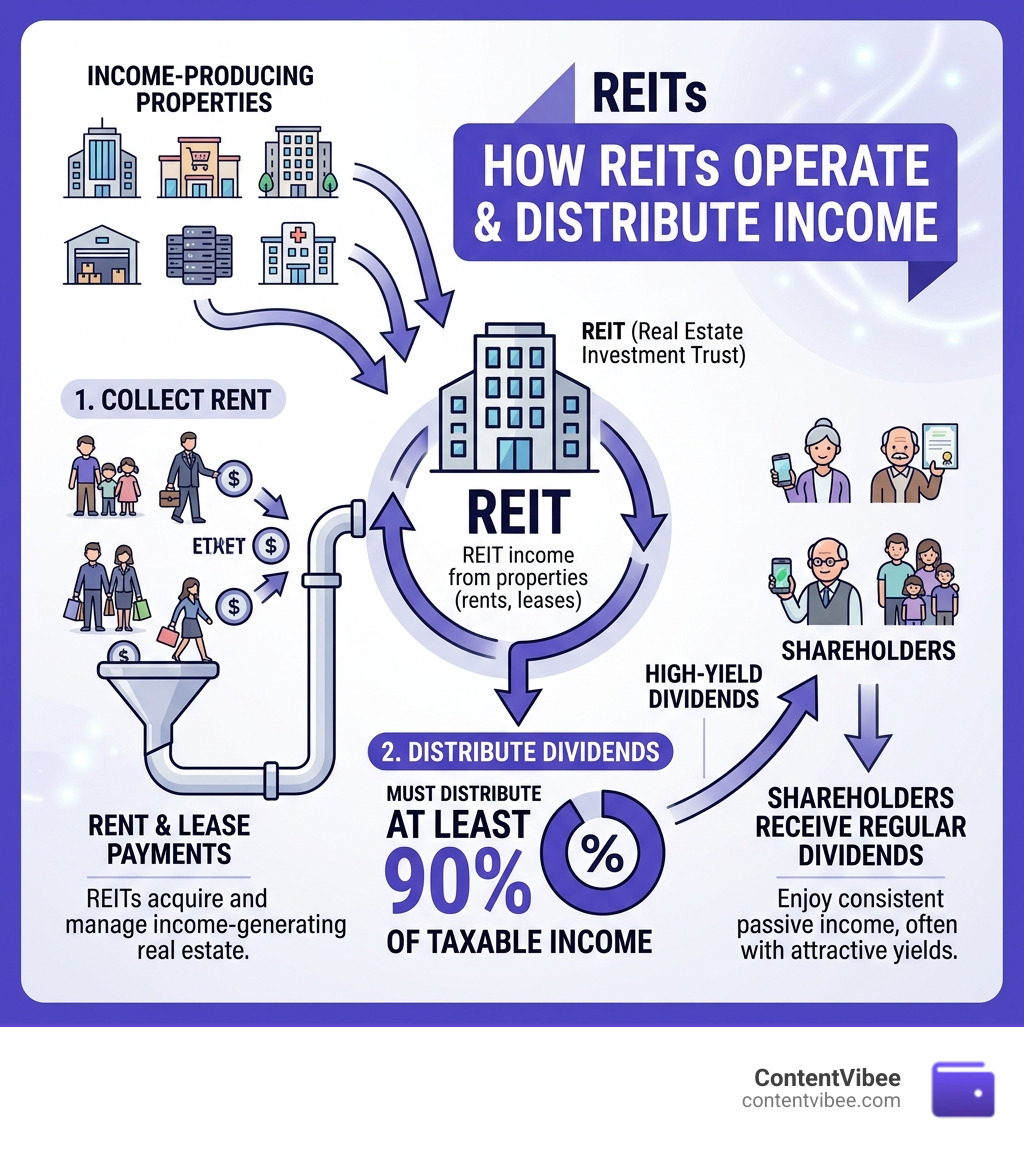
| Why are yields so high? | REITs must distribute at least 90% of taxable income to shareholders annually |
| Typical high-dividend REIT yields | 5% to 21%+ depending on REIT type |
| Who should invest? | Income-focused investors, retirees, and rental property owners seeking lower-hassle returns |
| How to access REITs? | Buy individual REIT stocks, ETFs, or mutual funds through any brokerage account |
Think of a REIT like a landlord you can invest in for as little as the price of one share. The REIT collects rent from office buildings, shopping centers, hospitals, warehouses, or apartment complexes. Then it passes most of that income directly to you as dividends.
That’s the core appeal. No mortgage applications. No maintenance calls. No property managers.
And the numbers are significant. Roughly 170 million Americans already live in households with some REIT exposure — directly or through mutual funds and ETFs. Four out of five financial advisors now use REITs with their clients, primarily for portfolio diversification.
If you own rental properties and feel squeezed by capital gains taxes every time you sell, REITs offer a compelling alternative — or complement — to your existing real estate strategy.
For more real estate income strategies, explore Real Estate Investment Trust High Dividend Strategies.
Evaluating a Real Estate Investment Trust High Dividend Strategy

When we look at building a portfolio, we aren’t just looking for the highest number on the screen. A 20% yield looks great on paper, but if the company’s stock price drops by 30% in the same year, you’ve actually lost money. This is why we focus on a real estate investment trust high dividend strategy that balances immediate income with long-term stability.
The primary benefit of REITs is their low correlation with other assets like tech stocks or gold. When the broad market “zigs,” real estate often “zags.” This provides a much-needed cushion for your portfolio. Historically, REITs have delivered total returns similar to value stocks but with higher, more predictable income streams.
For those of us looking to retire or simply build a “rainy day” fund, income stability is king. Unlike homeownership, which is often an “illiquid consumption good” (meaning it costs you money for maintenance and taxes), a REIT is a liquid, income-generating machine. You can sell your shares on the stock exchange in seconds if you need cash—try doing that with a physical duplex!
For more tips on setting this up, check out How to Build a Passive Income Portfolio.
Identifying Sustainable Real Estate Investment Trust High Dividend Payouts
How do we know if a dividend is “safe”? In REITs, we don’t look at “Net Income” like we do for Apple or Amazon. Instead, we use FFO (Funds From Operations).
FFO adds back depreciation (a non-cash expense) to the earnings, giving us a clearer picture of the actual cash the REIT has available to pay us. We also watch the payout ratio. If a REIT is paying out 99% of its FFO, there’s no room for error if a major tenant leaves. Ideally, we like to see payout ratios in the 70% to 85% range for equity REITs, though mortgage REITs often run much higher.
Occupancy rates are another vital sign. A REIT with 95% occupancy, like Understanding The Matthews Real Estate Investment/, shows that the management knows how to keep their properties filled with paying tenants.
Impact of Interest Rates on Real Estate Investment Trust High Dividend Performance
As we sit here in April 2026, we’ve seen how sensitive REITs are to interest rates. When rates go up, the cost of borrowing for these companies increases, which can eat into the profits available for dividends.
However, the reverse is also true. When rates stabilize or fall, REITs often outperform the broad market. This is because their high yields become more attractive compared to “safe” investments like Treasury bonds. If you are worried about how debt impacts these investments, reading up on Is Yrefy A Smart Investment What You Need To Know/ can provide perspective on how different real estate vehicles handle capital costs and refinancing risks.
Top High-Yield REITs and ETFs for 2026
Choosing the right individual stocks can be daunting. That’s why many of us start with ETFs (Exchange Traded Funds) to get instant diversification across hundreds of properties.
One standout is the Hoya Capital High Dividend Yield ETF (RIET). As of mid-April 2026, it has maintained a remarkably consistent monthly distribution of $0.0855 per share since 2023. It targets the 100 highest-yielding real estate securities in the U.S., focusing on quality and lower leverage.
If you prefer picking individual winners, here is a look at some heavy hitters currently in the market:
| REIT Name | Sector | Forward Yield (April 2026) |
|---|---|---|
| Park Hotels & Resorts | Hotels/Lodging | 9.62% |
| Americold Realty Trust | Cold Storage/Industrial | 8.01% |
| Healthpeak Properties | Healthcare/Life Science | 7.39% |
| Community Healthcare Trust | Healthcare | 11.9% |
| Innovative Industrial Properties | Specialty (Cannabis) | 15.2% |
Park Hotels is particularly interesting right now. Analysts at The Best REITs to Buy | Morningstar have noted it is significantly undervalued, trading at a price-to-fair-value ratio of just 0.53.
To stay ahead of the curve, keep an eye on the Top Real Estate Investment Trends for 2026.
Leading Equity REITs for Monthly Income
For those who like getting a “paycheck” every month, Realty Income (NYSE: O) is the gold standard. Known as “The Monthly Dividend Company,” they have declared 669 consecutive monthly dividends and have increased their payout for 114 consecutive quarters. They own over 15,500 properties under long-term net leases to resilient tenants like 7-Eleven and Walgreens.
Another “Dividend Aristocrat” to consider is NNN REIT. They boast 36 consecutive years of dividend increases and maintain a portfolio that is 97.5% occupied. These companies are the “slow and steady” winners of the real estate world.
Learn more about high-yield structures in our deep dive on Why Agnc Investment Corp Dividend Yield/.
High-Yield Mortgage REITs (mREITs) and Specialty Sectors
If you have a higher risk tolerance, you might look at Mortgage REITs (mREITs). Instead of owning buildings, these companies own property mortgages and mortgage-backed securities. Because they use leverage (borrowed money) to boost returns, their yields can be astronomical.
For example, Ellington Credit Co. (EARN) currently offers a staggering 21.1% yield, while AGNC Investment Corp. sits at 14.2%. However, be warned: these are much more volatile than equity REITs. They are essentially “financial” stocks rather than “property” stocks.

Specialty sectors like cannabis real estate are also booming. Innovative Industrial Properties (IIPR) provides the facilities needed for cannabis cultivation. Because traditional banks often won’t touch this industry, IIPR can command high rents and high yields, currently around 15.2%.
Risks, Fraud Prevention, and Dividend Sustainability
We have to talk about the “elephant in the room”: yield traps. If a REIT is yielding 20%, the market might be pricing in a dividend cut. If the company’s FFO is falling or their debt is maturing at much higher interest rates, that high dividend might disappear tomorrow.
Always check the debt-to-equity ratio. A REIT drowning in debt is a REIT that might eventually stop paying you. For a look at how to evaluate these companies properly, see What You Need To Know About Matthews Real Estate/.
Identity Theft and Brokerage Account Fraud Recovery
As you build your wealth, you become a target. In 2026, digital security is just as important as your investment strategy. If your brokerage account is compromised, your high-dividend portfolio could be liquidated in minutes.
If you discover unauthorized activity, you need to know unauthorized bank transaction how to dispute and recover money USA 2026. Most financial institutions have a 60-day window for you to report fraud to be eligible for full recovery.
Furthermore, identity theft credit report fraud how to fix and protect your score USA is a common hurdle for investors. If someone opens a credit line in your name using your investment details, it can tank your credit score, making it impossible for you to get a mortgage for your own physical real estate projects. Always use two-factor authentication (2FA) on your brokerage accounts and consider a credit freeze if you aren’t actively applying for loans.
Avoiding Fraudulent Real Estate Investment Schemes
Unfortunately, the high yields of REITs attract scammers. We’ve seen an increase in “private REIT” scams that promise 15% returns with “no risk.”
If you become a wire transfer fraud victim what to do and recovery options USA 2026 include contacting your bank’s fraud department immediately to initiate a “SWIFT recall.” However, once the money is gone, it is notoriously hard to get back.
Be especially wary of “Zelle” requests for “exclusive” investment opportunities. If you are a victim, researching zelle fraud transaction recovery steps and bank protection options USA will show that Zelle is often treated like cash; once you authorize the payment, banks are less likely to refund you compared to credit card fraud.
Always stick to publicly traded REITs listed on major exchanges (NYSE or NASDAQ). These companies are required to file regular reports with the SEC, providing transparency that private schemes lack. Check out What Is Matthews Real Estate Investment Services/ for an example of a legitimate, transparent service provider.
Tax Characterization and Capital Gains Strategies
One thing beginners often miss is that not all dividends are taxed the same. Most REIT dividends are taxed as ordinary income, not at the lower “qualified dividend” rate. This is because REITs don’t pay corporate taxes; the tax burden is passed on to you.
However, there is a silver lining: the Section 199A deduction. This often allows you to deduct 20% of your REIT dividend income from your taxes, which is a huge win for income investors.
Sometimes, a portion of your dividend is classified as a Return of Capital (ROC). This isn’t taxed in the year you receive it! Instead, it lowers your “cost basis” in the stock. You only pay taxes on it when you eventually sell the shares.
For a deeper dive into these categories, visit Category/Real Estate/.
Managing Capital Gains Tax on REIT Sales
At ContentVibee, we are obsessed with maximizing your profits by minimizing your tax bill. When you sell a REIT for a profit, you owe capital gains tax.
One of the smartest moves we recommend is holding your real estate investment trust high dividend stocks in a Roth IRA. In a Roth IRA, your dividends grow tax-free, and your withdrawals in retirement are also tax-free. This completely bypasses the ordinary income tax issue.
Be careful of tax-related scams as well. An irs tax refund scam how to claim loss and prevent identity theft USA usually involves someone filing a fake return in your name to steal your “overpayment.” If you are managing a large REIT portfolio, ensure your tax preparer uses secure portals for all documents.
For more actionable tips, see our guide on Real Estate Tax Strategies.
Frequently Asked Questions about REIT Dividends
Why do REITs pay such high dividends compared to other stocks?
It’s actually the law! To maintain their status as a REIT and avoid paying federal corporate income taxes, these companies must distribute at least 90% of their taxable income to shareholders. While a tech company might keep its cash to build new data centers, a REIT is designed to send that cash directly to you.
Are REIT dividends taxed differently than regular stock dividends?
Yes. Most stock dividends (like those from Coca-Cola) are “qualified” and taxed at 0%, 15%, or 20%. REIT dividends are usually “non-qualified” and taxed at your normal income tax rate. However, the 20% pass-through deduction (Section 199A) helps lower that bill significantly.
What is the difference between an equity REIT and a mortgage REIT?
Equity REITs own and operate physical buildings (like an apartment complex). They make money from rent. Mortgage REITs (mREITs) don’t own buildings; they own the debt on those buildings. Equity REITs are generally safer and offer better long-term growth, while mREITs offer much higher immediate yields but with significantly more risk.
Conclusion
Investing in a real estate investment trust high dividend strategy is one of the most powerful ways to build long-term wealth and secure a steady stream of passive income. Whether you choose the stability of “The Monthly Dividend Company” (Realty Income) or the high-octane yields of the mREIT sector, you are participating in the massive U.S. commercial real estate market for the price of a single share.
At ContentVibee, we believe that real estate shouldn’t just be for the ultra-wealthy. By using REITs and smart tax strategies, you can turn your portfolio into a virtual landlord that works for you 24/7.
Ready to take the next step? Explore More info about real estate investment strategies to start maximizing your returns today!


