


Buy investment property no money down financing risk and loan options is one of the most searched topics in real estate right now — and for good reason. Most people assume you need $50,000 or more sitting in a bank account to get started. That’s simply not true.
Here’s a quick answer for those who want it fast:
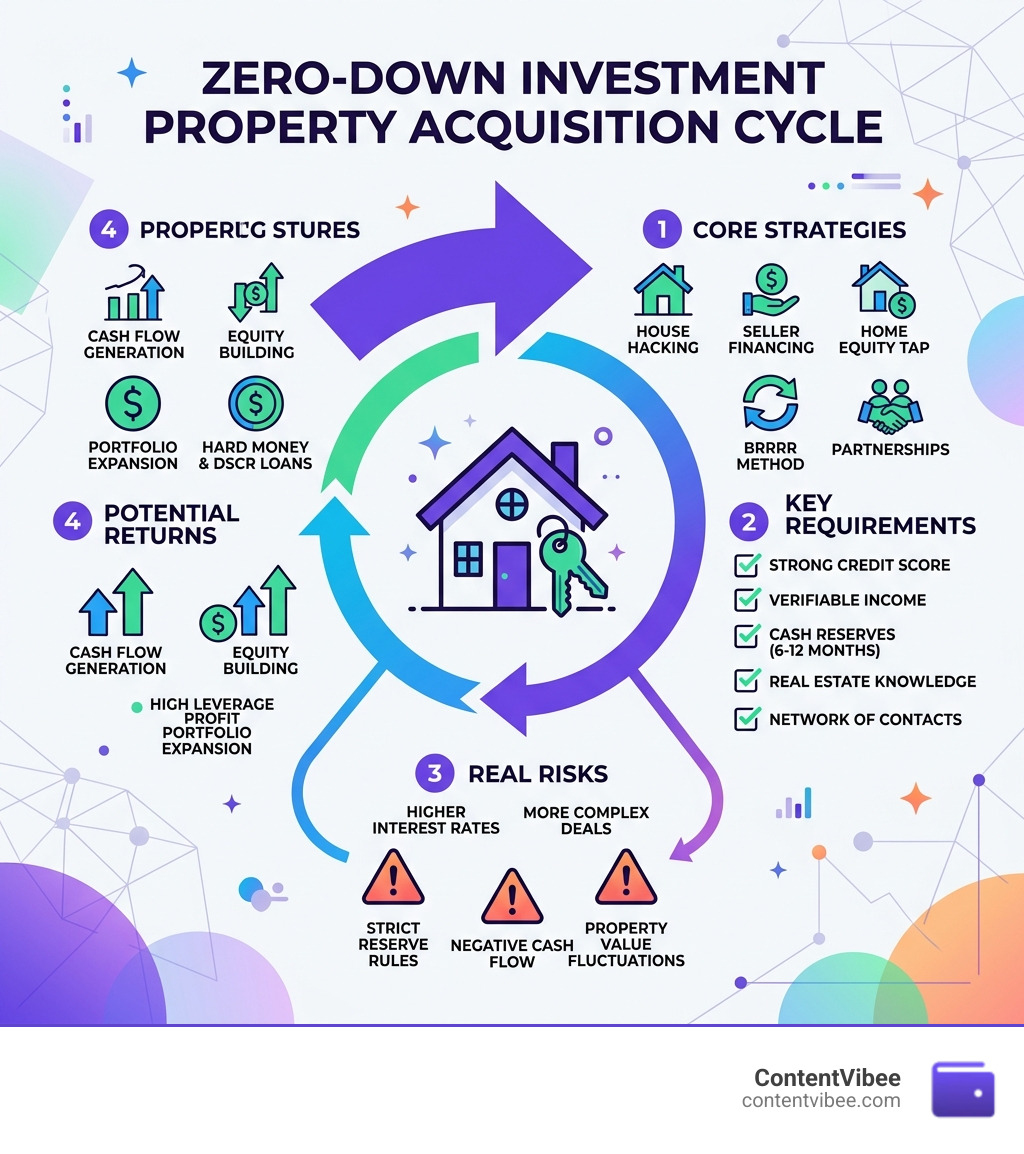
Yes, you can buy an investment property with little or no money down. The most common ways include:
- House hacking – Buy a multifamily property, live in one unit, rent the others
- VA loans – 0% down for eligible veterans, including owner-occupied multifamily
- Seller financing – The property seller acts as your lender
- Home equity (HELOC or cash-out refinance) – Tap equity in your current home
- BRRRR method – Buy, Rehab, Rent, Refinance, Repeat to recycle capital
- Hard money or DSCR loans – Asset-based lending focused on property income
- Partnerships or co-borrowers – Someone else brings the cash, you bring the deal
- Lease options / subject-to deals – Creative structures that bypass traditional lenders
But here’s the honest truth: no-money-down doesn’t mean no-risk. Traditional investment property loans typically require a 15% to 25% down payment. Going around that requirement means accepting trade-offs — higher interest rates, stricter reserve requirements (often 6–12 months of expenses), and more complex deal structures.
This guide breaks down every major strategy, what lenders actually require, the real risks involved, and how to protect yourself from fraud in creative lending situations.
Core Strategies for Buy Investment Property No Money Down Financing Risk and Loan Options
When we talk about entering the real estate market without a massive pile of cash, we are really talking about leverage and creativity. In 2026, the market has evolved, but the fundamentals of Real Estate remain the same: you either use your money, someone else’s money, or the property’s own potential to close the deal.
House Hacking: The Gateway Strategy
House hacking remains the most accessible “low-down” entry point. By purchasing a 2-4 unit multifamily property and living in one unit, you qualify for residential financing instead of commercial or traditional investment loans. This allows you to use an FHA loan (3.5% down) or even a VA loan (0% down). The rental income from the other units often covers the entire mortgage, allowing you to live for free while building equity.
Seller Financing: Bypassing the Banks
In a seller financing deal, the person selling the home acts as the bank. Instead of you getting a mortgage from a traditional lender, you sign a promissory note to the seller. This is particularly effective with “free-and-clear” properties—which represent about one-third of all properties in the USA.
The beauty here is the flexibility. Terms like interest rates (typically 6-8% in 2026) and down payments are entirely negotiable. Some motivated sellers might accept 0% down if you can prove you’ll improve the property’s value. However, you must be aware of Why Real Estate Investment Software Pricing/ when analyzing these deals to ensure the “creative” terms don’t eat your entire cash flow.
VA and USDA Loans
For those who qualify, government-backed loans are the gold standard for zero-down investing.
- VA Loans: If you are a veteran or active-duty service member, you can buy a 1-4 unit property with 0% down, provided you live in one unit. VA loans are also assumable, meaning a future buyer could take over your low-rate loan.
- USDA Loans: While primarily for rural areas, USDA loans cover 97% of U.S. land, including many suburban pockets. They offer 0% down options, though they are strictly for primary residences (so you’d need to “back into” the investment by living there first).
Comparing Your Entry Options
To help you visualize the landscape, we’ve put together a comparison of the most common loan types used for these strategies.
| Loan Type | Typical Down Payment | Key Requirement | Best For |
|---|---|---|---|
| FHA Loan | 3.5% | Owner-occupancy (1 year) | First-time house hackers |
| VA Loan | 0% | Military service | Veterans/Active Duty |
| Conventional | 15-25% | High credit score (740+) | Pure investment (non-owner) |
| Seller Finance | Negotiable (0-10%) | Motivated seller | Distressed or paid-off homes |
| Hard Money | 0-20% | Property value/ARV | Fix-and-flip / BRRRR |
For more insights on how these loans function in specific niches, check out How to Buy an Investment Property With No Money Down.
Using Home Equity for Buy Investment Property No Money Down Financing Risk and Loan Options
If you already own a home, you might be sitting on a gold mine. As of 2026, many American homeowners have significant equity built up. You can tap into this “dead equity” to fund the down payment on an investment property, effectively making it a no-cash-out-of-pocket deal for you.
- HELOC (Home Equity Line of Credit): This works like a credit card secured by your home. You only pay interest on what you use. It’s perfect for the “Buy” and “Rehab” phases of an investment.
- Cash-Out Refinance: You replace your current mortgage with a larger one and take the difference in cash. Most lenders allow you to borrow up to 80% of your home’s value (LTV).
- Home Equity Loan: A lump-sum loan with a fixed interest rate.
While this is a powerful tool, it’s vital to protect your assets. We recommend learning How to protect your home equity from identity theft and fraud to ensure a scammer doesn’t tap into your hard-earned equity before you do.
Navigating Hard Money and DSCR Buy Investment Property No Money Down Financing Risk and Loan Options
When traditional banks say “no” because you have too many loans or a complex income, asset-based lenders step in.
Hard Money Loans These are short-term, high-interest loans (10-18% interest and 2-4 points) used primarily for fix-and-flips. They focus on the After-Repair Value (ARV) rather than your credit score. Some hard money lenders will fund 100% of the purchase and 100% of the renovation if the deal is a “home run” (usually bought at 70% of ARV). For more on professional firms in this space, see What You Need To Know About Matthews Real Estate/.
DSCR (Debt Service Coverage Ratio) Loans These are the darlings of the 2026 investor market. A DSCR loan doesn’t care about your personal income or your DTI (Debt-to-Income) ratio. Instead, it looks at the property’s ability to pay for itself. If the expected rent is 1.25x the mortgage payment (PITI), you’re in. While they usually require a down payment, many investors pair them with a partner or home equity to achieve a zero-down result.
Creative Financing and Partnership Models
If you don’t have the money, you need to find someone who does. This is where partnerships and creative deal-structuring come into play.

The BRRRR Method: The Ultimate Wealth Accelerator
The BRRRR method (Buy, Rehab, Rent, Refinance, Repeat) is the most popular way to build a portfolio with “no” long-term money. You buy a distressed property (often with hard money), renovate it to add value, rent it out, and then do a cash-out refinance. If you’ve added enough value, the new loan pays back your initial investment and the hard money loan, leaving you with a performing asset and your original “seed” money back in your pocket for the next deal.
Equity Sharing and Partnerships
We often see “sweat equity” partnerships where one partner provides the capital (the “Money Partner”) and the other provides the expertise and management (the “Active Partner”). This is a fantastic way to Buy Investment Property No Money Down Financing Risk and Loan Options because your “down payment” is your time and skill.
Subject-To and Lease Options
- Subject-To: You take over the seller’s existing mortgage payments. You don’t “assume” the loan in the traditional sense; the loan stays in the seller’s name, but the deed transfers to you. This is risky due to “due-on-sale” clauses but can secure 2-4% interest rates in a 7% market.
- Lease Options: You lease a property with the option to buy it later at a set price. You can then sublease it to a tenant (often called a “sandwich lease”).
Before diving into these, especially with non-traditional structures, it’s wise to understand Why Mobile Home Investment Roi And Financing Risk/ as similar principles of high-leverage risk apply.
Financial Security and Fraud Prevention in Creative Lending
The world of no-money-down investing often involves private individuals and non-traditional platforms, which increases the risk of financial foul play. In 2026, digital security is just as important as the real estate itself.
Protecting Against Wire and Bank Fraud
When dealing with private money or hard money lenders, you will likely be moving large sums of money. Wire transfer fraud victim what to do and recovery options USA 2026 is a major concern. Always verify wiring instructions over the phone with a known contact. If you suspect an unauthorized bank transaction how to dispute and recover money USA 2026, contact your financial institution immediately; most have a 24-hour window for “recalling” fraudulent wires.
Credit and Identity Protection
In the quest for 100% financing, you’ll be sharing your SSN and financial documents with various lenders. This opens the door to identity theft credit report fraud how to fix and protect your score USA. A single fraudulent inquiry or a new “ghost” account can tank your credit score, making you ineligible for the very loans you’re seeking.
We recommend:
- Freezing your credit reports between loan applications.
- Using a secure portal for document sharing—never email tax returns or bank statements as attachments.
- Regularly auditing your report for SSN misuse in private lending scenarios where a lender might use your info for unauthorized purposes.
If you have already fallen victim, knowing How to report financial fraud and recover lost investment funds is the first step toward reclaiming your investment future.
Understanding Lender Requirements and Risk Mitigation
While we love the idea of zero-down, we have to talk about the “catch.” Lenders aren’t charities; if they aren’t taking your cash, they are taking your creditworthiness or your equity.
The “Hidden” Costs
Even in a “no-money-down” deal, you usually need some cash.
- Closing Costs: Typically 3% to 6% of the purchase price.
- Appraisal Gaps: If the property appraises for less than the purchase price, you must cover the difference in cash.
- Reserves: Most zero-down lenders demand 6-12 months of mortgage-plus-expenses reserves sitting in a liquid account.
Qualifications
To qualify for the best Buy Investment Property No Money Down Financing Risk and Loan Options, lenders typically look for:
- Credit Score: A minimum of 620 is required for most programs, but 740+ is preferred to get rates that don’t kill your cash flow.
- DTI Ratio: For owner-occupied house hacking, your total debt-to-income should be under 45%.
- The 50% Rule: We always advise investors to assume that 50% of their gross rental income will go toward expenses (taxes, insurance, maintenance, vacancies) before the mortgage is even paid. If the math doesn’t work with this rule, the deal is too risky for a no-down structure.
The Risk of Negative Cash Flow
When you finance 100% of a property, your monthly mortgage payment is at its absolute maximum. If the market dips or your vacancy rate rises, you could face negative cash flow—where you are paying out of pocket every month just to keep the property. This is the fastest route to foreclosure.
Frequently Asked Questions about No-Money-Down Investing
Can I buy a rental property with zero down and no closing costs?
It is possible but requires “stacking” strategies. You can use a zero-down loan (like VA) and then negotiate seller concessions where the seller pays your 3-6% closing costs. Alternatively, some lenders offer “lender credits” where they cover closing costs in exchange for a slightly higher interest rate. However, be wary of scams; if someone asks for an upfront “processing fee” via Zelle to secure such a deal, refer to Zelle fraud transaction recovery steps and bank protection options USA via our categories page to see why that’s a red flag.
What is the minimum credit score for a zero-down investment loan?
Generally, you need at least a 620. However, portfolio lenders (local banks that keep their own loans) may be more flexible if the property is a great deal. If your score is low due to errors, see Identity theft credit report fraud how to fix and protect your score USA to learn how to dispute inaccuracies and boost your score quickly.
How does the BRRRR method eliminate the need for long-term cash?
BRRRR works through forced appreciation. By buying a “fixer-upper” at a discount and renovating it, you create equity. When you refinance, the bank lends you 75-80% of the new, higher value. If you did it right, that 75% loan is enough to pay off your original purchase loan and all your renovation costs. You end up owning the property with “zero” of your own money left in the deal.
Conclusion
The path to Buy Investment Property No Money Down Financing Risk and Loan Options is paved with creativity, but it must be reinforced with education and security. Whether you are house hacking your first duplex, leveraging home equity, or partnering with a capital provider, the goal is the same: building a portfolio that works for you.
At ContentVibee, we believe that automated portfolio management and rigorous risk review are the keys to long-term success. Real estate is a powerful tool, but in the digital age of 2026, protecting your identity and your transactions is just as vital as finding the right property.
Ready to dive deeper into smart investing? Check out More info about investment categories to find the strategy that fits your financial goals. The best time to start was yesterday; the second best time is today. Happy investing!


