


What a 403(b) to Roth Conversion Actually Means (And Why It Matters)
A 403b to roth conversion is one of the most powerful moves available to nonprofit and public-sector workers who want tax-free income in retirement — but it comes with real tax consequences you need to understand before you act.
Here’s the quick answer:
What is a 403(b) to Roth conversion?
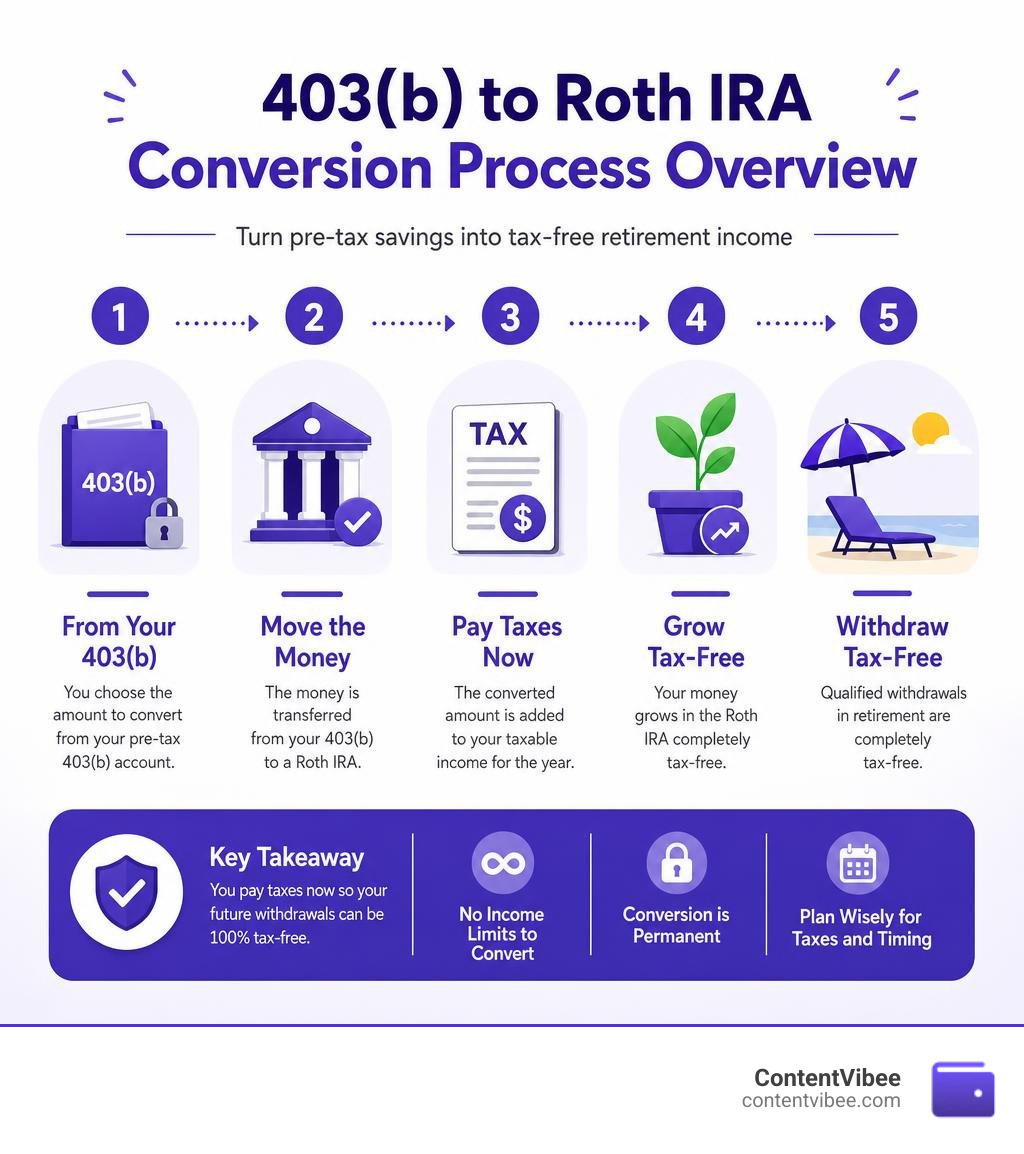
- You move money from your pre-tax 403(b) account into a Roth IRA.
- The transferred amount is added to your taxable income for that year.
- You pay ordinary income tax on it now — in exchange for tax-free withdrawals later.
- There are no income limits to convert (unlike direct Roth IRA contributions).
- The conversion is permanent — it cannot be reversed.
If you work for a public school, hospital, nonprofit, or church, there’s a good chance you have a 403(b) plan sitting in the background, quietly growing — but also quietly building a future tax bill. Every dollar in a traditional 403(b) will eventually be taxed when you withdraw it. That includes required minimum distributions (RMDs), which kick in at age 73 whether you need the money or not.
Converting to a Roth IRA flips that equation. You pay the taxes now, and everything that grows inside the Roth — for the rest of your life — can come out completely tax-free.
The tradeoff? The conversion creates taxable income in the year you do it. A large conversion can push you into a higher tax bracket, trigger Medicare premium surcharges, or increase taxes on your Social Security benefits. Timing and strategy matter enormously.
This guide walks you through everything: eligibility, the step-by-step process, tax implications, and how to decide if a conversion actually makes sense for your situation.
Understanding the Basics of a 403b to Roth Conversion
To understand why a 403b to roth conversion is such a game-changer, we have to look at how Uncle Sam treats our retirement buckets.
Most 403(b) plans are funded with pre-tax dollars. When you contribute, you get a tax break today, but the money is essentially locked in a “tax-deferred” vault. When you retire and start pulling that money out to pay for your beach house or grocery bills, every single dollar is taxed as ordinary income.
A Roth IRA is the exact opposite. You fund it with after-tax dollars. Because you already paid your dues to the IRS on that money, it grows entirely tax-free, and your qualified withdrawals in retirement are 100% tax-free.
When you convert a pre-tax 403(b) to a Roth IRA, you are voluntarily unlocking that pre-tax vault, handing the IRS their cut today, and moving the remaining balance into the tax-free Roth vault.

However, we must keep the IRS’s five-year rule in mind. Any money you convert to a Roth IRA must sit in the account for at least five tax years before you can withdraw the converted earnings tax-free, and you must also be at least age 59½. Each conversion you perform has its own separate five-year clock for penalty-free withdrawals of the converted principal if you are under age 59½.
Traditional 403(b) vs. Roth 403(b) Rules
Some modern employer plans offer a Roth 403(b) option alongside the traditional pre-tax 403(b). It is vital to understand the difference between these two when planning a rollover:
- Traditional 403(b): Contributions are made pre-tax, reducing your current-year adjusted gross income (AGI). All withdrawals of contributions and earnings are taxed at retirement.
- Roth 403(b): Contributions are made with after-tax dollars. The earnings grow tax-free, and qualified distributions are tax-free.
If you already have a Roth 403(b) and decide to roll it over to a Roth IRA, the process is incredibly smooth. Because those contributions were already taxed, moving a Roth 403(b) directly into a Roth IRA triggers zero new income taxes on the converted contributions. You are simply moving after-tax money from a workplace plan to an individual plan.
In-Plan Conversions vs. Rollovers
If you want to move pre-tax 403(b) money into a Roth account, you actually have two distinct paths depending on your plan’s rules and your employment status:
- In-Plan Roth Conversion: If your employer’s plan allows it, you can convert pre-tax funds into a designated Roth account within the same 403(b) plan. You pay income taxes on the converted amount in the year of the conversion, but the money stays inside your workplace plan.
- Rollover to a Roth IRA: This involves moving your 403(b) funds out of the workplace plan entirely and into an individual Roth IRA that you control at a brokerage of your choice.
For more details on how workplace plans handle internal Roth options, you can review the Frequently asked questions pertaining to Roth 403(b), contributions, after-tax contributions, and the Roth in-plan conversion feature.
Eligibility and Triggering Events for Conversions
We often get asked, “Am I actually allowed to convert my 403(b)?”
The great news is that there are no income limits on Roth IRA conversions. Even if your income is too high to make a direct contribution to a Roth IRA (which in 2026 phases out between $153,000 and $168,000 for single filers, and $242,000 to $252,000 for married couples filing jointly), you can still convert a 403(b) to a Roth IRA.
However, the real hurdle isn’t your income; it’s whether you have a triggering event that allows you to move the money out of your employer’s plan.
The IRS generally restricts you from moving money out of an active employer-sponsored retirement plan unless you meet one of the following criteria:
- You reach age 59½.
- You separate from service (you quit, retire, or are laid off).
- The employer terminates the 403(b) plan.
- You become completely disabled.
Can You Convert While Still Employed?
If you are still happily employed with the organization hosting your 403(b), you cannot simply roll your money out to an external Roth IRA on a whim. You must check your specific plan document to see if it allows for in-service distributions.
Many plans allow in-service distributions once you reach age 59½. If your plan allows this, you can roll a portion of your active traditional 403(b) into an external Roth IRA while remaining employed. If your plan does not allow in-service distributions, or if you are under age 59½, you will generally have to wait until you leave your employer to perform an external rollover.
Hardship withdrawals do not qualify as eligible rollover distributions; you cannot use a hardship withdrawal to execute a Roth conversion.
How to Complete a 403b to Roth Conversion
Once you have confirmed you are eligible to move your funds, you must choose how the transfer will physically take place. There are two primary methods: a direct rollover and an indirect rollover.
- Direct Rollover (Trustee-to-Trustee): This is the gold standard. Your 403(b) plan administrator sends the funds directly to your Roth IRA custodian (or hands you a check made out directly to your new custodian “for the benefit of [Your Name]”). No taxes are withheld, and the money never touches your personal bank account.
- Indirect Rollover: The plan administrator cuts a check directly to you. By law, they must withhold 20% for federal income taxes. You then have exactly 60 days to deposit the entire 100% of the original distribution into your Roth IRA. To do this, you must use outside personal cash to make up for the 20% that was withheld. If you fail to deposit the full amount within 60 days, the missing 20% is treated as a taxable distribution and may be subject to a 10% early withdrawal penalty if you are under age 59½.
We strongly advise avoiding indirect rollovers. They are a logistical headache and introduce unnecessary tax risks.
| Feature | Direct Rollover | Indirect Rollover |
|---|---|---|
| Tax Withholding | 0% withheld automatically | 20% mandatory withholding |
| Time Limit | None (completed directly) | Must be completed within 60 days |
| Complexity | Very low | High (must replace withheld funds) |
| Penalty Risk | Virtually none | High if 60-day window is missed |
Step-by-Step Process for a 403b to Roth Conversion
Ready to make the move? Follow our step-by-step checklist to ensure a seamless transition:
- Open a Roth IRA: If you don’t already have one, set up a Roth IRA at a reputable financial institution or brokerage.
- Contact Your 403(b) Plan Administrator: Ask for their rollover paperwork and confirm whether they require any specific forms from your new Roth IRA custodian.
- Request a Direct Rollover: Instruct the administrator to send the funds directly to your Roth IRA custodian. Ensure the check is made payable to the custodian “FBO [Your Name].”
- Keep an Eye Out for Form 1099-R: In January of the year following your conversion, your old 403(b) provider will send you Form 1099-R. This form reports the distribution to both you and the IRS.
- File Your Taxes Correctly: You must report the conversion on your federal income tax return (Form 1040) and attach Form 8606 to track your non-deductible retirement transactions.
Tax Implications of a 403b to Roth Conversion
The tax bill is the single biggest factor to watch out for. When you convert pre-tax 403(b) assets to a Roth IRA, the entire converted amount is treated as ordinary taxable income in the calendar year the conversion occurs.
For example, if you convert a $50,000 traditional 403(b) to a Roth IRA and find yourself in the 22% federal tax bracket, that conversion could generate roughly $11,000 in federal income taxes, plus any applicable state income taxes. If you convert a larger sum, say $200,000, while in the 24% bracket, you could face a tax bill of nearly $48,000.
Crucial Best Practice: Always pay your conversion taxes using non-retirement personal funds (like a standard savings account). If you pay the taxes directly out of the converted 403(b) balance, you will significantly reduce the amount of money left over to compound tax-free. Furthermore, if you are under age 59½, using retirement funds to pay the tax bill is considered an early distribution and will trigger an additional 10% IRS penalty on the amount withheld for taxes.
Is a 403b to Roth Conversion Right for You?
A 403b to roth conversion is highly beneficial for many, but it is not a one-size-fits-all strategy. Deciding whether to convert comes down to comparing your current marginal tax rate with your expected marginal tax rate in retirement.
The Golden Rule of Roth Conversions:
- If you expect your tax bracket to be higher in retirement than it is today, converting now at a lower rate is a brilliant move.
- If you expect your tax bracket to be lower in retirement than it is today, it is usually better to leave your money in a pre-tax account and pay the lower tax rate later.
Let’s look at the primary advantages and disadvantages of making this transition:
Pros:
- Tax-Free Growth & Withdrawals: Your investments grow completely insulated from future tax hikes.
- No Lifetime RMDs: You can leave the money in your Roth IRA to compound for as long as you live.
- Better Estate Planning: Passing a tax-free Roth IRA to your heirs is far superior to leaving them a heavily taxed traditional 403(b).
- Tax Diversification: Having both pre-tax and tax-free buckets allows you to strategically manage your tax brackets in retirement.
Cons:
- Immediate Tax Bill: You must have the liquidity to pay the income taxes in the year of conversion.
- Permanence: Once you convert, you cannot undo it. The IRS banned “recharacterizations” of conversions starting in 2018.
- Potential Bracket Creep: A large conversion can accidentally push you into a higher tax bracket or increase your Medicare Part B premiums (IRMAA surcharges).
Required Minimum Distributions (RMDs) and Conversions
One of the greatest hidden benefits of a Roth IRA is that it frees you from the clutches of Required Minimum Distributions (RMDs).
Under current IRS rules, traditional 403(b) accounts and traditional IRAs require you to start taking mandatory annual distributions at age 73. These distributions are fully taxable and can easily push you into a higher tax bracket, even if you don’t need the income to live on.
Roth IRAs, however, are entirely exempt from RMDs during the lifetime of the original owner. If you convert your 403(b) to a Roth IRA, you can let that money sit and compound tax-free for decades, or leave it entirely intact for your children or spouse.
When a Conversion Makes the Most Financial Sense
A conversion is especially powerful during specific transitional periods of your life.
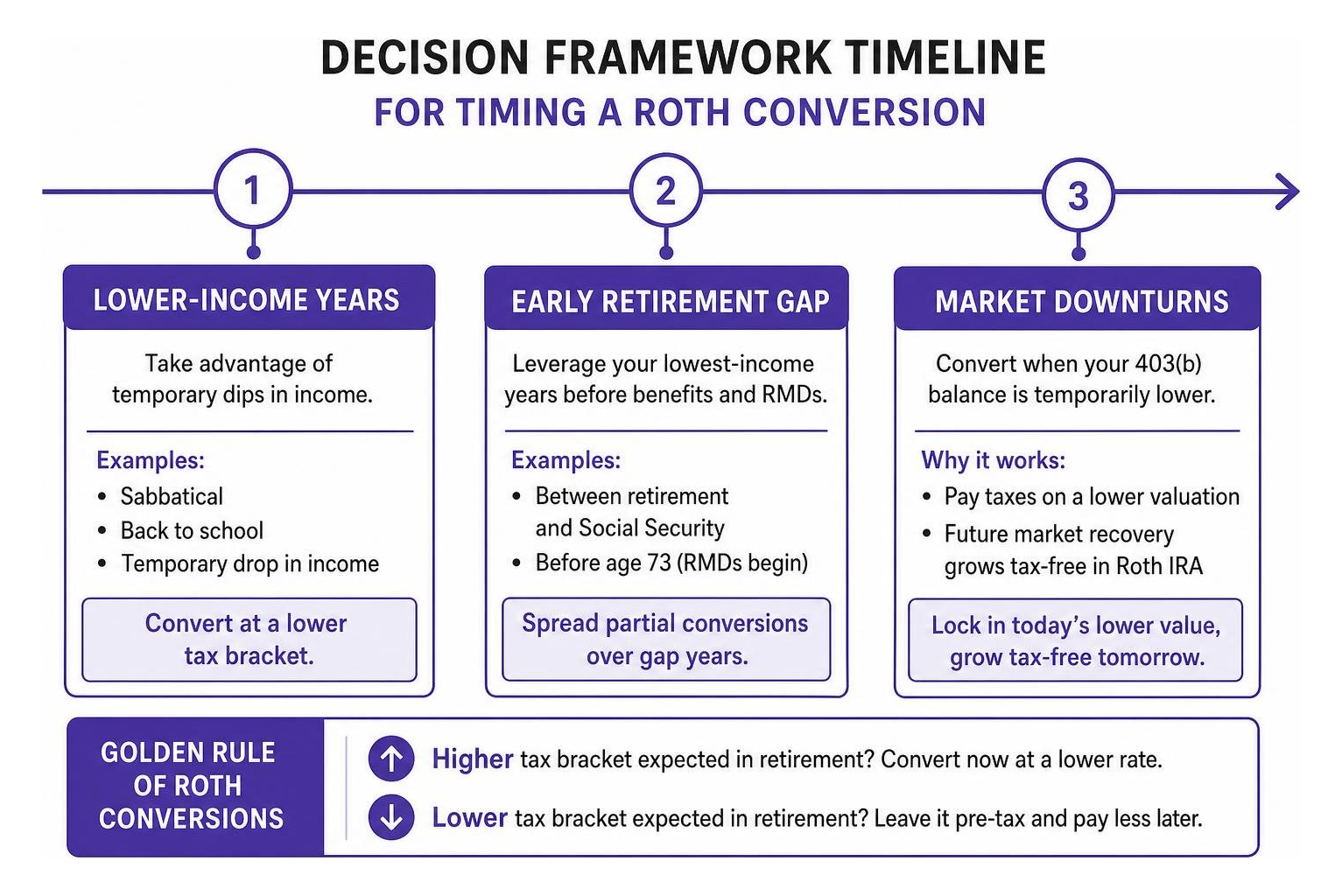
We highly recommend looking for these strategic windows to execute a conversion:
- Lower-Income Years: If you take a sabbatical, go back to school, or experience a temporary drop in income, your tax bracket will be lower, making it the perfect time to convert at a discount.
- Early Retirement Gap: The years between when you stop working full-time and when you begin taking Social Security benefits or RMDs are often your lowest-income years. Spreading out partial Roth conversions over these “gap years” can save you thousands in taxes.
- Market Downturns: If the stock market drops and your 403(b) balance temporarily declines, you can convert your depressed assets to a Roth IRA. You will pay taxes on the lower valuation, and the subsequent market recovery will happen entirely tax-free inside your Roth IRA.
Frequently Asked Questions about 403(b) Conversions
Can I reverse a 403(b) to Roth IRA conversion?
No. Under the Tax Cuts and Jobs Act, the ability to “recharacterize” (or undo) a Roth IRA conversion was permanently eliminated. Once the funds from your 403(b) are converted to a Roth IRA, the decision is final. You cannot change your mind and move them back to a pre-tax account to avoid the tax bill, so make sure you calculate your tax impact carefully before initiating the transfer.
How do SECURE Act 2.0 rules in 2026 affect my 403(b)?
The SECURE Act 2.0 introduced massive changes to retirement plans that are fully active in 2026:
- Mandatory Roth Catch-Ups for High Earners: If your wages from your current employer exceeded $145,000 (indexed to approximately $150,000 for 2026) in the prior calendar year, any catch-up contributions you make to your 403(b) must be made as after-tax Roth contributions.
- Enhanced Catch-Up Limits: If you are aged 60 to 63 in 2026, you can take advantage of an enhanced catch-up limit of $11,250 (compared to the standard age-50+ catch-up of $8,000), allowing you to supercharge your tax-free savings.
Do I have to pay a 10% penalty on the converted amount?
No. As long as you complete a proper rollover (ideally a direct trustee-to-trustee transfer), you will not owe the IRS a 10% early withdrawal penalty on the converted amount, even if you are under age 59½. The IRS treats the move as a rollover, not a standard early distribution. However, any converted earnings must still comply with the five-year rule to avoid penalties on future withdrawals.
Conclusion
Executing a 403b to roth conversion is an exceptional way to take control of your financial destiny, secure tax-free income, and protect your hard-earned savings from future tax hikes. However, because conversions are permanent and trigger immediate tax liabilities, planning your timing and tax payment strategy is absolutely critical.
At ContentVibee, we are dedicated to helping you navigate these complex retirement decisions with clear, actionable advice. If you are coordinating your retirement plan with your partner, taking the time to map out your joint retirement strategy can ensure both of your savings are fully optimized for the future.


