

Uncovering Liability and Commercial Negligence Under Georgia Law
An Atlanta truck accident lawsuit allows injured victims to recover financial compensation by proving commercial negligence, violations of Federal Motor Carrier Safety Regulations (FMCSR), and equipment or maintenance failures against drivers, motor carriers, and corporate third parties. Under Georgia law, filing a successful claim requires securing critical digital telemetry before it is overwritten, establishing corporate liability, and navigating Georgia’s strict two-year statute of limitations and modified comparative fault rules.
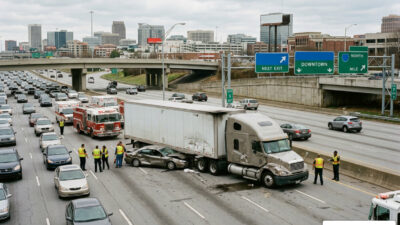
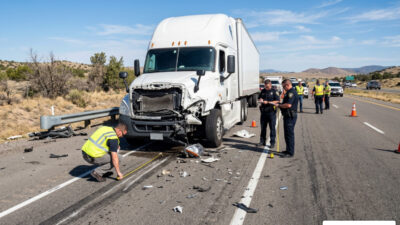
When a commercial semi-truck collides with a standard passenger car, the legal landscape shifts dramatically. Unlike ordinary traffic collisions, where claims typically involve two individual drivers and standard auto insurance, commercial trucking crashes require navigating strict state tort principles, corporate hierarchies, and dense federal safety regulations.
Understanding these structural differences is crucial before initiating legal action:
| Feature | Standard Passenger Car Claim | Commercial Truck Collision Claim |
|---|---|---|
| Typical Insurance Coverage | Georgia minimum liability is just $25,000 per person / $50,000 per incident | Federal regulations mandate $750,000 to $5,000,000+ (most maintain $1M+ policies) |
| Potential Defendants | At-fault motorist; vehicle owner | Driver, motor carrier, freight broker, cargo loaders, mechanics, manufacturers |
| Regulatory Framework | Georgia Rules of the Road (O.C.G.A. Title 40) | Georgia statutes plus Title 49 of the Code of Federal Regulations (FMCSR) |
| Critical Evidence | Police report, basic photos, personal dashcam footage | ECM black box telemetry, Electronic Logging Devices (ELDs), fleet maintenance logs, driver qualification files |
| Investigation Urgency | Standard (evidence remains relatively accessible) | High (digital telemetry and engine logs are routinely overwritten within weeks) |
Under federal law, interstate motor carriers must comply with Federal Motor Carrier Safety Administration (FMCSA) safety rules. These include strict Hours-of-Service (HOS) limits designed to eliminate driver fatigue, mandatory pre-trip safety checks, and strict drug-testing standards. When a carrier forces a driver to meet unrealistic delivery windows—leading to hours-of-service violations—or fails to audit driver logbooks, the carrier faces direct liability for its institutional negligence.
Liability often extends across multiple corporate entities. Freight brokers who hire unsafe motor carriers with poor safety scores, third-party cargo loading contractors who improperly secure heavy freight, and outsourced maintenance facilities that sign off on defective brakes can all share financial responsibility. For an in-depth breakdown of corporate fleet structures, explore our comprehensive Commercial Vehicle Accident Lawyers Guide 2026.
Independent Contractors and Vicarious Liability Disputes
Trucking companies routinely attempt to shield themselves from legal liability by classifying their drivers as independent contractors rather than direct employees. Under Georgia’s common-law doctrine of respondeat superior, an employer is held strictly liable for the negligent actions of its employee occurring within the scope of employment. However, this vicarious liability does not automatically apply to independent contractors unless specific legal criteria are proven.
Georgia courts rely on the “right-to-control” test to determine true employment status. Judges look past written labels in a contract and examine whether the company controls or maintains the right to control the time, manner, and method of the driver’s daily work. If a trucking company dictates the driver’s specific routes, enforces rigid driving schedules, controls truck operations, and requires direct oversight, an employment relationship generally exists regardless of corporate disclaimers.
Commercial arrangements can complicate this analysis. In the federal ruling Lewis v. D. Hays Trucking, Inc. et al, No. 1:2008cv01904 – Document 169 (N.D. Ga. 2010), the court examined whether a major chemical shipper could be held liable for a fatal collision involving an independent logging hauler carrying an 82,520-pound load (exceeding Georgia’s 80,000-pound statutory limit under O.C.G.A. § 32-6-26). The court determined that holding equipment financing liens, advancing loan payments, and enforcing basic delivery specifications were standard commercial agreements rather than proof of immediate control over the driver’s operational methods.
Because motor carriers deploy complex legal structures to avoid accountability, retaining knowledgeable Truck Accident Attorneys Atlanta early in your case is essential to uncover vendor contracts, dispatch records, and corporate lease arrangements.
Mechanical Failures and Equipment Inspection Violations
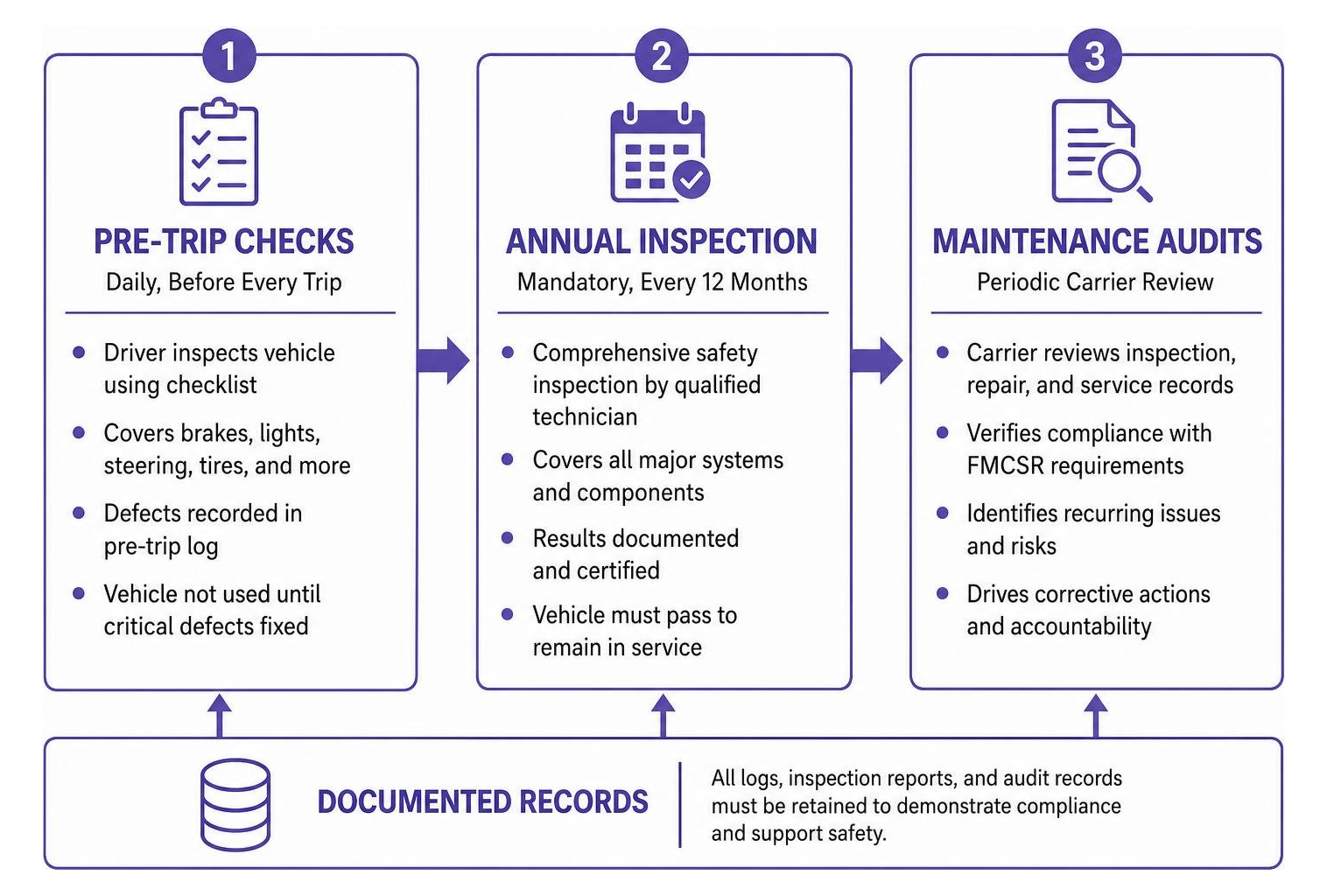
Large commercial rigs operate under immense stress, requiring continuous, rigorous mechanical maintenance. Under the Federal Motor Carrier Safety Regulations (FMCSR), commercial carriers must ensure every vehicle undergoes a thorough, documented annual safety inspection alongside daily pre-trip and post-trip driver evaluations.
When trucking outfits cut corners on maintenance, catastrophic equipment failures occur:
- Defective Braking Systems: Air brake imbalances, worn friction linings, and uncalibrated automatic slack adjusters drastically increase stopping distances on busy highways like I-285.
- Electrical and Lighting Malfunctions: Broken coiled pigtail power cables cut power to trailer tail lights, side markers, and turn indicators, turning an 80,000-pound commercial vehicle into a visual road hazard at night.
- Worn Conspicuity Tape: Federal regulations mandate specific retroreflective sheeting along the sides and rear of commercial trailers to help other drivers see them in low-light conditions.
- Steering and Suspension Failures: Overloaded axles and worn ball joints lead to sudden loss of control at highway speeds.
The immense danger of poor vehicle maintenance was demonstrated in a major $32.5M Settlement Reached After Deadly Trucking Collision | Law.com. In that Gwinnett County wrongful death underride case, plaintiff litigators uncovered through extensive discovery that the tractor-trailer had skipped required annual safety inspections for nearly two years. Crucially, mechanical examinations proved the trailer had a defective electrical pigtail connection and peeling, weathered retroreflective conspicuity tape, which made the trailer virtually invisible during an early morning turn.
Navigating an Atlanta Truck Accident Lawsuit: The 6-Step Civil Litigation Process
Securing maximum compensation through a formal lawsuit follows a structured, multi-phase civil litigation path. Commercial insurers rarely offer full policy limits voluntarily; establishing substantial financial leverage requires methodically building an airtight, trial-ready case.
Here is how the litigation process works under Georgia civil court rules:
- Comprehensive Investigation and Pleadings: Legal counsel conducts an exhaustive review, issues emergency preservation demands, and files a formal Summons and Complaint in the appropriate State or Superior Court, detailing every theory of negligence.
- Service of Process and Responsive Pleadings: Defendants (including the motor carrier, driver, and their commercial insurers under Georgia direct action statutes) are served and generally have 30 days to file their written Answers and preliminary motions.
- Formal Discovery Phase (6 to 12 Months): Both sides exchange written interrogatories, demand internal corporate documents, analyze electronic black box data, and take sworn video depositions of the truck driver, safety directors, and corporate executives.
- Independent Expert Analysis and Reconstruction: Specialized accident reconstructionists, biomechanical engineers, conspicuity specialists, and vocational economists generate formal reports establishing liability, crash mechanics, and lifelong financial losses.
- Court-Ordered Mediation and Settlement Conferences: With full evidence on the table, parties often engage in intensive alternative dispute resolution overseen by an experienced neutral mediator to attempt a pre-trial resolution.
- Pre-Trial Motions and Jury Trial (6 to 24 Months Post-Filing): If the defense refuses to offer a fair settlement, the case proceeds through motions in limine, jury selection, and a full civil trial to pursue a binding verdict.
To understand how each phase impacts your financial recovery, review our step-by-step breakdown on How A Truck Accident Injury Lawsuit Works From Claim To Settlement.
Immediate Evidence Gathering for an Atlanta Truck Accident Lawsuit
Evidence in commercial vehicle collisions begins disappearing the moment the crash scene is cleared. Engine control modules (ECMs) and Electronic Logging Devices (ELDs) automatically overwrite critical crash telemetry within 14 to 30 days, or immediately if the truck is returned to active service.
To prevent the loss or deliberate destruction of crucial crash data, a formal legal spoliation letter must be sent immediately via certified mail to the motor carrier, driver, insurance companies, and repair facilities.
Failing to act promptly gives the trucking company’s rapid-response team an unfair advantage. Discover Why You Need An Atlanta Truck Accident Attorney Immediately to safeguard this fragile technical evidence before it is lost.
Georgia Comparative Fault and Statutory Deadlines
Georgia handles shared responsibility under a modified comparative fault rule governed by O.C.G.A. § 51-12-33. Under this statute, an injured party can recover financial compensation from a negligent defendant as long as the plaintiff’s own responsibility is less than 50 percent.
If you share a portion of the blame, your total financial award is reduced in direct proportion to your assigned percentage of fault:
- Scenario A: A jury awards $2,000,000 in total damages. They find the truck driver 90% at fault for speeding and running a red light, and find you 10% at fault for minor inattention. Your final recoverable compensation is reduced by 10%, resulting in a net award of $1,800,000.
- Scenario B: A jury determines you were 50% or more responsible for the collision. Under Georgia’s 50% bar rule, you are entirely barred from recovering any compensation.
Under O.C.G.A. § 9-3-33, Georgia imposes a strict two-year statute of limitations for personal injury and wrongful death lawsuits, running from the exact date the collision occurred. If you miss this statutory deadline, Georgia courts will dismiss your claim with prejudice, forever barring financial recovery. In cases involving municipal or county-owned commercial vehicles, strict ante-litem notice deadlines apply, requiring written notice within six to twelve months of the crash.
For detailed local guidance on navigating these strict statutory timelines, read our Truck Accident Lawyer Atlanta Guide 2026.
Calculating Damages: Economic Losses, Pain, and Punitive Recovery
Commercial truck collisions often result in life-altering, catastrophic trauma, including traumatic brain injuries (TBI), spinal cord damage, compound fractures, and severe burn injuries. Calculating the full value of your legal claim requires an exhaustive evaluation of both tangible economic losses and non-economic damages.
Victims of commercial trucking negligence in Georgia can pursue three primary categories of legal damages:
- Economic Damages: Quantifiable, out-of-pocket financial losses resulting directly from the collision:
- Past and emergency medical expenses (ambulance transport, trauma surgery, ICU stays).
- Future medical care, physical therapy, home modifications, and lifelong prescription needs.
- Past lost wages and verifiable loss of future earning capacity.
- Property damage, vehicle replacement costs, and out-of-pocket travel expenses for medical appointments.
- Non-Economic Damages: Intangible, human damages that compensate for the physical and emotional impact of the injury:
- Physical pain and suffering endured during and after the collision.
- Severe mental anguish, post-traumatic stress disorder (PTSD), and driving anxiety.
- Permanent physical impairment, physical disfigurement, and loss of bodily function.
- Loss of consortium and diminished enjoyment of life.
- Georgia Wrongful Death Damages: In fatal crashes, surviving family members can claim the “full value of the life of the decedent” from the perspective of the deceased, combining both economic earnings potential and the intangible joy of living.
For detailed benchmarks on valuation methodologies and injury compensation brackets, review our Ultimate Guide To Truck Accident Settlement Amounts.
Factors Affecting an Atlanta Truck Accident Lawsuit Settlement
Unlike standard motorists who carry Georgia’s basic $25,000 liability limits, commercial freight carriers typically hold substantial liability protection. Most interstate motor carriers maintain baseline commercial liability insurance of $1 million to $5 million, frequently backed by multi-layered commercial umbrella policies reaching tens of millions of dollars.
Several pivotal variables directly influence whether your case settles for policy limits or proceeds into prolonged court litigation:
- Severity and Permanence of Injuries: Claims involving permanent disability, chronic pain, or lifelong care generate significantly higher settlement values than soft-tissue injuries.
- Clarity of Corporate Liability: Undisputed evidence of gross safety non-compliance (such as falsified electronic logbooks or missed mechanical inspections) compels insurers to settle quickly to avoid trial risks.
- Insurance Policy Structures and Limits: Uncovering primary, excess, and umbrella policies determines the practical ceiling of financial recovery.
- Insurer Bad-Faith Exposure: If a plaintiff issues a formal time-limited demand for policy limits backed by clear evidence of catastrophic harm, an insurer that unreasonably refuses risks exposure to an excess verdict far beyond the policy face value.
- Structured Settlements vs. Lump Sums: Injured plaintiffs can structure large multi-million dollar payouts through tax-exempt annuities, providing guaranteed, lifetime monthly income alongside upfront funds for ongoing care.
To see how specialized legal practices build settlement leverage against national insurance carriers, read our Truck Accident Law Firm Complete Guide.
Proving Gross Negligence and Evidence Spoliation for Punitive Awards
In Georgia, punitive damages are not awarded simply for ordinary negligence or bad driving. Under O.C.G.A. § 51-12-5.1(b), punitive damages require clear and convincing evidence showing:
“willful misconduct, malice, fraud, wantonness, oppression, or that entire want of care which would raise the presumption of conscious indifference to consequences.”
While Georgia generally caps standard punitive damages at $250,000, this statutory cap is completely removed in cases involving active drug or alcohol impairment, or where the defendant acted with specific intent to cause harm.
Courts take a strict view of these evidentiary thresholds. In the federal legal decision Judge Dismisses Punitive Damages Claim in Northern District of Ga. Trucking Tort | Law.com, the court dismissed claims for punitive damages and statutory attorney fees at the preliminary pleading stage. The court emphasized that plaintiffs cannot rely on generic, boilerplate statutory allegations of reckless conduct; the initial complaint must state specific, verified factual details proving conscious indifference.
Conversely, corporate cover-ups and evidence destruction can result in massive financial exposure. A prime example occurred in Fulton County, reported in ‘Unbelievably Bad Conduct:’ Jury Returns Nearly $100 Million Verdict, Including Punitive Damages and Fees Against Trucking Company | Law.com.
In that wrongful death case, a Fulton County jury returned a verdict of nearly $100 million. The trial team demonstrated that following a fatal I-20 crash, the trucking company engaged in severe evidence spoliation by deleting dashcam footage and removing the victim’s airbag control module. In addition to a $66.25 million compensatory award, the jury assessed statutory punitive damages, more than $1.9 million in costs, and $31.5 million in legal fees directly resulting from the defense’s egregious misconduct and bad faith.
Frequently Asked Questions About Atlanta Truck Accident Claims
What is the deadline to file a semi-truck injury lawsuit in Georgia?
Under O.C.G.A. § 9-3-33, you have exactly two years from the date of the collision to file a personal injury or wrongful death lawsuit. If criminal traffic citations were issued against the truck driver (such as reckless driving or DUI), this two-year statutory clock may be paused (tolled) until the criminal prosecution is fully resolved, up to a maximum statutory tolling extension of six years under O.C.G.A. § 9-3-99. However, you should never delay filing, as physical evidence and electronic records can be lost long before statutory deadlines expire.
How does Georgia’s 50% modified comparative fault rule impact my recovery?
Georgia’s modified comparative negligence statute (O.C.G.A. § 51-12-33) allows you to recover compensation as long as your assigned fault is 49% or less. If a jury finds you 20% responsible for a crash resulting in $1,000,000 in total damages, the court reduces the final payout by 20%, awarding you $800,000. If your fault reaches 50% or higher, you recover nothing. Commercial defense insurers frequently use this rule to shift blame onto passenger vehicle drivers to avoid paying claims.
Who can be named as defendants beyond the commercial truck driver?
Commercial truck accident claims often involve multiple responsible corporate parties:
- The Motor Carrier / Trucking Company: Liable under vicarious liability (respondeat superior) and directly liable for negligent hiring, improper training, and forcing hours-of-service violations.
- Third-Party Freight Shippers and Brokers: Liable for negligently selecting unsafe carriers with poor safety compliance records.
- Cargo Loading Companies: Liable for poorly balanced, unsecured, or overweight freight that shifts during transit and causes rollovers or jackknifes.
- Contract Maintenance and Repair Facilities: Liable for signing off on defective brakes, worn tires, or uninspected safety equipment.
- Commercial Auto Liability Insurers: Under Georgia’s Direct Action Statute, insurers of registered motor carriers can often be named directly as defendants in the lawsuit.
Securing Legal and Financial Protection After a Commercial Collision
Recovering from a catastrophic commercial truck crash requires a dual focus: protecting your physical health while taking decisive legal action to secure your financial future. In addition to proving liability, resolving a major truck claim requires carefully managing hospital subrogation liens, coordinating ERISA health insurance repayments, and structuring multi-million dollar payouts to ensure lifelong financial security.
Navigating corporate defense tactics, federal transportation codes, and multi-layered insurance policies requires experienced legal guidance. If you or a loved one has suffered severe injuries in a commercial vehicle wreck, take immediate action to partner with an experienced commercial vehicle legal team who can demand preservation of digital evidence, establish corporate liability, and fight for the full compensation you deserve.