


Common Causes and High-Risk Corridors for Atlanta Commercial Truck Accidents
Atlanta is one of the busiest freight and logistics hubs in the nation. As a result, our local highways experience extreme commercial traffic density every single day. Corridors like the I-285 perimeter loop, the I-75/I-85 Downtown Connector, Spaghetti Junction (the Tom Moreland Interchange), and Fulton Industrial Boulevard are notorious for heavy truck congestion and complex multi-lane maneuvers.
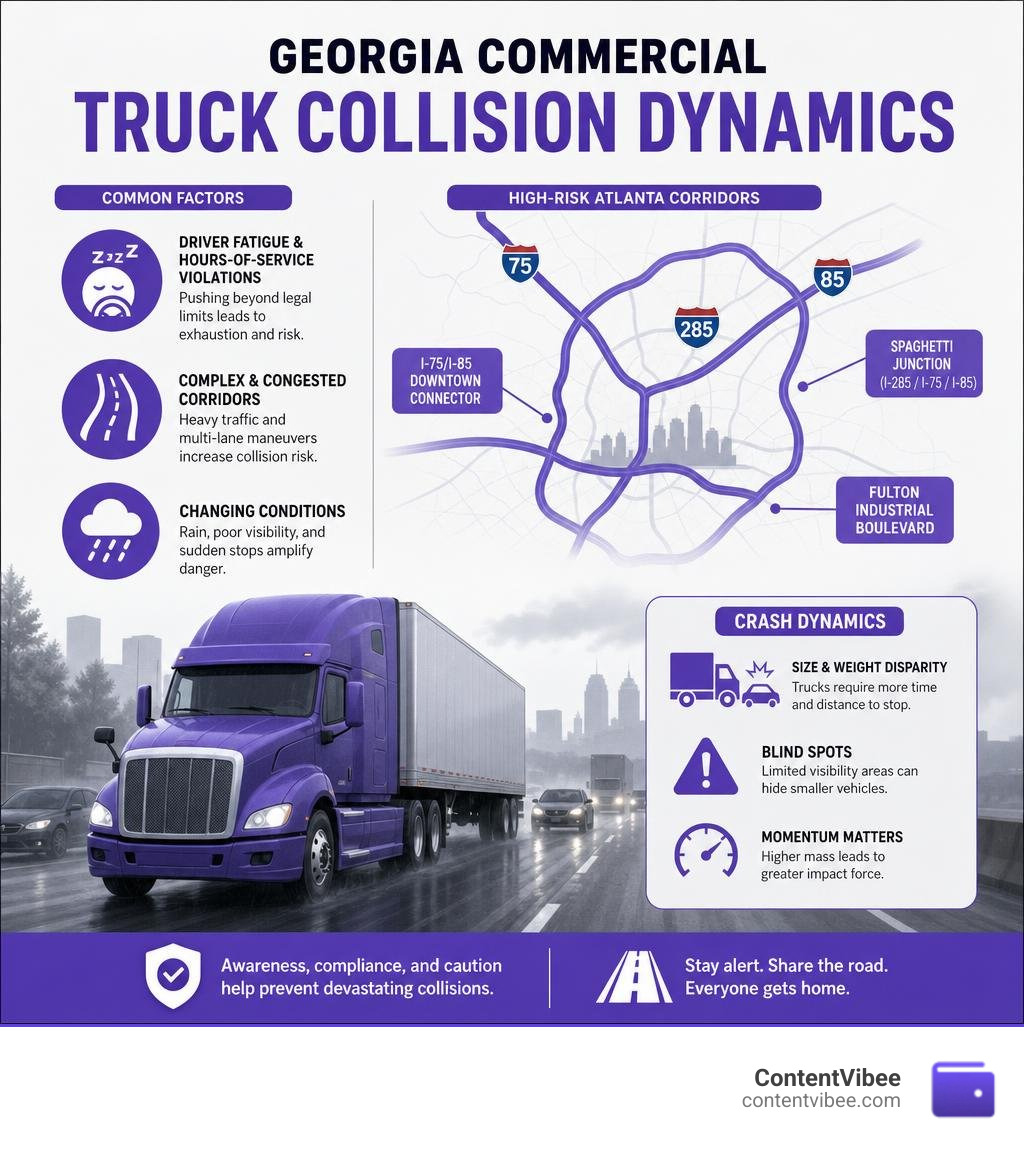
Over the last decade, truck-involved crashes in Georgia have increased by 49%. On average, 180 to 230 fatal truck accidents occur across the state each year, with commercial vehicles accounting for 14% of all motor vehicle fatalities statewide. Georgia also holds 9 of the nation’s top 100 trucking bottlenecks, multiplying the risk of severe collisions.
When we examine why these crashes occur, several recurring causes stand out:
- Driver Fatigue and Hours-of-Service Violations: Under Federal Motor Carrier Safety Administration (FMCSA) rules, commercial drivers are limited to 11 hours of driving within a 14-hour window. However, tight delivery schedules created by shipping operators lead many truckers to push beyond legal limits. Studies show fatigue plays a role in at least 13% of fatal truck crashes. Furthermore, taking over-the-counter or prescription stimulants does not eliminate physical fatigue—it merely masks exhaustion, leading to sudden drops in alertness behind the wheel.
- Distracted Driving: At 65 mph, a commercial truck travels the length of a football field in roughly 5 seconds. Distractions such as mobile phones, GPS adjustments, or dispatch monitors leave drivers unable to react in time to sudden traffic slowdowns on congested highways like I-20 or I-85.
- Improper Cargo Loading and Load Shifts: When cargo loading companies fail to secure weight properly, freight can shift in transit. This imbalance causes jackknife incidents, rollover crashes, or catastrophic cargo spills across multi-lane interstates.
- Mechanical Failures and Deferred Maintenance: Faulty brakes, worn tires, and steering failures frequently trigger high-speed collisions. Retreaded or regrooved tires are strictly prohibited on the front steering wheels of commercial vehicles under federal law, yet improper fleet maintenance remains widespread.
- Adverse Weather and Driving Conditions: Although most truck accidents occur during calm, clear weather, sudden rainstorms on Atlanta interstates significantly increase stopping distances for 80,000-pound vehicles.
How an Atlanta Truck Accident Attorney Proves Driver Negligence
Establishing liability requires gathering technical evidence before it disappears or is overwritten. An experienced atlanta truck accident attorney immediately takes steps to capture critical evidence that proves driver or carrier fault.
To build a solid claim, lawyers rely on key evidentiary sources:
- Black Box (EDR) Telemetry: Event Data Recorders capture pre-collision speed, engine RPM, throttle position, brake application, and seatbelt usage.
- Electronic Logging Device (ELD) Records: Federal law mandates ELDs for modern commercial vehicles. These digital records reveal exact driving hours, rest breaks, and potential hours-of-service violations.
- Driver Qualification Files and Toxicological Reports: Carriers must maintain complete driver files, including drug/alcohol screening results, medical certifications, and historical driving safety records.
- Maintenance and Inspection Logs: Under 49 CFR Part 396, carriers are required to perform routine inspections. Reviewing these logs uncovers whether deferred maintenance contributed to mechanical breakdown.
Attorneys send a formal spoliation of evidence letter to the trucking company immediately after being retained. This legal notice commands the carrier to preserve all physical evidence, black box data, and operational logs, preventing routine data overwrites. For additional guidance, review our overview on evaluating top legal representation.
Determining Multi-Party Liability Under Georgia Trucking Laws
Unlike standard passenger vehicle crashes where fault typically rests on one driver, commercial truck claims routinely involve multiple corporate entities.

Potentially liable parties include:
- The Truck Driver: For reckless driving, fatigue, speeding, distracted driving, or driving under the influence.
- The Motor Carrier (Trucking Company): For forcing unrealistic schedules, ignoring safety protocols, or failing to enforce rest breaks.
- Cargo Loading Contractors: For improperly distributing or securing freight inside trailers.
- Third-Party Maintenance Providers: For failing to properly repair critical mechanical systems like brakes and steering assemblies.
- Vehicle and Parts Manufacturers: For design or manufacturing defects in components like tires or brake lines.
Georgia follows a modified comparative fault rule under O.C.G.A. § 51-12-33. Under this statute, an injured victim can recover financial compensation as long as they are found to be less than 50% at fault for the crash. However, any awarded damages are reduced proportionally by the victim’s percentage of fault. If a court finds an injured party 50% or more at fault, they are completely barred from recovering compensation.
For a deeper look into corporate legal accountability, read our article on Unpacking Corporate Negligence & Liability Laws.
Corporate Negligence vs. Driver Error
To maximize financial recovery, a legal strategy must look beyond individual driver mistakes and examine systemic corporate negligence. Under the doctrine of respondeat superior (vicarious liability), motor carriers are financially responsible for negligent acts committed by their employees during the scope of employment.
However, carriers often try to escape vicarious liability by classifying drivers as independent contractors. Lawyers defeat this defense by bringing direct corporate negligence claims against the motor carrier, including:
- Negligent Hiring: Hiring drivers with history of traffic violations, CDL suspensions, or failed drug screens.
- Negligent Supervision and Retention: Retaining drivers despite known hours-of-service violations or dangerous driving habits.
- Negligent Maintenance: Cutting corners on required vehicle repairs to keep trucks on the road.
Under FMCSA 49 CFR mandates, carriers bear a non-delegable duty to ensure their commercial fleets comply with strict federal safety standards. Establishing a pattern of corporate shortcuts helps build a strong case for maximum recovery.
Catastrophic Injuries and Recoverable Damages in Georgia Claims
Due to the massive force disparity between an 80,000-pound semi-truck and a 4,000-pound passenger vehicle—83% of truck accident fatalities occur among occupants of the smaller vehicle. Survivors often face life-altering physical conditions.
Common catastrophic injuries include:
- Traumatic Brain Injuries (TBIs): Ranging from severe concussions to permanent cognitive and motor function deficits.
- Spinal Cord Injuries and Paralysis: Permanent paraplegia or quadriplegia requiring lifelong medical care.
- Complex Bone Fractures and Amputations: Severe crushing injuries that require orthopedic surgeries or limb amputations.
- Severe Burns and Disfigurement: Caused by post-collision fires or dangerous cargo chemical spills.
Victims of commercial vehicle collisions in Georgia are entitled to seek several categories of damages:
| Damage Category | Examples Included | Primary Objective |
|---|---|---|
| Economic Damages | Emergency ER care, hospital stays, surgeries, lost wages, future loss of earning capacity, physical therapy | Reimbursing quantifiable financial out-of-pocket costs |
| Non-Economic Damages | Physical pain and suffering, emotional distress, loss of enjoyment of life, PTSD, loss of consortium | Compensating for subjective, non-monetary impact |
| Punitive Damages | Imposed under O.C.G.A. § 51-12-5.1 in cases of gross negligence, willful misconduct, or DUI | Punishing egregious bad behavior and deterring future misconduct |
When collisions prove fatal, surviving family members can file a wrongful death claim under Georgia law (O.C.G.A. § 51-4-1 et seq.) to recover the “full value of the life of the deceased,” covering both tangible financial support and intangible life experiences lost. To learn more about financial valuations, check out our guide on understanding semi truck settlement expectations.
Role of an Atlanta Truck Accident Attorney in Maximizing Settlement Values
Insurance carriers representing commercial trucking fleets are well-funded and backed by specialized legal teams. Immediately after a severe crash, insurers often dispatch rapid-response teams to the crash scene to collect evidence and minimize their exposure.
An atlanta truck accident attorney levels the playing field by:
- Conducting an independent investigation of the crash site.
- Hiring expert reconstruction engineers to model physical impact forces.
- Working with medical and vocational economic experts to craft comprehensive life care plans.
- Calculating the full impact of lost future earnings and lifetime medical care needs.
Having a dedicated attorney manage communications prevents insurance adjusters from tricking injured victims into giving recorded statements that could be used to diminish their claim value. Read our practical advice on handling claims without getting steamrolled.
What to Do Immediately After a Crash: Actionable Steps and Georgia Timelines
The steps taken immediately following a commercial truck collision can directly impact both your health and your legal claim.

If you are involved in a commercial truck crash, follow these actionable steps:
- Call 911 Immediately: Ensure law enforcement officers and emergency medical services are dispatched to the scene.
- Seek Immediate Medical Evaluation: Always get checked by medical professionals, even if you feel fine initially. Internal injuries and soft-tissue trauma often present delayed symptoms.
- Document the Crash Scene: If physically able, take photos and video of all damaged vehicles, skid marks, road conditions, traffic signals, and visible physical injuries.
- Gather Witness Contact Details: Collect names, phone numbers, and addresses of any neutral eyewitnesses at the scene.
- Obtain the Police Incident Report: Request a copy of the official Georgia Uniform Motor Vehicle Accident Report once finalized.
- Avoid Making Statements to Insurance Adjusters: Do not give recorded statements, sign paperwork, or accept quick settlement offers before speaking with a qualified lawyer.
Under Georgia statute O.C.G.A. § 9-3-33, the general statute of limitations for personal injury and wrongful death lawsuits is two years from the date of the accident. Missing this filing window permanently forfeits your legal right to pursue financial recovery.
While certain tolling exceptions apply (such as claims involving minors or incapacitated individuals), waiting is dangerous. Trucking companies are legally allowed to destroy or overwrite electronic driver logs after six months unless served with a formal preservation demand.
For a complete breakdown of the legal timeline, refer to our step-by-step guide on how a truck accident injury lawsuit works from claim to settlement.
Contingency Fees and How Long Resolution Takes
A common concern among crash victims is how much legal representation costs. Most personal injury attorneys operate on a contingency fee basis. Under this fee structure:
- You pay zero upfront costs or hourly fees out of pocket.
- Case expenses (such as expert witness fees, court filing costs, and record retrieval) are covered by the law firm during litigation.
- Attorney fees are calculated as an agreed-upon percentage of the final settlement or court verdict. If your attorney does not recover compensation for you, you owe no attorney fees.
The timeline for resolving a truck accident claim varies based on case complexity, injury severity, and insurer cooperation:
Building a strong, trial-ready case ensures you do not have to accept lowball insurance offers out of desperation. For more details on filing procedures, read everything you need to know about filing a semi truck claim.
How an Atlanta Truck Accident Attorney Protects Your Legal Rights
Navigating a commercial truck collision claim on your own places you at a disadvantage against commercial insurance carriers. Motor carriers and their corporate legal teams work aggressively to shield themselves from financial accountability.

An experienced atlanta truck accident attorney serves as your legal advocate by:
- Issuing Preservation Letters: Immediately blocking the deletion of Black Box telemetry, ELD records, and dashcam footage.
- Handling All Insurer Communications: Shielding you from high-pressure settlement tactics and recorded interviews designed to shift fault.
- Uncovering All Available Insurance Policies: Finding primary, excess, and umbrella commercial coverage policies across multiple liable parties.
- Preparing Every Case for Trial: Showing insurance adjusters that you are prepared to present your case before a jury, which encourages fair out-of-court settlement offers.
When you need trusted assistance after a major accident, review our detailed resource on finding reliable legal help when needed.
Frequently Asked Questions About Commercial Truck Accidents
What evidence is most critical to secure immediately after an Atlanta truck crash?
The most critical evidence includes onboard Event Data Recorder (black box) telemetry, Electronic Logging Device (ELD) hours-of-service records, driver qualification files, vehicle maintenance/inspection logs, and the official Georgia Uniform Motor Vehicle Accident Report. Because carriers routinely overwrite digital data, sending an immediate spoliation demand letter is vital to preserve these records.
How does Georgia’s modified comparative fault rule affect my compensation?
Under Georgia law (O.C.G.A. § 51-12-33), you can recover financial damages as long as your share of fault is under 50%. Your overall compensation is reduced by your fault percentage (for example, a $100,000 award is reduced to $80,000 if you are found 20% at fault). If you are found 50% or more responsible, you cannot recover any damages.
What is the statute of limitations for filing a truck lawsuit in Georgia?
Under O.C.G.A. § 9-3-33, you generally have two years from the date of the crash or wrongful death to file a personal injury lawsuit in Georgia. Limited tolling exceptions exist for claims involving minor children or legally incapacitated victims, but taking legal action immediately is always recommended to ensure critical corporate evidence is preserved.
Conclusion
A collision with an 80,000-pound commercial vehicle can turn your life upside down in seconds. Navigating severe injuries, costly medical treatment, and aggressive insurance tactics requires strong legal support. Retaining a dedicated atlanta truck accident attorney helps ensure your rights are protected while you focus on recovering your health and peace of mind.
At ContentVibee, we empower everyday Americans by breaking down complex legal processes into practical, actionable guides. If you or a loved one has been injured in a commercial vehicle collision, do not wait until vital corporate evidence is lost or legal deadlines pass. Take control of your financial recovery today. Explore ContentVibee’s Comprehensive Atlanta Truck Accident Guide for 2026 to learn more about protecting your rights and securing the legal assistance you deserve.


