
Why You Need a Specialized Truck Accident Attorney Atlanta GA
When an 80,000-pound tractor-trailer collides with a standard 4,000-pound passenger car, the physical and legal aftermath looks nothing like a typical fender-bender. Handling commercial claims requires understanding intricate industry practices, multi-layered corporate structures, and massive insurance policies. Knowing why you need an Atlanta truck accident attorney immediately comes down to how fast motor carriers react: major transportation companies deploy rapid-response teams within hours of an impact to control the scene and shield themselves from liability.
A standard auto accident lawyer might simply request a police report and exchange insurance cards. In contrast, seasoned truck accident attorneys in Atlanta immediately send formal spoliation letters. These legal notices require trucking outfits to preserve crucial evidence:
- Electronic Control Module (ECM or “black box”) telemetry
- Electronic Logging Device (ELD) hours-of-service data
- Driver Qualification Files (DQFs) and hiring background checks
- Fleet inspection and brake maintenance records
- Post-crash alcohol and drug screening results
Without swift legal intervention, ECM telematics can be overwritten within days or lost during standard vehicle repairs, leaving victims without vital evidence.
Essential Qualities to Look For in a Truck Accident Attorney Atlanta GA
Finding top counsel requires looking beyond highway billboard slogans. When discovering how to evaluate the best truck accident attorney Atlanta has to offer, several key capabilities stand out:
- A Proven Trial Record: Motor carrier insurance adjusters track which law firms settle for modest sums and which take cases before Fulton or DeKalb County juries. Litigators with courtroom results command higher settlement values.
- Dedicated Financial Resources: Truck litigation is capital-intensive. Credible firms front tens of thousands of dollars to retain certified accident reconstructionists, trucking safety specialists, and forensic economists.
- Contingency Fee Transparency: Reputable advocates work on contingency, meaning you pay zero upfront fees and legal costs come out of a successful settlement or verdict.
- Deposition Savvy: An attorney must know how to cross-examine corporate safety directors, expose cut corners, and uncover logbook discrepancies.
Regulatory Knowledge of Federal and Georgia Trucking Laws
Federal Motor Carrier Safety Regulations (FMCSR), codified under Title 49 of the Code of Federal Regulations (49 C.F.R.), set rigorous safety requirements for all commercial motor vehicles exceeding 10,01 pounds. Georgia has adopted these federal guidelines for both interstate and intrastate transit.
Understanding these rules exposes actionable safety breaches:
- Hours of Service (49 C.F.R. Part 395): Drivers are strictly limited to an 11-hour driving window within a 14-hour workday, followed by 10 consecutive hours off-duty.
- Driver Qualification (49 C.F.R. Part 391): Motor carriers must review driving histories, confirm valid commercial driver’s licenses (CDLs), and maintain medical examiner certifications.
- Inspection, Repair, and Maintenance (49 C.F.R. Part 396): Systematic vehicle checks, including daily pre-trip and post-trip inspections, are mandatory to identify worn brake linings, steering issues, and bad tires.
Critical Factors in Atlanta Big Rig Wrecks and High-Risk Corridors
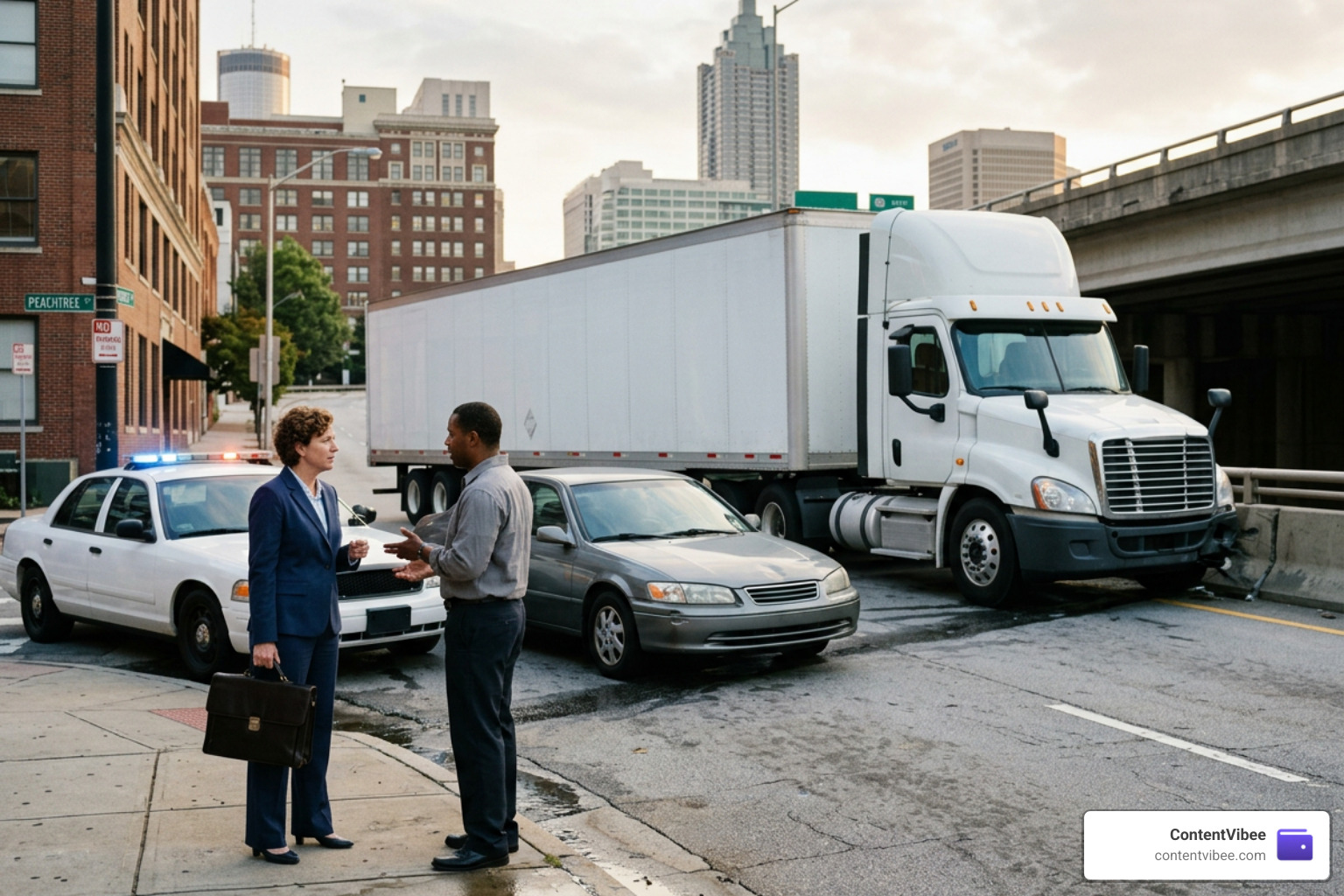
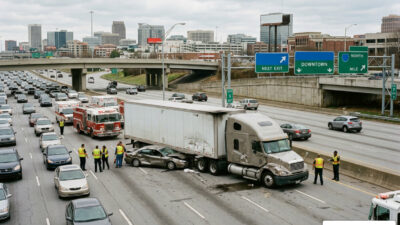
Atlanta serves as the logistics hub of the Southeast, funneling thousands of long-haul rigs through dense metro lanes every day. Specific bottlenecks create frequent hazard zones:
- The Downtown Connector (I-75/I-85): Intense lane changes, limited visibility, and heavy congestion regularly produce severe rear-end and sideswipe collisions.
- The I-285 Perimeter Loop: The primary route for bypassing city center traffic frequently sees jackknife accidents, underride crashes, and rollover wrecks near major industrial hubs.
- The I-20 Interchange Corridors: East-west logistics traffic across Fulton and DeKalb counties often encounters high-speed merges and sudden slowdowns.
Across the United States, more than 4,800 people die and another 100,000 suffer injuries in commercial truck crashes each year. When commercial trucks skip mandatory rest breaks or speed to meet unrealistic delivery deadlines, ordinary motorists face extreme hazards.
Determining Multi-Party Liability Beyond the Truck Driver
Unlike typical passenger vehicle claims, liability in a semi-truck crash often extends across several commercial entities:
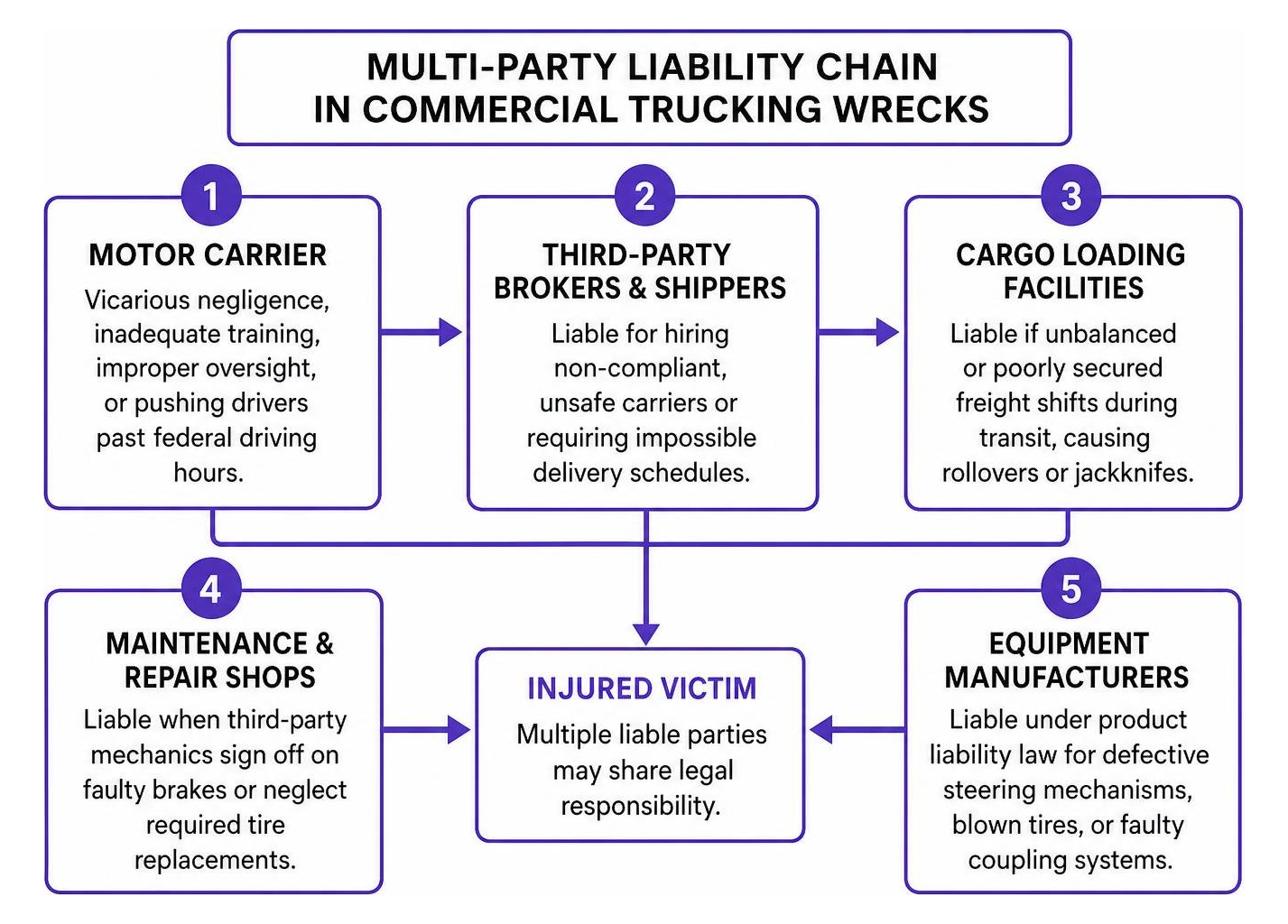
- The Motor Carrier: Liable for vicarious negligence, inadequate driver training, improper oversight, or pushing drivers past federal driving hours.
- Third-Party Logistics Brokers and Shippers: Liable for hiring non-compliant, unsafe carriers or requiring impossible delivery schedules.
- Cargo Loading Facilities: Liable if unbalanced or poorly secured freight shifts during transit, causing rollovers or jackknifes.
- Maintenance and Repair Shops: Liable when third-party mechanics sign off on faulty brakes or neglect required tire replacements.
- Equipment Manufacturers: Liable under product liability law for defective steering mechanisms, blown tires, or faulty coupling systems.
The differences between standard auto and trucking claims are substantial, as shown in our truck accident law firm complete guide:
| Feature | Standard Passenger Car Accident | Commercial Truck Accident |
|---|---|---|
| Typical Insurance Coverage | $25,000 to $100,000 policy limits | $750,000 to $5,000,000+ commercial umbrella policies |
| Governing Legal Framework | State traffic statutes (Georgia Code) | FMCSR (49 C.F.R.) and Georgia Transportation Laws |
| Liable Parties Involved | Usually just the at-fault driver | Driver, carrier, freight broker, cargo loader, mechanic |
| Evidentiary Sources | Police report, photos, witness statements | ECM black box, ELDs, DQFs, dispatch logs, telematics |
| Defense Strategy | Insurance claims adjuster | Rapid-response defense attorneys, scene investigators |
Severe Injuries and Calculating Maximum Settlement Value
Because fully loaded big rigs carry enormous momentum, collisions often result in catastrophic, permanent harm. Common injuries include:
- Traumatic Brain Injuries (TBIs): Skull fractures, diffuse axonal injuries, and severe cognitive impairments.
- Spinal Cord Trauma: Herniated discs, fractured vertebrae, and permanent paralysis (paraplegia or quadriplegia).
- Traumatic Amputations: Severe crushing injuries that require surgical limb removal.
- Third-Degree Burns: Fuel tank ruptures leading to extensive burns and permanent scarring.
To understand potential financial recoveries, our ultimate guide to truck accident settlement amounts highlights the difference between economic damages (past and future medical bills, surgeries, lost wages, and loss of earning capacity) and non-economic damages (physical pain, emotional distress, and loss of enjoyment of life). In cases involving egregious recklessness, such as driving under the influence or falsifying safety records, Georgia courts may also award punitive damages.
Navigating Georgia Truck Accident Laws and the Claims Process

Succeeding in a Georgia commercial vehicle claim requires strict adherence to state statutory rules. As detailed in our truck accident law firm guide 2026 and walkthrough of how a truck accident injury lawsuit works from claim to settlement, Georgia law has several distinct legal nuances:
- Statute of Limitations (O.C.G.A. § 9-3-33): Personal injury and wrongful death lawsuits must be filed within two years of the crash or date of death. If an injured victim misses this statutory deadline, the court will dismiss the case entirely.
- Modified Comparative Negligence: Under Georgia law, you can recover financial compensation as long as you are less than 50% at fault for the collision. However, your awarded compensation is reduced in direct proportion to your share of fault.
- Wrongful Death Claims (O.C.G.A. § 51-4-1): When a collision is fatal, surviving family members can pursue the “full value of the life of the decedent” (including lifetime earning capacity and personal relationships) along with an estate claim for medical and funeral expenses.
- Direct Action Statutes: In specific commercial trucking cases, Georgia law allows plaintiffs to name the motor carrier’s insurance company directly as a party to the lawsuit, preventing insurers from hiding behind corporate shells.
Immediate Steps to Take After an Atlanta Commercial Truck Crash
If you are involved in a commercial wreck, taking clear steps helps protect your health and legal rights. As explored in our truck accident lawyer Atlanta guide 2026 and checklist covering ways to know for sure if you need a personal injury lawyer Atlanta, follow these key actions:
- Call 911 Immediately: Ensure Georgia State Patrol, Atlanta Police, or local county deputies document the scene and draft an official crash report.
- Prioritize Medical Care: Receive an immediate emergency evaluation. Adrenaline can mask severe spinal trauma, internal bleeding, and concussions.
- Capture Scene Evidence: If safely able, take photos and videos of vehicle damage, skid marks, road conditions, and the trucking company name and DOT registration number printed on the cab.
- Gather Witness Information: Record names, phone numbers, and statements from neutral bystanders before they leave.
- Decline Recorded Statements: Commercial insurance adjusters often call within days to elicit statements that minimize claim value. Refer all adjuster communications to your attorney.
How to Select the Best Truck Accident Attorney Atlanta GA Offers Near You
When choosing legal representation, consult our truck accident lawyers near me guide to evaluate:
- Local Court Insight: Experience in local trial courts across Fulton, DeKalb, Cobb, Gwinnett, and Paulding counties.
- Industry Relationships: Access to independent engineers, digital forensics investigators, and medical specialists.
- Clear Communication: A firm that offers transparent legal guidance, regular case updates, and straightforward answers about litigation strategy.
Frequently Asked Questions About Atlanta Truck Accident Claims
How is fault determined under Georgia’s modified comparative negligence rule?
Georgia follows a modified comparative negligence system with a 50% bar rule (O.C.G.A. § 51-12-33). You can recover compensation only if you are 49% or less at fault. If a jury awards $1,000,000 in total damages but finds you 20% responsible, your final recovery is reduced by 20% to $800,000. If you are found 50% or more at fault, you recover nothing. Insurance companies often try to assign undue blame to victims to avoid payouts, which is why an independent accident reconstruction is essential.
What is the statute of limitations for filing a truck accident lawsuit in Georgia?
Under O.C.G.A. § 9-3-33, the statute of limitations for filing personal injury and wrongful death lawsuits in Georgia is two years from the date of the incident or passing. Property damage claims have a four-year window under O.C.G.A. § 9-3-32. While limited exceptions may toll (pause) the clock, such as when criminal charges against an at-fault driver remain pending, you should never delay legal action because physical evidence and digital log records can disappear quickly.
Why do commercial truck accident claims result in larger settlement amounts?
Commercial trucking claims typically yield larger settlements than standard auto accidents for two main reasons: severe physical trauma and significantly higher insurance coverage. The Federal Motor Carrier Safety Administration requires interstate commercial carriers to maintain at least $750,000 to $5,000,000 in primary public liability insurance, often backed by multi-million-dollar corporate umbrella policies. These expanded limits ensure adequate financial recovery for permanent disabilities, lifetime medical needs, and substantial lost earnings.
Conclusion
Recovering from a severe tractor-trailer accident involves navigating complex medical, legal, and financial challenges. Commercial motor carriers and their insurers protect their bottom lines from day one, which makes strong legal representation essential.
At ContentVibee, we provide practical legal and financial resources to help injured victims understand their rights and pursue the full compensation they deserve. By securing black box data early, establishing multi-party liability, and working with seasoned trial counsel, you can build a strong case and protect your family’s future.
To take the next step in evaluating your legal options, visit The Truck Accident Law Firm for a comprehensive case assessment.