


The Real Difference Between Leasing and Financing a Car in 2026
Understanding the difference between lease and finance car options is one of the most important decisions you’ll make when shopping for a new vehicle. Get it wrong and you could pay thousands more than you need to.
Here’s the short answer:
| Lease | Finance | |
|---|---|---|
| What you’re doing | Renting for 2-3 years | Buying with a loan |
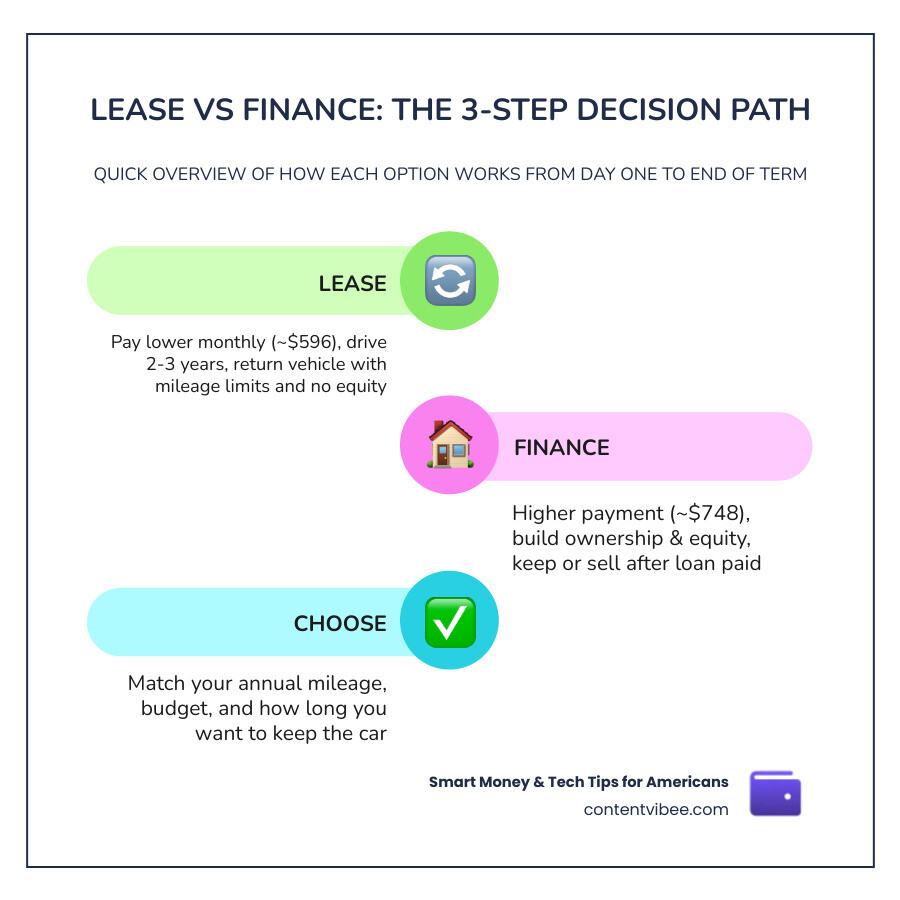
| Monthly payment | Lower (~$596/mo avg) | Higher (~$748/mo avg) |
| Ownership | No — return the car | Yes — you own it after payoff |
| Mileage limits | Yes (10,000-15,000/yr) | No limits |
| Equity built | None | Yes |
| Best for | Low mileage, new car every few years | Long-term ownership, high mileage |
Think of it this way: leasing is like renting an apartment — lower monthly cost, less commitment, but nothing to show for it at the end. Financing is like getting a mortgage — higher payments, but you’re building toward something you own.
In Q2 2025, about 24% of new vehicles were leased — meaning the vast majority of buyers still choose financing. But that doesn’t automatically make financing the right call for you.
The best choice depends on three things: how much you drive, how long you keep your cars, and what your monthly budget looks like.
Keep reading — we’ll break down every factor so you can make a confident, clear-headed decision.
Understanding the Difference Between Lease and Finance Car Options
When we talk about the difference between lease and finance car options, we are essentially looking at two different paths to the driver’s seat. Financing involves taking out an auto loan to purchase a vehicle. You make monthly payments that consist of principal and interest, and once the loan is fully satisfied, the car is yours to keep, sell, or trade.
Leasing, on the other hand, is more akin to a long-term rental. You are paying for the right to use the vehicle during its most expensive years—the first two to four years of its life. Because you aren’t paying for the entire value of the car, but rather the “slice” of value it loses while you drive it, your payments stay lower.
Asset Ownership and Depreciation
The biggest psychological hurdle for many Americans is the concept of ownership. When you finance, you are building equity. Every payment brings you closer to owning a piece of machinery that, while depreciating, still has significant resale value. According to 2026 market data, a typical vehicle retains about 60% of its value after three years.
Leasing ignores equity building in favor of lifestyle flexibility. You aren’t tied to the car’s future resale value. If the market for that specific model crashes, it’s the leasing company’s problem, not yours. However, this convenience comes at a cost. Lease vs. Finance: The Best Way To Get A New Car In 2026 highlights that because you are paying for the car during its most rapid depreciation period, leasing can often be more expensive over a six-to-nine-year horizon.
Pros and Cons at a Glance
- Financing Pros: Ownership after payoff, no mileage limits, freedom to customize, lower long-term cost.
- Financing Cons: Higher monthly payments, maintenance costs after warranty, resale responsibility.
- Leasing Pros: Lower monthly payments, drive a new car every 3 years, always under warranty, no resale hassle.
- Leasing Cons: No equity, mileage restrictions, “perpetual” car payments, potential wear-and-tear fees.
How the Difference Between Lease and Finance Car Payments Affects Your Budget
In May 2026, we are seeing a significant “payment gap.” On average, a lease payment is about $596 per month, while a loan payment for the same vehicle averages $748. That’s a $152 monthly difference that stays in your pocket with a lease.
Why is it cheaper? A lease payment is calculated using three components:
- Depreciation Fee: The difference between the car’s original price (Capitalized Cost) and its value at the end of the lease (Residual Value).
- Rent Charge: This is the interest, often expressed as a “money factor.”
- Taxes and Fees: Local sales tax and acquisition fees.
When you finance, you are paying for the entire car plus interest. If you want to see how these numbers look for your specific budget, you can use more info about finance tools to run the math.
Navigating the Difference Between Lease and Finance Car Mileage Limits
One of the most restrictive parts of a lease is the mileage cap. Most standard leases allow for 10,000 to 12,000 miles per year. If you exceed these limits, you could be looking at overage fees ranging from $0.15 to $0.30 per extra mile. For someone who drives 15,000 miles on a 12,000-mile lease, that’s an extra $450 to $900 due the moment you turn the keys in.
If you have a long daily commute or enjoy cross-country road trips, financing is almost always the smarter move. There are no “mileage police” when you own the car. While high mileage will lower your trade-in value later, you won’t face a sudden, massive bill at the end of your term. For more detailed regulatory guidance on these limits, check out What should I know about leasing versus buying a car?.
Monthly Payments, Interest Rates, and Total Cost of Ownership

In the current 2026 economic climate, interest rates have stabilized but remain higher than the “free money” era of the early 2020s. This makes understanding the difference between lease and finance car interest charges vital.
20% Down Payment and APR
For financing, the gold standard is still a 20% down payment. This protects you from becoming “upside down” on your loan—where you owe more than the car is worth. If you finance $45,000 over 60 months at a 7.5% interest rate, your total interest paid over the life of the loan could exceed several thousand dollars.
Leasing uses a “money factor” instead of an Annual Percentage Rate (APR). To compare the two, multiply the money factor by 2,400. For example, a money factor of 0.003125 is equivalent to a 7.5% APR. We always recommend negotiating the “Capitalized Cost” (the price of the car) just as aggressively for a lease as you would for a purchase. Many people forget that the lease payment is based on this price!
Total Cost Over Time
If you plan to keep a car for six years or more, financing is the undisputed winner. Research shows that two back-to-back three-year leases typically cost thousands more than buying one car and owning it for six years. The savings increase even further if you keep the car for nine or ten years. Buying or Leasing a Car in 2026: Which Make is Best for You? notes that the cheapest way to drive is to buy a reliable car and maintain it until repairs are no longer economical.
Sales Tax Implications
In many states, sales tax works differently for leases. When you finance, you often pay sales tax on the full purchase price upfront (or roll it into the loan). When you lease, you may only pay sales tax on the monthly payment itself. This can lower your initial “out-the-door” costs significantly.
Credit Score Requirements and Impact
Your credit score is the gatekeeper for both options, but the requirements are often stricter for leasing.
- Leasing: Dealerships and manufacturers usually look for “Prime” or “Super-Prime” scores (720+). Because they still own the asset, they want to ensure you are a low-risk driver who will maintain the car and make payments on time.
- Financing: While a high score gets you the best rates, there are more “Subprime” options for financing. Even if your credit isn’t perfect, you can often find a loan, though the interest rate will be considerably higher.
Both options will impact your credit score similarly. Making on-time monthly payments helps build your history. Conversely, a single missed payment can tank your score. We recommend getting a free credit report before you even step foot on a lot so there are no surprises during the “hard inquiry” phase.
Mileage, Maintenance, and Customization Restrictions
When you look at the difference between lease and finance car responsibilities, maintenance is a major factor.
Warranty and Repairs
One of the biggest “pros” of leasing is that the car is almost always under the manufacturer’s bumper-to-bumper warranty for the duration of the lease. If the transmission fails in month 30, it’s not your financial problem. When you finance, you eventually move into the “out-of-warranty” phase, where you are 100% responsible for all repairs.
Customization and Resale
Do you want to add a high-end roof rack, tint the windows, or upgrade the sound system? If you finance, go right ahead—it’s your car. If you lease, you generally cannot make permanent modifications. If you do, you’ll likely have to pay to have them removed or restored to factory condition before returning the vehicle. Leasing Vs Financing A Car: Key Differences & Decision Factors points out that customizations on a leased car are essentially “lost investments.”
GAP Insurance
Because cars depreciate so quickly, if your car is totaled or stolen in the first year, your standard insurance might not cover the full amount you owe the lender or leasing company. Many leases include “GAP insurance” automatically to cover this difference, whereas, with financing, you usually have to purchase it as an add-on.
End-of-Term Options: Buyouts, Returns, and Early Termination
The end of the agreement is where the difference between lease and finance car paths diverge most sharply.
The Lease End Process
When a lease ends, you usually have three choices:
- Turn it in: Pay the “disposition fee” (usually $300-$500), pay for any excess wear or mileage, and walk away.
- Buy it: Use the “Purchase Option” to buy the car for its Residual Value. This can be a great deal if the car is worth more than the buyout price.
- Trade it: Use any “positive equity” (if the car is worth more than the buyout) as a down payment on a new lease or purchase.
Early Termination: The “Trap”
Ending a lease early is notoriously difficult and expensive. You might face “early termination fees” that cost between $3,000 and $8,000+. Financing is much more flexible; you can sell the car at any time, though if you have “negative equity,” you’ll have to pay the lender the difference between the sale price and your loan balance. For a deeper dive into these end-of-term mechanics, see Difference Between Leased and Financed: Car Buying Guide 2026.
Decision Guide: Which Option Fits Your 2026 Lifestyle?
Choosing between leasing and financing isn’t just about the math; it’s about your life.
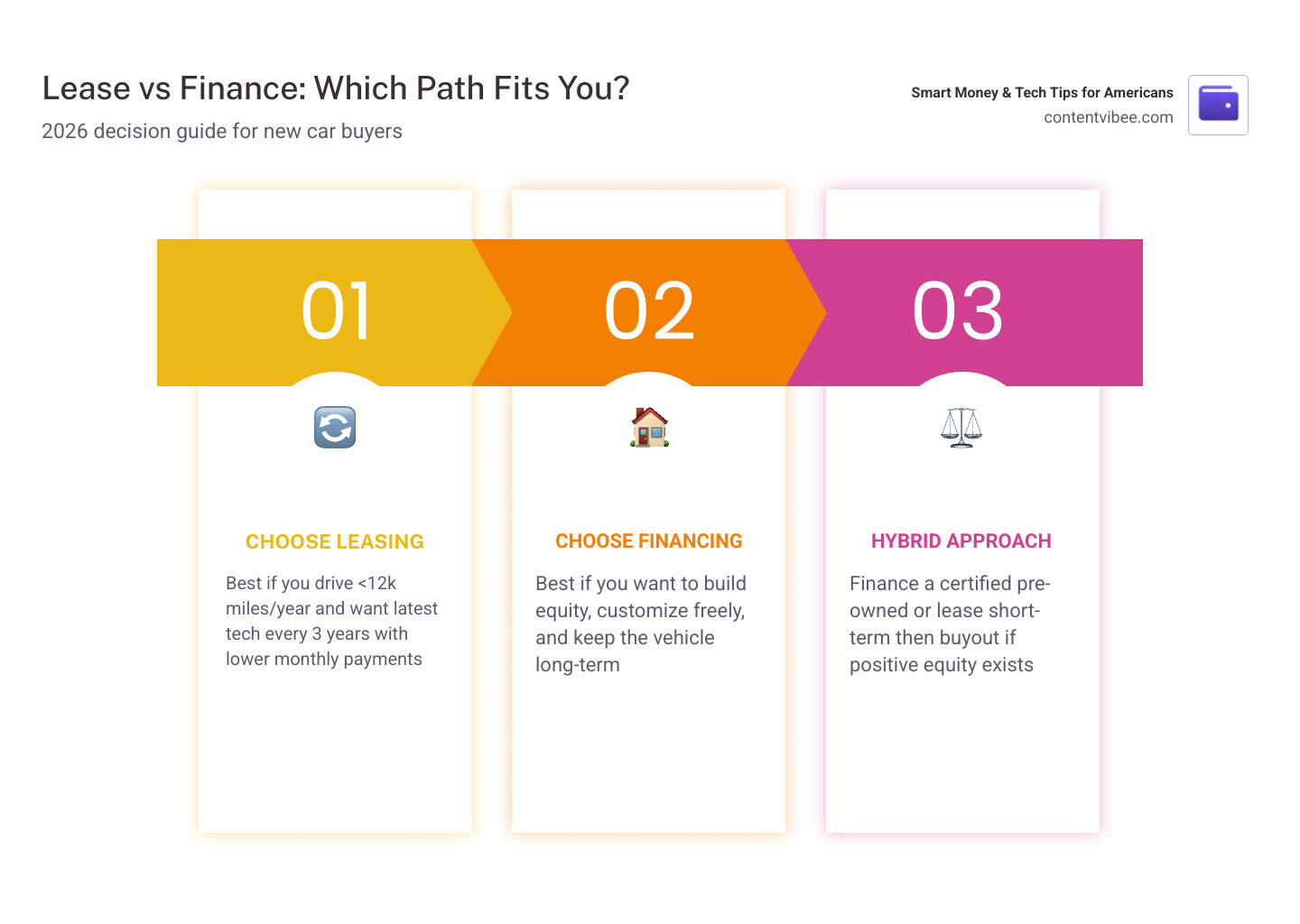
Choose Leasing If:
- You drive less than 12,000 miles per year.
- You want the latest safety tech and infotainment features every three years.
- You want to minimize your monthly out-of-pocket expenses.
- You use the car for business (leases often offer better tax deductions for business owners).
- You hate the hassle of selling a used car.
Choose Financing If:
- You drive a lot (15,000+ miles per year).
- You plan to keep the car for 5 to 10 years.
- You want to eventually have NO car payment at all.
- You like to customize your vehicle.
- You have a lower credit score and need more flexible lending options.
Frequently Asked Questions
Can I buy my car at the end of a lease?
Yes! Most lease contracts include a “Purchase Option.” This allows you to buy the car at a pre-determined price (the residual value) at the end of the term. In a market where used car prices are high, this can often be a very smart financial move.
Which option is better for high-mileage drivers?
Financing is significantly better for high-mileage drivers. Lease overage fees can be brutal, often costing $0.25 per mile. If you drive 20,000 miles a year on a 12,000-mile lease, you could owe an extra $2,000 every single year of the lease when you return it.
What happens if I want to end my agreement early?
If you finance, you can sell or trade the car whenever you want, though you must pay off the remaining loan balance. If you lease, ending the agreement early is very expensive and usually involves paying all remaining payments plus an early termination fee.
Does leasing or financing affect my credit score more?
They affect your score in almost identical ways. Both show up as a “debt” on your credit report. The key is making on-time payments. A lease may slightly help your “credit mix” if you already have several loans, but the impact is generally the same.
Conclusion
At Smart Money & Tech Tips for Americans, we believe that the “best” financial decision is the one that aligns with your long-term goals. If you value the utility of a car and want to eliminate a recurring bill from your life, financing is your path to freedom. If you view a car as a service—like your smartphone or Netflix subscription—and want the lowest possible monthly cost for a premium experience, leasing is a fantastic tool.
Before you head to the dealership, take a moment to look at your actual driving habits from the last year. Be honest about your mileage and how long you really plan to keep that shiny new 2026 model.
Ready to see how the numbers stack up for your dream car? Calculate your car payments today and go into the dealership with the data you need to win.


