


The Crypto Market Never Sleeps — But You Can
Bot trading for beginners is the practice of using automated software to buy and sell assets — typically cryptocurrencies — based on rules you set in advance, without needing to watch the market yourself.
Here’s a quick breakdown of what you need to know:
- What it is: A trading bot is a program that connects to your exchange account and executes trades automatically, based on signals like price levels, indicators, or market conditions.
- How it works: Bots connect to exchanges via API keys, analyze market data, and place orders in milliseconds — far faster than any human can react.
- Who it’s for: Anyone who wants a more disciplined, hands-off approach to investing, especially busy professionals who can’t monitor markets all day.
- What it costs: Entry-level platforms start around $14–19/month, though accounts under $5,000 may see fees eat significantly into returns.
- Biggest benefit: Bots remove emotional decision-making and run 24/7 — including while you’re asleep, at work, or on weekends.
- Biggest risk: Bots can fail, get hacked, or follow a bad strategy just as automatically as a good one.
If you’ve ever watched a mutual fund quietly bleed fees while your money barely grows, automated trading can feel like a breath of fresh air. The idea is simple: let a system do the disciplined work your emotions won’t let you do.
Traditional stock markets close nights and weekends. Crypto doesn’t. Bitcoin can drop 10% or surge to new highs while you’re catching a few hours of sleep. That’s exactly the problem trading bots are designed to solve.
Algorithmic trading already dominates traditional finance — 60–75% of trading volume in major US, European, and Asian markets is generated by automated systems. Crypto is heading the same direction, fast.
This guide will walk you through everything: how bots work, which types suit beginners, how to set one up safely, and what realistic results actually look like.
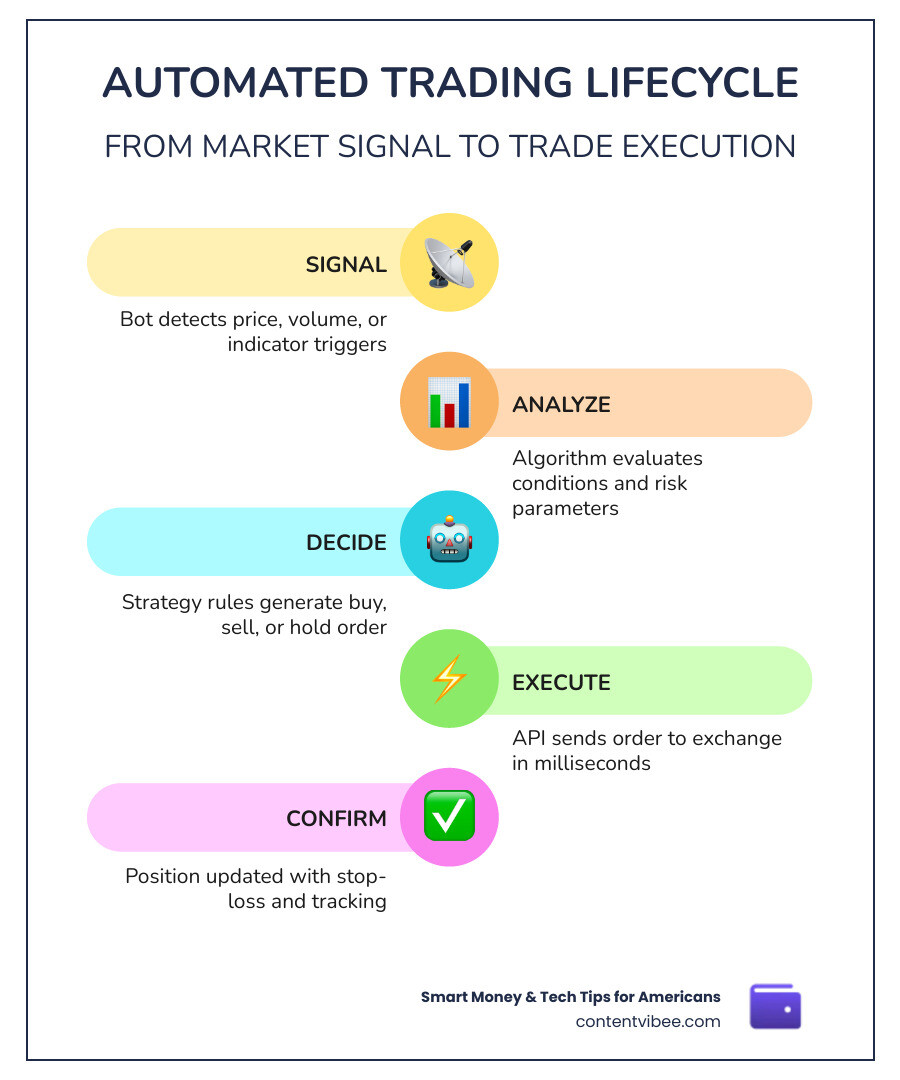
Essential bot trading for beginners terms:
What is Bot Trading for Beginners and How Does It Work?
At its core, a trading bot is like a smart digital assistant that follows your instructions to the letter without ever getting tired or panicking. While a human might take 30 seconds to notice a price movement and another 30 to log in and place a trade, a bot does this in milliseconds.
The API Connection: Your Bot’s “Secure Phone Line”
To work, the bot needs to talk to your exchange (like Coinbase or Kraken). It does this through an API (Application Programming Interface) connection. Think of an API key as a set of credentials that tells the exchange: “I allow this specific software to see my balance and place trades, but I do NOT allow it to withdraw my money.”

The Four-Step Bot Logic
- Market Analysis: The bot scans massive amounts of data, from price action to social media sentiment.
- Signal Generation: Based on the rules you’ve set, the bot identifies a “buy” or “sell” opportunity.
- Risk Check: The bot calculates how much of your capital to risk based on your settings.
- Execution: The bot sends the order to the exchange instantly.
In the traditional US stock market, algorithms have been the “secret sauce” for Wall Street firms for decades. However, the crypto market is where bot trading for beginners has really exploded because crypto trades 24/7/365. Since humans need silly things like “sleep” and “food,” bots fill the gap.
However, we must remember that Every Investor Faces Risk. Just because a bot is fast doesn’t mean it’s infallible. If you give a bot a bad set of rules, it will simply lose your money faster than you could manually.
Core Types of Automated Strategies
Not all bots are created equal. Some are designed to “buy the dip,” while others thrive when prices are bouncing up and down in a narrow range.
| Bot Type | Best Market Condition | Beginner Friendliness | How it Works |
|---|---|---|---|
| DCA (Dollar-Cost Averaging) | Trending/Bullish | High | Buys fixed amounts at set intervals to lower average entry price. |
| Grid Bot | Sideways/Range-bound | High | Places a “grid” of buy and sell orders to profit from volatility. |
| Arbitrage Bot | Any | Low | Exploits price differences between two different exchanges. |
| Signal-Based | Volatile | Medium | Executes trades based on external alerts (like TradingView). |
Choosing the Best Bot Trading for Beginners Strategy
If you are just starting out, we recommend sticking to DCA or Grid trading.
Grid Trading is fantastic for “sideways” markets where the price isn’t really going anywhere but is vibrating up and down. The bot buys when the price drops slightly and sells when it ticks back up, pocketing small profits dozens of times a day.
Dollar-Cost Averaging (DCA) is perhaps the ultimate beginner strategy. Instead of trying to time the “perfect” entry, the bot buys a small amount every day or week. This reduces the impact of volatility and is often the best choice for those with a long-term investment time horizon. You can find a curated list of tools in this guide on the Best Crypto Trading Bots for Beginners (2026).
Why Bot Trading for Beginners Requires AI Integration
By May 2026, the line between simple “if-this-then-that” bots and AI-driven systems has blurred. Modern AI bots don’t just follow static rules; they use machine learning to adapt. Research shows that machine learning models can now predict Bitcoin price movements with roughly 66% accuracy.
AI helps beginners by:
- Pattern Recognition: Identifying complex chart setups that a human might miss.
- Sentiment Analysis: Scanning news and social media to see if the market is turning “fearful” or “greedy.”
- Adaptive Learning: Adjusting the “grid” levels in real-time as market volatility changes.
Platforms like StockHero have become highly rated because they offer AI-driven stock trading that brings these advanced capabilities to everyday investors without requiring a degree in data science.
Benefits and Risks of Algorithmic Trading
Why use a bot at all? The most honest answer is that humans are generally terrible at trading. We get scared when prices drop (selling at the bottom) and greedy when they rise (buying at the top).
The Benefits:
- Emotional Discipline: A bot doesn’t care about “FUD” (Fear, Uncertainty, and Doubt). It executes the plan.
- 24/7 Coverage: While you’re enjoying dinner or sleeping, your bot is watching the 3 AM Asian market volatility.
- Backtesting: You can “time travel” your strategy. You can ask the bot, “If I had run this strategy in 2024, would I have made money?”
- Speed: In the time it takes you to click “Confirm Order,” a bot could have executed ten trades.
The Risks:
- Technical Failures: If your internet goes down or the exchange’s API lags, the bot might miss a critical exit.
- “Flash Crashes”: Extreme market events (like the 2022 FTX collapse) can overwhelm a bot’s logic.
- Over-Optimization: This is a common beginner trap. It’s easy to create a bot that would have been perfect for yesterday’s market, but fails miserably in tomorrow’s market.
- Security: If you don’t secure your API keys, hackers could potentially “trade” your balance away into their own accounts.
Proper asset allocation and risk management are essential. We always tell our readers: never put your entire portfolio into a single bot strategy. Diversification is still the only “free lunch” in investing, even when using AI. Choosing the right investment portfolio means balancing these automated tools with more stable assets.
Step-by-Step Setup for Your First Bot
Ready to get started? Don’t worry; you don’t need to be a coder. In 2026, most platforms are “no-code,” meaning you just click buttons and drag sliders.
1. Choose Your Exchange and Verify
First, you need a place for the bot to trade. Use a reputable exchange that is compliant with US regulations. Complete your “Know Your Customer” (KYC) verification fully before connecting a bot.
2. Generate API Keys (The Most Important Step!)
Go to your exchange settings and find “API Management.” When you create a new key:
- Label it: Call it something like “MyFirstBot.”
- Permissions: Select “Enable Reading” and “Enable Spot Trading.”
- CRITICAL: Do NOT check the box for “Enable Withdrawals.” This ensures that even if someone steals your API key, they can’t take your money out.
3. Connect to a Bot Platform
Whether you use a cloud-based service or a zero-complexity setup like MagicTradeBot, you will paste your API Key and Secret Key into the bot’s interface.
4. Paper Trading (The “Safety Net”)
Before you use a single real dollar, use Paper Trading. This is a simulation that uses live market data but “fake” money. We recommend paper trading for at least one week. If the strategy doesn’t work with fake money, it definitely won’t work with real money.
5. Set Your Risk Parameters
- Position Sizing: Never let one trade use more than 2–5% of your total capital.
- Stop-Loss: Set a “hard” stop-loss. If the price drops by 10%, the bot should automatically sell to prevent a total wipeout.
- Take Profit: Don’t be greedy. Set levels where the bot automatically locks in gains.
Understanding investment calculator accuracy can help you project how these small, automated wins can add up over time.
Costs, ROI, and Security Best Practices
Automated trading isn’t free, and the math can be tricky for beginners.
The “Fee Trap”
Many beginners start with a small amount, like $500 or $1,000. However, if your bot subscription costs $50/month, you are starting with a 60% annual overhead on a $1,000 account. You would need to make a 60% return just to break even!
Generally, bot trading becomes more economically viable for accounts over $5,000. This allows the profits to comfortably outpace the subscription fees and exchange trading fees. It’s the same reason comparing robo-advisor fees is so important in traditional investing—every dollar spent on fees is a dollar that isn’t compounding.
Security Checklist:
- Two-Factor Authentication (2FA): Enable this on your bot platform AND your exchange. Use an app like Google Authenticator, not SMS.
- IP Whitelisting: If your bot platform provides an IP address, tell your exchange to only accept trades coming from that specific IP.
- Regular Audits: Check your API permissions once a month to ensure nothing has changed.
Taxes: The Silent Profit-Killer
In the US, every single trade a bot makes is a taxable event. If your bot makes 500 trades a month, you have 500 capital gains (or loss) entries to report.
- Pro Tip: Use crypto tax software that connects via API to your exchange. It will automatically calculate your gains and losses for your IRS filings.
By using a compound interest calculator for retirement, you can see how even modest daily gains from a bot—if reinvested—can lead to significant wealth over a decade.
Frequently Asked Questions about Bot Trading
Are trading bots legal and taxable?
Yes, trading bots are perfectly legal in the United States. They are simply tools to execute a strategy. However, as mentioned above, they are fully taxable. Every “buy” and “sell” is a transaction that the IRS cares about. Most traders use automated tax software to handle the heavy lifting.
How much money do I need to start?
While some platforms like Blockonomi’s guide suggest you can start with as little as $500, we recommend having at least $2,000 to $5,000. This ensures that the monthly subscription fees don’t eat up all your potential profits. If you have less, consider starting with a free bot tier or exchange-native bots.
Can bots withdraw money from my exchange?
Only if you let them. When you set up your API keys, you are given the option to allow withdrawals. Never enable this. A properly configured bot only has “Trade” and “View” permissions. This means the bot can move your USD into Bitcoin and back, but it cannot move that Bitcoin to an outside wallet.
Conclusion
At Smart Money & Tech Tips for Americans, we believe that technology should work for you, not the other way around. Bot trading for beginners is a powerful way to bring Wall Street-level discipline to your personal portfolio. By removing the “human element”—the fear, the greed, and the need for sleep—you can participate in the markets more rationally.
However, automation is not a “magic money button.” It requires careful setup, regular monitoring, and a solid understanding of risk. Start small, use paper trading, and always prioritize security. If you’re wondering if these types of tools fit your lifestyle, you might also ask: Is the Autopilot Investment App Worth the Cost?
The goal of automated trading isn’t just to make money; it’s to buy back your time. Let the bots handle the 3 AM price swings while you focus on what matters most.
Disclaimer: The information provided in this guide is for educational purposes only and does not constitute financial advice. Trading cryptocurrencies and using automated bots involves significant risk of loss. Always consult with a financial professional before making investment decisions.


