


Why Knowing How to Enroll in Health Insurance Can Save You Time and Money
Knowing how to enroll in health insurance is one of the most important steps you can take to protect yourself and your family from unexpected medical costs.
Here’s a quick answer if you need it right now:
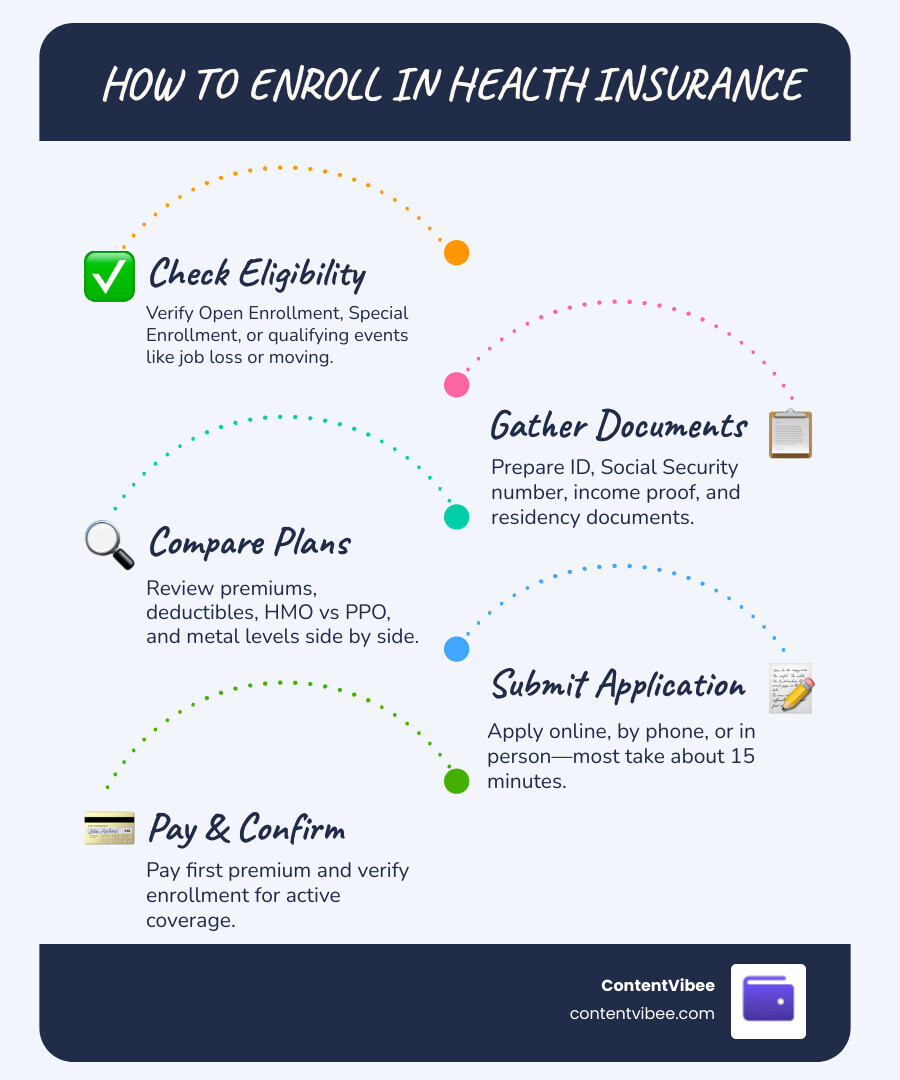
How to enroll in health insurance — quick steps:
- Check your eligibility — Determine if you qualify for a government plan (like BC’s MSP or the US Marketplace) or need private coverage.
- Gather your documents — Collect ID, proof of income, and residency documents before you start.
- Compare plans — Look at coverage levels, premiums, and deductibles side by side.
- Submit your application — Apply online, by phone, or in person — most applications take about 15 minutes.
- Pay your first premium — Coverage doesn’t start until your first payment goes through.
- Confirm your enrollment — Check your account or contact your insurer to verify your plan is active.
Most people put off enrolling because it feels complicated. But in most cases, you can get covered in under 15 minutes — with no medical exam required for many plans.
Whether you’re new to a province, between jobs, self-employed, or simply shopping for better coverage in 2026, the process is more straightforward than it looks.
How to Enroll in Health Insurance: A Step-by-Step Guide
Navigating the healthcare system can feel like trying to solve a Rubik’s Cube in the dark, but it doesn’t have to be. Whether you are looking for primary coverage through the Health Insurance Marketplace or supplemental private plans, the core process remains remarkably consistent.
The first thing we recommend is deciding which “door” you are walking through. In the United States, most of us will look toward the Marketplace (HealthCare.gov) or state-based exchanges. If you’re a Virginian, you’ll be looking at Virginia’s Insurance Marketplace or exploring private options like Virginia Health Insurance Plans | Anthem.

To get started, we suggest following the official steps to stay covered. There are several official ways to apply:
- Online: This is the fastest method. You can create an account and see eligibility results almost instantly.
- Phone: You can call for free, non-biased help to review choices and enroll.
- In-Person: Certified assisters in your local area can walk you through the paperwork.
- Paper Application: While slower (it takes about 2 weeks for results), this remains an option for those who prefer physical forms.
To help you visualize the different levels of private or supplemental coverage, here is a general breakdown of plan tiers often found in the industry:
| Plan Tier | Typical Coverage Level | Best For… |
|---|---|---|
| Basic | 60% reimbursement | Occasional prescriptions and emergency-only dental. |
| Standard | 70% – 75% reimbursement | Families needing routine dental and vision exams. |
| Enhanced | 80% – 90% reimbursement | High prescription drug needs and orthodontic coverage. |
For a deep dive into the official application steps, check out this guide on how to apply for health insurance.
Determining Your Eligibility and Enrollment Period for How to Enroll in Health Insurance
Timing is everything. You can’t just buy health insurance the moment you feel a sneeze coming on (well, you can, but it might not cover that specific cold).
In the U.S., the Open Enrollment Period typically runs from November 1 to January 15. This is the window where anyone can sign up for a plan for the upcoming year. If you miss this window, you need a “Special Enrollment Period” triggered by a Qualifying Life Event. These events include:
- Getting married or divorced.
- Having a baby or adopting.
- Losing existing health coverage (like leaving a job).
- Moving to a new state or zip code.
If you are looking for health insurance options for every American family, it is also worth checking if you qualify for Medicaid or the Children’s Health Insurance Program (CHIP), which accept applications year-round.
For our friends who may be moving across borders or specifically to British Columbia, the Medical Services Plan (MSP) is mandatory. However, there is a wait period—usually the balance of the month you arrive plus two full months. During this time, we strongly advise getting temporary private insurance to bridge the gap.
Gathering Required Documentation and Identification
Before you sit down to apply, have your “digital folder” ready. Most online applications take about 15 minutes if you have your documents handy. If you’re scanning IDs, make sure they are “corner-to-corner” scans—meaning the whole ID is visible, in focus, and not cut off.
You will generally need:
- Social Security Numbers for everyone in your household.
- Income Information: Recent tax returns, W-2s, or pay stubs.
- Proof of Citizenship or Legal Residency: This could be a passport, Green Card, or for those in BC, a study permit or work permit valid for at least six months.
- Proof of Address: A utility bill or lease agreement.
In BC, once your application is processed, you’ll need to visit an ICBC office to get your BC Services Card. This card is your golden ticket to the healthcare system and includes your Personal Health Number (PHN).
Comparing Plans and Completing Your Enrollment: How to Enroll in Health Insurance
This is where the rubber meets the road. When you compare plans, don’t just look at the monthly premium. Look at the deductible (what you pay before insurance kicks in) and the out-of-pocket maximum.
You’ll encounter terms like HMO (Health Maintenance Organization), which usually requires you to stay within a specific network, and PPO (Preferred Provider Organization), which offers more flexibility to see specialists without a referral. In the Marketplace, plans are categorized by “metal levels” (Bronze, Silver, Gold, Platinum) which indicate how you and the plan share costs.
Once you pick a plan, you must complete your enrollment and pay your first premium. This is a critical step: Your coverage is not active until that first payment is received by the insurance company. The Marketplace doesn’t collect your premium; you pay the insurer directly.
After paying, keep an eye on your mailbox. You should receive a membership packet and your physical insurance card within a few weeks.
Maximizing Your Coverage and Staying Protected
Once you’ve figured out how to enroll in health insurance, the next step is making that insurance work for you. Basic plans often cover the essentials—like doctor visits and hospital stays—but there are often “gaps” that can lead to high out-of-pocket costs.

Understanding Supplemental Options and Private Insurance Gaps
Even the best government or employer plans might not cover everything. This is where supplemental or “extended” health insurance comes in. These plans are designed to cover:
- Prescription Drugs: Some plans offer up to $250,000 in coverage.
- Dental Care: From routine cleanings to major work like crowns or orthodontics.
- Vision Care: Eye exams, glasses, and contact lenses.
- Paramedical Services: This includes massage therapy, physiotherapy, and psychology—often without needing a doctor’s referral.
- Travel Insurance: Emergency medical coverage for when you leave the country.
One of our favorite tips for those leaving a job is the 60-day window. If you apply for a “Group Conversion” or “Health Coverage Choice” plan within 60 days of losing your workplace benefits, you can often get guaranteed acceptance. This means you won’t have to answer medical questions or undergo an exam, even if you have pre-existing conditions.
Managing Your Plan and Avoiding Coverage Lapses
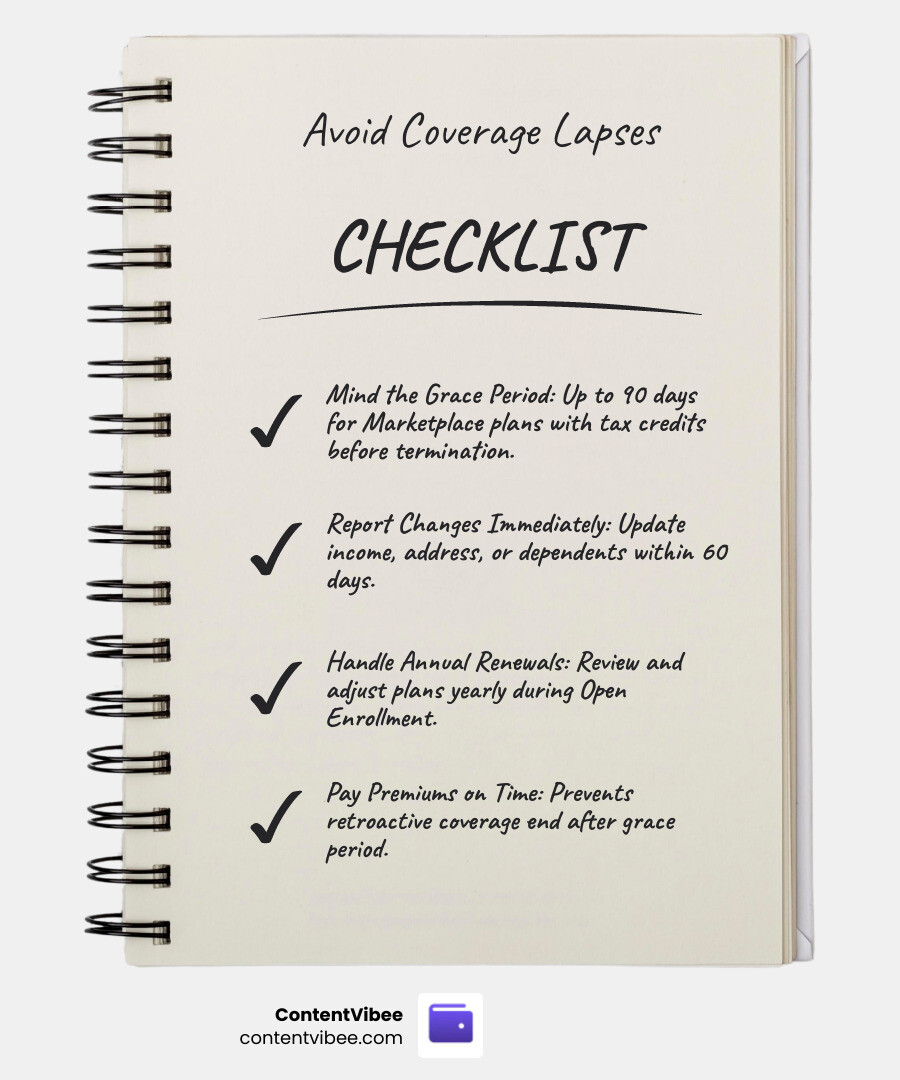
Life happens. You might move, your income might change, or you might simply forget to update a credit card expiration date. Here is how to keep your coverage safe:
- Mind the Grace Period: If you miss a premium payment, most Marketplace plans offer a 90-day grace period (if you receive tax credits). However, be careful! If you don’t pay by the end of that period, your insurer can terminate your coverage retroactively to the last day of the first month you missed.
- Report Changes Immediately: If you get a raise, lose a dependent, or move, report it to the Marketplace within 60 days. This ensures your tax credits are calculated correctly and you don’t end up owing money at tax time.
- Annual Renewals: Every year during Open Enrollment, take 10 minutes to review your plan. Even if you like your current coverage, premiums and benefits change. You might find a similar plan for a lower price.
Conclusion: Smart Financial Planning with ContentVibee
At ContentVibee, we believe that managing your health is just as important as managing your wealth. Understanding how to enroll in health insurance is a foundational part of a solid financial plan. By choosing the right plan today, you are protecting your future self from the “sticker shock” of medical bills.
Whether you’re looking for the best way to get marketplace insurance or seeking help to enroll in a plan, the resources are there to make it easy.
Health insurance is just one piece of the puzzle. From staying updated on the latest tech tips to understanding average refi closing costs, we are here to provide the practical advice you need to thrive in 2026. Stay covered, stay smart, and keep your finances in the green!


