

FRS Investment Plan Withdrawal Rules and Penalties can trip up even the most prepared Florida public employees — and a single wrong move can cost you thousands.
Here’s a quick summary of the key rules:
| Rule | Details |
|---|---|
| Vesting | 1 year of FRS service = 100% vested in all contributions and earnings |
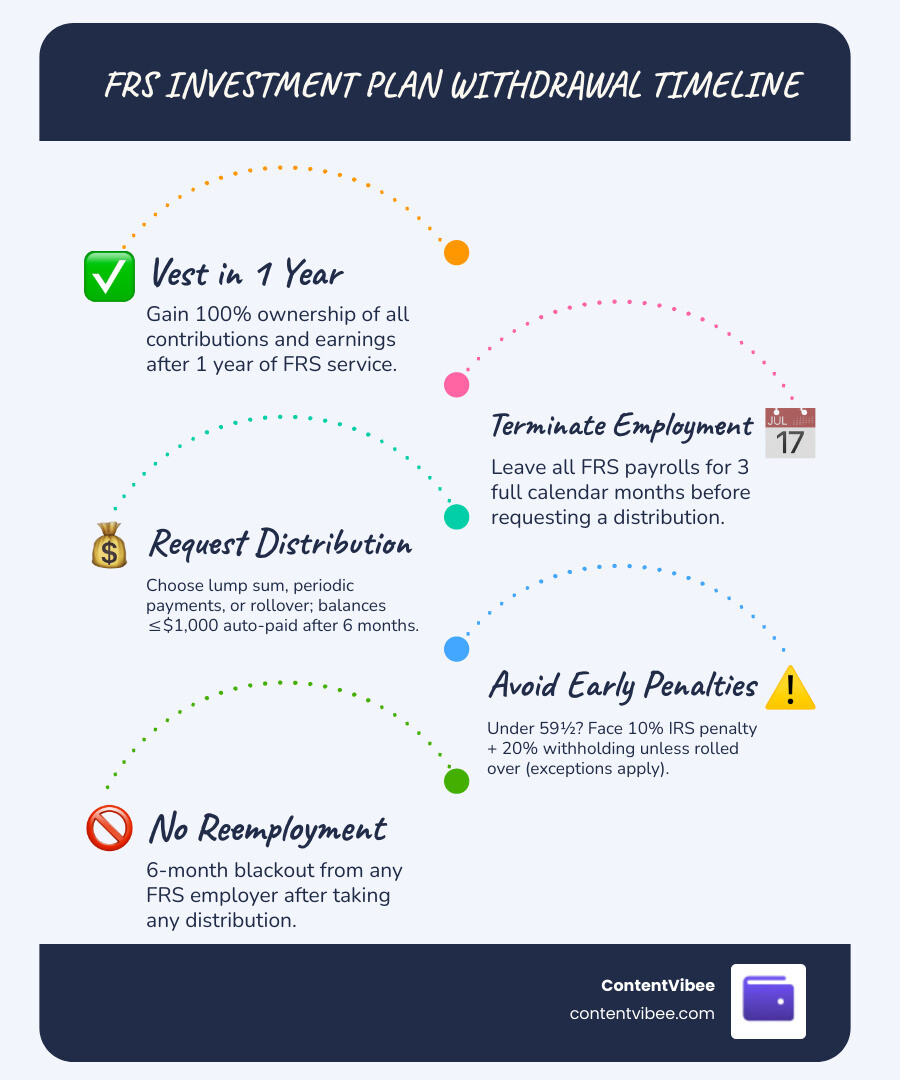
| Waiting period | Must be off all FRS payrolls for 3 full calendar months before taking a distribution |
| Early withdrawal penalty | 10% IRS penalty if under age 59½ (exceptions apply) |
| Mandatory withholding | 20% federal withholding on any taxable payout not directly rolled over |
| Reemployment restriction | 6-month blackout from any FRS employer after taking any distribution |
| Automatic payout | Balances of $1,000 or less are automatically distributed after 6 months |
| Required Minimum Distributions | Must begin the year you turn 73 (or at termination, whichever is later) |
These rules apply whether you’re retiring at 65 or leaving a public job in your 30s. The stakes are real — a $30,000 payout taken too early can shrink to just $21,000 after withholding and penalties.
Understanding the rules before you act is the difference between a secure retirement and an expensive mistake.
Understanding FRS Investment Plan Withdrawal Rules and Penalties
Navigating the Florida Retirement System (FRS) can feel like trekking through the Everglades without a map. As of April 2026, the rules remain stringent but manageable if you know where the pitfalls lie. At ContentVibee, we believe that “online justice” starts with having the right information to protect your hard-earned savings.
The first thing we need to discuss is vesting. In the FRS Investment Plan, vesting is the process by which you earn “ownership” of the money in your account. Unlike the Pension Plan, which requires much longer service periods, the Investment Plan is famous for its “1-year rule.”
If you have completed one year of FRS-covered service, you are 100% vested in all employee contributions, employer contributions, and any investment earnings. If you leave before that one-year mark, you are only entitled to your own 3% employee contributions and their associated earnings. The employer portion stays behind in a “suspense account.”

When you decide to terminate your employment, you aren’t just walking away from a job; you’re making a major choice about your financial future. Before you can even think about a withdrawal, you must be completely off the payroll of all FRS-participating employers. This includes temporary, OPS, or adjunct positions. If you have more questions about the basics, checking out the FRS Investment Plan FAQ is a great place to start.
Tax Implications and FRS Investment Plan Withdrawal Rules and Penalties
Let’s talk about the “tax man.” Because the money in your FRS Investment Plan is typically pre-tax, the IRS wants its cut the moment that money leaves the plan’s protective shell.
If you take a distribution that isn’t a direct rollover to another qualified plan, the FRS is legally required to withhold 20% for federal income taxes. This isn’t a suggestion; it’s a mandatory “pre-payment” to the IRS. Furthermore, if you are under the age of 59½, you may be hit with an additional 10% early withdrawal penalty.
We often see members surprised by the math. If you withdraw $30,000 to pay off debt or buy a car, $6,000 goes immediately to the IRS for withholding, and another $3,000 might be owed as a penalty. You end up with only $21,000. This is why managing your Money & Credit wisely is so vital—sometimes the “cost” of accessing your own money is simply too high.
Impact of Rollovers on FRS Investment Plan Withdrawal Rules and Penalties
One of the most common moves for terminated employees is rolling their funds into an Individual Retirement Account (IRA). While this keeps your money tax-deferred, there is a hidden danger.
The FRS Investment Plan has a special “tax exception” for members who retire at age 55 (or age 50 with 25 years of service for Special Risk employees). Under this rule, you can take distributions from the FRS plan without the 10% IRS early withdrawal penalty. However, this exception does not transfer to an IRA.
If you roll your money into an IRA at age 56 and then try to take a withdrawal, you will likely pay that 10% penalty because IRAs generally require you to be 59½ to avoid it. This is a primary reason why many experts suggest you [PDF] Think Twice Before Rolling Out of the Investment Plan – MyFRS.
Additionally, while you’re managing your transition, you might be looking at other financial obligations, such as a TJ Maxx Credit Card Payment – Pay Online & Phone. It’s important to balance these immediate needs without raiding your retirement nest egg and triggering irreversible penalties.
Timing and Distribution Options for Terminated Employees
Timing is everything. In FRS Investment Plan Withdrawal Rules and Penalties, the calendar is your best friend or your worst enemy.
For most employees who have not reached “Normal Retirement” age, you must wait three full calendar months after the month you terminated before you are eligible for a distribution. For example, if you quit on January 15th, your “termination month” is January. You must then wait through February, March, and April. You would finally be eligible to request a payout on May 1st.
However, if you have reached Normal Retirement (which varies based on your hire date and class, but generally involves reaching age 62 or 30 years of service for older hires, or age 65 or 33 years for newer hires), you have a “fast track” option. You can take a one-time distribution of up to 10% of your balance after being terminated for just one full calendar month. The remaining 90% becomes available after the standard three-month wait.
When you are finally eligible, you have several payout options:
- Lump-Sum Payment: You take the whole thing (minus the 20% withholding).
- Periodic Payments: You set up a schedule to receive a certain amount every month or quarter.
- Annuities: You “buy” a guaranteed stream of income for the rest of your life.
- Rollover: You move the money to an IRA or a 401(k) at a new job.
| Scenario | Waiting Period for 10% Payout | Waiting Period for Full Payout |
|---|---|---|
| Normal Retirement Met | 1 Full Calendar Month | 3 Full Calendar Months |
| Early Termination | Not Available | 3 Full Calendar Months |
Choosing the right path depends on your long-term goals. Taking a lump sum might feel great today, but it ends your “retiree” relationship with the FRS and can impact your eligibility for the Health Insurance Subsidy (HIS).
Reemployment Restrictions and Retiree Status
This is the section where people often get “burned.” In Florida, the FRS considers you “retired” the moment you take any distribution from your Investment Plan account — even a rollover of $1 to an IRA.
Once you are considered a “retiree,” a massive “No Entry” sign goes up at every FRS-participating employer in the state. This includes school districts, county governments, and state agencies.
- The 6-Month Blackout: You cannot be reemployed by any FRS employer in any capacity (even as a volunteer or contractor) for the first six calendar months following the month of your distribution. If you break this rule, your retirement is voided, and you must repay every cent you took out.
- The 7–12 Month Window: Between months 7 and 12, you can return to work, but your retirement benefits (like your periodic payments) might be suspended while you are working.
Taking a distribution also means you become a “Renewed Member” if you return to work later. Renewed members are generally restricted to the Investment Plan and cannot join the Pension Plan or participate in DROP.
If you are looking for ways to build credit while navigating these restrictions, you might consider What the Open Sky Credit Card Is and Who It’s For as a tool to maintain financial health without touching your retirement funds. Taking a distribution just to cover short-term bills can trigger a six-month ban from your entire career field in Florida!
Frequently Asked Questions about FRS Withdrawals
We get a lot of questions at ContentVibee about the “what-ifs” of the FRS. Here are the most common scenarios we see.
Can I take a distribution while still employed by an FRS agency?
The short answer is: No. The FRS Investment Plan is designed for retirement, not as a savings account. You cannot take a “hardship withdrawal” or a loan while you are still actively employed by an FRS-participating agency.
The only exception is if you reach age 59½ while still working. At that point, you can take a distribution from your account even if you haven’t terminated employment. However, doing so will still mark you as a “retiree” in the eyes of the FRS, which can have significant consequences for your future service credit and membership status.
What happens to my unvested funds if I leave before one year?
If you leave your FRS job after, say, nine months, you haven’t met the one-year vesting requirement. Your 3% employee contributions are yours to keep, but the employer contributions go into a “suspense account.”
If you return to an FRS-covered job within five years, that money is “reinstated” to your account, and your previous nine months of service count toward your one-year vesting goal. However, if you take a distribution of your vested employee contributions, you effectively forfeit that unvested employer money forever. If you don’t return to FRS work within five years, the money is also forfeited to the state.
Are there fees for keeping my money in the plan after I quit?
One of the best things about the FRS Investment Plan is that it has some of the lowest fees in the industry. However, once you are no longer an active employee receiving contributions, you are considered an “inactive member.”
Inactive members are charged an annual administrative fee of $24, which is deducted from your account at a rate of $6 per quarter. Even with this fee, the FRS plan is often much cheaper than a commercial IRA. Many people choose to leave their money in the plan precisely because the investment management fees (ranging from 0.01% to 0.47%) are so low compared to the retail market.
Conclusion
Understanding FRS Investment Plan Withdrawal Rules and Penalties is essential for any Florida public servant. Whether you are eyeing the exit door for a new career or finally hanging up the hat after 30 years, the decisions you make in the first three months of “freedom” will resonate for decades.
At ContentVibee, we are committed to providing you with the legal and financial guides you need to navigate these complex systems. Retirement should be a time of peace, not a time spent haggling with the IRS or realizing you’ve accidentally banned yourself from working for six months.
Take your time, weigh the 20% withholding against your immediate needs, and consider the long-term growth of staying in a low-fee plan. Your future self will thank you for being diligent today. Explore more financial guides on our site to keep your financial house in order!


