

When Your Retirement Savings Are on the Table: What You Need to Know About 401k Division in a California Divorce
If you’re facing a 401k divorce California situation, here is the short answer:
Only the portion of your 401(k) contributed during your marriage is subject to division. California is a community property state, so that marital portion is typically split 50/50. Contributions made before your wedding date — or after your legal date of separation — generally remain yours alone.
| Question | Quick Answer |
|---|---|
| Does my spouse get half my entire 401(k)? | No — only the portion earned during the marriage |
| How is it split? | 50/50 under California community property law |
| Do I need a special court order? | Yes — a QDRO is required for 401(k) plans |
| Are there tax penalties? | Not if a QDRO is used correctly |
| Is there a minimum marriage length? | No — even a short marriage creates divisible community property |
Retirement accounts are often the largest single asset a couple divides in a California divorce — sometimes worth more than the family home. Yet they are also among the most mishandled, because two separate bodies of law apply at once: California community property law and federal ERISA rules.
Get this wrong and you could lose tens of thousands of dollars to taxes, penalties, or a court order the plan administrator simply rejects.
This guide breaks it all down in plain language — so you know exactly where you stand.
Understanding 401k Divorce California Laws and Community Property
When we talk about 401k divorce california rules, we have to start with the “Community Property” philosophy. Under California Family Code §760, the law presumes that any asset acquired by a married person while living in California is community property. This means that from the day you say “I do” until the day you legally separate, the “community” (the two of you as a single legal unit) owns what you earn.
In May 2026, with California courts handling over 110,000 family law cases annually, retirement division remains a top-tier financial issue. The core principle is simple: if you worked and contributed to a 401(k) during those years of marriage, your spouse owns half of those contributions and half of the employer matching funds.
However, California also recognizes “quasi-community property.” This applies if you lived outside of California during your marriage but acquired assets that would have been community property if you had lived here. When you file for divorce in the Golden State, those out-of-state 401(k) contributions are treated just like California community property. For a deeper look at how these benefits are structured, you can read more about Divorce and Retirement Benefits in California.
Determining Community Property in a 401k Divorce California Case
The “Date of Separation” is perhaps the most critical milestone in your divorce timeline. In California, this isn’t just the day someone moves out; it’s the date when there is a “complete and final break” in the marital relationship, evidenced by both an intent to end the marriage and actions consistent with that intent.
Everything contributed to your 401(k) between the date of marriage and the date of separation is community property. This includes:
- Your payroll deductions.
- Employer matching contributions.
- Interest, dividends, and capital gains earned on those specific marital contributions.
Conversely, Family Code §770 protects your separate property. If you had $50,000 in your 401(k) before you got married, that $50,000 (and the growth on it) belongs to you. To keep these pots of money clear, we often look at how 401k investment companies fees and retirement structures impact the total value over time.
Calculating the Split: Separate Property vs. Community Interest
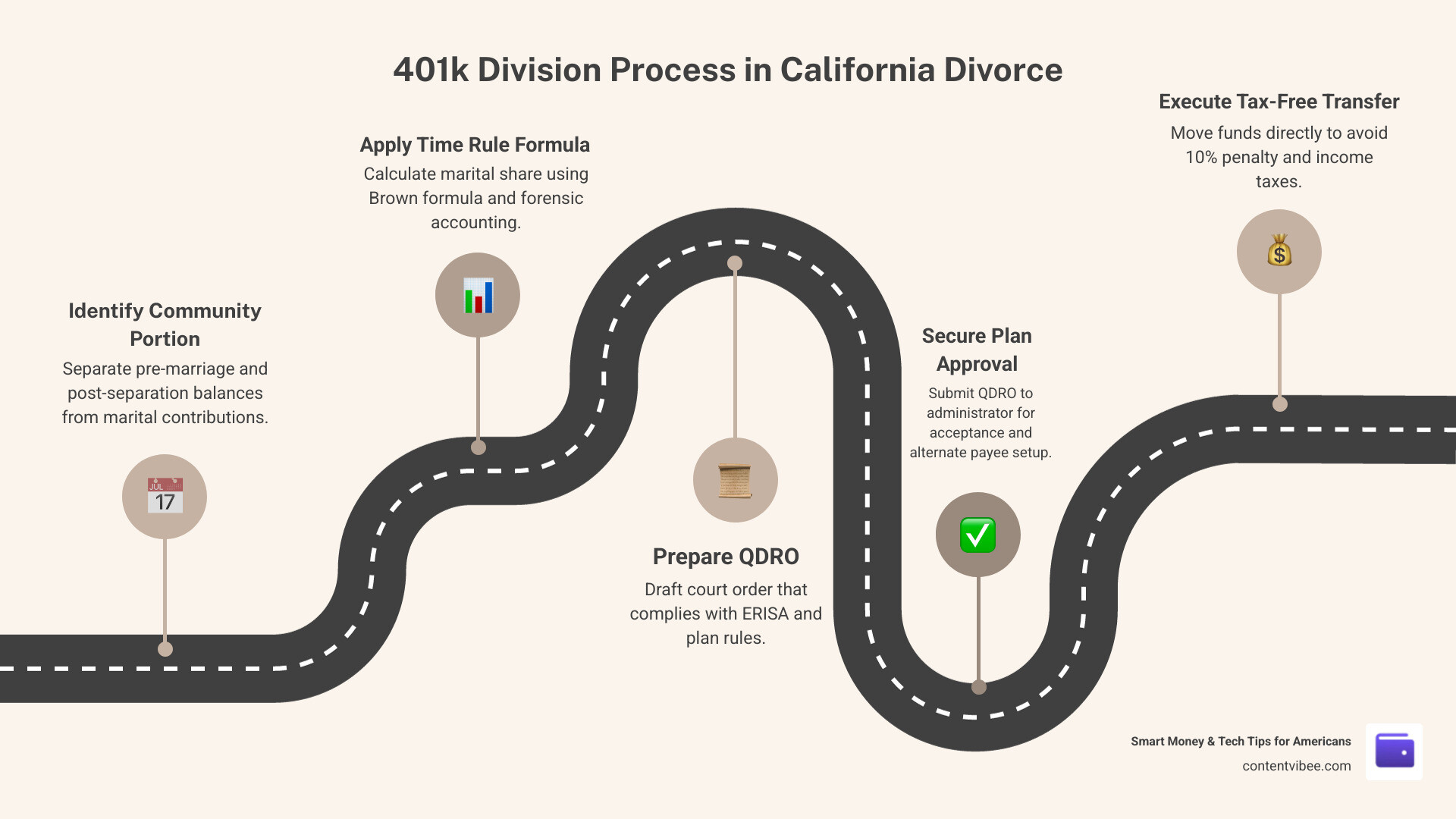
Calculating the exact split in a 401k divorce california case can feel like a high school algebra nightmare, but it usually boils down to the “Time-Rule Formula” (sometimes called the Brown Formula).
This formula creates a fraction to determine the community share:
- Numerator: The amount of time (months or years) you contributed to the plan during the marriage.
- Denominator: The total amount of time you have participated in the plan.
For example, if you were in a plan for 20 years total, but were only married for 10 of those years, the community interest is 50%. Your spouse would then be entitled to half of that community share (25% of the total account).

However, 401(k)s are “defined contribution plans,” which can be more complex than simple pensions. If you made massive contributions early in the marriage and smaller ones later, a simple time-rule might not be fair. This is where forensic accounting comes in. We often recommend tracing contributions to ensure that pre-marital balances and their specific market appreciation are carved out accurately. Understanding these nuances is a key part of navigating the financial maze of family law costs.
The Role of the QDRO and Avoiding Tax Penalties
You cannot simply write “I give my ex-wife $100,000 from my 401(k)” on a napkin and expect the bank to honor it. Because 401(k)s are governed by federal law (ERISA), plan administrators are prohibited from “assigning” benefits to anyone other than the employee—unless they receive a Qualified Domestic Relations Order (QDRO).
A QDRO is a specialized court order that instructs the 401(k) plan administrator to divide the account. It creates an “alternate payee” (your spouse) who is granted a specific portion of the account.
The beauty of a properly drafted QDRO is that it allows for a tax-free transfer of funds. Under IRC §414(p), the transfer from your account to your spouse’s rollover IRA is not a taxable event. Furthermore, if your spouse needs to take cash out immediately, IRC §72(t)(2)(C) provides a special exception: the 10% early withdrawal penalty (for those under 59 ½) is waived for distributions made “incident to divorce” via a QDRO. You’ll still owe ordinary income tax, but that 10% savings is huge. As we often say, divorce costs: why your ex might be your most expensive hobby, so saving 10% wherever possible is a win.
Why a QDRO is Essential for Your 401k Divorce California Settlement
We have seen many cases where a Marital Settlement Agreement (MSA) was signed, but the QDRO was never filed. Years later, when the employee retires or dies, the ex-spouse finds they have no legal claim to the money because the plan administrator never “qualified” the order.
A QDRO is essential because:
- It’s a Legal Mandate: Plan administrators cannot pay your ex without it.
- Survivor Benefits: It can protect your spouse’s interest if you pass away before retirement.
- Direct Transfer: It allows the money to move directly into the ex-spouse’s own retirement account, keeping it tax-deferred.
If you’re wondering, “Is my wife entitled to half my 401(k) in a divorce?“, the answer is yes, but only if the procedural steps like the QDRO are followed to the letter.
Protecting Your Assets and Navigating ATROs
The moment a divorce petition is served in California, Automatic Temporary Restraining Orders (ATROs) go into effect under Family Code §2040. These are not about physical safety; they are financial “freeze” orders.
ATROs prohibit either spouse from:
- Withdrawing funds from retirement accounts.
- Taking out new 401(k) loans.
- Changing beneficiary designations.
If you try to “empty the clip” by cashing out your 401(k) once the divorce starts, the court will likely order you to pay it all back, plus your spouse’s legal fees, and potentially award 100% of the asset to your spouse as a sanction for breach of fiduciary duty.

Instead of fighting the split, many couples use Asset Offsetting. This is a “smart money” move where one spouse keeps the entire 401(k) while the other spouse receives an asset of equal value—usually the equity in the family home.
| Asset Type | Division Method | Key Consideration |
|---|---|---|
| 401(k) | QDRO Required | Federal ERISA law applies; 10% penalty exception exists. |
| IRA | Divorce Decree | No QDRO needed; transfer must be “incident to divorce.” |
| Pension | QDRO / Time-Rule | Often requires “Joinder” of the plan to the court case. |
Frequently Asked Questions about California 401k Division
Is my spouse entitled to half of my 401(k) if we were married for less than 10 years?
Yes. There is a common myth that you must be married for 10 years to split a retirement account (this actually stems from Social Security rules). In a 401k divorce california case, there is no minimum duration. If you were married for six months and contributed $5,000, your spouse is legally entitled to $2,500 of those contributions plus the gains on them.
Can I use my 401(k) to pay for my divorce attorney fees?
Technically, yes, but it requires a court order or agreement. Using a QDRO to pay legal fees is a common strategy to avoid the 10% early withdrawal penalty. However, keep in mind that the amount withdrawn will be treated as ordinary income, so you’ll need to set aside roughly 20-30% for the tax man.
What happens if my spouse tries to hide or withdraw funds during the divorce?
This is a major violation of California’s disclosure laws. If a spouse hides a 401(k) and it is discovered later, the court has the power to award 100% of that account to the other spouse. Transparency is not just a moral choice; it’s a financial survival strategy in California.
Conclusion
Navigating a 401k divorce california doesn’t have to be a financial disaster. By understanding the difference between community and separate property, and ensuring a QDRO is filed early in the process, you can protect your long-term stability.
At Smart Money & Tech Tips for Americans, we believe that the best defense is a good offense—which means having the right data and the right experts on your side. Whether you are offsetting assets or splitting them down the middle, make sure your paperwork is ironclad. For those in the Southern California area, you can find more specific resources in our detailed reviews of the top 10 family law attorneys in LA to help you cross the finish line with your retirement intact.