


Does Mediation Cost Money? Here’s What You Need to Know First
Does mediation cost money? Yes — but usually far less than going to court.
Here’s a quick breakdown before we dive deeper:
| Mediation Type | Typical Cost |
|---|---|
| Court-sponsored or nonprofit | Free to low-cost (sliding scale) |
| Private mediator (hourly) | $100–$500 per hour |
| Straightforward divorce (total) | $3,000–$8,000 |
| Complex/high-asset divorce (total) | $25,000+ |
| Average simple case (total) | $5,000–$7,500 |
| Litigation per spouse | $15,000–$35,000+ |
The short version: mediation costs real money, but it’s typically a fraction of what you’d spend in a courtroom battle.
If you’re facing a divorce or legal dispute and watching every dollar, this matters a lot. Legal fees can spiral fast. Mediation offers a structured, private path to resolution — and it almost always costs less than hiring two separate attorneys and going to trial.
But not all mediation is the same. Costs vary based on who your mediator is, where you live, how complicated your situation is, and whether you’re using a private professional or a court-connected program. Some programs are even free if you qualify.
This guide breaks down exactly what you can expect to pay, who pays it, and how to keep costs as low as possible.
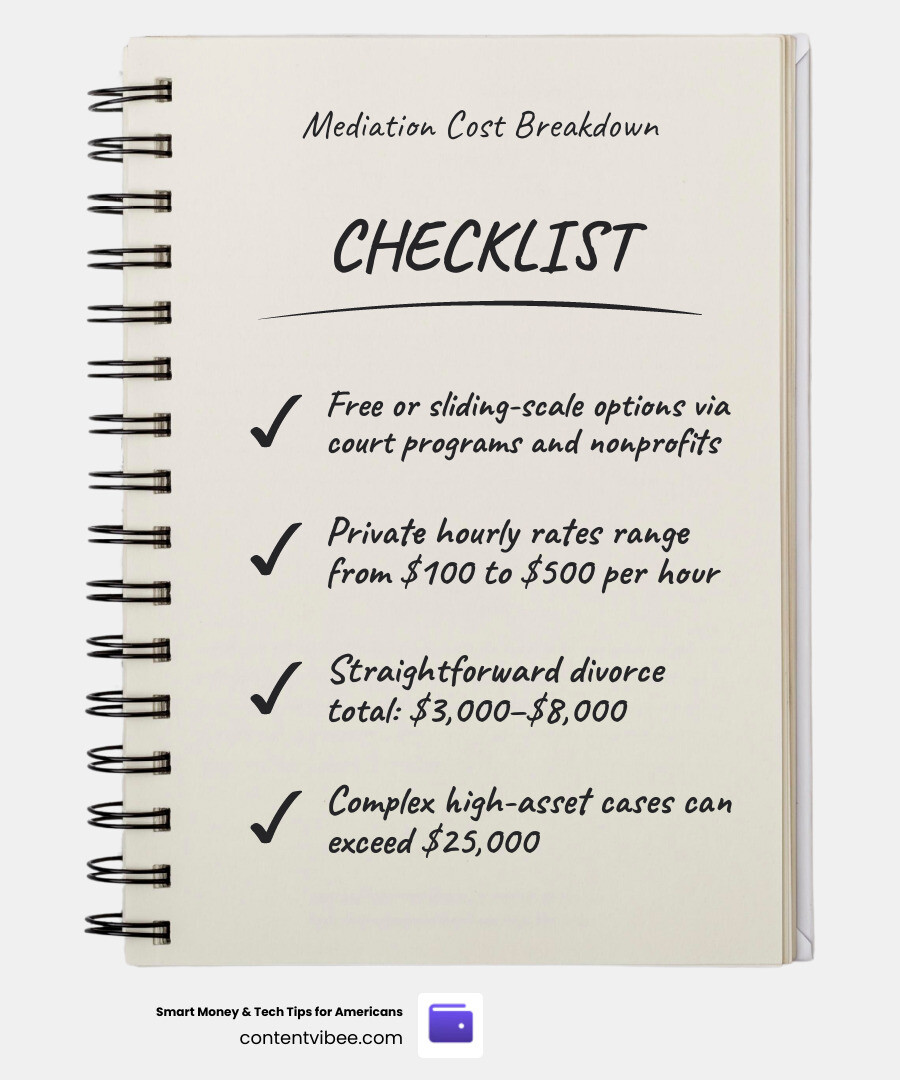
Does Mediation Cost Money? Understanding the Basics
When people ask us, “does mediation cost money?” they are often surprised to learn that the answer depends heavily on the “venue” of the dispute. In California, mediation is a diverse field ranging from volunteer-run community centers to elite attorney-mediators charging premium rates.
Why does mediation cost money for private sessions?
If you choose a private mediator, you are paying for a high level of professional expertise and a neutral environment. Unlike a judge, who is assigned by the state, a private mediator is a professional you hire to facilitate your specific negotiation.
The fees for private sessions cover:
- Professional Expertise: Many mediators are retired judges or experienced attorneys who bring decades of legal knowledge to the table.
- Neutrality: You are paying for a person who has no stake in the outcome, ensuring a fair environment for both sides.
- Case Management: This includes the administrative work of scheduling, coordinating with both parties, and managing the intake process.
- Document Preparation: Mediators often draft the final “Memorandum of Understanding” or settlement agreement that summarizes your decisions.
The difference between court-sponsored and private fees
In California, the court system offers several paths that can drastically change your bill. For example, California’s Superior Courts often provide mediation programs for civil and family law cases.
- Court-Ordered/Roster Mediators: Some courts maintain a “roster” of approved mediators. In certain jurisdictions, these mediators may offer a capped rate or even a set number of free hours (often the first two hours) before switching to a market rate.
- Private Market Rates: Private mediators have no fee caps. In high-cost areas like Los Angeles or San Francisco, rates can be significantly higher than in more rural counties.
- Scheduling Flexibility: While court-sponsored programs are cheaper, they often have long wait times. Private mediation allows you to resolve your dispute on your own timeline, which can save money in the long run by avoiding months of ongoing legal conflict.
For more general information on how courts handle these fees, you can also view New Jersey’s mediation FAQ for a comparative look at how different states approach court-connected costs.
Typical Cost Ranges and Fee Structures in 2026
As we look at the landscape in May 2026, fee structures have become more standardized but remain flexible. Most mediators use one of three methods: hourly billing, flat-fee packages, or half/full-day rates.
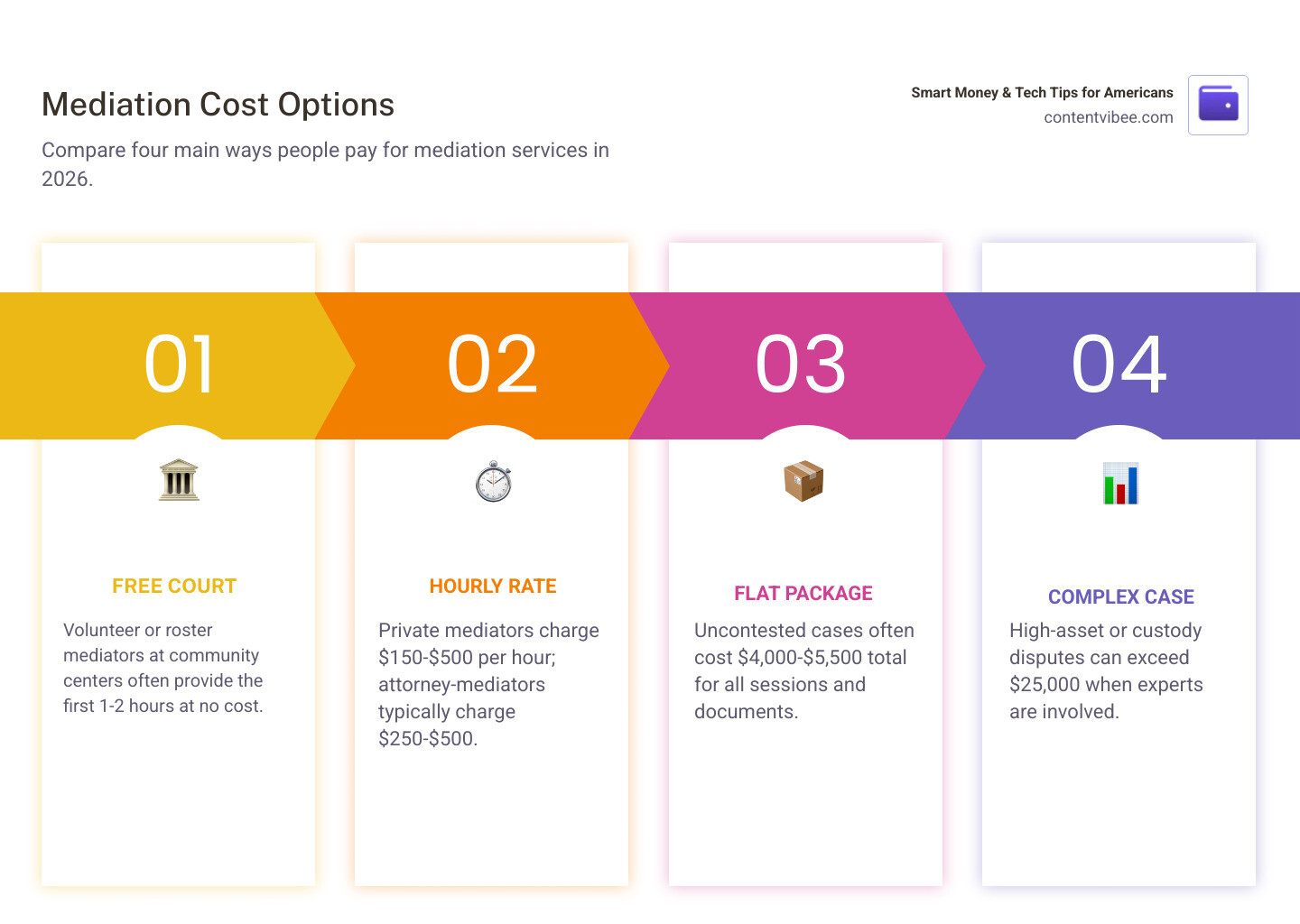
Typical Hourly and Flat Fees
- Hourly Fees: The most common structure. Most mediators in California charge between $150 and $500 per hour.
- Attorney-Mediators: Because they can provide legal context (though not individual legal advice), attorney-mediators typically charge at the higher end, ranging from $250 to $500 per hour.
- Flat-Rate Packages: Many firms now offer “all-in” packages for uncontested divorces or simple disputes. These typically cost between $4,000 and $5,500 and include a set number of sessions and document preparation.
- Initial Consultation: Some mediators offer a free 30-minute screening call, while others charge their standard hourly rate for the first meeting.
If you’re feeling overwhelmed by these numbers, you aren’t alone. You can find more details on navigating the financial maze of family law costs to see how these fees fit into a larger legal budget.
How much does mediation cost money for complex divorces?
When a marriage involves significant assets, the mediation process becomes more intensive. High-asset cases involving business valuations, multiple real estate holdings, or complex retirement accounts (like QDROs) require more time and precision.
In these instances, mediation can cost $25,000 or more. While that sounds high, a litigated high-asset divorce can easily exceed $100,000 per spouse in legal fees. Mediation remains the “budget-friendly” choice even at the high end.
Standard rates for straightforward disputes
For a “standard” case—perhaps a marriage of less than 10 years with a home and a few shared accounts—the process is much faster.
- Duration: Usually 4 to 6 hours of actual meeting time.
- Total Cost: Typically ranges from $5,000 to $7,500.
- Efficiency: These cases are often resolved in two or three sessions of 90 minutes each, which helps keep the parties focused and prevents “decision fatigue.”
Factors That Influence the Total Price of Mediation
The total bill isn’t just about the mediator’s hourly rate; it’s about the “friction” involved in the case. Several variables can push your costs up or down.
Case Complexity and Number of Disputes
If you agree on 90% of the issues but are stuck on one specific asset, your mediation will be brief. However, if you are disputing child custody, alimony, and the division of a family business, you will naturally spend more hours in the mediator’s office.
Additional expenses to budget for
The mediator’s fee isn’t the only cost. Depending on your situation, you might need:
- Forensic Accountants: To track down assets or value a business ($300–$600/hour).
- Consulting Attorneys: Even in mediation, it is wise to have your own lawyer review the final agreement.
- Filing Fees: California court filing fees for a petition for dissolution of marriage are currently around $435, though this varies slightly by county.
- Paralegal Support: Some mediation firms use paralegals for document gathering to save you money on the mediator’s higher hourly rate.
For a deeper dive into California-specific pricing, check out this guide on divorce mediation costs in California.
How party cooperation impacts the bottom line
This is the “secret sauce” of saving money. If both parties arrive prepared, organized, and willing to compromise, the cost drops significantly.
- Homework: Mediators often give “homework” (gathering bank statements, tax returns, etc.). If you do this work yourself, you aren’t paying a professional $300/hour to sort through your shoebox of receipts.
- Conflict Levels: Every hour spent arguing over “who gets the toaster” is an hour you are paying for. We always recommend saving the emotional battles for a therapist and using the mediator for the business of the settlement.
Who Pays for Mediation and How to Find Low-Cost Options?

A common question is: “Who is responsible for the bill?” In most cases, the default is a 50/50 split between the two parties. This ensures that both sides have “skin in the game” and are motivated to reach a resolution.
Cost Splitting and Insurance
- 50/50 Split: This is the standard for divorce and most civil disputes.
- Insurance Defense: In personal injury or insurance cases, if the settlement is expected to be over $100,000, the insurance company often picks up the entire mediation bill to encourage a settlement and avoid trial costs.
- Employment Disputes: In some workplace mediations, the employer may pay the full cost as part of their internal dispute resolution policy.
Does mediation cost money for child custody cases?
In California, there is a major exception to the “mediation costs money” rule. Under California Family Code § 3160, the state mandates mediation for any case involving child custody or visitation disputes. These services are provided by the court (often through Family Court Services) at no cost to the parents. While these sessions are focused strictly on parenting plans and not financial division, they provide an invaluable free resource for families.
Financial assistance and fee waivers
If you cannot afford mediation, you aren’t necessarily out of luck.
- CDRCs: Community Dispute Resolution Centers provide sliding-scale fees based on your income.
- Fee Waivers: If you have a court-ordered mediation and meet “indigent status” requirements, you can file a motion to have the fees waived or reduced.
- Law School Clinics: Some California law schools offer free mediation clinics where supervised students help parties resolve disputes.
To learn more about how these costs are split specifically in the Golden State, you can read about who pays for mediation in California.
Mediation vs. Litigation: A Financial Comparison
The biggest reason to choose mediation isn’t just that it’s “cheaper”—it’s that it’s predictably cheaper. Litigation is an open-ended financial commitment. Trial dates can be pushed back, motions can be filed, and discovery can take years.
Why mediation is 60-80% cheaper than trial
In a typical litigated case, each party hires their own attorney. According to 2026 data, a contested divorce can cost between $15,000 and $35,000 per spouse.
- Reduced Legal Hours: Instead of two lawyers billing for every phone call and email, you have one mediator facilitating the core conversation.
- No Formal Discovery: Discovery (the legal process of gathering evidence) is the most expensive part of a lawsuit. In mediation, parties voluntarily exchange documents, saving thousands in legal fees.
- Fewer Procedural Steps: You skip the hearings, the depositions, and the “waiting for a judge” time.
If you want to see how this compares to other legal costs, check out our guide on how much a personal injury lawyer costs.
Long-term savings of mediated agreements
Beyond the immediate bill, mediation saves money in the future.
- Higher Compliance: People are more likely to follow an agreement they helped create than a “judgment” handed down by a stranger in a robe.
- Relationship Preservation: For parents, the ability to co-parent without hostility is priceless. It prevents future “post-decree” litigation, which can cost a fortune in the years following a divorce.
Frequently Asked Questions about Mediation Costs
How do mediators typically charge for their time?
Most mediators in 2026 use hourly billing. However, for civil cases (like a car accident or business dispute), many prefer half-day (4 hours) or full-day (8 hours) flat rates. This prevents the “clock-watching” stress and encourages parties to stay until the deal is done. You should also ask about “administrative fees”—some offices charge a one-time fee of $150–$500 to set up your file.
Can one party be forced to pay the entire mediation bill?
A judge can order one party to pay the full cost if there is a significant income disparity, but usually, it’s a mutual agreement. In settlement negotiations, one side might offer to pay the full mediation fee as an “olive branch” to get the other side to agree to a specific deal.
What happens to the fees if mediation fails?
This is a tough one. If you spend 10 hours in mediation and don’t reach an agreement, you still owe the mediator for those 10 hours. Most retainers are non-refundable for time already spent. However, even “failed” mediation usually narrows the issues, meaning you’ll spend less time (and money) in court later because you’ve already sorted through the basic facts.
Conclusion
At Smart Money & Tech Tips for Americans, we believe that financial empowerment starts with having the right information. Does mediation cost money? Yes, it is a professional service that requires an investment. However, compared to the alternative of a long, public, and expensive court battle, it is almost always the smarter financial move.
By choosing mediation, you take control of the timeline, the privacy, and—most importantly—the costs of your legal resolution. Whether you are navigating a divorce or a business dispute, being prepared with organized documents and a willingness to compromise will be your best strategy for keeping those fees in check.
To learn more about our mission to help Americans navigate complex financial and legal hurdles, visit our about page.