Introduction
Delaware state filing fees vary depending on your business type, but here are the core costs you need to know right now:
| Filing Type | Fee |
|---|---|
| LLC Formation (Certificate of Formation) | $110 |
| Corporation Formation (minimum) | $109 |
| Name Reservation (120 days) | $75 |
| LLC Annual Franchise Tax | $300 (due June 1) |
| Corporate Annual Report Fee (domestic) | $50 (due March 1) |
| Corporate Annual Report Fee (foreign) | $125 (due June 30) |
| Corporate Franchise Tax (minimum) | $175–$400 |
| Certificate of Good Standing (short form) | $50 |
| 1-Hour Expedited Processing | $1,000 |
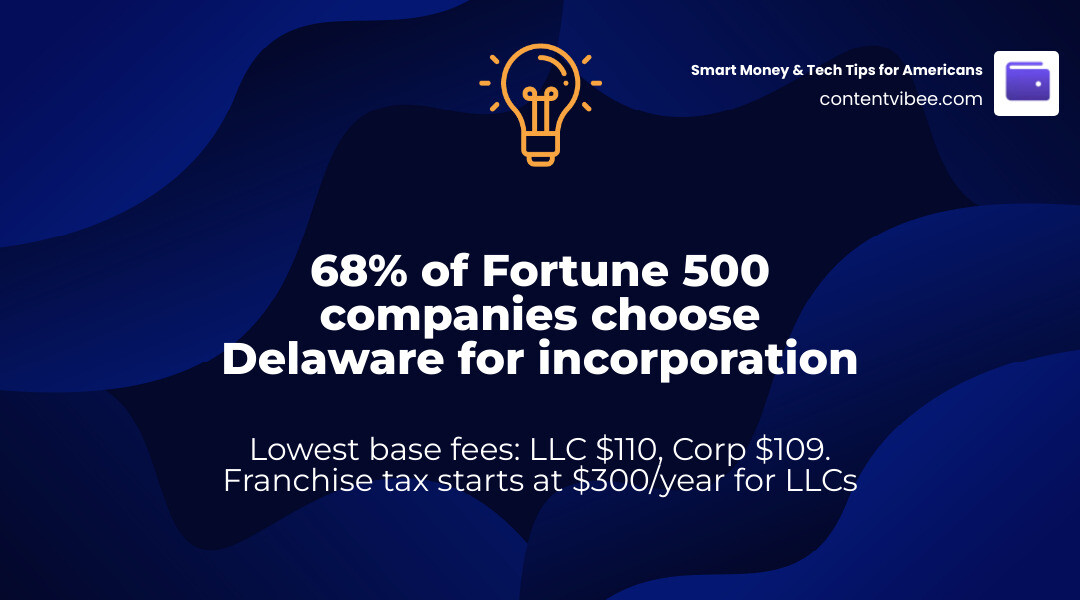
Delaware has a well-earned reputation as the top state for business formation. More than 68% of Fortune 500 companies are incorporated there — and for good reason. The state offers a business-friendly legal environment, a specialized Court of Chancery, and a streamlined filing system through the Division of Corporations.
But “business-friendly” doesn’t always mean cheap. Whether you’re forming an LLC, incorporating, or just trying to stay compliant year after year, the fees add up quickly — especially if you need expedited processing, certified documents, or registered agent services.
This guide breaks down exactly what you’ll pay, so there are no surprises.
When we think of Delaware, we often think of a corporate haven. The state’s fame comes largely from the Court of Chancery, a specialized court that handles business disputes with judges instead of juries, providing a level of predictability that big corporations love. However, for most of us running smaller ventures or tech startups, the primary concern is the bottom line: what are the delaware state filing fees going to look like today, in May 2026?
Operating in the legal and financial advice industry, we at Smart Money & Tech Tips for Americans have seen many entrepreneurs get blindsided by “hidden” costs. While the initial formation fee might look low, Delaware’s tiered tax system and expedited service surcharges can turn a $110 filing into a $1,500 bill if you aren’t careful.
Initial Formation: Delaware State Filing Fees for LLCs and Corporations
Setting up your entity is the first hurdle. Delaware distinguishes clearly between Limited Liability Companies (LLCs) and Corporations, both in how they are governed and how much they cost to start.
For those forming an LLC, the process is relatively straightforward. You file a Certificate of Formation, and the standard state filing fee is $110. This is a flat fee, making it the preferred choice for many small business owners who want simplicity.
Corporations, however, have a more variable cost structure. To start a domestic corporation, you file a Certificate of Incorporation. The minimum fee is $109, but this is just the starting point. This total includes a $15 minimum filing tax, an $89 filing fee, and a $5 municipality fee. If your document is long, be prepared to pay $9 per page for county recording fees for every page after the first one.
Before you even file, you might want to secure your business name. A name reservation in Delaware costs $75 and holds your chosen name for 120 days. This is a great way to protect your brand while you get your paperwork in order. For the most up-to-date figures, you can always check the Official Delaware Corporate Fee Schedule.
Calculating Delaware State Filing Fees for Stock Corporations
If you are starting a corporation, the state wants to know about your “Authorized Shares.” This is the total number of shares the company is legally allowed to issue.
- Minimum Filing Tax: $15 (for the first few thousand shares).
- Base Filing Fee: $89.
- County Overage: $9 per page for additional pages.
If you are authorizing millions of shares right out of the gate, your initial filing fee will climb significantly higher than the $109 minimum.
Foreign Qualification Costs
What if you are already incorporated in a state like California but want to do business in Delaware? You’ll need to “qualify” as a foreign entity. The Certificate of Authority for a foreign corporation carries a minimum fee of $245. Additionally, you are required by law to maintain a registered agent with a physical address in Delaware to receive legal documents, which adds an annual service cost.
Understanding Corporate Stock Fees: Par Value vs. No-Par Value
This is where things get a bit technical, and where many new owners get confused. When you set up a corporation, you must decide if your stock has a Par Value or No-Par Value. This choice drastically changes your delaware state filing fees and future taxes.
You can use the Delaware Initial Filing Fee Calculator to run these numbers based on your specific share structure.
The Authorized Shares Method
The Authorized Shares Method is usually best for corporations with a small number of authorized shares (typically 5,000 or fewer).
- 5,000 shares or less: $175 minimum tax.
- 5,001 to 10,000 shares: $250 tax.
- Each additional 10,000 shares: Adds $85 to the tax bill.
The maximum annual tax for this method is $200,000.
The Assumed Par Value Capital Method
For startups that plan to issue millions of shares but have low total assets, the Assumed Par Value Capital Method is often the “money-saving” route. This method calculates tax based on your total gross assets and the ratio of issued shares to authorized shares.
- Minimum Tax: $400.
- Tax Rate: $400 per million (or portion thereof) of assumed par value capital.
- Large Corporate Filers: If you reach certain revenue or asset thresholds, you may be designated a “Large Corporate Filer,” which carries a maximum tax of $250,000.
Annual Compliance: Franchise Taxes and Reporting Deadlines
In Delaware, you don’t just pay once and forget about it. The state collects an annual “Franchise Tax” for the privilege of being incorporated there.
- LLCs: Pay a flat $300 annual tax. There is no “annual report” document to file, just the payment. The deadline is June 1st every year.
- Domestic Corporations: Must file an Annual Report and pay Franchise Tax by March 1st. The filing fee for the report is $50 ($25 for exempt non-profits).
- Foreign Corporations: Must file their annual report by June 30th and pay a $125 filing fee.
Penalties for Late Delaware State Filing Fees
Delaware is strict about its deadlines. If you miss the March 1st or June 1st cutoff, the state will immediately assess a $200 penalty. On top of that, they charge 1.5% interest per month on both the unpaid tax and the penalty. If you let this go too long, your business status will become “Void,” and you’ll have to pay significant reinstatement fees to get back into “Good Standing.”
Mandatory Nature of Business Disclosure
As of recently, Delaware requires all domestic corporations to disclose the “Nature of Business” on their annual reports. This is a mandatory field that describes your revenue-generating activities. Failure to fill this out accurately can lead to your filing being rejected, which might push you past the deadline and into penalty territory.
Expedited Services and Administrative Document Costs
If you are in a rush to close a deal or open a bank account, Delaware offers some of the fastest processing times in the country—for a price.
- Priority 1 (1-Hour Service): $1,000 surcharge.
- Priority 2 (2-Hour Service): $500 surcharge.
- Same-Day Service: $100 fee (must be submitted by a certain time).
- 24-Hour Service: $50 fee.
These fees are in addition to the standard filing costs. If you are forming an LLC ($110) and need it in an hour, you are looking at a $1,110 total.
Certificates and Certified Copies
Banks and investors often require proof that your business is legitimate.
- Certificate of Good Standing (Short Form): $50. This confirms your entity is active and taxes are paid.
- Certificate of Good Standing (Long Form): $175. This includes a more detailed history of your filings.
- Certified Copies: $50 per document.
- Apostilles: If you are doing business internationally, you may need an Apostille for document authentication, which carries its own set of fees depending on the use case.
UCC Filings and Search Fees
Uniform Commercial Code (UCC) filings are essential if your business is taking out loans using equipment or inventory as collateral.
- UCC-1 (Web Filing): $50 flat fee. This is the most cost-effective method.
- UCC-1 (Authorized Filer): $100 base fee.
- Additional Debtors: $25 surcharge per name if there are more than two debtors.
- Extra Pages: $2 per page after the first four pages.
For more details on lien-related costs, see the UCC Filing & Expedited Fees page.
Comparing Delaware State Filing Fees to Neighboring States
While Delaware is the most popular, it isn’t always the cheapest. Here is how it stacks up against its neighbors:
| State | Formation Fee | Annual Fee/Tax |
|---|---|---|
| Delaware | $110 (LLC) / $109 (Corp) | $300 (LLC) / $175+ (Corp) |
| Pennsylvania | $125 | $0 (Decennial report) |
| New York | $200 | $25+ (Biennial) |
| New Jersey | $125 | $75 (Annual) |
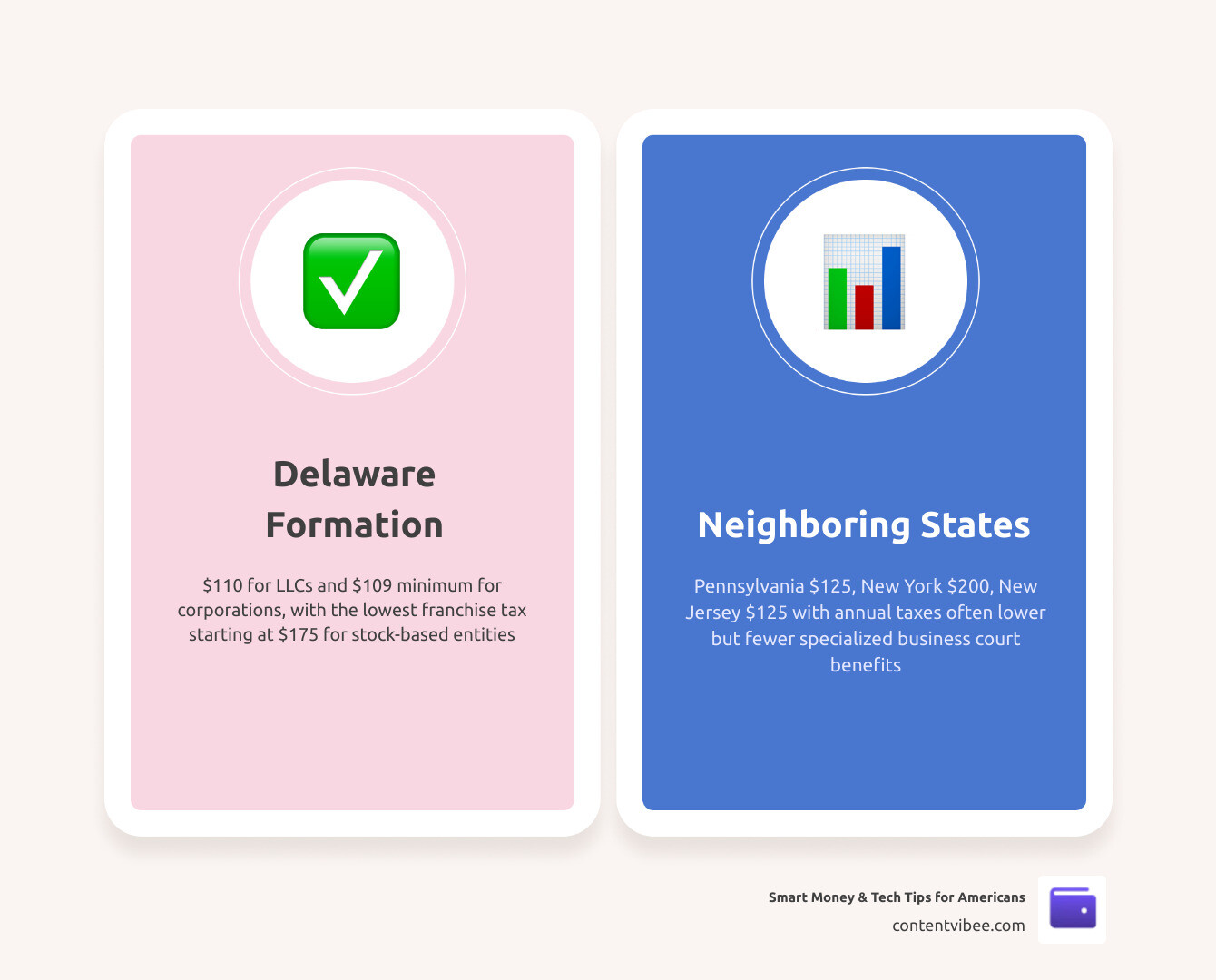
While Delaware’s annual costs are higher, businesses choose it for the legal infrastructure. If you anticipate complex lawsuits or plan to go public, the extra $300 a year is seen as a “legal insurance” premium.
Frequently Asked Questions about Delaware State Filing Fees
What is the cheapest way to file a UCC-1 in Delaware?
The cheapest way is definitely the web filing portal, which costs a flat $50. Using an “authorized filer” (a third-party service) usually doubles that base cost to $100 before any additional service fees are added. Ensure your XML transmissions are formatted correctly to avoid delays.
How much does a Delaware Certificate of Good Standing cost?
A standard Short Form certificate costs $50. This is usually all you need for bank accounts or lease agreements. If you need a Long Form certificate, which lists all filed amendments and merger history, the cost jumps to $175.
Are there additional costs for registered agents and DBAs?
Yes. Delaware requires a Registered Agent. While you can sometimes act as your own if you have a physical office in the state, most out-of-state owners pay between $100 and $300 annually for a professional service.
If you want to operate under a name other than your legal entity name (e.g., “XYZ LLC” doing business as “Tasty Treats”), you must file a DBA (Doing Business As). In Delaware, these are handled at the county level (New Castle, Kent, or Sussex), and fees vary by county but are generally around $25-$50.
Conclusion
Navigating delaware state filing fees requires a mix of smart budgeting and strict adherence to the calendar. While the $110 LLC formation fee is affordable, the ongoing $300 annual tax and potential $1,000 rush fees can catch the unprepared off guard.
At Smart Money & Tech Tips for Americans, we recommend filing early to avoid the “procrastination tax” of expedited fees and late penalties. Always double-check your stock calculations if you’re incorporating, and keep a close eye on those March and June deadlines.
Ready to make your mark in the most business-friendly state in the union? Start your business today with professional filing support and ensure your compliance is handled by the experts.