


What You Need to Know About California Divorce in 2026
A California divorce — legally called a dissolution of marriage — ends your marriage through the court system and can also settle property, debts, child custody, and support.
Quick answers for common questions:
| Question | Answer |
|---|---|
| Do I need my spouse’s agreement? | No — California does not require mutual consent |
| What is the legal ground for divorce? | Irreconcilable differences (no-fault state) |
| Residency requirement? | 6 months in California + 3 months in your filing county |
| How long does it take? | At minimum, 6 months and 1 day from date of service |
| Filing fee? | $435–$450 per spouse (as of 2026) |
| Faster option available? | Yes — summary dissolution for short marriages with limited assets |
Going through a divorce is one of the most stressful and expensive things a person can face. Legal fees, court costs, and emotional strain hit all at once. The good news: understanding the process early can save you serious time and money.
California was actually the first state in the U.S. to adopt no-fault divorce, back in 1969. That means you don’t need to prove your spouse did anything wrong. You simply need to show the marriage has broken down due to irreconcilable differences.
This guide walks you through every step — from checking eligibility to finalizing your judgment — so you can move forward with confidence.
Eligibility and Residency Requirements for a California Divorce
Before we dive into the paperwork, we need to make sure you can actually file in the Golden State. California has strict residency requirements that act as “gatekeepers” for the court system.
To file for a california divorce, at least one spouse must have lived in California for the last six months. Additionally, that person must have lived in the specific county where the case is being filed for the last three months.
But what if you don’t meet these requirements yet? Don’t panic. Many people file for a “legal separation” first. Legal separation doesn’t have a residency requirement. Once you hit the six-month mark of living in the state, you can usually “amend” your petition to a full divorce.
Special Residency Situations
- Military Members: If you are stationed in California, you may meet residency requirements even if your “legal” home is another state.
- Same-Sex Couples: If you were married in California but now live in a state (or country) that won’t let you divorce because they don’t recognize your marriage, California courts may allow you to file here regardless of residency.
- Domestic Partners: For those in registered domestic partnerships, the rules are almost identical to marriage. If the partnership was registered in California, the court has jurisdiction to end it even if neither of you lives here anymore.
For a deeper dive into these specific legal nuances, we recommend checking out the Divorce in California | California Courts | Self Help Guide.
Choosing Your Path: Dissolution, Separation, or Annulment
Not every relationship ends the same way. In California, we have several legal paths to choose from, and picking the right one can save you thousands in legal fees.
1. Dissolution (Divorce)
This is the standard path. It restores both parties to the status of “single” and allows for the division of assets, custody orders, and support.
2. Summary Dissolution
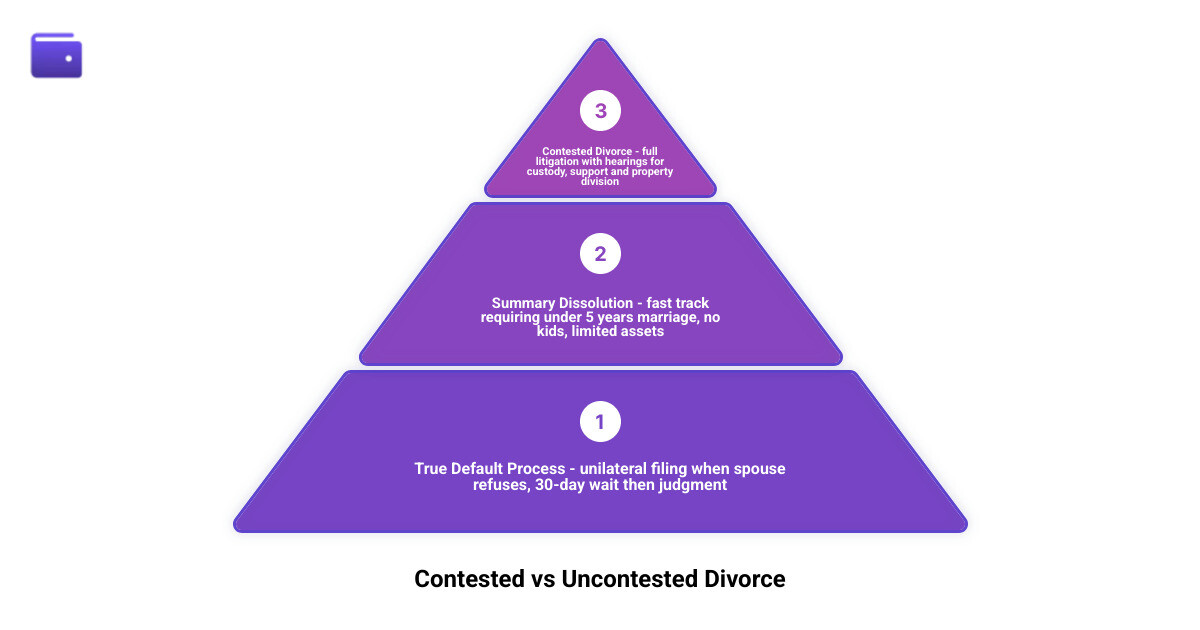
Think of this as “Divorce Lite.” It’s a faster, simpler way to end a marriage for couples who meet very specific criteria:
- Married for 5 years or less.
- No children together.
- Don’t own any real estate.
- Limited community property and debts (usually under $57,000 in assets).
- Both parties agree to the divorce.
3. Joint Petition
New for 2026, the Joint Petition option allows couples who agree on everything to file together from the start. This streamlines the process and can often reduce the total number of forms required.
4. Legal Separation
In a legal separation, the court decides on property and custody, but you remain legally married. People often choose this for religious reasons or to keep certain insurance benefits. You cannot remarry while legally separated.
5. Nullity (Annulment)
An annulment means the marriage was never legal to begin with. This is rare and requires proving things like fraud, bigamy, or “unsound mind” at the time of the wedding.
| Feature | Divorce (Dissolution) | Legal Separation | Annulment (Nullity) |
|---|---|---|---|
| Ends Marriage? | Yes | No | Yes (Marriage never existed) |
| Residency Required? | Yes | No | No |
| Waiting Period? | 6 Months | None | None |
| Can Remarry? | Yes | No | Yes |
When weighing these options, consider the financial impact. We’ve found that many couples rush into the most expensive option without realizing a simpler path exists. For more on the fiscal side of things, read our guide on Navigating the Financial Maze of Family Law Costs.
Step-by-Step Guide to the California Divorce Process

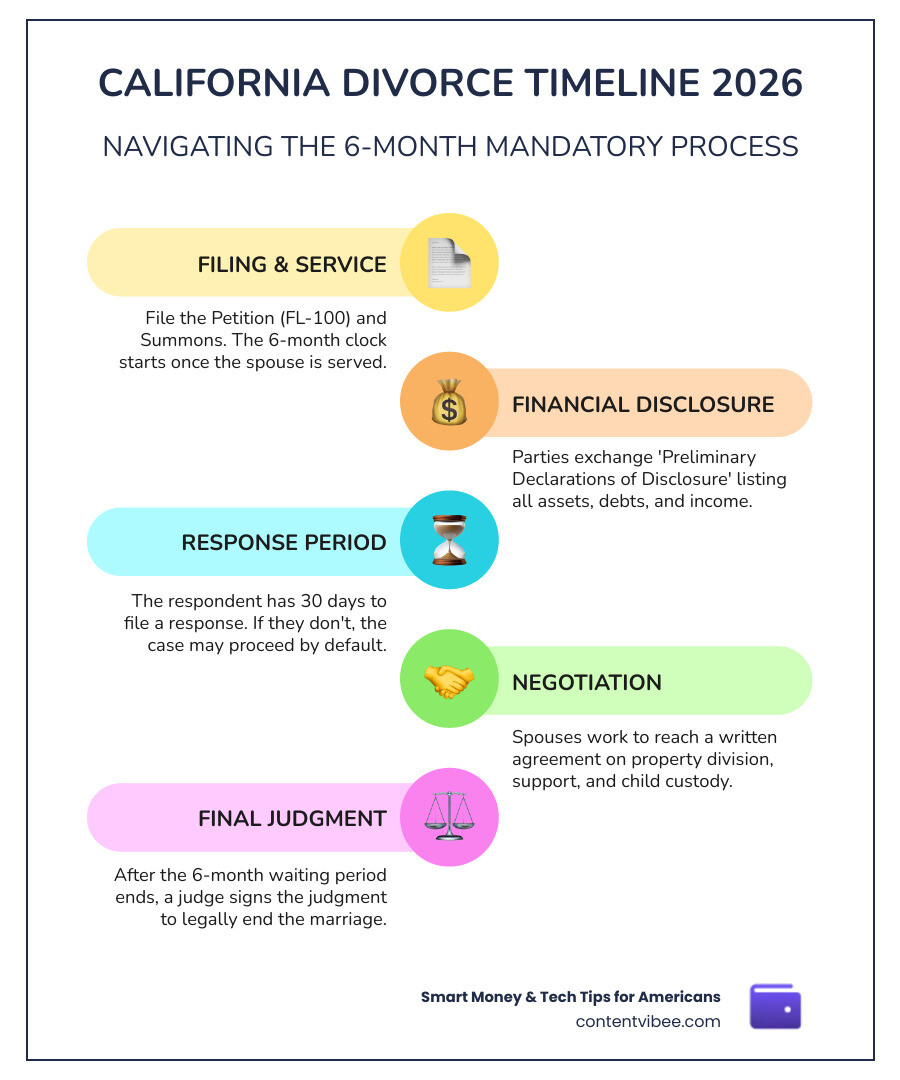
Once you’ve chosen your path, it’s time to face the paperwork. The california divorce process follows a specific sequence of “moves” that ensure both sides are treated fairly.
The primary forms you’ll need to start are:
- Petition (FL-100): This tells the court what you want (divorce, custody, etc.).
- Summons (FL-110): This notifies your spouse that a case has started and explains the “automatic temporary restraining orders” (ATROs) that prevent either of you from moving money or taking children out of state without permission.
For a comprehensive checklist of these forms, the state provides an excellent resource: FL-107-INFO Legal Steps for a Divorce or Legal Separation.
Filing Your Initial California Divorce Papers
To start the clock on that mandatory six-month waiting period, you must file your papers with the court clerk. As of May 2026, the filing fee in most California counties is between $435 and $450.
If you cannot afford the fee, you can ask for a “Fee Waiver.” If you are on public assistance or have a low income, the court will often waive the costs entirely. This is a crucial “pro-tip” for managing your budget during a transition. If you’re wondering about the bigger picture of expenses, check out How Much Do Divorce Lawyer Fees Really Cost?.
Serving and Responding to a California Divorce Petition
After filing, you must legally “serve” your spouse. You cannot just hand them the papers yourself; a third party over 18 must do it and sign a Proof of Service.
Once served, your spouse has 30 days to file a Response.
- If they respond: The case is “contested” (even if you agree on most things).
- If they don’t respond: You can ask for a Default Judgment. This means you can finish the divorce without their participation, though you still have to follow all the legal steps.
If you find yourself in a high-conflict situation in a major city like Los Angeles, you might need professional help to navigate the response phase. We recommend looking through Detailed Reviews of the Top 10 Family Law Attorneys LA to see who might best represent your interests.
Dividing Assets, Debts, and Navigating Family Law
California is a community property state. This is one of the most misunderstood parts of a california divorce.
In simple terms, almost everything you earned or bought during the marriage is owned 50/50 by both spouses. It doesn’t matter whose name is on the paycheck or the car title. Conversely, “separate property” (things you owned before the marriage or received as an inheritance/gift) usually stays with the original owner.
Financial Disclosures: The “No Secrets” Rule
Both spouses must complete a Declaration of Disclosure. This is a full list of everything you own and everything you owe. In California, hiding assets is a big no-no; if a judge finds out you hid a secret bank account, they can actually award 100% of that account to your spouse as a penalty.
Child Custody and Support
California uses the “Best Interest of the Child” standard. Courts prefer “frequent and continuing contact” with both parents unless there is a safety concern.
- Legal Custody: Who makes big decisions (school, doctors).
- Physical Custody: Where the child lives.
- Child Support: Calculated using a statewide formula based on income and the amount of time each parent spends with the child.
Spousal Support (Alimony)
Unlike child support, spousal support isn’t just a simple formula for long-term orders. Judges look at factors like the length of the marriage, the “standard of living” during the marriage, and each person’s ability to work. Generally, if you were married for less than 10 years, support usually lasts for half the length of the marriage.
Domestic Violence Protections
Safety is our first priority. If there is a history of abuse, California law provides strong protections. A history of domestic violence can create a “rebuttable presumption” that the abuser should not have sole or joint custody. Furthermore, if a spouse is convicted of a violent sexual felony or domestic violence, they may be barred from receiving any spousal support.
For survivors, resources like California Divorce | WomensLaw.org offer vital safety planning and legal information. Divorce can be expensive, but your safety is priceless. As we often say, Divorce Costs: Why Your Ex Might Be Your Most Expensive Hobby, but staying in an unsafe situation has a much higher cost.
Frequently Asked Questions about California Divorce
How long is the mandatory waiting period in California?
The absolute earliest your divorce can be final is six months and one day from the date the respondent was served with the papers. This is a mandatory “cooling off” period required by state law. Even if you agree on everything on Day 1, you aren’t legally single until that six-month clock runs out. You cannot remarry until you receive a final judgment with a specific “status termination date.”
Can I get a divorce if my spouse refuses to sign?
Yes. Because California is a no-fault state, you do not need your spouse’s permission to get a divorce. If they refuse to sign the papers or participate in the process, you can move forward with a “True Default.” As long as you have properly served them and waited the 30-day response period, the court can grant the divorce without their signature.
What are the requirements for a summary dissolution?
As mentioned earlier, this is the “shortcut” path. To qualify in 2026, you generally must:
- Be married for less than 5 years.
- Have no children (and the wife isn’t pregnant).
- Not own any land or buildings.
- Owe less than $7,000 in “community” debts (excluding car loans).
- Have community property worth less than $57,000.
- Both sign a joint agreement dividing your property.
For more details on this specific process, visit The divorce process | California Courts | Self Help Guide.
Conclusion
Navigating a california divorce is a marathon, not a sprint. Between the residency requirements, the mandatory six-month waiting period, and the complexities of community property, there is a lot to manage. However, by staying organized and utilizing the self-help resources provided by the California Courts, you can navigate this transition without losing your mind—or all of your savings.
At Smart Money & Tech Tips for Americans, we believe that the right information is the best tool for financial and personal stability. Whether you are filing a joint petition or dealing with a complex contested case, the “final judgment” is your goal. Once that paper is signed by a judge and the waiting period has passed, you are free to begin your next chapter.
If you’re in the Los Angeles area and realize you need professional guidance to handle the heavy lifting, don’t hesitate to consult our Detailed Reviews of the Top 10 Family Law Attorneys LA to find a partner who can help you protect your future. Stay smart, stay safe, and take it one form at a time.