


Your Savings Are Losing Value — Unless You Act Now
High interest savings accounts are one of the simplest, lowest-risk tools available to protect your money from inflation — and right now, the difference between the best and worst accounts is staggering.
Here’s a quick look at what you need to know:
| What You’re Looking For | Quick Answer |
|---|---|
| Top APY available (July 2026) | 4.15% (Forbright Bank) |
| National average APY | 0.38% |
| How much better are top accounts? | Up to 10x the national average |
| Minimum deposit required | $0 at many top banks |
| Are deposits insured? | Yes — FDIC insured up to $250,000 |
| Monthly fees at top accounts | None |
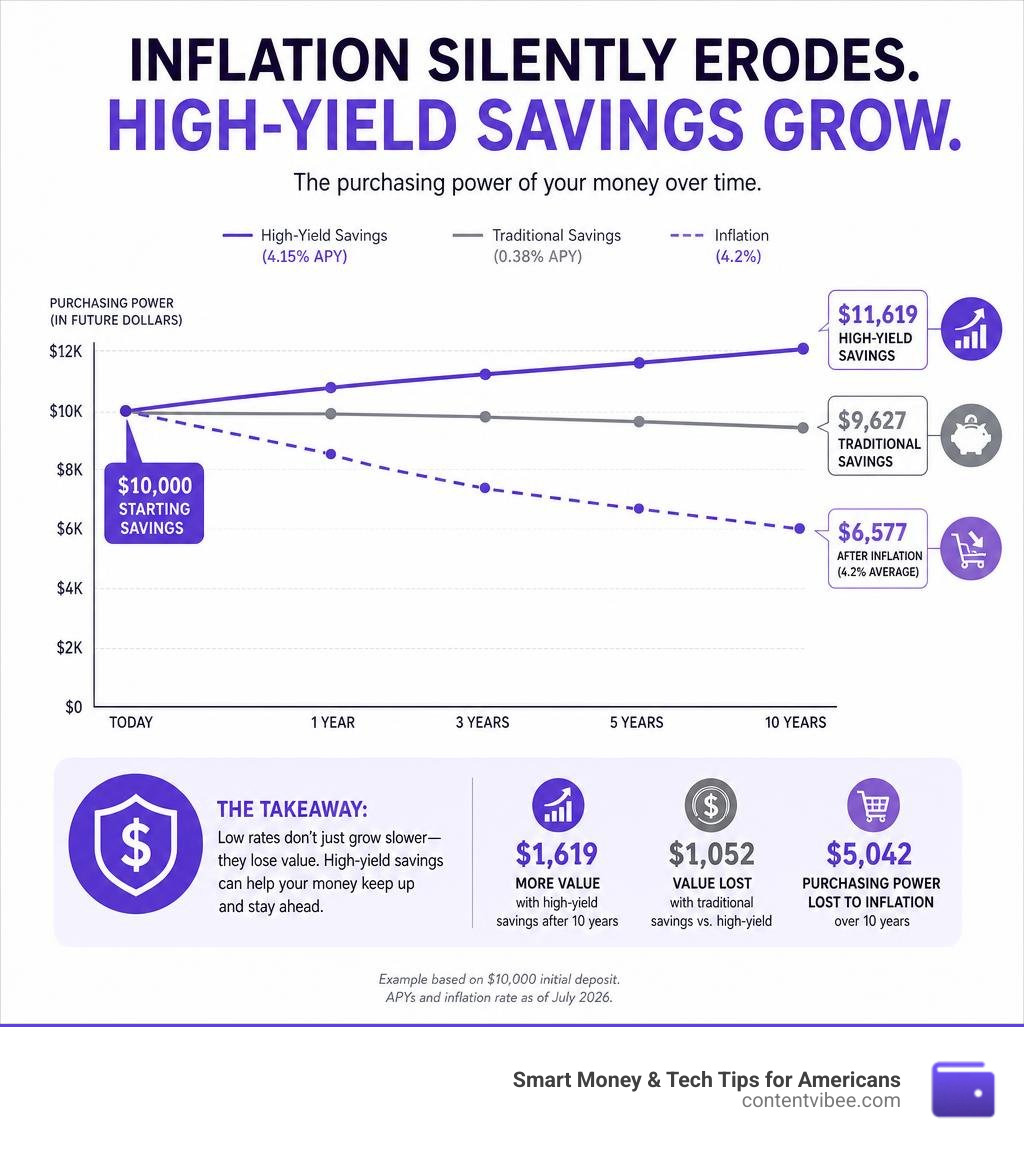
The math is simple but sobering. If inflation is running at 4.2% (as it did in May 2026), a traditional savings account paying 0.38% isn’t just underperforming — it’s actively costing you purchasing power every month.
For retirees and pre-retirees especially, this gap matters. You’ve worked hard to build your nest egg. Leaving it in a low-yield account is like leaving money on the table — permanently.
The good news? The top high-yield savings accounts today are closing that gap, offering rates that can actually keep pace with or beat inflation — with zero stock market risk and no landlord headaches.
In this guide, we’ll walk you through exactly which accounts are paying the most, what to watch out for, and how to get your money working harder starting today.
What is a High-Yield Savings Account and How Does It Work?
To understand why a high-yield savings account (HYSA) is such a powerful financial tool, it helps to look under the hood of traditional banking. For decades, Americans walked into their local brick-and-mortar bank branches, deposited cash, and walked out with a passbook savings account. Today, those same traditional accounts pay a measly national average of 0.38% APY.
A high-yield savings account operates on the same basic principles as a traditional savings account, but with one massive upgrade: it pays an interest rate that is often ten times higher.
The secret behind these higher rates lies in online banking and digital convenience. Online-only financial institutions do not have to pay for physical branch networks, tellers, vault security, or utility bills for hundreds of physical locations. They pass these massive overhead savings directly to you in the form of a higher Annual Percentage Yield (APY).
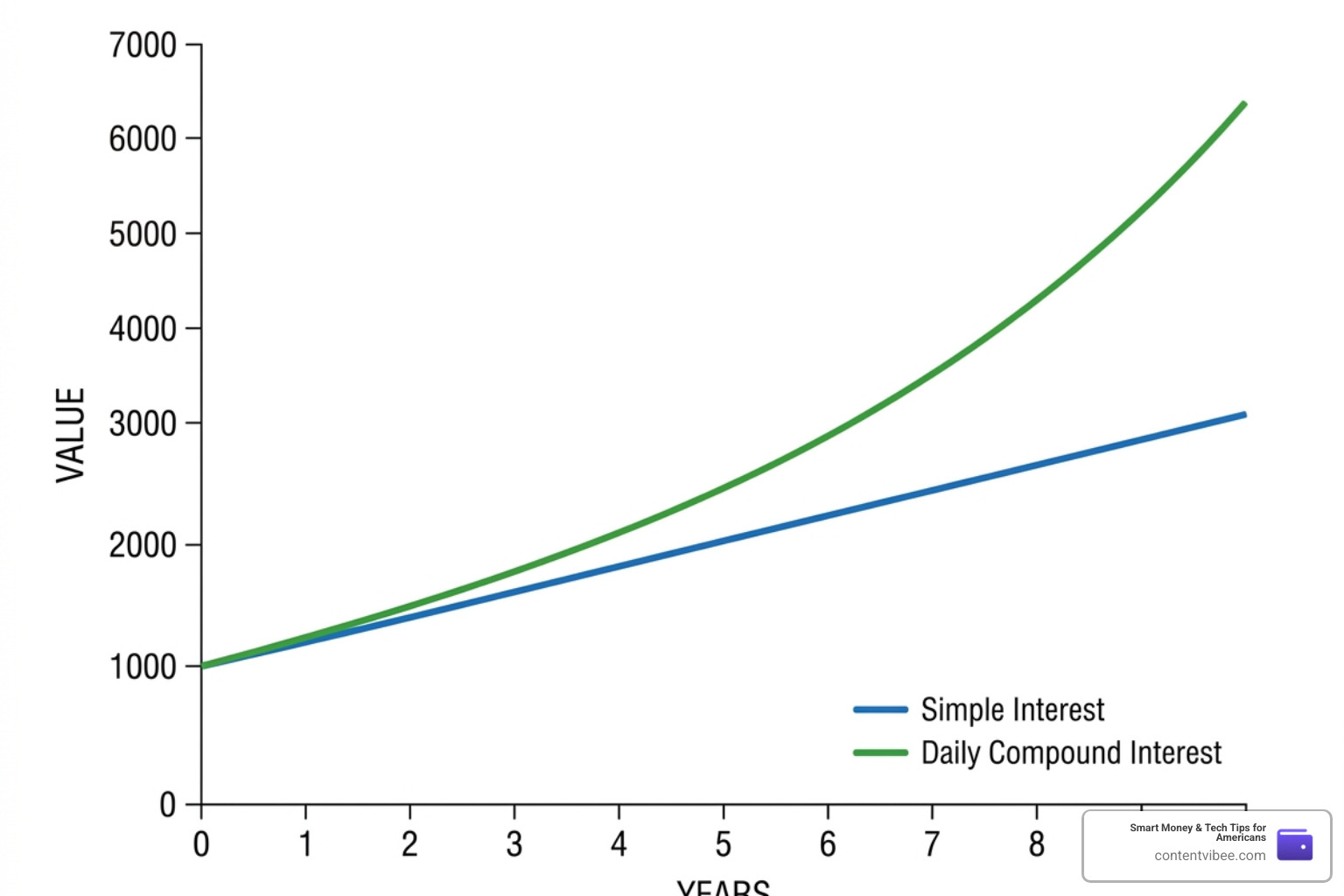
At the heart of how these accounts grow your money is compound interest. Compound interest is essentially earning “interest on your interest.” When you deposit money into a high-yield account, the bank calculates your interest earnings periodically.
Most top-tier online banks use daily compounding. This means that every single day, the bank calculates interest based on your current balance (which includes the principal you deposited plus any interest you have already earned). At the end of each month, this accumulated interest is paid out and added to your balance, creating a larger base for the next month’s daily compounding calculations. Over time, this compounding effect acts like a snowball rolling down a hill, accelerating your savings growth without you having to lift a finger.
Key Features of High Interest Savings Accounts
When you are evaluating different high interest savings accounts, you will find that they share several defining features designed to make saving both lucrative and hassle-free:
- Minimal or Zero Fees: Unlike traditional brick-and-mortar accounts that might charge you $5 to $12 a month just to keep your account open, the best online high-yield accounts pride themselves on having no monthly maintenance fees.
- Low to No Minimum Deposits: Many of the top-paying banks allow you to open an account with a $0 minimum deposit. This means you do not need a massive fortune to start earning top-tier interest rates.
- Daily Compounding with Monthly Payouts: As mentioned, daily compounding maximizes your growth potential, ensuring that every penny starts working for you immediately.
- Robust Digital Tools: Because these institutions are digital-first, they invest heavily in intuitive mobile apps, automated transfer options, and goal-tracking features.
Top High Interest Savings Accounts Rates in July 2026
Finding the best home for your cash requires looking at the current marketplace. As of July 2026, the savings landscape is highly competitive, even as we navigate the ripple effects of recent Federal Reserve monetary policy.
Today’s top-performing savings rate is 4.15% APY, offered by Forbright Bank. When you compare this to the current national average of 0.38% APY (a rate that has remained stubbornly unchanged since April 20, 2026, according to official FDIC monthly data), the contrast is stark.
To help you compare high interest savings options, we have compiled a list of the top-performing accounts in the market today.
| Financial Institution | Current APY (July 2026) | Minimum Deposit to Open | Monthly Fee | Key Highlight |
|---|---|---|---|---|
| Forbright Bank | 4.15% APY | $0 | $0 | Market-leading rate with no minimum balance requirements. |
| CIT Bank | 4.10% APY | $100 | $0 | Requires a $5,000 minimum balance to unlock the Platinum tier rate. |
| Vio Bank | 4.01% APY | $100 | $0 | High yield with a low opening threshold. |
| Peak Bank | 4.01% APY | $100 | $0 | Highly competitive rate with clean digital management. |
| Happen Bank | 4.00% APY | $0 | $0 | Requires a $250 monthly recurring deposit to maintain top rate. |
| Marcus by Goldman Sachs | 3.40% APY | $0 | $0 | Backed by Goldman Sachs; offers seamless same-day transfers up to $100,000. |
| Synchrony Bank | 3.30% APY | $0 | $0 | Award-winning customer service and highly rated mobile apps. |
| Amex Online Savings | 3.10% APY | $0 | $0 | Backed by over 170 years of brand history; no minimums or fees. |
If you are looking for a complete checking and savings package, the Axos ONE bundle offers up to 4.21% APY on savings balances up to $249,999.99 when you meet qualifying direct deposit requirements. For those who prefer relationship-focused banking, options like the US Bank Open Savings program allow you to link accounts to maximize your financial ecosystem. Additionally, institutions like My Banking Direct provide highly secure, competitive alternatives backed by major national banking groups.
How Federal Reserve Decisions and Inflation Impact Your APY
You might wonder why savings rates fluctuate over time. The primary driver behind these movements is the Federal Reserve. When the Fed adjusts its benchmark interest rate (the federal funds rate), commercial banks quickly adjust their own deposit and lending rates.
During the economic shifts of 2024 and 2025, the Federal Reserve implemented six rate cuts, bringing the federal funds rate down to its current range of 3.50% to 3.75% as of June 17, 2026. Because of these cuts, high-yield savings rates have trended slightly downward from their historical peaks of over 5% in late 2023.
Despite this downward trend, keeping your money in a high-yield account remains critical due to inflation. With CPI inflation reaching 4.2% in May 2026, your real return (your APY minus the inflation rate) is the ultimate metric of your wealth preservation.
If you leave your money in a traditional bank account earning 0.38%, you are locking in a real return of -3.82% per year. In other words, your money is losing purchasing power rapidly. By shifting your funds to an account like Forbright Bank at 4.15% APY, your real return is virtually flat (-0.05%), meaning you are effectively shielding your hard-earned cash from being eroded by rising prices.
How to Choose the Right Account for Your Goals
With so many options available, choosing the right high interest savings accounts requires looking beyond the headline APY. You must find an account that fits your lifestyle, accessibility needs, and specific financial goals.
First, pay close attention to APY tiers and qualification requirements. Some banks draw you in with a high promotional rate, only to require a massive minimum balance or complex monthly activities. For example, CIT Bank offers a stellar 4.10% APY, but you must maintain a $5,000 balance to get it. Axos ONE requires $1,500 in monthly direct deposits to unlock its highest rate tier. If you cannot consistently meet these requirements, you might be better off with an account like Amex No Fees HYSA or Marcus, which offer strong, flat rates on all balances with no strings attached.
Second, consider how you plan to use the money. Are you saving for a short-term goal, an emergency fund, or long-term cash reserves? This will dictate how much liquidity you need:
- Certificates of Deposit (CDs): If you know you won’t need your cash for a set period (e.g., 6 months to 5 years), a CD can lock in a fixed interest rate. This protects you if the Fed continues to cut rates, but you will face early withdrawal penalties if you need to access your money before the term ends.
- Money Market Accounts (MMAs): These accounts act as a hybrid between checking and savings. They often offer competitive yields and come with debit cards or check-writing privileges, though they frequently require higher minimum balances (often between $1,000 and $10,000) to waive fees.
- High-Yield Savings Accounts: These offer the best balance of high variable rates and liquidity. You can withdraw your cash whenever an emergency strikes without worrying about lock-up periods or penalties.
Understanding FDIC Insurance and Account Limitations
No matter which bank you choose, safety should always be your top priority. Fortunately, saving with a reputable online bank is just as safe as keeping your money with the oldest brick-and-mortar institution in your hometown.
The gold standard of deposit safety is FDIC insurance (Federal Deposit Insurance Corporation) for banks, or NCUA insurance (National Credit Union Administration) for credit unions. Both federally backed programs insure your deposits up to $250,000 per depositor, per insured institution, for each ownership category.
If you have a joint account with a spouse, that coverage automatically bumps up to $500,000. For individuals with larger cash balances, many digital institutions participate in programs like CDARS or specialized insured deposit networks (such as the Axos Insured Deposit Program) to spread your deposits across multiple partner banks, effectively securing millions of dollars in FDIC protection under a single login.
While your principal is safe, you must be aware of certain account limitations. Historically, federal guidelines under Regulation D limited depositors to six “convenient” withdrawals or transfers out of a savings account per month. While the Federal Reserve suspended these enforcement actions globally, many banks still maintain a six-transfer limit per statement cycle or charge excess transaction fees if you exceed it. Always read the fine print of your chosen account to avoid unexpected charges.
Strategies to Accelerate Your Savings Growth
Once you have opened your high interest savings account, the next step is to optimize how you use it. Simply depositing a lump sum is great, but establishing smart savings habits will compound your success.
One of the most effective strategies is to automate your savings transfers. We recommend setting up an automatic transfer to trigger the morning after your paycheck hits your checking account. By treating your savings like a non-negotiable monthly bill, you remove the decision-making process entirely. If you don’t “see” the money in your checking account, you are far less likely to spend it.
Another fantastic digital feature offered by modern online banks is the ability to create savings buckets or sub-accounts. Rather than pooling all your money into one giant, confusing balance, savings buckets allow you to visually segregate your funds within a single account. You can designate specific buckets for different savings goals, such as:
- Emergency Fund: Covering 3 to 6 months of essential living expenses.
- Planned Purchases: Saving for a down payment on a home, a new car, or a summer vacation.
- Tax Reserves: Essential for the 36% of American adults who run a side hustle or do freelance work.
How to Maximize Earnings in High Interest Savings Accounts
To squeeze every last drop of interest out of your savings, implement these active management practices:
- Set Up Rate Alerts: Because high-yield savings rates are variable, they can change at any time. Sign up for rate alerts or check financial comparison sites quarterly to ensure your bank is still competitive.
- Utilize Relationship Rates: Some institutions reward you with rate boosts if you link a checking account and meet minimum monthly transaction limits.
- Perform Quarterly Audits: Take fifteen minutes every three months to calculate your net APY (interest earned minus any sneaky fees). If your bank’s rate has drifted significantly below the top of the market, do not hesitate to transfer your funds to a higher-paying competitor.
Frequently Asked Questions about High-Yield Savings
Do high-yield savings accounts have debit cards or checks?
Generally, high-yield savings accounts do not come with debit cards, ATM cards, or check-writing capabilities. They are designed specifically for storing and growing wealth rather than daily spending. To access your funds, you will typically initiate an online ACH transfer to a linked external checking account. However, if you require direct access to your cash via ATMs or physical checks, you may want to look into a Money Market Account (MMA) or a bundled checking-and-savings option like Axos ONE.
What is the difference between interest rate and APY?
While these two terms sound identical, they represent slightly different calculations:
- Interest Rate (Nominal Rate): This is the basic interest rate the bank pays you annually, excluding the effect of compounding.
- Annual Percentage Yield (APY): This reflects the actual amount of interest you earn over a full year, taking into account how frequently interest compounds (daily, monthly, or quarterly). Because of compounding, the APY will always be slightly higher than the nominal interest rate. When comparing accounts, always use APY as your point of comparison.
How long do online fund transfers take?
Standard online ACH transfers between your high-yield savings account and an external bank typically take 1 to 3 business days to process. If you initiate a transfer after 7:00 PM Eastern Time or on a weekend or bank holiday, the transfer will begin processing on the next business day. Some modern platforms offer expedited or same-day transfers (for example, Marcus supports same-day transfers up to $100,000), while others may hold large incoming deposits for up to a week to verify funds.
Conclusion
In an era of economic shifts and persistent inflation, protecting your hard-earned money is a necessity. Leaving your cash in a traditional bank account earning a mere 0.38% is a quiet drain on your wealth. By moving your money to one of the top high interest savings accounts paying upwards of 4.15% APY, you can actively defend your purchasing power and secure your financial future.
Here at Smart Money & Tech Tips for Americans, our mission is to deliver concise, actionable advice that helps you optimize your smart money decisions. Don’t let inflation erode your hard work. Take control of your cash reserves, compare your options, and make your money work as hard as you do.
Ready to see how much your savings can grow over time? Calculate your savings growth with our free finance calculator today and take the first step toward a more secure tomorrow.