


Are Online Banking Interest Rates Worth Your Attention Right Now?
If you’re comparing online banking interest rates, here’s what you need to know right now:
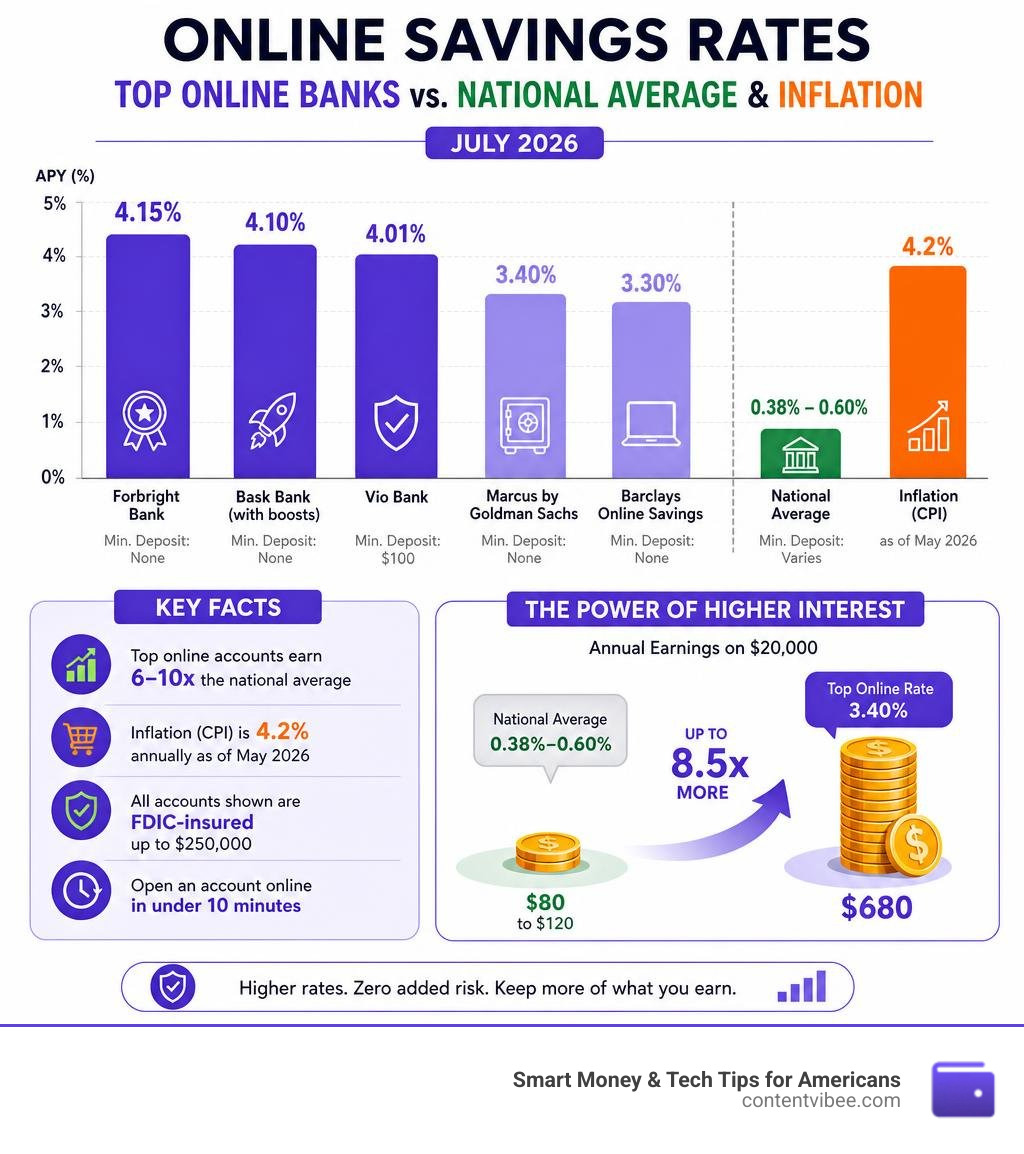
Top rates available in July 2026:
| Bank | APY | Minimum Deposit |
|---|---|---|
| Forbright Bank | 4.15% | None |
| Bask Bank (with boosts) | 4.10% | None |
| Vio Bank | 4.01% | $100 |
| Barclays Online Savings | 3.30% | None |
| Marcus by Goldman Sachs | 3.40% | None |
Key facts at a glance:
- The national average savings rate sits at just 0.38%–0.60%
- Top online accounts earn 6–10x that average
- Current inflation (CPI) is 4.2% annually as of May 2026 — meaning even some top rates don’t fully keep up
- All leading accounts listed here are FDIC-insured up to $250,000
For retirees and those nearing retirement, leaving cash in a traditional bank account right now is quietly costly. The gap between what big banks pay and what the best online savings accounts offer has never been more dramatic.
Think about it this way: a $20,000 deposit at the national average rate earns roughly $80 a year. That same deposit at 3.40% APY earns closer to $680. That’s real money — with zero added risk.
And with inflation running at 4.2%, every fraction of a percentage point matters more than ever.
The good news is that the top online banks have made it genuinely easy to move your money. No branch visits. No complex paperwork. Many accounts open in under 10 minutes.
This guide compares today’s best options side by side — so you can find the account that fits your needs without wading through fine print.
Understanding the Landscape of Online Banking Interest Rates
To make your money work as hard as possible, it helps to understand why online banking interest rates are so much higher than what you see at your local brick-and-mortar branch.
Traditional banks have massive overhead costs. They have to pay for physical buildings, local property taxes, vault security, and in-person tellers. Online-only banks don’t have these expenses. By operating digitally, they pass those massive operational savings directly to you in the form of higher Annual Percentage Yields (APYs).
However, the rate environment is never static. Over the last two years, we have watched the Federal Reserve navigate a complex economic landscape. Following six Federal Reserve rate cuts throughout 2024 and 2025, the central bank opted to leave the federal funds rate unchanged at 3.50% to 3.75% on June 17, 2026.
Because of these prior cuts, online savings rates have trended slightly downward since early May 2026. Yet, even with these shifts, the gap between traditional and online accounts remains staggering.
Consider this: the national average savings rate sits at a meager 0.38% to 0.60%. If you bank with a traditional institution, your yield is practically microscopic. By contrast, the top online savings accounts are still yielding upward of 4.00% APY—which is roughly ten times the national average.
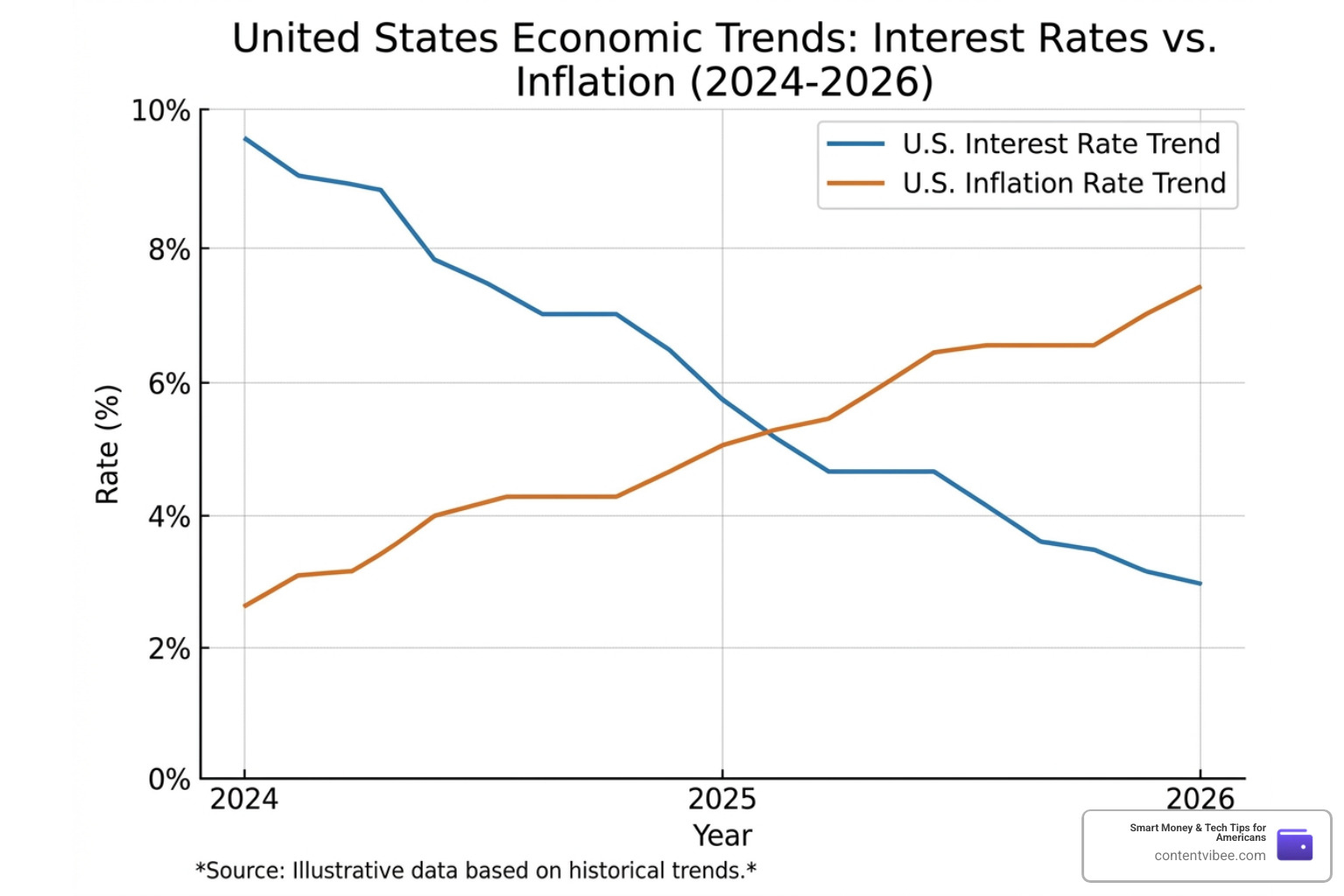
But there is an elephant in the room: inflation. The Consumer Price Index (CPI) leaped to 4.2% on an annual basis for May 2026. If your savings APY is earning less than that, your money is technically losing a small amount of purchasing power over time.
While a high-yield savings account may not entirely outpace a 4.2% inflation rate right now, it acts as a vital shield. Earning 4.15% APY minimizes your losses significantly compared to earning 0.38% at a traditional bank. If you want to see how different rates impact your long-term wealth, checking out Savings account interest rates – Today’s Rates | U.S. Bank can give you a clear picture of how traditional relationship rates stack up against online-only yields.
Comparing Top High-Yield Savings Accounts
When shopping for the perfect place to park your cash, you cannot look at APY alone. You must evaluate how interest compounds, the underlying fee structures, and how easily you can access your funds when life throws a curveball.
Most top online banks compound interest daily and credit it to your account monthly. Daily compounding is a saver’s best friend because it means you earn interest on your interest every single day. Over a year, this compounding frequency is what bridges the gap between a raw interest rate and your actual APY.
Furthermore, fee structures can make or break your returns. A single $5 monthly maintenance fee can completely wipe out the interest earned on a modest balance. Fortunately, the premier online banks featured in our comparison have eliminated monthly service fees entirely.
High-Yield Competitors and Online Banking Interest Rates
Let’s look at how the top players in the online banking space compare. While some household names offer great reliability, newer or specialized online divisions are currently pushing the absolute limits of today’s yields.
For example, Barclays Online Savings offers a very respectable 3.30% APY. This rate is five times the national average, features daily compounding, and has no monthly maintenance fees or minimum balance requirements to open. It is a highly stable, reliable choice with an intuitive interface.
However, if your primary goal is squeezing out every possible hundredth of a percent, competitors like Forbright Bank, CIT Bank, and Vio Bank are leading the pack. Forbright Bank currently leads the market with a top rate of 4.15% APY. Vio Bank is close behind, offering 4.01% APY on all balances for its Online Savings account, requiring a very reasonable $100 minimum deposit to open.
Meanwhile, CIT Bank’s Platinum Savings account offers up to 4.10% APY, though it requires you to maintain a higher balance of at least $5,000 to secure that top tier. If you prefer an award-winning user experience, the High Yield Online Savings Account | Marcus by Goldman Sachs® offers a highly competitive 3.40% APY with absolutely no fees, no minimum deposit, and same-day transfers for amounts up to $100,000.
| Bank | APY | Minimum to Open | Monthly Fee | Key Highlight |
|---|---|---|---|---|
| Forbright Bank | 4.15% | $0 | $0 | Highest overall yield currently available |
| Bask Bank | 4.10% (with boosts) | $0 | $0 | Stackable promotional boosts for savers |
| Vio Bank | 4.01% | $100 | $0 | Consistent high yield on all balance tiers |
| CIT Bank | 4.10% | $100 | $0 | Requires $5,000 balance to earn top rate |
| Marcus by Goldman Sachs | 3.40% | $0 | $0 | Same-day transfers up to $100k; top-rated app |
| Barclays Bank | 3.30% | $0 | $0 | Simple, reliable, 5x the national average |
Account Requirements and Online Banking Interest Rates Boosts
As you evaluate these rates, you will notice that some banks require you to jump through a few hoops to unlock their highest yields. These “rate boosts” or relationship tiers can be highly lucrative if they align with your existing financial habits, but they can be a headache if they do not.
Take Bask Bank, for instance. They offer a base APY of 3.75% on their Interest Savings Account. However, you can earn up to 4.10% APY by taking advantage of their stackable promotions. New customers can earn a 0.10% APY boost simply by opening an account and making an initial deposit within 15 business days. You can stack an additional 0.25% APY boost on top of that by setting up qualifying direct deposits of $2,500 or more per statement cycle. To learn more about how to qualify, check out the Rate Boost Promotion | Bask Bank.
Other banks use similar strategies:
- Apple Bank: Offers up to 3.55% APY on its Simple Savings account, but you must enroll in their Simple Banking Program. This requires you to link an Apple Bank checking account and complete at least five transactions of $25 or more each month.
- Happen Bank: Offers a strong 4.00% APY, but requires a consistent $250 monthly deposit to maintain that rate.
- Ally Bank: Known for its competitive variable rates and excellent customer service, Ally does not require a minimum deposit. However, they enforce a limit of 10 withdrawals per statement cycle to keep your savings on track.
If you are already planning to use an online account for your primary direct deposits, these boosted accounts are an excellent way to maximize your returns. But if you want a “set-it-and-forget-it” emergency fund where you do not have to worry about monthly transaction counts, a fee-free, no-minimum account like Marcus or Barclays may be the more practical choice.
Choosing Between a High-Yield Savings Account and a CD
If you are looking to secure a strong yield, you might find yourself choosing between a liquid high-yield savings account (HYSA) and a Certificate of Deposit (CD). Both have distinct advantages, and the right choice depends entirely on your timeline and financial goals.
An online savings account offers liquidity. You can deposit and withdraw money whenever you need it (subject to your bank’s monthly withdrawal limits, which typically range from 6 to 10 transactions). However, the interest rate on a savings account is variable. If the Federal Reserve decides to cut rates again later this year, your online bank will likely lower its APY in tandem.
A CD, on the other hand, offers rate certainty. When you open a CD, you lock in a fixed interest rate for a specific term—whether that is 6 months, 1 year, or 5 years. Even if the Fed slashes interest rates tomorrow, your CD rate remains completely untouched.
The trade-off is accessibility. If you need to withdraw your money from a CD before the term ends, you will typically face an early withdrawal penalty, which can eat into your earned interest.
How to decide:
- Choose a High-Yield Savings Account for your emergency fund, upcoming vacation fund, or any cash you might need to access within the next few months.
- Choose a CD for cash you know you won’t need for a set period, such as a down payment on a house you plan to buy next year. This allows you to lock in today’s high rates before they potentially trend lower.
Frequently Asked Questions About Online Savings Rates
Navigating online banking can raise a few questions. Here are the answers to the most common queries we receive from savers looking to optimize their yields.
How do Federal Reserve rate cuts affect my online savings APY?
The Federal Reserve sets the federal funds rate, which is the interest rate banks charge each other for overnight loans. While online banks do not directly copy the Fed’s rate, their variable savings account APYs are highly sensitive to it.
When the Fed cuts rates, banks experience compressed profit margins, prompting them to lower the interest rates they pay to depositors. Conversely, when the Fed raises rates, online banking interest rates rise as banks compete to attract your deposits. Because savings accounts feature variable rates, your bank can adjust your APY at any time without prior notice.
Is my money safe in an online-only bank?
Yes, your money is incredibly safe, provided the online bank is backed by the Federal Deposit Insurance Corporation (FDIC) or, in the case of credit unions, the National Credit Union Administration (NCUA).
Both the FDIC and NCUA protect your deposits up to $250,000 per depositor, per insured institution, for each account ownership category. Because online banks carry the exact same federal backing as the massive physical banks on your local street corner, your principal is entirely secure against bank failure.
What is the difference between interest rate and APY?
While these terms are often used interchangeably, they represent slightly different calculations:
- Interest Rate: The base percentage of interest the bank pays you on your principal balance annually, excluding compounding.
- Annual Percentage Yield (APY): The actual percentage return you earn over the course of a year, taking into account how frequently interest compounds (daily, monthly, or quarterly).
Because compounding adds earned interest back into your principal, your APY will always be slightly higher than your base interest rate.
Conclusion
Maximizing your savings in July 2026 does not require taking on market risk. By simply moving your cash from a low-yielding traditional bank to a premier online savings account, you can instantly boost your earnings by up to ten times.
Whether you opt for the market-leading yields of Forbright or Vio Bank, the flexible relationship boosts of Bask Bank, or the streamlined simplicity of Marcus or Barclays, the transition is quick, secure, and highly rewarding.
At ContentVibee, we are committed to helping you make smart money decisions that protect and grow your hard-earned wealth. Ready to see how much your savings can grow over time with these competitive rates? Calculate your savings growth using our interactive tool and take control of your financial future today.


