


What Is a 1099-R? Your Quick Answer
If you’re wondering what a 1099-R is, here’s the short version:
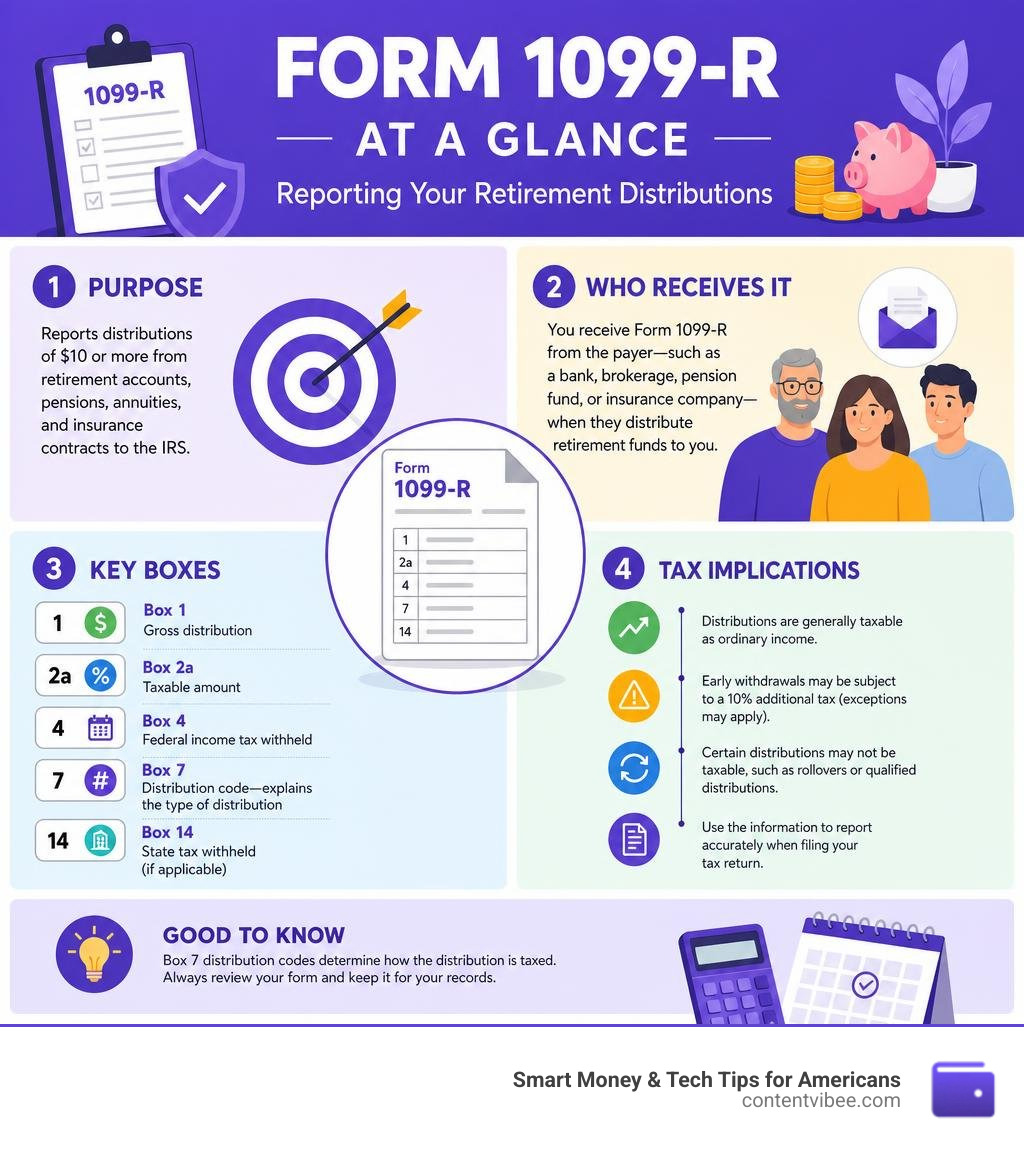
Form 1099-R is an IRS tax form that reports distributions of $10 or more from retirement accounts, pensions, annuities, and insurance contracts. You receive it from whoever paid you — a bank, brokerage, pension fund, or insurance company — and you use it to report that income when you file your taxes.
Common reasons you receive a Form 1099-R:
- You took a distribution from an IRA, 401(k), or pension
- You rolled over funds from one retirement account to another
- You reached retirement age and started receiving pension payments
- A retirement plan loan defaulted and became a taxable distribution
- You withdrew excess contributions from a retirement account
- You are a beneficiary receiving distributions from an inherited retirement account
Tax season has a way of filling your mailbox with forms you didn’t expect. For retirees and anyone drawing from a retirement account, Form 1099-R is one of the most important documents you’ll receive — and also one of the most misunderstood.
The form looks simple on the surface. But the boxes inside it, especially the distribution codes in Box 7, can mean the difference between owing a penalty and paying nothing extra at all.
This guide breaks down everything you need to know: what each box means, how taxes work for different account types, what to do if something looks wrong, and how to make sure the IRS gets the right information.
Form 1099-R: What Is It and Why Did You Receive It?
When we talk about retirement planning, we often focus on the fun part: watching our nest egg grow. But eventually, the time comes to use those funds. That is where Form 1099-R enters the picture.
Form 1099-R, officially titled “Distributions From Pensions, Annuities, Retirement or Profit-Sharing Plans, IRAs, Insurance Contracts, etc.,” is an information return required by the IRS. Its primary job is to report any designated distribution of $10 or more from your retirement accounts or insurance contracts during the calendar year.
According to the official guidance on About Form 1099-R, Distributions From Pensions, Annuities, Retirement or Profit-Sharing Plans, IRAs, Insurance Contracts, etc. | Internal Revenue Service, payers must issue this form to both you and the IRS to document any payout. This includes traditional pensions, annuities, profit-sharing plans, individual retirement arrangements (IRAs), and even permanent disability payments under life insurance contracts. If money moved out of a tax-advantaged account and into your hands (or another account), the IRS wants a paper trail.
Who Receives a Form 1099-R?
You will receive a Form 1099-R if you meet the basic recipient criteria: namely, you received a distribution of at least $10 from a qualified retirement source.
This isn’t just for retirees who are happily enjoying their golden years. You might receive this form if you:
- Took a one-time withdrawal from a traditional IRA or 401(k).
- Rolled over your 401(k) from an old employer to a new employer’s plan or an IRA.
- Received survivor or beneficiary benefits from a deceased relative’s retirement plan.
- Received permanent and total disability payments from an insurance contract.
- Withdrew money from a tax-sheltered annuity.
As outlined in the guide on What is Form 1099-R and do you have to pay taxes on it? | Fidelity, even transactions that aren’t taxable—like a direct rollover to another qualified retirement account—will trigger a 1099-R. The IRS still needs to verify where that money went so they don’t accidentally tax you on a tax-free rollover.
Receiving a 1099-R While Still Working
It can be a bit of a shock to receive a retirement tax form when you are still working a 9-to-5 job. Why would this happen?
The most common reason is a retirement plan loan. Many employer-sponsored 401(k) plans allow active employees to borrow against their balances. However, if you miss payments, leave your job, or otherwise fail to repay the loan according to the plan’s rules, the outstanding balance is treated as a “deemed distribution.”
According to retirement experts at What is Form 1099-R and why did I get one? – Ascensus, a defaulted loan is reported on Form 1099-R as taxable income. You might also receive a 1099-R if you took an “in-service withdrawal” (withdrawing funds while still employed, often allowed after age 59½ or for specific hardship reasons) or if you had to pull out excess contributions because you accidentally saved more than the annual IRS limit.
Decoding the Key Boxes on Form 1099-R
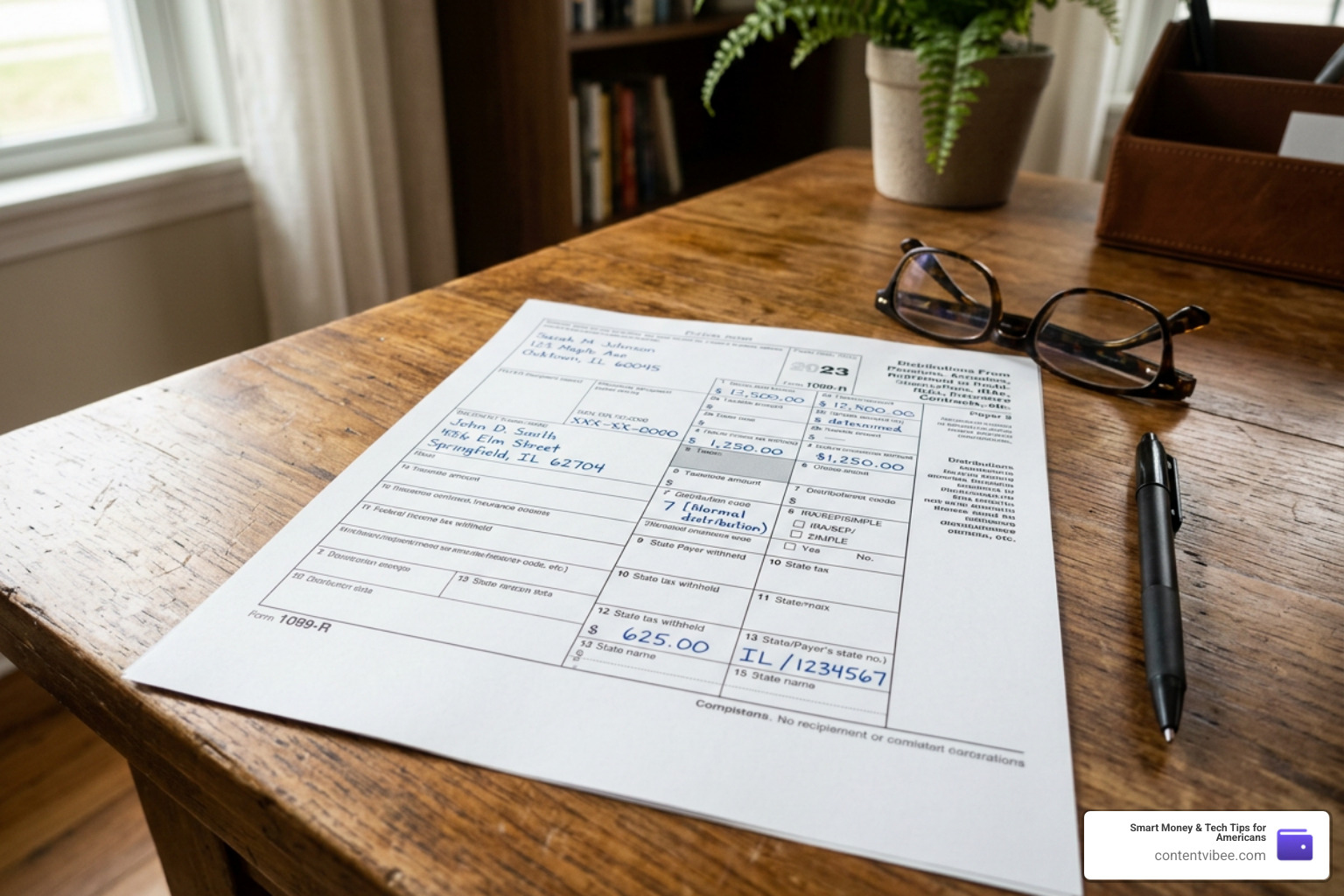
At first glance, Form 1099-R looks like a confusing grid of numbers and letters. However, once you know which boxes hold the critical details, it becomes much easier to read. The layout is designed to show the IRS exactly how much money moved, how much of it is subject to income tax, and whether any taxes were already withheld at the source.
If you want to view the physical layout of the form, you can review the 2026 Form 1099-R draft to see how these boxes are positioned relative to each other.
Box 1 vs. Box 2a: Gross vs. Taxable Distributions
The most important distinction on your 1099-R is the difference between Box 1 and Box 2a.
- Box 1 (Gross distribution): This shows the total dollar amount of the distribution before any deductions, withholdings, or taxes were taken out. It represents the absolute amount of cash or assets that left your account.
- Box 2a (Taxable amount): This is the portion of the distribution that is subject to federal income tax.
Often, Box 1 and Box 2a will show the exact same number—especially if you took a straightforward withdrawal from a traditional IRA or 401(k). But they can also be wildly different. For example, if you rolled over $50,000 directly from a traditional 401(k) to a traditional IRA, Box 1 will show $50,000, but Box 2a will likely show $0 because the transaction is tax-free.
If the payer cannot calculate the taxable portion, they will leave Box 2a blank and check the box in Box 2b (Taxable amount not determined). This is very common with traditional IRAs, where the custodian doesn’t know if you made non-deductible (after-tax) contributions. In these cases, you must calculate the taxable portion yourself using IRS Form 8606.
Additionally, Box 5 (Employee contributions/Roth contributions or insurance premiums) shows the amount of after-tax employee contributions or Roth contributions you recovered tax-free during the year. This helps explain why your taxable amount in Box 2a is lower than the gross distribution in Box 1. You can read more about these specific reporting rules in the 2026 Instructions for Forms 1099-R and 5498.
Box 7: The Power of Distribution Codes
If Box 1 and Box 2a tell us “how much,” Box 7 tells us “why.” Box 7 contains a combination of numerical and alphabetical distribution codes that explain the exact nature of the distribution to the IRS.
There are 30 different distribution codes used to identify the type of distribution reported, and they play a massive role in determining whether you owe taxes or early withdrawal penalties.
Here are some of the most common codes you will see:
- Code 1 (Early distribution, no known exception): You took a distribution before reaching age 59½, and the payer doesn’t know of any exception to the 10% early withdrawal penalty.
- Code 2 (Early distribution, exception applies): You are under 59½, but you qualify for a penalty exception (such as a systematic withdrawal plan or a Qualified Birth and Adoption Distribution).
- Code 3 (Disability): The distribution was made due to total and permanent disability.
- Code 4 (Death): The payments were made to a beneficiary or survivor due to the account holder’s death.
- Code 7 (Normal distribution): You took a standard distribution after reaching age 59½ (or age 73/75 for Required Minimum Distributions).
- Code G (Direct rollover): You rolled over funds directly to another eligible retirement plan or IRA. This is generally tax-free.
- Code L (Deemed distribution of a plan loan): Your retirement plan loan defaulted and is now considered taxable income.
- Code Y (Qualified Charitable Distribution): Introduced as an optional code for 2026, this identifies a tax-free transfer directly from your IRA to an eligible charity.
In 2026, the IRS also introduced new structures, such as Box 7c (for specific types of accounts) and Box 7d (reporting earnings on excess contributions). For a complete, technical breakdown of all 30 codes, check out the 2026 Instructions for Forms 1099-R and 5498.
Do You Have to Pay Taxes on 1099-R Distributions?
The short answer is: it depends. Receiving a Form 1099-R does not automatically mean you owe taxes. The taxability of the income reported on the form is determined by the type of retirement account you have, your age, and what you did with the money.
When you draw retirement income, understand how federal taxes interact with your overall financial picture. For instance, your retirement withdrawals can sometimes impact how your other benefits are taxed. If you want to see how retirement income fits into your broader tax strategy, we highly recommend reading our guide on Uncle Sam’s Cut: Understanding Taxes on Social Security.
Traditional vs. Roth Account Tax Treatment
The primary factor in whether you owe taxes is whether the distribution came from a traditional pre-tax account or a Roth after-tax account.
| Account Type | Tax Treatment on Contributions | Tax Treatment on Distributions (Form 1099-R) |
|---|---|---|
| Traditional IRA / 401(k) | Pre-tax (contributions reduce your taxable income in the year they are made). | Taxable. Distributions are taxed as ordinary income at your current income tax bracket. |
| Roth IRA / 401(k) | After-tax (contributions are made with money that has already been taxed). | Tax-Free. Qualified distributions (taken after age 59½ and after holding the account for 5 years) are completely tax-free. |
If you withdraw money from a traditional account, Box 2a will show the taxable amount, and you will report this on your Form 1040. If you take a qualified distribution from a Roth IRA, your Box 1 will show the gross amount, but Box 2a will be $0 (or blank).
That if your taxable retirement distributions push you into a higher tax bracket, it can affect other areas of your taxes. To understand how ordinary income thresholds interact with your retirement years, look at our Social Security Taxable Income Guide 2026.
Special Scenarios: Rollovers, Loans, and Excess Contributions
There are several scenarios where a Form 1099-R is issued, but little or no tax is actually owed:
- Direct and Indirect Rollovers: If you move money directly from a 401(k) to an IRA (a direct rollover), the transaction is tax-free. You will receive a 1099-R with Code G in Box 7, and Box 2a will show $0. If you do an indirect rollover (where the money is paid to you first, and you have 60 days to deposit it into another retirement plan), the payer is required to withhold 20% for federal taxes. You must deposit the full 100% of the distribution within 60 days to avoid taxes and penalties on the withheld portion.
- Plan Loan Offsets: If you leave your employer with an outstanding 401(k) loan, the plan may perform a “plan loan offset,” subtracting the loan balance from your account. This is reported on Form 1099-R and is taxable unless you roll over the offset amount to an IRA or eligible plan by your tax filing deadline (including extensions).
- Excess Contributions: If you put too much money into your IRA or 401(k), you must withdraw the excess and any earnings on those excess contributions to avoid excise penalties. The returned earnings are taxable in the year the contribution was made and will be reported on a 1099-R (often utilizing Box 7d in 2026).
Navigating these special rules is vital to avoid unexpected penalties from the IRS. For more tips on managing taxes during your post-work years, check out our guide on Taxing Your Golden Years: A Guide to Social Security Tax on Benefits.
What to Do When You Receive a Form 1099-R
Once your retirement providers start mailing out tax documents, it’s time to take action. Handling your 1099-R forms correctly ensures that your tax return is processed smoothly and that you don’t receive any dreaded “matching error” notices from the IRS.
The IRS maintains a strict database of all filed 1099-R forms. When you file your Form 1040, their automated systems match the numbers you enter against the copies submitted by your financial providers. This is why accuracy is so critical. You can learn more about how the IRS utilizes these forms at About Form 1099-R, Distributions From Pensions, Annuities … – IRS.
Handling Forms from Major Providers
If you have retirement accounts spread across different financial institutions—such as Fidelity, Ascensus, or state pension systems—you will receive separate 1099-R forms from each provider.
Most major providers make it incredibly easy to access your tax documents online. Instead of waiting for the mail, you can log into your account portal in mid-to-late January to download a PDF copy.
- Fidelity customers can navigate to the “Tax Info & Forms” section of their online dashboard.
- Ascensus savers can access their documents via their employer-sponsored portal or personal retirement dashboard. If you have questions about your form, Ascensus provides dedicated customer support to walk you through your specific account details, as noted on What is Form 1099-R and why did I get one? – Ascensus.
Once you download your forms, verify that your name, address, and Social Security Number (or Taxpayer Identification Number) are correct.
Deadlines and Missing Forms
By law, payers must send out Form 1099-R by January 31 of the year following the distribution. If you took a distribution in 2025, your form must be postmarked or available online by January 31, 2026.
If mid-February rolls around and you haven’t received a form you were expecting:
- Check your online account: Many providers default to paperless delivery.
- Contact the plan administrator: Ask if the form was sent and request a duplicate copy.
- Use a substitute form: If you still cannot get the form by late February, you can file IRS Form 4852 (Substitute for Form W-2 or Form 1099-R). You will estimate your distribution and withholding amounts based on your bank statements or pay stubs.
For historic context on general filing regulations and timeline exceptions, you can refer to the 2023 Instructions for Forms 1099-R and 5498.
Correcting Errors on Your 1099-R
Errors do happen. A provider might report a direct rollover as a taxable distribution, or they might enter the wrong distribution code in Box 7.
If you find an error on your Form 1099-R:
- Do not try to correct it yourself on your tax return. If the numbers you input do not match what the custodian reported to the IRS, the IRS matching system will flag your return and automatically issue a CP2000 notice demanding back taxes and penalties.
- Contact the issuer immediately. Request that they issue a corrected Form 1099-R. The corrected form will have the “CORRECTED” box checked at the top.
- File with the corrected form. If you have already filed your taxes, you will need to file an amended return (Form 1040-X) once you receive the corrected 1099-R.
Frequently Asked Questions About Form 1099-R
Why did I receive multiple Form 1099-Rs in the same tax year?
It is very common to receive multiple 1099-R forms. This usually happens because:
- You have multiple accounts: If you took distributions from both a traditional IRA and a 401(k), each custodian will send a separate form.
- Your distribution code changed mid-year: For example, if you turned age 59½ during the year, your provider might issue two forms—one with Code 1 (early distribution) for withdrawals taken before your birthday, and one with Code 7 (normal distribution) for withdrawals taken after.
- You switched from disability to regular retirement: State pension systems (like LASERS) often issue separate forms when your status changes mid-year.
- You rolled over funds and took a cash withdrawal: The rollover will be on one form (Code G), and the cash withdrawal will be on another.
Do I need to attach Form 1099-R to my federal tax return?
If you file a paper tax return, you must attach Copy B of Form 1099-R to your Form 1040, but only if federal income tax was withheld (shown in Box 4). If no tax was withheld, you do not need to attach it, though you must still report the income. If you file electronically, your tax software will transmit the 1099-R details automatically, so you do not need to mail physical copies. Always keep Copy C for your personal financial records for at least three years.
How do qualified charitable distributions (QCDs) appear on Form 1099-R?
A Qualified Charitable Distribution (QCD) allows IRA owners who are 70½ or older to transfer up to $105,000 annually directly from their IRA to an eligible charity completely tax-free.
When you make a QCD, your custodian will still issue a Form 1099-R.
- Box 1 (Gross distribution) will show the total amount transferred to the charity.
- Box 2a (Taxable amount) may show the full amount as taxable (or be blank), because the custodian doesn’t always track whether the transfer qualified as a QCD.
- Box 7 may utilize Code Y (if the optional 2026 reporting is used by your custodian).
When filing your Form 1040, you must report the total distribution on line 4a. If the entire amount was a QCD, you will enter $0 on line 4b (the taxable line) and write “QCD” next to it so the IRS knows why it isn’t being taxed.
Conclusion
Understanding what a 1099-R is and how to read it is one of the most practical steps you can take to protect your retirement savings from unnecessary taxes and penalties. Whether you are actively withdrawing funds, rolling over an old account, or handling an unexpected plan loan default, keeping a close eye on your tax forms keeps you in the driver’s seat of your financial future.
At ContentVibee, we are dedicated to helping you make smart money decisions and optimize your retirement strategies. If you want to continue building a bulletproof retirement plan, don’t miss The Ultimate Guide to Social Security Benefit Optimization.
For more actionable retirement resources, use our tools and guides:
- Social Security Calculator: Estimate Your Benefit Amount
- The Complete Guide to Social Security Full Retirement
- The Definitive Guide to Social Security Claiming Age
- The Complete Guide to Benefit Rules
- The Ultimate Guide to the Earnings Test
- The Ultimate Guide to Social Security and Common Law Marriage
Taking charge of your retirement forms today means fewer surprises next April. Keep planning smart, and let us help you keep more of your hard-earned money!


