


The 457(b) Early Withdrawal Advantage Most Retirement Savers Don’t Know About
457b early withdrawal rules are fundamentally different from every other employer-sponsored retirement plan — and that difference could save you thousands of dollars if you’re planning to retire before age 59½.
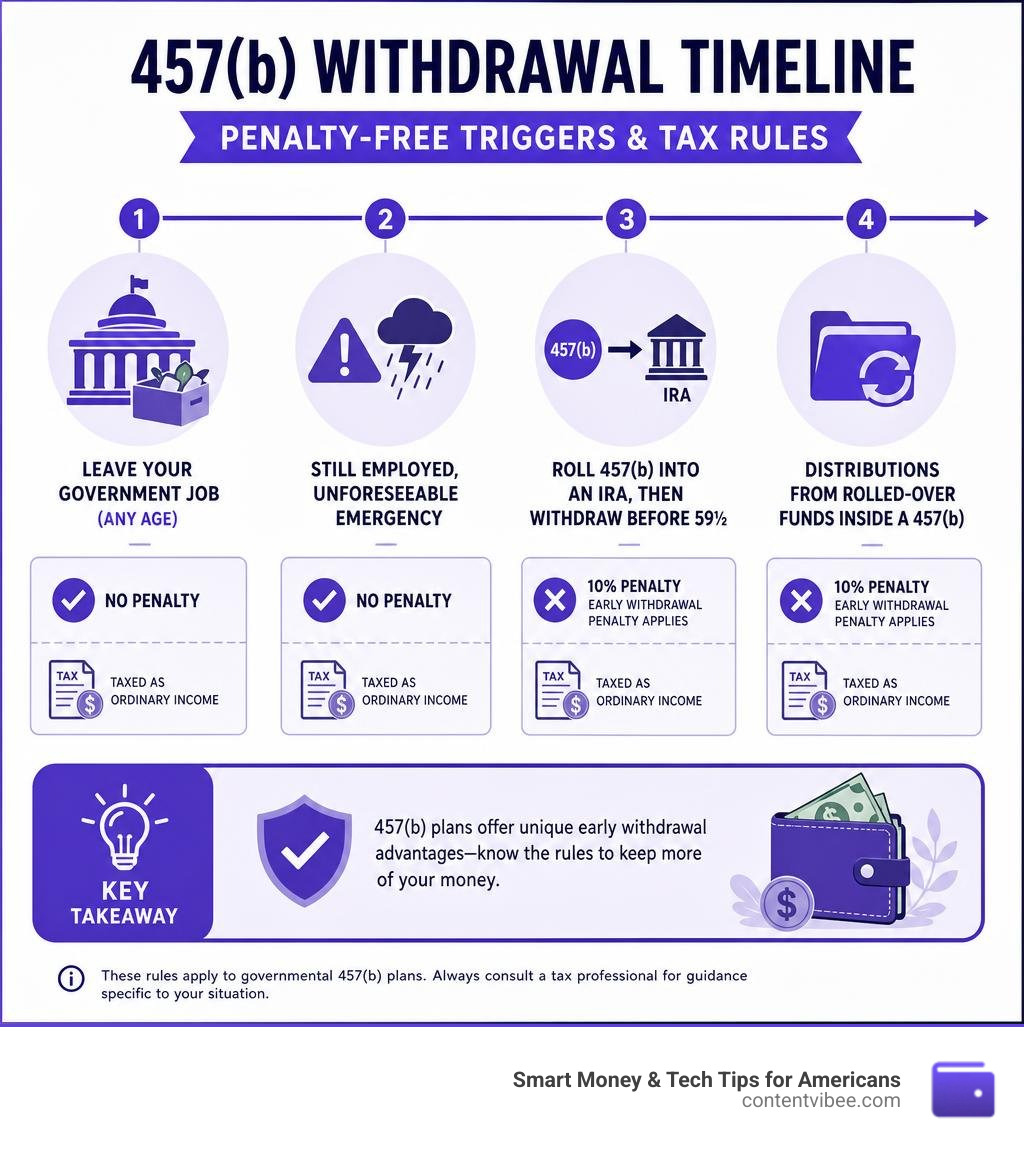
Quick Answer: Can You Withdraw From a 457(b) Early Without Penalties?
| Situation | Penalty? | Taxes? |
|---|---|---|
| Leave your government job (any age) | No penalty | Yes, ordinary income tax |
| Still employed, unforeseeable emergency | No penalty | Yes, ordinary income tax |
| Roll 457(b) into an IRA, then withdraw before 59½ | Yes, 10% penalty | Yes, ordinary income tax |
| Distributions from rolled-over funds inside a 457(b) | Yes, 10% penalty | Yes, ordinary income tax |
Most retirement accounts punish you for withdrawing early. Take money from a 401(k) or 403(b) before age 59½ and the IRS charges a 10% early withdrawal penalty on top of regular income taxes.
A governmental 457(b) plan plays by completely different rules.
If you leave your government employer — whether you’re 45, 52, or any age — you can access your 457(b) funds immediately with zero early withdrawal penalty. You still owe regular income taxes, but that 10% surcharge simply does not apply.
For pre-retirees trying to bridge the gap between their last paycheck and Social Security or pension income, this is a significant advantage that often goes overlooked.
But there are traps. One wrong rollover decision can permanently eliminate this benefit. Understanding exactly how the rules work — and what to avoid — is what this guide is about.
What is a 457(b) Plan and Who is Eligible?
When we look at the landscape of retirement savings, accounts like the 401(k) and 403(b) tend to hog the spotlight. However, the 457(b) plan is a quiet powerhouse designed specifically for individuals who dedicate their careers to public service or specialized non-profit work.
At its core, a 457(b) plan is a non-qualified, tax-advantaged deferred compensation plan. When you contribute to a traditional 457(b), your contributions are deducted from your paycheck before federal and state taxes are calculated. This lowers your taxable income for the current year, and your investments grow tax-deferred until you make a withdrawal.
So, who gets to participate in these plans? Eligibility is strictly defined by the Internal Revenue Code. Generally, 457(b) plans are offered to:
- Governmental Employees: Individuals working for state and local governments, counties, cities, public school districts, and state-chartered universities. This includes public school teachers, police officers, firefighters, and administrative staff.
- Select Non-Profit Employees: Highly compensated employees, executives, or select management staff at certain tax-exempt 501(c) organizations, such as private hospitals, charities, or trade associations.
Because of the unique structure of these plans, they serve as an excellent vehicle for those looking to build a robust nest egg. If you are fortunate enough to have access to one, it is often referred to as a “golden ticket” for early retirement. To understand the foundational benefits of this setup, you can read our deep dive on Demystifying the 457 Deferred Compensation Plan: Your Golden Ticket to Early Retirement.
To explore the structural rules directly from the source, you can review the details on What is a 457(b) plan and how does it work? – Fidelity Investments.
The Rules of a 457b Early Withdrawal vs. 401(k) and 403(b)
The single greatest feature of a governmental 457(b) plan is its exemption from the Employee Retirement Income Security Act (ERISA) rules that mandate early withdrawal penalties.
Under standard qualified plans like a 401(k) or 403(b), the IRS imposes a strict 10% additional tax on any distributions taken before you reach age 59½, unless you qualify for a narrow set of exceptions (such as separating from service in or after the year you turn 55).
With a governmental 457(b) plan, the 10% penalty is entirely off the table once you separate from your employer. If you quit, retire, or are laid off at age 40, you can request a 457b early withdrawal and pay only your standard ordinary income tax.
Let’s look at how these rules stack up side-by-side in 2026:
| Feature | Governmental 457(b) | Traditional 401(k) | Traditional 403(b) |
|---|---|---|---|
| Primary Sponsoring Employers | State/local governments, public schools | Private corporations | Public schools, non-profits, hospitals |
| 10% Penalty Before Age 59½? | No (upon separation from service) | Yes (unless Rule of 55 applies) | Yes (unless Rule of 55 applies) |
| ERISA Protection? | No (exempt from standard ERISA) | Yes | Yes (in most cases) |
| Employer Contribution Limits | Shared with employee limit ($24,500 in 2026) | Separate from employee limit (Up to $72,000 total) | Separate from employee limit (Up to $72,000 total) |
This structural difference means that governmental 457(b) plans are uniquely suited to serve as a financial bridge for early retirees. If you plan to stop working before age 59½, you can draw from your 457(b) to cover living expenses without touching other accounts that would trigger heavy penalties.
For those trying to coordinate these accounts with other retirement assets, checking out our comparison of Pension vs 401k Tax Strategies for Working Retirees can help clarify how to balance different income streams. For a broader look at smart distribution planning, see the Guide to 457(b) Withdrawals: Accessing Your Funds Wisely.
Key Triggers for Penalty-Free Access to 457(b) Funds
While the lack of a 10% penalty is a massive benefit, you cannot simply treat your 457(b) like a standard savings account while you are still working. The IRS restricts when you can actually pull money out of the plan.

To access your funds, you must meet specific distribution triggers. Understanding these triggers is essential to avoiding unexpected tax bills or administrative roadblocks.
Separation from Service: The Ultimate 457b Early Withdrawal Loophole
The most common and flexible trigger for a 457b early withdrawal is separating from service with the employer who sponsors your plan.
The moment you officially terminate your employment relationship—whether you retire, transition to the private sector, or simply take a career break—the plan assets become available to you. There is no minimum age requirement. A 35-year-old municipal worker who leaves their job has the exact same penalty-free access to their 457(b) balance as a 60-year-old retiree.
It is worth noting that while public safety employees (such as police officers and firefighters) have special exceptions allowing penalty-free 401(k) or pension access at age 50, the governmental 457(b) plan remains superior because it requires no specific age milestone whatsoever.
Unforeseeable Emergency: Meeting the High Bar for In-Service Distributions
If you are still actively employed by your plan sponsor and need to access your funds, your options are much more limited. The IRS allows for “in-service” distributions only under strict circumstances, the most notable being an “unforeseeable emergency.”
This is a much higher bar to clear than a standard 401(k) “hardship” withdrawal. According to IRS regulations, an unforeseeable emergency must be a severe financial hardship resulting from an illness, accident, casualty loss, or other extraordinary and unforeseeable circumstance arising from events beyond your control.
According to the legal standards outlined in 26 CFR § 1.457-6 – Timing of distributions under eligible plans. | Electronic Code of Federal Regulations (e-CFR) | US Law | LII / Legal Information Institute, the following rules apply:
- What Qualifies:
- Sudden and unexpected illness or accident involving you, your spouse, or your dependents.
- Loss of your property due to casualty (such as severe storm or fire damage not covered by insurance).
- Imminent foreclosure on or eviction from your primary residence.
- Funeral expenses for a spouse or dependent.
- What Does NOT Qualify:
- The purchase of a primary home.
- Paying for college tuition for your children.
- Paying off standard credit card debt accumulated through voluntary spending.
Additionally, you must prove that you cannot relieve the hardship through other means, such as insurance payouts, reasonable liquidation of other assets, or stopping your active contributions to the plan. The distribution is also strictly limited to the exact dollar amount necessary to satisfy the emergency, plus any taxes you expect to owe on the withdrawal.
Small Account Cash-Outs and Plan Loans
If you do not meet the criteria for an unforeseeable emergency but still need in-service access, there are two minor exceptions to keep in mind:
- Small Account Cash-Outs: You may be allowed a one-time, in-service distribution if your total account balance is $7,000 or less (or the threshold set by Section 411(a)(11)(A)), you have not made any contributions to the plan during the prior two-year period, and you have never received a prior small account cash-out.
- Plan Loans: Many governmental 457(b) plans offer loan provisions. If your plan permits it, you can typically borrow up to 50% of your vested balance or $50,000 (whichever is less). You must repay the loan with interest, usually within five years, through payroll deductions. However, be cautious: if you separate from service with an outstanding loan balance, the remaining unpaid portion will be treated as a taxable distribution.
Tax Implications and Rollover Traps to Avoid
While bypassing the 10% penalty is a major victory, a 457b early withdrawal is still subject to federal and state tax rules. Failing to plan for these expenses can lead to a painful tax bill in April.
How a 457b Early Withdrawal is Taxed
Every dollar you withdraw from a traditional, pre-tax 457(b) plan is taxed as ordinary income at your current marginal tax bracket.
If you decide to withdraw a large sum of money all at once—referred to as a lump-sum distribution—you run the risk of triggering a “tax cascade.” A massive single-year distribution can easily push you into a much higher tax bracket, meaning you pay a far higher percentage of your hard-earned savings to the IRS than if you had spread the distributions out over several years.
If your employer offers a Roth 457(b) option, the tax treatment is reversed. Contributions are made with after-tax dollars, and qualified withdrawals are completely tax-free. However, to qualify for tax-free withdrawals, you must generally reach age 59½ and have held the Roth account for at least five tax years.
To explore how these tax dynamics compare to other retirement vehicles, you can read our guide on Alternative Ways to Save for Retirement That Actually Work.
The Rollover Trap: Losing Your Penalty-Free Status
The single most dangerous trap for 457(b) participants is the rollover decision.
When you leave your job, financial advisors or financial institutions may encourage you to roll your workplace retirement accounts into a Traditional IRA or a new employer’s 401(k) to “consolidate” your assets.
Do not do this without careful planning.
The moment you roll your governmental 457(b) funds into an IRA, a 401(k), or a 403(b), those funds lose their unique 457(b) identity. They become subject to the rules of the receiving plan. If you subsequently need to withdraw that money before age 59½, you will be hit with the standard 10% early withdrawal penalty.
If you want to maintain your ability to take penalty-free early withdrawals, the smartest move is often to leave your money exactly where it is—inside the governmental 457(b) plan—or perform direct trustee-to-trustee transfers only to another governmental 457(b) plan if you change public sector jobs.
Strategic Planning: Contribution Limits and RMDs in 2026
To make the most of your retirement planning, you must stay up-to-date on the current IRS limits and distribution timelines. As we navigate the landscape of 2026, several key numbers and provisions under the SECURE 2.0 Act have come into play.
Maximizing 2026 Contribution Limits and Catch-Up Rules
In 2026, the baseline employee contribution limit for a 457(b) plan is $24,500 (up from $23,500 in 2025). This is an individual limit, meaning if your employer offers both a 403(b) and a 457(b), you can actually “double-dip” and contribute the maximum amount to both plans, allowing you to shield up to $49,000 in pre-tax income in 2026.
Additionally, there are several catch-up provisions designed to help you supercharge your savings as you approach retirement:
- Standard Age 50+ Catch-Up: If you are age 50 or older, you can contribute an additional $8,000 in 2026, bringing your total limit to $32,500.
- SECURE 2.0 “Super Catch-Up”: For participants aged 60, 61, 62, or 63, SECURE 2.0 permits an enhanced catch-up limit of up to $11,250 in 2026, allowing for a maximum contribution of $35,750.
- Special 3-Year Pre-Retirement Catch-Up: This unique 457(b) rule allows you to contribute up to double the normal limit (up to $49,000 in 2026) during the three years prior to your plan’s normal retirement age. This is only available if you have “unused” contribution room from prior years when you did not contribute the maximum allowed.
Note: You cannot use both the age-based catch-up and the special pre-retirement catch-up in the same tax year; you must use whichever one provides the greater benefit.
To see how these limits impact your long-term retirement timeline, use our Retirement Calculator: Estimate Savings Needed.
Required Minimum Distributions (RMDs) and Governmental vs. Non-Governmental Plans
Once you reach a certain age, the IRS requires you to start taking withdrawals, known as Required Minimum Distributions (RMDs). For 457(b) plans, RMDs must begin by April 1 following the calendar year you turn 73, or the year you officially retire from the sponsoring employer (whichever is later).
It is also critical to understand the stark differences between governmental and non-governmental 457(b) plans, as they have massive implications for asset protection and withdrawal flexibility:
- Governmental 457(b) Plans: Funded assets are held in a trust for the exclusive benefit of the participants. This means your money is completely safe from your employer’s creditors. Furthermore, these plans are eligible for rollovers to IRAs and enjoy the standard penalty-free early withdrawal rules.
- Non-Governmental (Tax-Exempt) 457(b) Plans: These plans are structured very differently. By law, the assets remain the property of the employer until they are distributed to you. This means if the non-profit organization files for bankruptcy, its general creditors can lay claim to your retirement savings. Additionally, non-governmental 457(b) plans cannot be rolled over into an IRA; they can only be rolled into another non-governmental 457(b) plan.
To read the statutory definitions and legal framework governing these plans, you can review 26 U.S.C. § 457 | Deferred compensation plans of State and local governments and tax-exempt organizations.
Frequently Asked Questions about 457(b) Withdrawals
Navigating retirement rules can be confusing. Here are quick, direct answers to the most common questions we receive.
Is there a 10% penalty for withdrawing from a governmental 457(b) before age 59½?
No. If you have separated from service with the employer who sponsors your governmental 457(b) plan, you can withdraw your funds at any age without paying a 10% early withdrawal penalty. However, you will still owe ordinary income tax on any pre-tax distributions.
Can I roll over my 457(b) into an IRA without tax consequences?
Yes, you can perform a direct, tax-free rollover from a governmental 457(b) to a Traditional IRA. However, doing so triggers the “rollover trap.” Once the money is inside the IRA, it loses its 457(b) penalty exemption. If you need to access those funds before age 59½, you will be subject to the standard 10% early withdrawal penalty.
What qualifies as an unforeseeable emergency for a 457(b) withdrawal?
According to IRS guidelines, an unforeseeable emergency must be a severe financial hardship resulting from sudden, unexpected events beyond your control. This includes severe illnesses, accidents, casualty losses (like uninsured storm damage), or imminent foreclosure on your primary residence. It does not include predictable expenses like buying a home or paying for college tuition.
Conclusion
We believe that achieving financial independence is all about making smart money decisions today to secure your freedom tomorrow. For public servants and eligible non-profit employees, the 457(b) plan is one of the most powerful tools available for early retirement planning.
By understanding the rules of a 457b early withdrawal, avoiding the common rollover traps, and maximizing your annual contribution limits, you can build a flexible, penalty-free bridge to your golden years.
As you design your broader retirement strategy, don’t forget to account for how Uncle Sam views your other income sources. To keep learning, read our guide on Uncle Sam’s Cut: Understanding Taxes on Social Security to make sure your retirement budget is completely optimized.