


Social Security Spousal Benefit Rules at a Glance
A social security spousal benefit is a monthly retirement payment based on a current or former spouse’s work record. It can help if your own Social Security retirement benefit is lower, or if you have little or no work history.
Here is the quick answer:
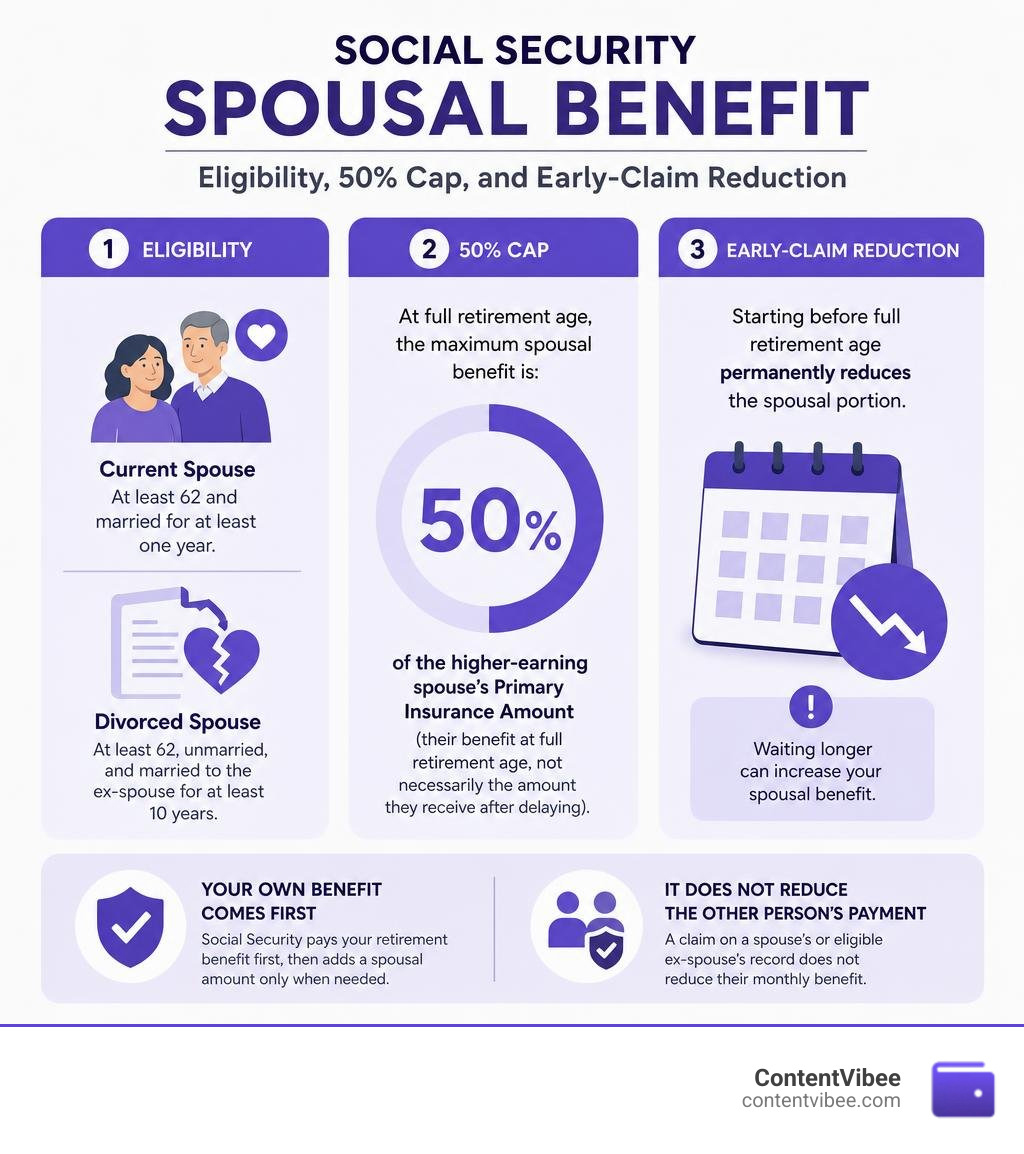
- Who may qualify: A current spouse generally must be at least 62 and married for at least one year. A divorced spouse generally must be at least 62, unmarried, and have been married to the ex-spouse for at least 10 years.
- How much it pays: At full retirement age, the maximum is usually 50% of the higher-earning spouse’s Primary Insurance Amount – their benefit at full retirement age, not necessarily the amount they receive after delaying.
- Claiming early costs money: Starting before full retirement age permanently reduces the spousal portion of the payment.
- Your own benefit comes first: Social Security pays your retirement benefit first, then adds a spousal amount only when needed to bring your total up to the higher spousal amount.
- It does not reduce the other person’s payment: A claim on a spouse’s or eligible ex-spouse’s record does not cut their monthly benefit.
These rules can feel technical at a time when money decisions already carry stress. But the key questions are simple: Do you qualify, whose record can you use, and when should you claim? This guide breaks down the answers, including the special rules for divorce, survivor benefits, early filing, and outdated strategies that no longer work.
Understanding Social Security Spousal Benefit Eligibility
Navigating Social Security benefits often feels like trying to decipher a legal manual written in ancient Latin. Luckily, the fundamental concepts behind the social security spousal benefit are straightforward once we peel back the bureaucratic jargon.
At its core, the spousal benefit exists to protect lower-earning or non-working spouses in retirement. If you stayed home to raise children, managed a household, or spent years earning less than your partner, the Social Security Administration (SSA) recognizes your contribution. To explore every qualification detail, check out The Complete Guide to Social Security Spousal Benefit Eligibility.
Legal definitions and entitlement rules are officially codified under SSA Handbook § 305. These guidelines establish clear boundaries for who qualifies based on age, marital status, and the primary earner’s filing status.
Primary Requirements for Married Couples
If you are currently married, you must satisfy four basic conditions before collecting a spousal payment on your partner’s record:
- Age Requirement: You must be at least 62 years old, unless you qualify under an exception for caring for a child under age 16 or a disabled child.
- Marriage Duration: You must be married for at least 1 continuous year prior to filing your claim. (If a biological child was born to you and your spouse, or if you were entitled to certain annuity or survivor benefits the month before marrying, this 1-year waiting period is waived.)
- Primary Earner Status: Your primary worker spouse must already be receiving their own retirement or disability benefits. You cannot draw a standard spousal benefit until your partner files their claim.
- Primary Insurance Amount Threshold: Your own retirement benefit at Full Retirement Age (FRA) must be less than 50% of your spouse’s Primary Insurance Amount (PIA).
To learn more about these initial baseline criteria, read our deep dive on What is a Social Security Spousal Benefit.
Special Qualification Rules for Divorced Spouses
What happens if you are divorced? The government recognizes that long-term marriages build shared financial foundation, even after legal separation.
If you are seeking benefits on an ex-spouse’s record, you must meet these specific criteria:
- 10-Year Rule: Your marriage must have lasted at least 10 continuous years. If you divorced after 9 years and 11 months, you unfortunately do not qualify.
- Current Marital Status: You must be currently unmarried. If you remarried after divorce, you generally cannot claim on your ex-spouse’s record unless that subsequent marriage ended in death, annulment, or divorce.
- Age Requirement: You must be at least age 62.
- Two-Year Rule (Independently Entitled Divorced Spouse): If you have been divorced for at least two continuous years, you can claim benefits on your ex-spouse’s record even if your ex has not yet applied for their own retirement benefits, provided your ex is at least age 62 and eligible for Social Security.
Calculating Your Monthly Payment and Maximum Benefits

Understanding how much money will arrive in your bank account each month requires knowing two crucial terms: Primary Insurance Amount (PIA) and Full Retirement Age (FRA).
Your spouse’s PIA is the base monthly benefit amount calculated by the Social Security Administration if they claim benefits exactly upon reaching their Full Retirement Age (which is age 67 for everyone born in 1960 or later). For detailed payment step-by-step instructions, see our full article on Determining Your Spousal Social Security Benefit Amount.
The official calculation methodology is maintained directly on the SSA’s official Benefits for Spouses page.
The 50 Percent Primary Insurance Amount Cap
The maximum social security spousal benefit you can ever receive is 50% of your spouse’s Primary Insurance Amount.
It is vital to realize that this 50% cap is locked to your spouse’s benefit at Full Retirement Age, not their actual monthly payout if they delayed claiming.
- Primary earner delays past FRA: If your spouse delays claiming retirement until age 70, their own monthly payout increases by 8% per year due to Delayed Retirement Credits. However, your spousal benefit does NOT increase. Your maximum spousal payout remains capped at 50% of their base PIA.
- Primary earner claims early: If your primary spouse claims early at age 62, their personal monthly payment is reduced. However, your potential maximum spousal benefit is still computed using 50% of their base PIA (though your own claiming age will impact your final check).
Deemed Filing and the Automatic Top-Off
Under modern Social Security rules, you cannot “cherry-pick” which benefit to draw first. When you apply for Social Security, the rule known as deemed filing automatically applies to anyone born after January 1, 1954.
Deemed filing means that when you apply for either your own retirement benefit or a spousal benefit, you are automatically deemed to have applied for both if you are eligible for both.
Social Security computes your payment through an automatic “top-off” mechanism:
- SSA calculates your own retirement benefit based on your lifetime earnings.
- SSA calculates 50% of your spouse’s Primary Insurance Amount.
- If your own retirement benefit is higher than the spousal amount, you receive 100% of your own benefit and $0 in spousal benefits.
- If your spousal amount is higher, SSA pays your own personal retirement benefit first, then adds a spousal supplement (the top-off) so your total combined monthly payment equals the higher spousal amount.

Let’s look at a concrete example:
- Example: Maria’s own benefit at FRA is $800 per month. Her husband John’s benefit at FRA is $2,200 per month.
- John’s PIA = $2,200. The maximum spousal target (50%) = $1,100.
- Because $1,100 is higher than Maria’s $800 personal benefit, Maria receives her own $800 plus a $300 spousal top-off, bringing her total monthly payment to $1,100.
Impact of Claiming Age on Benefit Payouts
Timing is everything in Social Security planning. While the maximum spousal benefit is 50% of your partner’s PIA, claiming early permanently reduces that percentage.

For a complete look at how claiming timelines affect your monthly income, read How Age Affects Your Social Security Spousal Benefits.
How Age Affects Your Social Security Spousal Benefit Payouts
If your Full Retirement Age is 67, claiming a spousal benefit before age 67 results in a permanent monthly reduction factor applied to the spousal portion of your payment.
The reduction penalty formulas are calculated as follows:
- First 36 months early: Benefits are reduced by 25/36 of 1% per month (approx. 6.94% per year).
- Additional months beyond 36 (months 37 to 60): Benefits are reduced by 5/12 of 1% per month (approx. 5% per year).
If your FRA is 67 and you claim at age 62 (60 months early), your spousal benefit suffers the maximum penalty of 35%, dropping your payment down to 32.5% of your spouse’s Primary Insurance Amount.
| Claiming Age | Months Before FRA (FRA = 67) | Total Penalty Reduction | Final Spousal Benefit (% of Spouse’s PIA) |
|---|---|---|---|
| 67 (Full Retirement Age) | 0 months | 0.0% | 50.0% |
| 66 | 12 months | 8.33% | 45.8% |
| 65 | 24 months | 16.67% | 41.7% |
| 64 | 36 months | 25.0% | 37.5% |
| 63 | 48 months | 30.0% | 35.0% |
| 62 (Earliest Age) | 60 months | 35.0% | 32.5% |
Note: For individuals born on the 1st of any month, Social Security calculates your benefit as if you were born in the previous month.
Exceptions to Early Claiming Reductions
There is one critical exception to early claiming penalties: caring for a qualifying child.
Under the Social Security Administration’s Program Operations Manual System (SSA – POMS: RS 00202.020), if you are caring for a child of the primary worker who is under age 16 or entitled to Social Security disability benefits, you can collect spousal benefits at any age, and your benefit is not reduced for age, even if claimed before FRA.
Furthermore, for a divorced spouse, if an entitled child is in your care during your very first Month of Entitlement (MOET), your spousal benefit remains unreduced for age in subsequent months prior to Full Retirement Age even if the child ages out later.
Comparing Current, Divorced, and Survivor Benefit Rules
People often confuse spousal benefits with survivor benefits or ex-spousal claims. However, these three categories operate under distinct statutory frameworks.
For a focused breakdown on married life considerations, check out How Social Security Benefits Work for Married Couples.
Key Differences Between Spousal and Survivor Benefits
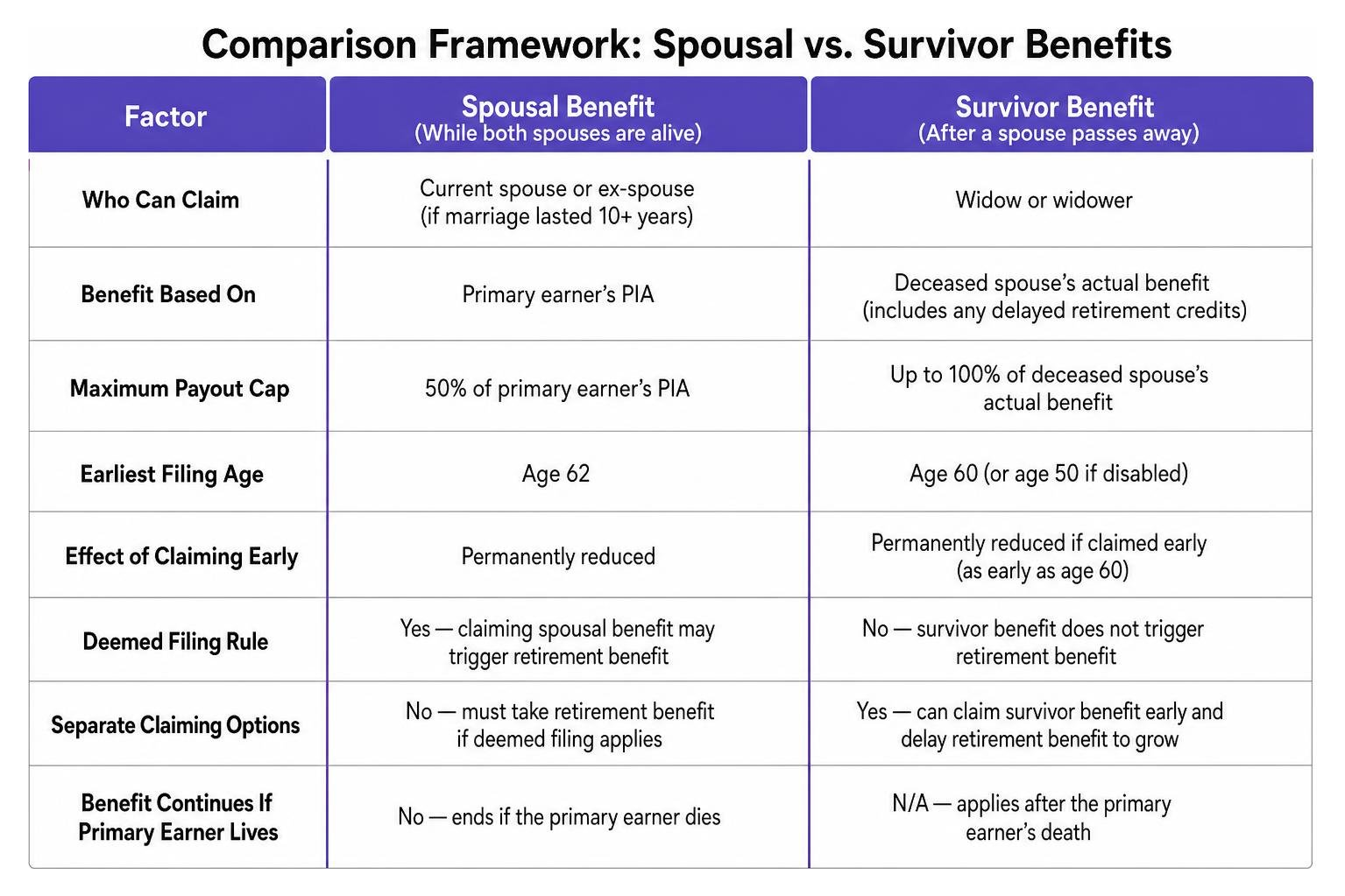
While a social security spousal benefit is paid while both partners are alive, a survivor benefit (widow/widower benefit) kicks in after a spouse passes away.
Key differences include:
- Maximum Payout Cap: Spousal benefits max out at 50% of the primary earner’s PIA. Survivor benefits can pay up to 100% of the deceased spouse’s actual benefit—including any Delayed Retirement Credits earned by the earner for delaying until age 70.
- Earliest Filing Age: Spousal benefits generally start at age 62. Survivor benefits can start as early as age 60 (or age 50 if the surviving spouse is disabled).
- Separate Claiming Options: Under survivor rules, deemed filing does not force you to apply for retirement and survivor benefits simultaneously. A widow or widower can choose to claim a reduced survivor benefit at age 60 while letting their own retirement benefit grow until age 70, then switch to their higher personal payout.
How Ex-Spouse Rules Differ from Current Spouse Rules
Divorced spousal benefits follow most of the same mathematical payout percentages as current spouse benefits, but offer key administrative protections:
- Privacy Rights & No Notification: Your former partner is never notified when you apply for benefits on their work record.
- No Impact on Ex-Spouse: Claiming on an ex-spouse’s record does NOT reduce their monthly check, nor does it impact what their current spouse can draw.
- Exemption from Family Maximum: Standard spousal benefits paid to current family members are subject to the Social Security Family Maximum cap. Benefits paid to a divorced spouse are completely exempt from the family maximum calculations.
- Independent Entitlement: As noted earlier, if you have been divorced for 2+ years, you do not have to wait for your ex-spouse to apply for their own retirement benefits before you file.
Navigating Claiming Strategies and Legislative Changes
If you have talked to older friends or read outdated financial books from a decade ago, you might have heard about clever strategies to boost household income. However, major federal law changes altered these tactics.
To test your own timing and benefit scenarios, try our interactive Social Security Spousal Benefit Calculator.
For official commentary regarding qualifying standards, read the SSA update: Do You Qualify for Social Security Spouse’s Benefits?.
The End of File-and-Suspend and Restricted Applications
The Bipartisan Budget Act of 2015 permanently closed two popular loophole strategies:
- File and Suspend: Previously, a primary earner could file for retirement at FRA to unlock spousal benefits for their partner, then immediately suspend their own payout to earn delayed credits up to age 70. This practice was eliminated. Today, if a primary earner suspends their benefits, all spousal benefits drawing on that record are suspended as well.
- Restricted Application: Previously, a spouse at FRA could submit a “restricted application” for spousal benefits only, collecting 50% of their partner’s check while letting their own personal retirement benefit earn 8% annual delayed credits. This strategy was phased out. Now, under comprehensive deemed filing, anyone born after January 1, 1954 cannot file a restricted application for spousal benefits if they are also eligible for retirement benefits on their own record.
How Earnings Delay Affects Your Social Security Spousal Benefit
Many retirees ask: “If my spouse delays filing until age 70 to maximize our household income, should I wait too?”
Here is the strategic reality:
- For your primary spouse: Delaying retirement benefits past FRA up to age 70 increases their personal check by 8% per year.
- For your spousal benefit: Delaying your spousal claim past your own Full Retirement Age yields zero additional money. Spousal benefits do not earn Delayed Retirement Credits.
Once you reach your Full Retirement Age, your spousal benefit reaches its absolute maximum (50% of your partner’s PIA). Holding off past your FRA won’t increase that spousal top-off check by a single penny!
Frequently Asked Questions About Social Security Spousal Benefits
Does my ex-spouse need to know when I claim benefits on their record?
No. The Social Security Administration maintains strict legal privacy policies. SSA will not notify your ex-spouse when you file a claim on their record, nor will your application require their consent or involvement. Furthermore, your claim will not reduce their payment or affect their current spouse’s eligibility in any way.
Can I collect my own retirement benefit and a spousal benefit at the same time?
You do not get to collect full payouts from both programs stacked on top of each other. Under Social Security’s dual entitlement rules, the SSA pays your own personal retirement benefit first. If 50% of your spouse’s Primary Insurance Amount is higher than your own benefit, SSA adds a spousal supplement (top-off) to equal the higher total amount.
How does working while claiming early affect my spousal benefit?
If you claim a spousal benefit before reaching your Full Retirement Age and continue to work, your check is subject to the Social Security Earnings Test.
If your earned income exceeds the annual limit set by the SSA, Social Security will temporarily withhold $1 in benefits for every $2 earned above the threshold. However, once you reach Full Retirement Age, SSA recalculates your monthly benefit to credit you back for any months benefits were withheld due to working earnings.
Conclusion
Understanding the social security spousal benefit rules is one of the most practical steps you can take to protect your retirement lifestyle. Whether you are currently married, navigating a past divorce, or planning ahead for survivor security, knowing how eligibility, age reductions, and deemed filing work together ensures you don’t leave money on the table.
Setting up a personal “my Social Security” account online takes less than 10 minutes and gives you quick access to official benefit estimates. Coordinate timing decisions carefully with your partner, spousal benefits top out at Full Retirement Age, and avoid relying on outdated rules like file-and-suspend.
For actionable guidance on finding the sweet spot for your claiming age, explore our detailed Social Security Spousal Benefits Timing Guide.