


What Is the Average Semi Truck Accident Settlement?
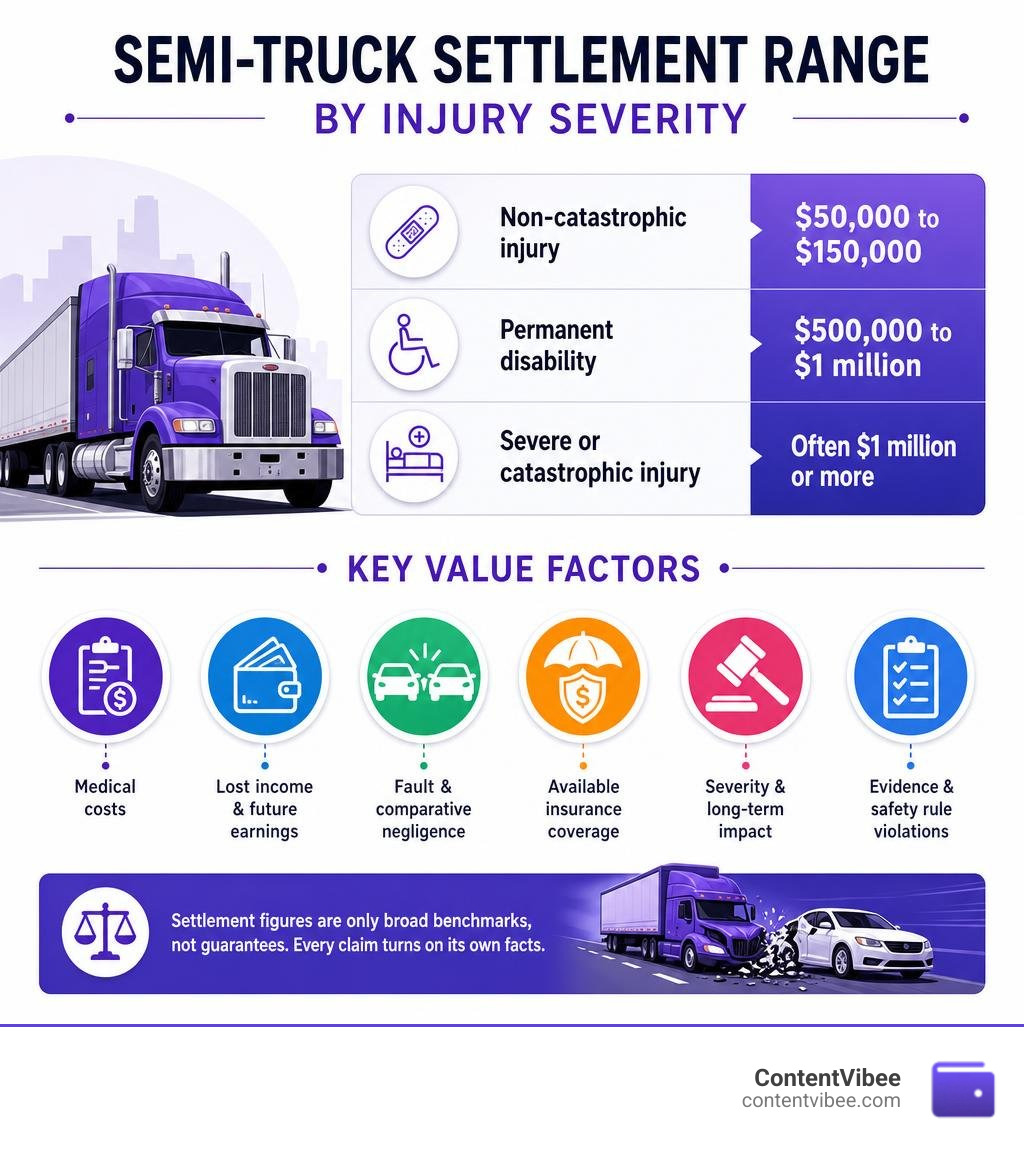
What is the average semi truck accident settlement? A commonly cited average is about $74,000, but that number can be misleading. Many claims with non-catastrophic injuries settle in the $50,000 to $150,000 range, while cases involving permanent disability, major surgery, or wrongful death may reach $500,000 to more than $1 million.
| Type of claim | Common settlement range |
|---|---|
| Non-catastrophic injury | $50,000 to $150,000 |
| Permanent disability | $500,000 to $1 million |
| Severe or catastrophic injury | Often $1 million or more |
A semi-truck crash is not like a typical car accident claim. The injuries can be more serious, evidence may include driver logs and truck data, and several parties may share responsibility. The final value depends on medical costs, lost income, fault, available insurance, and whether trucking safety rules were broken.
Settlement figures are only broad benchmarks, not guarantees. Every claim turns on its own facts.
What Is the Average Semi Truck Accident Settlement and Payout Range?
When accident victims ask us what is the average semi truck accident settlement, they are often searching for a concrete anchor to gauge their own case. While industry datasets point to a broad mean settlement of approximately $74,000 across all recorded commercial truck claims nationwide, this statistical average merges routine property-damage-only incidents with life-altering catastrophic collisions.
Due to the sheer size differential—where a fully loaded 80,000-pound semi-truck impacts a 3,000-pound passenger automobile—settlements for truck accidents are historically 3 to 5 times higher than typical passenger vehicle claims. In crashes resulting in physical injuries, over 70% of claims are settled out of court, yielding non-catastrophic payouts that commonly fall between $50,000 and $150,000. For an in-depth breakdown of how historical payouts are structured, review our Ultimate Guide to Truck Accident Settlement Amounts.
To understand where your claim fits on the financial spectrum, it helps to examine how injury severity directly drives settlement distributions across commercial transport claims:
| Injury Severity Level | Key Clinical Characteristics | Median Settlement Range |
|---|---|---|
| Minor / Moderate | Soft tissue sprains, mild whiplash, minor lacerations, brief recovery | $20,000 – $50,000 |
| Moderate to Severe | Fractures, disc herniations, complex surgical repairs, extended leave | $50,000 – $150,000 |
| Permanent Disability | Traumatic brain injury (TBI), spinal trauma, loss of limb, lifelong care | $500,000 – $1,000,000+ |
| Fatalities / Wrongful Death | Loss of life, loss of consortium, funeral costs, lost future income | $1,000,000 – $5,000,000+ |
Calculating What Is the Average Semi Truck Accident Settlement for Minor vs. Catastrophic Injuries
The physical impact of a collision determines the baseline trajectory of your financial recovery. Minor claims—such as soft tissue strains or simple bone fractures that heal within weeks—rarely accumulate the extensive economic damages required to hit six-figure numbers. However, when a collision causes traumatic brain injury (TBI), spinal cord paralysis, severe burn injuries, or permanent disability, damages skyrocket.
In catastrophic injury cases, median settlements jump dramatically into the $500,000 to $1,000,000+ bracket. This reflects not just past medical expenses, but the staggering lifetime costs of constant medical care, home modifications, physical therapy, specialized medical equipment, and complete loss of earning capacity. To learn how specialized legal representation approaches high-stakes injury claims, consult our In-Depth Guide to Serious Truck Accident Lawyer.
How Insurance Policies Impact What Is the Average Semi Truck Accident Settlement
Unlike private motorists who often carry baseline state liability insurance (frequently capped at $25,000 or $50,000), commercial motor carriers are held to rigorous federal standards. The Federal Motor Carrier Safety Administration (FMCSA) mandates strict minimum financial responsibility requirements for freight operators:
- Non-hazardous freight (under 10,000 lbs): Minimum $300,000 public liability coverage.
- General freight (over 10,000 lbs): Minimum $750,000 public liability coverage.
- Oil transport and specialized cargo: Minimum $1,000,000 public liability coverage.
- Hazardous materials transport: Minimum $5,000,000 public liability coverage.
In practice, large commercial fleets frequently carry excess, umbrella, and multi-layered commercial policies worth tens of millions of dollars. These higher policy limits ensure that when severe harm occurs, there is adequate financial coverage to pay out multi-million dollar verdicts or negotiated settlements. Discover how policy thresholds influence commercial litigation in our A Comprehensive Guide to Commercial Truck Accident Attorney.
Key Factors Determining Your Truck Accident Claim Value

No two commercial trucking accidents unfold under identical circumstances. Establishing the precise financial valuation of your claim requires analyzing several core legal, economic, and procedural elements.
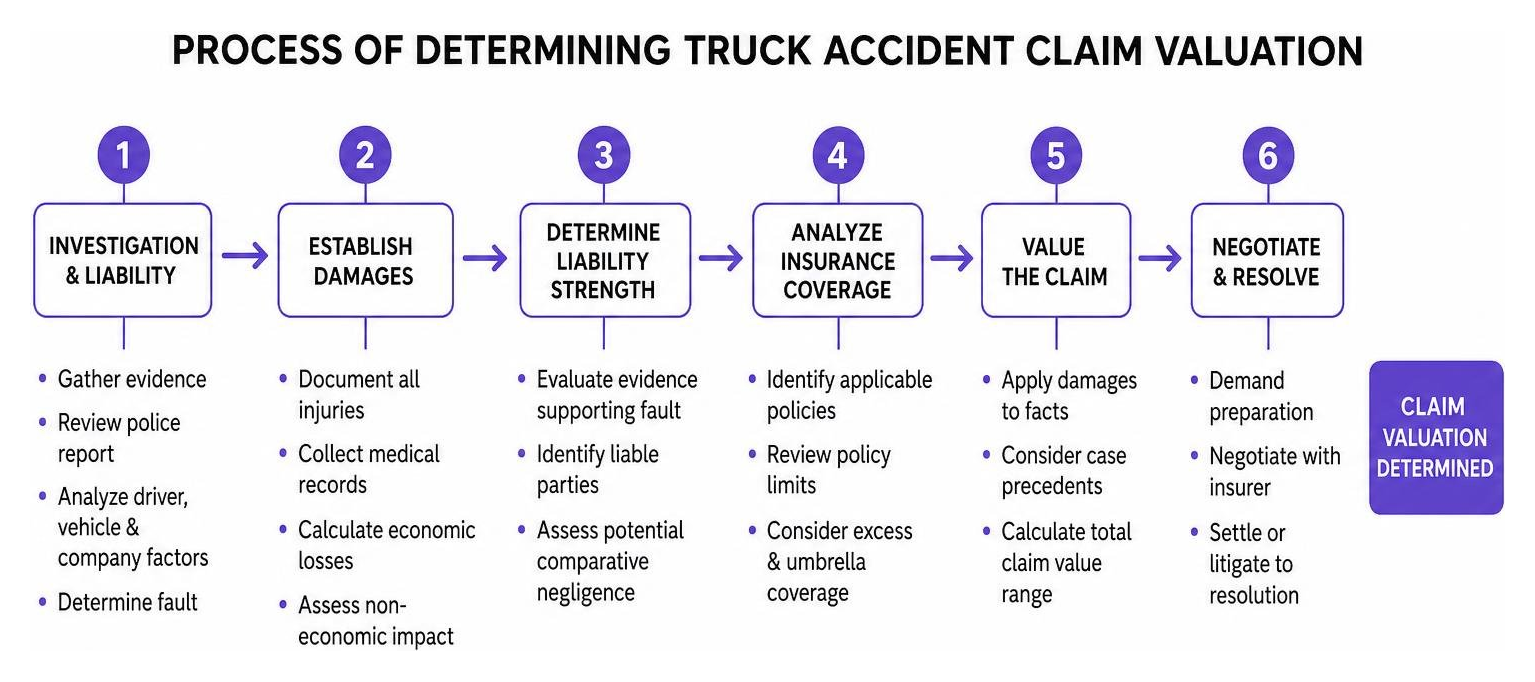
To navigate these moving parts successfully, claimants must understand how loss calculation works under personal injury law. For additional guidance, read our Ultimate Guide to 18 Wheeler Accident Lawyer.
Economic vs. Non-Economic Damages in Semi-Truck Claims
When establishing what is the average semi truck accident settlement payout for an individual, damages are divided into two primary categories: economic and non-economic.
Economic Damages (Quantifiable Losses):
- Current and Future Medical Bills: Ambulance transportation, emergency room treatment, surgeries, ICU care, doctor visits, medications, and physical therapy.
- Lost Income and Lost Earning Capacity: Compensation for time away from work during recovery, as well as reduced future earnings if permanent impairments prevent you from returning to your prior trade.
- Property Damage: Repair or fair market replacement value for your destroyed personal vehicle and personal items within it.
- Out-of-Pocket Expenses: Travel expenses for specialized care, home care assistance, and medical devices.
Non-Economic Damages (Subjective Losses):
- Pain and Suffering: Physical agony, continuous discomfort, and physical limitations caused by trauma.
- Emotional Distress: Anxiety, depression, PTSD, sleep disturbances, and fear of driving post-accident.
- Loss of Enjoyment of Life: Inability to participate in daily hobbies, recreation, exercise, or family activities.
- Loss of Consortium: Damage to personal relationships, companionship, and marital bonds.
To evaluate these subjective losses, attorneys and insurers often use a multiplier method (multiplying economic damages by a factor between 1.5 and 5 depending on severity) or a per diem daily rate. To explore strategies for optimizing damage calculations, check out 18 Wheeler Accident Lawyers 8 of the Best for Your Case.
Multiple Liable Parties and Federal Trucking Regulations
One factor that sets semi-truck collisions apart from standard auto crashes is the presence of multiple potential defendants. Rather than pursuing just a single driver, a thorough investigation may expose systemic negligence across several corporate entities:
- The Truck Driver: Negligence involving speeding, tailgating, distracted driving, or driving under the influence.
- The Trucking Company / Motor Carrier: Vicarious liability, negligent hiring practices, inadequate safety training, or encouraging drivers to violate hours-of-service limits.
- Cargo Loaders and Shippers: Improperly loaded, off-balance, or unsecured cargo that causes jackknifing or rollover hazards.
- Maintenance Contractors & Mechanics: Failure to inspect, maintain, or repair critical systems like air brakes, steering assemblies, or tires.
- Equipment Manufacturers: Defective truck parts or mechanical component failures.
Furthermore, commercial carriers operate under federal guidelines enforced by the FMCSA. Proving that a carrier violated regulations—such as Hours of Service (HOS) rules, drug testing protocols, or mandatory inspection routines—can establish clear liability. Attorneys preserve crucial evidence by pulling electronic logging devices (ELDs), “black box” event data recorders (EDRs), dashcam footage, and maintenance logs before data is overwritten. To understand how multi-party liability creates added financial leverage, read Big Truck Wreck Lawyers 7 Things to Know Before Hiring.
Settlement Timeline and Settlement vs. Trial Decisions
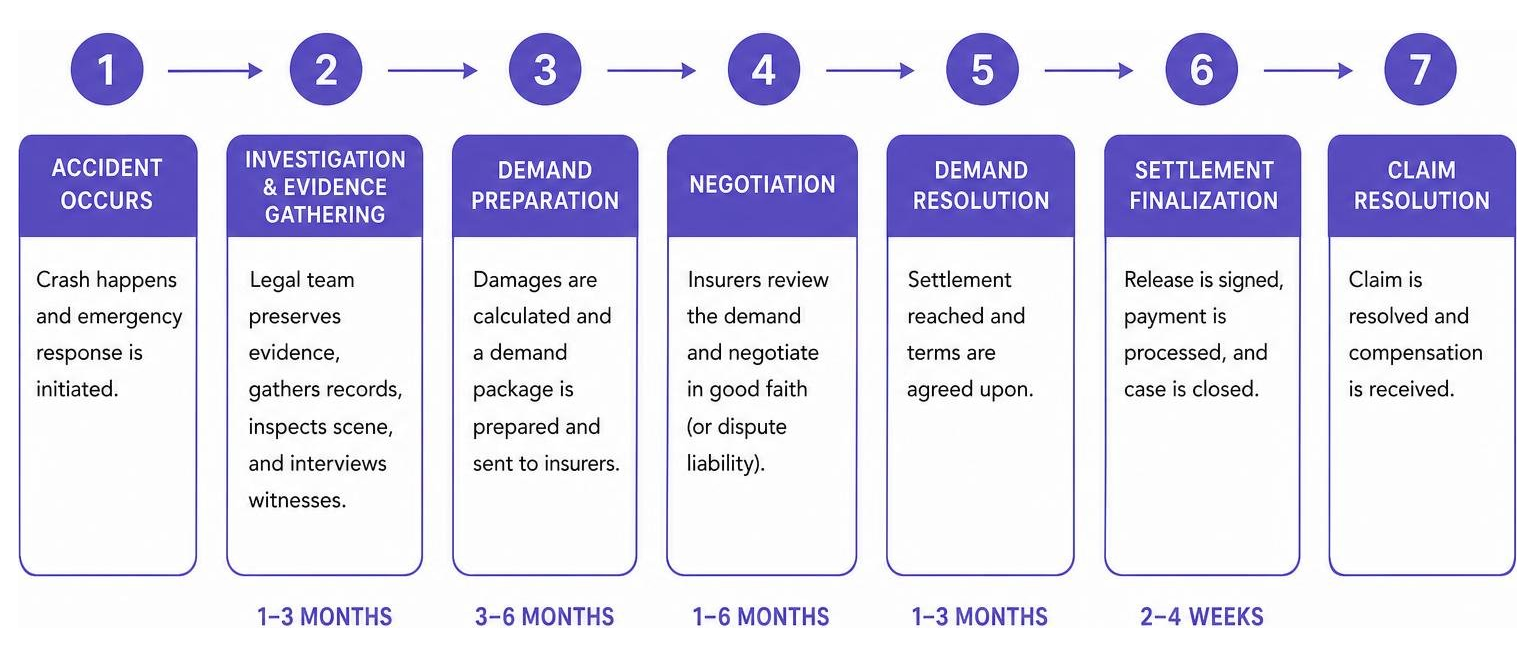
Commercial truck accident litigation rarely resolves overnight. Because millions of dollars are frequently on the line, insurance defense firms conduct aggressive investigations and resist fast payouts. Understanding the claim timeline helps injured victims manage financial pressures during negotiations.
Typical Timeline for Resolving Commercial Truck Claims
Most commercial truck accident claims take anywhere from 6 months to over 2 years to resolve. The length of time depends on the complexity of the case:
- Immediate Crash Investigation (Months 1–3): Legal teams issue spoliation letters to preserve black box data, gather police reports, inspect the collision scene, and interview witnesses.
- Medical Treatment and MMI (Months 2–12+): Payout calculations should not take place until the crash victim reaches Maximum Medical Improvement (MMI). Settling prior to MMI leaves long-term future medical care uncompensated.
- Demand Package and Negotiation (Months 6–14): Once total damages are calculated, a formal demand letter is served on the insurance company. Adjusters review the demand, starting settlement offers and counteroffers.
- Litigation and Pre-Trial Discovery (Months 12–24+): If the insurance carrier offers a lowball settlement, your legal team files a formal lawsuit. Both sides conduct depositions, exchange evidence, and hire medical and accident reconstruction experts.
- Mediation or Trial (Months 18–30): Court-ordered mediation resolves many disputes before trial. If negotiations fail, the case proceeds to a formal jury trial.
To learn more about managing litigation timelines effectively, check our analysis on Best Truck Accident Lawyers Injury Claims.
When to Accept a Settlement Offer vs. Going to Trial
Deciding whether to take a settlement offer or proceed to a jury trial is one of the most critical choices in any claim.
- Why Accept a Settlement? Settlements deliver immediate financial certainty, avoid expensive trial fees, prevent years of appellate delay, and guarantee guaranteed funds to pay immediate medical bills.
- Why Risk Going to Trial? Insurance carriers routinely offer initial settlements that fall far short of lifetime losses. If an insurer refuses to offer fair compensation for catastrophic injuries, taking the case to a jury can result in much higher verdicts, including punitive damages if gross negligence was involved.
To evaluate whether a settlement offer reflects fair market value for your injuries, review our resource on 5 Convincing Reasons You Need a Truck Accident Lawyer.
Critical Mistakes That Lower Your Truck Accident Settlement Value
Securing full financial recovery requires avoiding tactical missteps immediately following a crash. Insurance adjusters are trained to minimize payout liabilities, and simple errors early in the process can significantly lower your settlement value.
- Delaying Immediate Medical Treatment: Failing to seek immediate medical evaluation creates an opening for insurance defense attorneys to argue that your injuries were pre-existing, exaggerated, or caused by a separate incident.
- Providing Recorded Statements Without Counsel: Adjusters may ask leading questions designed to get you to inadvertently minimize your pain or admit partial fault. Never give a recorded statement without legal guidance.
- Admitting Fault at the Accident Scene: Apologizing or speculating on what happened while speaking to police or motor carriers can be interpreted as an admission of legal liability.
- Posting Details on Social Media: Defense investigators closely monitor public social media platforms. Photos showing you traveling, smiling, or engaged in physical activities can be presented in court to undermine claims of severe injury or pain.
- Accepting the First Quick Cash Offer: Initial offers sent by insurance companies shortly after a crash are designed to close claims before the full extent of your injuries and long-term costs are known.
Avoid these common traps by reviewing our 6 Insider Tips for Success With Lawyer for Semi Truck Accident.
Frequently Asked Questions About Commercial Truck Settlements
How long does it take to receive a truck accident settlement payout?
While uncomplicated property claims or minor injury claims can settle within 3 to 6 months, standard personal injury truck claims average 12 to 24 months. Complex cases involving multi-party litigation, permanent disability, or jury trials can take anywhere from 2 to 4 years to reach a final payout.
Why are truck accident settlements higher than passenger car accident payouts?
Truck accident claims tend to yield higher settlements due to three primary drivers:
- The sheer mass and momentum of fully loaded commercial vehicles inflict far more severe, catastrophic injuries.
- Federal law requires trucking fleets to carry significantly higher insurance coverage (starting at $750,000 up to $5,000,000+).
- Commercial truck crashes often involve multiple corporate entities whose systemic regulatory non-compliance can be proven in court.
How does comparative negligence affect my final settlement amount?
State laws dictate how fault affects recovery:
- Modified Comparative Fault (Most Common): You can recover damages as long as you are less than 50% (or 51%, depending on the state) at fault, though your payout is reduced by your percentage of fault. For example, if you are awarded $100,000 but found 20% at fault, you will receive $80,000.
- Pure Comparative Fault: You can recover damages even if you are 90% at fault, but your recovery is reduced proportionally by 90%.
- Contributory Negligence (Few States): If you are found to be even 1% at fault, you may be completely barred from recovering compensation.
Conclusion
Understanding what is the average semi truck accident settlement requires looking far beyond a single average dollar figure like $74,000. Because commercial vehicle crashes involve severe physical impacts, complex federal safety regulations, multi-layered insurance policies, and multiple corporate defendants, claim values vary widely. Payouts range from tens of thousands of dollars for minor injuries to multi-million-dollar settlements for permanent disabilities or fatal crashes.
By seeking prompt medical treatment, preserving key electronic truck evidence, calculating both economic and non-economic losses, and securing experienced legal representation, crash victims can protect their rights and seek fair compensation.
If you or a loved one are navigating a complex commercial truck claim and need actionable advice tailored to your situation, explore our comprehensive ContentVibee Truck Accident Settlement Guide today to evaluate your claim’s true worth and take control of your financial recovery.


