Can My Spouse Collect Social Security Before I Retire? The Quick Answer
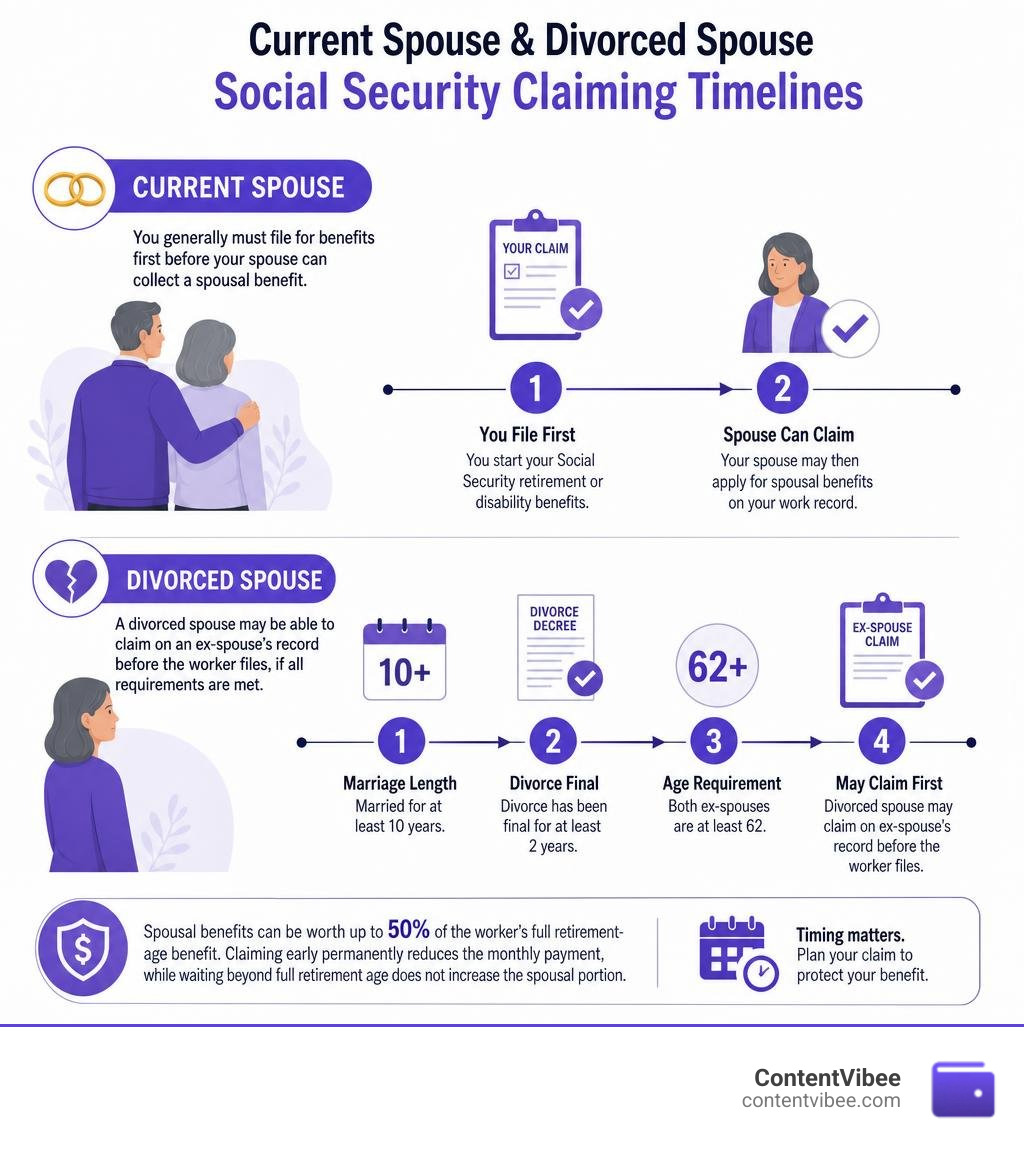
Can my spouse collect Social Security before I retire? Usually, no. If you are currently married, you generally must first file for Social Security retirement or disability benefits before your spouse can receive a spousal benefit on your work record.
There is one important exception: a divorced spouse may be able to claim on an ex-spouse’s record before the worker files, if the marriage lasted at least 10 years, the divorce has been final for at least 2 years, and both people are at least 62.
Spousal benefits can be worth up to 50% of the worker’s full retirement-age benefit. But timing matters. Claiming early can permanently reduce the monthly payment, while waiting beyond full retirement age does not increase the spousal portion.
This guide explains the rules in plain English, including the difference between current and former spouses, early-claiming cuts, working while receiving benefits, and outdated strategies you may still hear about.
Can My Spouse Collect Social Security Before I Retire?
When planning for retirement as a couple, timing is everything. We frequently speak with individuals who hope to start drawing household income by having one partner collect spousal benefits while the main earner continues working to build up delayed retirement credits. While this sounds like a clever financial strategy, Social Security Administration (SSA) regulations set clear boundaries on when and how these benefits can be accessed.
To understand how spousal payments function within a broader financial plan, it helps to read our detailed guide on How Social Security Spousal Benefits Work for Married Couples. Below, we break down the specific legal mechanics that govern whether your partner can claim benefits while you are still working.
Core Rules: Can My Spouse Collect Social Security Before I Retire as a Married Couple?
If you are currently married, the fundamental rule is simple: you must actively file for your own Social Security retirement or disability benefits before your spouse can claim a spousal benefit on your earnings record.
According to official SSA guidelines outlined in the SSA – POMS: RS 00202.001 – Definitions and Requirements for Spouse Benefits – 07/24/2017 , a primary worker (referred to legally as the Number Holder) must be entitled to retirement benefits (RIB) or disability benefits (DIB) before any current spouse can qualify for auxiliary benefits based on that same record.
In addition to the worker’s filing status, a current spouse must satisfy several basic eligibility criteria:
- Marriage Duration: You must generally be legally married for at least one continuous year immediately before filing (unless you are the biological parent of a child with your spouse or meet specific survivor/disability benefit transition rules).
- Age Requirement: Your spouse must be at least 62 years old, unless they are caring for a child who is under age 16 or disabled and entitled to benefits on your record.
- Benefit Amount Check: Your spouse’s primary insurance amount (PIA)—the benefit they earned on their own work record—must be less than 50% of your PIA. Social Security will always pay an individual’s own benefit first before adding any spousal top-up.
Because of these core requirements, if you decide to delay your retirement until age 70 to maximize your monthly payout, your current husband or wife cannot collect spousal benefits on your record during those intervening years.
Key Conditions: Can My Spouse Collect Social Security Before I Retire If We Are Divorced?
The rules shift dramatically if you are divorced. Congress recognized that former spouses may not remain in contact or coordinate financial strategies, so the law grants divorced individuals greater independence when claiming benefits.
As detailed in Social Security Married and Divorced Spousal Benefits , an ex-spouse can collect spousal benefits on your earnings record even if you have not yet retired or filed for benefits yourself. However, they must meet strict statutory conditions under the “independently entitled divorced spouse” rules:
- The 10-Year Marriage Rule: You and your former spouse must have been legally married for at least 10 continuous years prior to the finalization of the divorce.
- The 2-Year Divorce Rule: You must have been divorced for at least two consecutive years. (This two-year waiting period is waived if you, the primary earner, have already filed for your own retirement benefits).
- Age Requirement: Both you and your former spouse must be at least 62 years old.
- Current Marital Status: Your ex-spouse must be currently unmarried. If your ex-spouse remarries, they generally lose eligibility for spousal benefits on your record (unless that subsequent marriage also ends in death, divorce, or annulment).
An important detail that provides peace of mind is that an ex-spouse claiming benefits on your work record has zero impact on your own monthly checks or the checks of your current spouse. Furthermore, the Social Security Administration keeps claims completely private—your ex-spouse is not required to contact you, nor will SSA notify you when they apply.
Deemed Filing, File and Suspend, and Dual Entitlement

Navigating Social Security requires understanding how old claiming techniques have evolved over time. Years ago, financial advisors frequently recommended loopholes that allowed couples to claim spousal payments while delaying their own worker benefits. Major legislative updates have closed those gaps, creating a far more streamlined—and strict—system.
Deemed Filing Rules and Bipartisan Budget Act
The biggest structural shift in modern Social Security claiming rules came with the passage of the Bipartisan Budget Act of 2015. This legislation expanded what is known as deemed filing.
Under deemed filing, when you apply for Social Security retirement benefits, you are automatically “deemed” to have applied for spousal benefits as well, provided you meet the age and entitlement criteria for both. Conversely, if you apply for spousal benefits, SSA deems that you have also applied for your personal retirement benefits.
Here is how deemed filing works in practice:
- You cannot choose to take only a spousal benefit while leaving your own worker benefit untouched to grow by 8% per year in delayed retirement credits.
- Social Security will look at both your own record and your spouse’s record. They calculate your personal retirement amount first. If 50% of your spouse’s full benefit is higher than your personal benefit, SSA pays your earned benefit plus a “spousal combination” top-up to bring your total check to the higher amount.
- Effective Date & Cutoffs: Deemed filing applies to anyone who turned 62 on or after January 2, 2016. It extends all the way through Full Retirement Age (FRA).
To learn more about how dual earnings histories intersect for married partners, read our analysis on whether Can a Married Couple Both Collect Social Security?.
The Elimination of the File and Suspend Strategy
If you read older retirement planning books or internet forums, you might encounter references to the famous “file and suspend” strategy.
Prior to April 30, 2016, a primary earner who reached Full Retirement Age could submit an application for retirement benefits and then immediately suspend receiving checks. This permitted their husband or wife to claim a spousal benefit on the primary earner’s record, while the earner’s suspended benefit continued growing by earning delayed retirement credits up to age 70.
The 2015 Bipartisan Budget Act completely eliminated file and suspend.
Under current law, if a primary worker voluntarily suspends their retirement benefits to earn delayed credits, all auxiliary benefits payable on their record are also suspended. This means if you suspend your payments, your current spouse loses their spousal benefit for as long as your suspension remains active.
Note for divorced couples: Voluntary suspension by a primary earner does not stop an independently entitled ex-spouse from collecting spousal checks, preserving the ex-spouse’s financial independence.
Benefit Calculations, Early Claiming Reductions, and Working Rules

More than 2 million Americans currently collect spousal Social Security benefits. For many households, these checks form a crucial baseline of guaranteed monthly income. However, understanding the exact math behind how early claiming penalties reduce payouts is essential before submitting Form SSA-2.
You can run your own personalized estimates using our interactive Social Security Spousal Benefit Calculator. Below, we explain the reduction formulas and working rules in detail.
Earliest Claiming Age and Monthly Penalty Formulas
The earliest age a spouse can file for spousal benefits (without a qualifying child in care) is age 62. However, claiming at 62 comes with a substantial, permanent financial penalty.
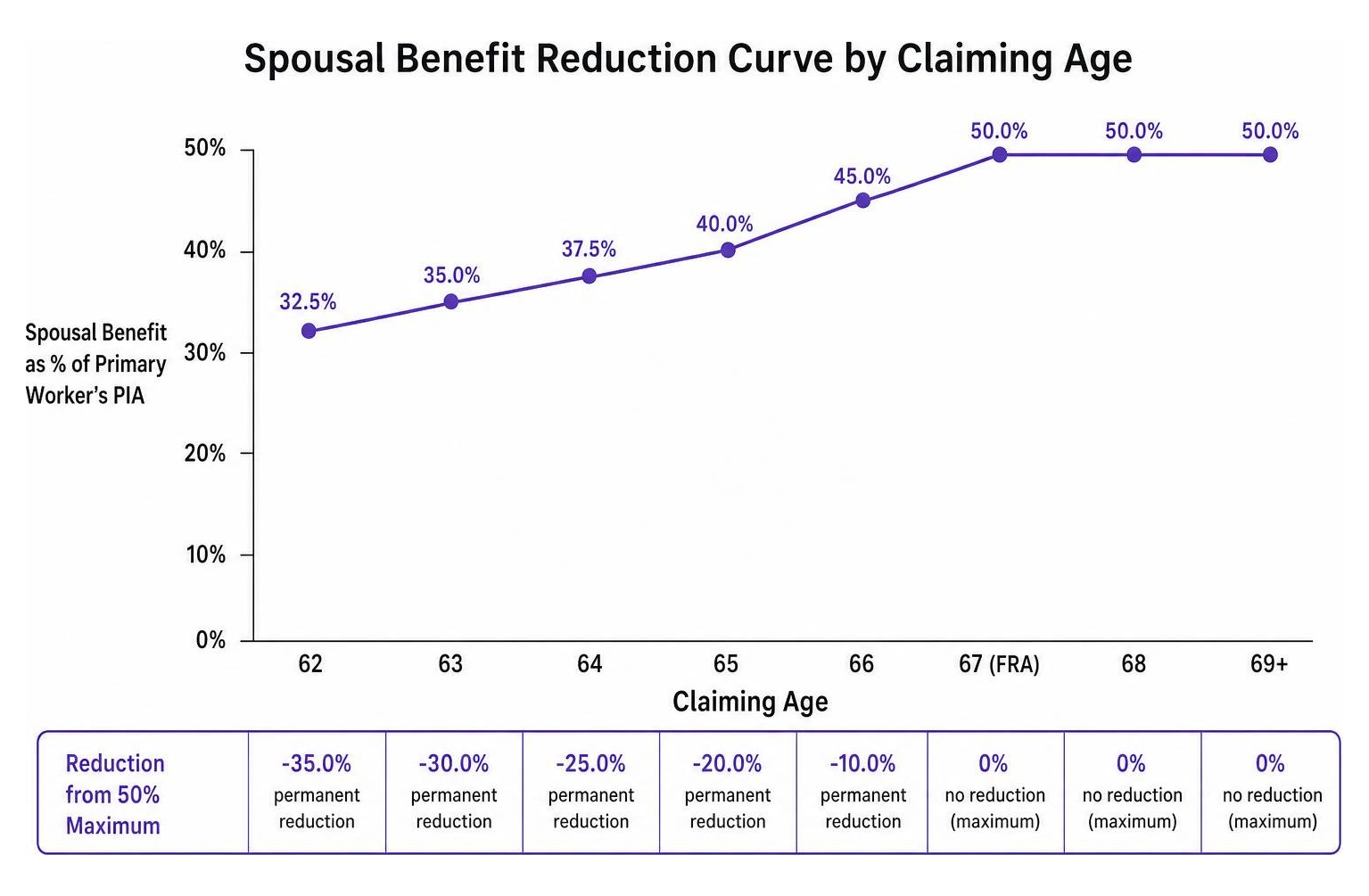
A spouse only receives the maximum spousal benefit—which is 50% of the primary worker’s Primary Insurance Amount (PIA)—if the spouse waits until reaching their own Full Retirement Age (FRA). For anyone born in 1960 or later, FRA is 67.
If a spouse claims prior to FRA, Social Security applies a two-tiered reduction formula to the spousal payment:
- First 36 Months Early: The benefit is reduced by 25/36 of 1% per month (approximately 8.33% per year).
- Additional Months Early (up to 24 months): For each month beyond 36 months (up to a maximum of 60 months prior to FRA), the benefit is reduced by 5/12 of 1% per month (approximately 5% per year).
Let’s look at the numbers for someone whose FRA is 67:
- Filing at Age 67 (FRA): Receives 50% of the worker’s PIA.
- Filing at Age 65 (24 months early): Receives 41.7% of the worker’s PIA.
- Filing at Age 64 (36 months early): Receives 37.5% of the worker’s PIA.
- Filing at Age 62 (60 months early): Receives 32.5% of the worker’s PIA.
Notice that claiming spousal benefits at 62 results in a total reduction of 35% from the full spousal rate, dropping the payout to just 32.5% of the primary earner’s primary benefit amount.
To explore age-based eligibility benchmarks, check out our guide on At What Age Can I Claim My Spouse’s Social Security?.
The Retirement Earnings Test and Child-in-Care Exceptions
Two important statutory rules can modify early spousal claiming outcomes: the Retirement Earnings Test and the Child-in-Care Exception.
1. The Retirement Earnings Test (RET)
If your spouse claims early spousal benefits while continuing to work, their earnings may trigger temporary benefit withholdings under the Retirement Earnings Test:
- Under Full Retirement Age All Year: If earnings exceed the annual limit, SSA withholds $1 in benefits for every $2 earned above the threshold.
- In the Year Reaching FRA: A higher exempt limit applies, and SSA withholds $1 in benefits for every $3 earned above the limit until the exact month FRA is reached.
- After Reaching FRA: The earnings test no longer applies. Working does not reduce monthly checks regardless of income.
Important Note: Withheld benefits are not lost forever. Once your spouse reaches FRA, SSA recalculates their monthly check upward to account for the months benefits were withheld.
2. The Child-in-Care Exception
A major exception to both age limits and early reduction formulas exists for parents raising young or disabled children. A spouse can collect spousal benefits at any age (even well under 62) without any early-claiming reduction if:
- They are caring for a child under age 16 who is entitled to child’s benefits on the primary earner’s record, OR
- They are caring for a disabled child of any age who became disabled prior to age 22 and receives benefits on the primary earner’s record.
To review options for household protection, refer to our article on Unlocking Social Security Retirement Benefits for Your Spouse.
Key Differences: Current Spouse vs. Divorced Spouse Benefit Rules
To wrap up these structural rules, the table below highlights the key operational differences between claiming as a current married partner versus claiming as a former spouse:
| Feature / Requirement | Current Spouse | Divorced Spouse |
|---|---|---|
| Primary Earner Filing Required? | Yes — Primary earner must file first. | No — Independent entitlement applies if divorced 2+ years. |
| Minimum Marriage Duration | 1 continuous year | 10 continuous years |
| Minimum Age to Claim | Age 62 (or any age with qualifying child) | Age 62 |
| Impact of Remarriage | N/A (Must remain married) | Benefit terminates if ex-spouse remarries. |
| Max Spousal Payout at FRA | 50% of worker’s PIA | 50% of worker’s PIA |
| Impact on Other Family Checks | Subject to Family Maximum Cap | Exempt from Family Maximum Cap |
| Notification to Worker | N/A (Filed together or coordinated) | Worker is not notified by SSA. |
Frequently Asked Questions About Spousal Benefits
Can I receive my own retirement benefit and a spousal benefit at the same time?
You cannot double-dip or combine full amounts from both records to receive a double payment. Under Social Security’s dual entitlement rules, SSA always calculates and pays your own personal retirement benefit first based on your earnings record.
If your personal retirement benefit is higher than 50% of your spouse’s primary insurance amount, you receive only your personal benefit. If your personal benefit is lower than the potential spousal benefit, Social Security pays your personal benefit plus a supplemental spousal check to bring your total combined monthly payment up to the higher spousal cap.
Do spousal benefits earn delayed retirement credits past Full Retirement Age?
No. Personal retirement benefits earn delayed retirement credits at a rate of 8% per year for every year you delay claiming past Full Retirement Age up to age 70. However, spousal benefits do not earn delayed retirement credits.
A spousal benefit reaches its absolute maximum value—50% of the primary earner’s PIA—at your Full Retirement Age. Delaying a spousal claim past your FRA will not increase your monthly payment. Therefore, if you are claiming purely as a spouse, there is zero financial benefit to waiting past your FRA.
How does working while receiving early spousal benefits affect monthly payments?
If you collect early spousal benefits before your Full Retirement Age and earn income over the annual limits, Social Security will temporarily withhold part or all of your monthly benefits under the Retirement Earnings Test ($1 withheld for every $2 earned over the annual limit).
If your spousal check is withheld due to earnings, it also impacts auxiliary benefits tied to that claim. However, once you reach your Full Retirement Age, SSA recalculates your payout percentage to restore the value of the checks that were withheld during your working years.
Conclusion
So, can my spouse collect Social Security before I retire? For married couples, the answer remains a firm no: you must submit an application for your own retirement or disability benefits before your partner can access spousal checks on your record. Divorced spouses who meet the 10-year marriage and 2-year divorce rules stand as the single major exception to this rule.
When mapping out your broader retirement income strategy, remember these four pillars:
- Spousal benefits max out at 50% of the primary earner’s Full Retirement Age benefit.
- Claiming at the earliest age of 62 slashes spousal checks down to 32.5% of the worker’s PIA.
- Under deemed filing, you cannot isolate spousal benefits while delaying your own worker record.
- Spousal benefits stop growing at Full Retirement Age and do not accumulate delayed credits.
Coordinating claiming timelines between partners is one of the most effective ways to maximize lifetime household wealth and ensure long-term survivor protection. For a complete deep dive into every eligibility rule and strategy, read The Complete Guide to Social Security Spousal Benefit Eligibility.