


Social Security Spousal Benefits: What Every Couple Needs to Know Before Claiming
Spousal benefits under Social Security can add hundreds of dollars a month to a couple’s retirement income — yet millions of Americans either claim them too early or don’t fully understand how they work.
Here’s a quick overview of how spousal benefits work:
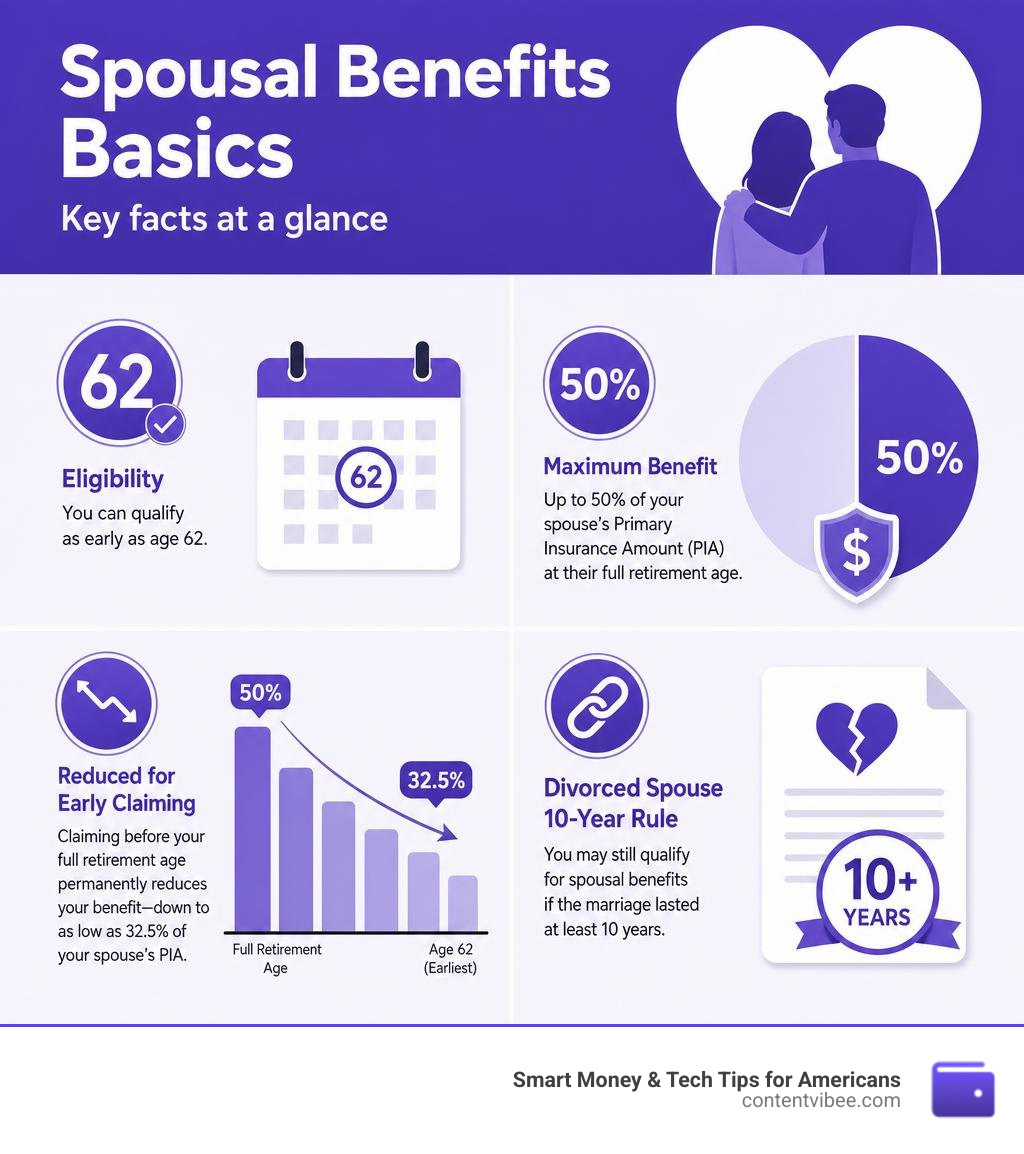
- Who qualifies: Married spouses age 62 or older (or any age if caring for a qualifying child under 16 or a disabled child) whose spouse is already receiving Social Security retirement or disability benefits
- How much you can receive: Up to 50% of your spouse’s primary insurance amount (PIA) — their full retirement age benefit
- When benefits are reduced: Claiming before your full retirement age permanently lowers your monthly amount, down to as low as 32.5% of your spouse’s PIA
- Key rule: If you qualify for both your own retirement benefit and a spousal benefit, Social Security pays the higher amount — not both combined
- Divorced spouses: May still qualify if the marriage lasted at least 10 years
- How to apply: Online at SSA.gov, by phone, or at a local Social Security office
As of December 2023, about 5.9 million people received spousal benefits — roughly 9% of all Social Security beneficiaries — with an average monthly payment of $492. Women make up approximately 95% of spousal-only beneficiaries, making this benefit especially important for couples where one partner earned significantly less over their career.
The rules around timing, dual entitlement, and claiming strategies can be confusing. Claiming at the wrong time can cost you thousands of dollars over a lifetime.
This guide breaks down everything you need to know — from eligibility and calculation to divorced spouse rules, survivor benefits, and how to apply.
Who Qualifies for Spousal Benefits Under Social Security?
To understand how spousal benefits function, we must first look at who actually qualifies to receive them. The Social Security Administration (SSA) has established clear guidelines to determine eligibility. These rules ensure that benefits are distributed fairly while protecting the financial integrity of the program.
At its core, the spousal benefit program is designed to provide financial security for couples, particularly when one partner has had lower lifetime earnings or has spent years working in the home. In fact, out of the roughly 5.9 million individuals receiving spousal benefits, women account for about 95% of all spousal-only beneficiaries. This program acts as a crucial safety net, bridging the retirement income gap for millions of families across the country.
To qualify for these benefits, your spouse must already be receiving their own retirement or disability benefits. You cannot claim a spousal benefit on your partner’s record if they have not yet filed for their own. Additionally, you must meet specific marriage duration and age requirements, which we will detail below. To explore the broader framework of who can qualify, check out The Ultimate Guide to Spousal Social Security Eligibility.
For a deep dive into the official legal definitions, you can reference the SSA Handbook § 305, which outlines the exact administrative rules governing spousal entitlement.
Age and Marriage Duration Rules
For currently married couples, the SSA requires that you meet a minimum marriage duration before you can file for spousal benefits. In most cases, you must have been married for at least one continuous year immediately before filing your application.
However, there are a few exceptions to this one-year rule. For example, if you are the natural parent of your spouse’s child, or if you were entitled (or potentially entitled) to certain other Social Security benefits—such as survivor or disability benefits—immediately before your marriage, the one-year requirement may be waived.
In terms of age, the absolute earliest you can claim spousal benefits is age 62, unless you qualify under a specific child-in-care exception. It is important to note that claiming at age 62 will result in a permanently reduced monthly payout. To get a clear picture of how age impacts your eligibility and lifetime payouts, read our guide on At What Age Can I Claim My Spouse’s Social Security?.
For the highly technical details regarding how the SSA defines a legal vs. deemed spouse, you can review the official policy database in the SSA – POMS: RS 00202.001 – Definitions and Requirements for Spouse Benefits – 07/24/2017.
Child-in-Care Exceptions for Spousal Benefits Under Social Security
While age 62 is the standard baseline, there is a major exception that waives the age requirement entirely. If you are caring for a child who is under age 16 or who became disabled before age 22, you can claim spousal benefits under social security at any age.
When you qualify under this “child-in-care” rule, your spousal benefit is not subject to the typical early retirement reductions. You receive the full spousal benefit amount (50% of your spouse’s primary insurance amount) regardless of how young you are when you claim.
However, once the child turns 16 (unless they are disabled), the child-in-care spousal benefit will stop, even if your spouse continues to receive their own retirement benefits. At that point, you would need to wait until you reach age 62 to apply for regular spousal benefits. You can find more official guidance on this exception by reading Do You Qualify for Social Security Spouse’s Benefits? | Social Security Matters | SSA.
How Spousal Benefits Are Calculated
Calculating your potential spousal benefit is key to building an effective retirement plan. The SSA uses a specific formula based on your partner’s earnings history, rather than your own.
The foundational concept to understand is the Primary Insurance Amount (PIA). The PIA is the monthly benefit amount a worker is entitled to receive if they claim exactly at their Full Retirement Age (FRA). Your FRA depends on the year you were born. For anyone born in 1960 or later, the FRA is 67.
When calculating spousal benefits, the baseline is always the worker’s PIA. The maximum spousal benefit you can receive is exactly 50% of your spouse’s PIA.
To illustrate, let’s look at how this compares to historical averages. In December 2023, the average retired worker benefit was $1,907 per month, while the average spousal benefit was $492. This difference exists because many spouses claim early, or they receive a combination of their own retirement benefit and a partial spousal top-off.
To see how these numbers translate to your personal financial situation, you can use our resource to Calculate Spouse Retirement Benefits or check out the official tool on the Benefits for Spouses page.
The 50% Maximum Benefit Rule
The 50% maximum rule is straightforward but highly rigid. If your spouse has a PIA of $2,000, your maximum possible spousal benefit is $1,000 per month.
It is vital to understand that this maximum is based entirely on your spouse’s PIA at their full retirement age. If your spouse decides to delay claiming their own benefit past their FRA to earn Delayed Retirement Credits (which increases their own benefit by 8% per year up to age 70), your spousal benefit does not increase. It remains capped at 50% of their FRA amount.
Conversely, if your spouse claims their own retirement benefit early (resulting in a permanent reduction for them), your base spousal benefit is still calculated using 50% of their full FRA PIA. However, if you claim your spousal benefit before your own FRA, your payout will be reduced. To run the numbers for your specific age and earnings scenarios, try our interactive Tools/Finance Calculator/Social Security Spousal Benefit Calculator.
Reductions for Claiming Before Full Retirement Age
If you choose to claim your spousal benefit before reaching your full retirement age, the SSA applies a monthly reduction formula. The reduction is permanent and is calculated as follows:
- For the first 36 months before your FRA, the benefit is reduced by 25/36 of 1% for each month.
- For any additional months beyond 36 months (up to a maximum of 60 months if claiming at age 62), the benefit is further reduced by 5/12 of 1% per month.
If your FRA is 67 and you claim at exactly age 62 (60 months early), your spousal benefit is reduced by 35%. This means instead of receiving 50% of your spouse’s PIA, you will receive only 32.5% of their PIA.
The table below illustrates how your claiming age affects your spousal benefit percentage, assuming a Full Retirement Age of 67:
| Claiming Age | Months Before FRA | Monthly Reduction | Percentage of Spouse’s PIA |
|---|---|---|---|
| 67 (FRA) | 0 | 0.00% | 50.0% |
| 66 | 12 | 8.33% | 45.8% |
| 65 | 24 | 16.67% | 41.7% |
| 64 | 36 | 25.00% | 37.5% |
| 63 | 48 | 30.00% | 35.0% |
| 62 | 60 | 35.00% | 32.5% |
As you can see, patience pays off. Claiming early can permanently reduce your monthly retirement income. To learn more about calculating these reductions based on your birth year, check out How to Calculate Your Spousal Retirement Age Easily.
Deemed Filing, Delayed Credits, and Suspension Rules
Navigating Social Security became a bit more complex after major legislative changes over the last decade. Understanding how the rules interact is essential to avoid leaving money on the table.
How Deemed Filing Affects Your Spousal Benefits Under Social Security
The Bipartisan Budget Act of 2015 introduced a rule called deemed filing. Under this rule, when you file for either your own retirement benefit or a spousal benefit, you are “deemed” to have filed for both simultaneously.
You do not get to choose which benefit to receive. Instead, the SSA will calculate both amounts and pay your own retirement benefit first. If your spousal benefit is higher than your own retirement benefit, you will receive an additional spousal “top-off” to make up the difference. The end result is that you receive a total monthly amount equal to the higher of the two benefits.
This rule eliminated a popular historical strategy where a higher-earning spouse would claim a spousal benefit while letting their own retirement benefit grow. Today, deemed filing applies to everyone who turned 62 after January 1, 2016. To understand how to coordinate these benefits, read His, Hers, and Ours: The Ultimate Guide to Dual Social Security Benefits.
For couples looking to build a robust financial plan, coordinating these claims is a proven method for maximizing Social Security benefits for couples.
Delayed Retirement Credits and Voluntary Suspension Rules
As mentioned earlier, spousal benefits do not earn Delayed Retirement Credits. If you delay claiming your spousal benefit past your full retirement age, the monthly amount will not increase beyond the 50% cap. Therefore, there is absolutely no financial incentive to delay claiming a spousal benefit past your FRA.
Furthermore, the 2015 Bipartisan Budget Act eliminated the “file-and-suspend” loophole. Previously, a worker could file for retirement benefits to allow their spouse to claim spousal benefits, and then immediately suspend their own payments to earn delayed credits.
Today, if a worker voluntarily suspends their retirement benefits, all spousal benefits on their record are also suspended. The only exception is for divorced spouses, who can continue to receive benefits even if their ex-spouse suspends their own record. To learn how to navigate these modern rules, refer to The Smart Couple’s Guide to Social Security Strategies.
Rules for Divorced Spouses
If you are divorced, you may still be eligible to claim spousal benefits under social security on your ex-spouse’s record. This is highly beneficial if your ex-spouse was the primary earner during your marriage.

To qualify on an ex-spouse’s record, you must meet the following criteria:
- Your marriage lasted for at least 10 continuous years.
- You are currently unmarried. If you remarry, you generally lose the right to claim benefits on your ex-spouse’s record (unless your subsequent marriage ends by death, divorce, or annulment).
- You are at least age 62.
- Your ex-spouse is eligible for retirement or disability benefits (even if they have not yet applied, provided you have been divorced for at least two consecutive years).
As of December 2023, approximately 1.1 million divorced individuals were receiving benefits on a former spouse’s record. Crucially, claiming benefits as a divorced spouse does not impact the benefit amount your ex-spouse (or their current spouse) receives.
To explore these rules in greater detail, see our Divorced Spouse Social Security Guide 2026 and read Can Divorced Spouse Get Social Security Benefits?.
Survivor Benefits vs. Regular Spousal Benefits
It is common to confuse regular spousal benefits with survivor benefits, but they are entirely different programs with unique rules. Regular spousal benefits are paid while your spouse is alive, whereas survivor benefits are paid after your spouse passes away.
The table below highlights the key differences between these two types of benefits:
| Feature | Regular Spousal Benefit | Survivor Benefit |
|---|---|---|
| Minimum Claiming Age | Age 62 (unless caring for a child < 16) | Age 60 (or 50 if disabled) |
| Maximum Benefit Amount | Up to 50% of living spouse’s PIA | Up to 100% of deceased spouse’s benefit |
| Delayed Credits Impact | No benefit from spouse’s delayed credits | Benefits do include spouse’s delayed credits |
| Deemed Filing Rules | Deemed filing applies | Deemed filing does not apply |
Because deemed filing does not apply to survivor benefits, a surviving spouse has a unique planning opportunity. You can choose to claim a survivor benefit early while letting your own retirement benefit grow until age 70, or vice versa. This flexibility allows surviving spouses to maximize their lifetime income.
To learn more about these strategies, read What You Need to Know About Spousal Survivor Benefits and utilize our tool to Calculate Survivor Retirement Benefits.
How to Apply and Required Documentation
When you are ready to file for your spousal benefits, you can submit your application online at SSA.gov, over the phone at 1-800-772-1213, or in person at your local Social Security office.
Applying online is generally the fastest and most convenient method, provided you are at least 61 years and 9 months old. To prepare for the application process, read our comprehensive overview on Applying for Spousal Benefits.
For a complete look at the administrative guidelines and the exact forms used by SSA claims representatives, you can refer to the SSA – POMS: RS 00202.050 – Spouse’s Benefits – Evidence and Forms Requirements – 02/16/2006.
Required Documents Checklist
To ensure your application is processed smoothly, you should gather all necessary documentation beforehand. The SSA will require original documents or certified copies.
Here is a checklist of the standard documents you will need:
- Your Social Security number and your spouse’s Social Security number
- Your original birth certificate or other proof of birth
- Your original marriage certificate
- Proof of U.S. citizenship or lawful alien status if you were not born in the United States
- Your W-2 forms or self-employment tax returns for the most recent tax year
- If applicable, final divorce decrees showing that your marriage lasted at least 10 years
Having these documents ready will prevent processing delays. For a complete step-by-step preparation guide, download The Ultimate Checklist for Your Application for Spousal Benefits.
Frequently Asked Questions about Spousal Benefits
Can both spouses collect spousal benefits at the same time?
No, both spouses cannot collect spousal benefits on each other’s records simultaneously. To claim a spousal benefit, your partner must already be receiving their own retirement benefit. Under deemed filing rules, the SSA will always pay your own retirement benefit first. Only if your spousal benefit is higher will you receive a top-off.
Therefore, it is mathematically impossible for both spouses to receive a spousal benefit on each other’s records at the same time. One spouse will always be receiving their own retirement benefit, while the other may receive a spousal benefit. To understand how dual-income couples can coordinate their claims, read Can a Married Couple Both Collect Social Security?.
Does working in retirement reduce my spousal benefits?
Yes, if you claim spousal benefits before your full retirement age and continue to work, your benefits may be temporarily reduced by the Retirement Earnings Test.
In 2026, if you are under your FRA for the entire year, the SSA will deduct $1 from your benefits for every $2 you earn above the annual limit (which is adjusted annually for inflation). During the year you reach FRA, a higher limit applies, and the SSA deducts $1 for every $3 earned above the limit until the month you reach FRA.
Once you reach your full retirement age, the earnings limit no longer applies, and the SSA will recalculate your monthly benefit upward to account for any payments that were withheld. To see how working might impact your monthly checks, read Working in Retirement: Are Spousal Benefits Reduced by Working?.
How do spousal benefits affect my Medicare eligibility?
Your spousal Social Security benefits do not directly impact your Medicare eligibility, but your spouse’s work record can help you qualify.
Most Americans qualify for premium-free Medicare Part A at age 65 based on their own work history (by earning 40 work credits). If you do not have enough work credits on your own, you can qualify for premium-free Medicare Part A based on your spouse’s work record, provided they are at least 62 years old and you have been married for at least one year. You must still enroll in Medicare Part B and pay the standard monthly premium.
Conclusion
At Smart Money & Tech Tips for Americans, we believe that navigating retirement planning shouldn’t feel like learning a foreign language. Understanding how spousal benefits under social security work is one of the most powerful steps you can take to secure your financial future. By coordinating your claiming ages, understanding deemed filing, and knowing the rules for divorced or surviving spouses, you can maximize your household’s lifetime income.
Whether you are planning to claim soon or are looking ahead to the future, taking the time to understand these rules ensures you get every dollar you deserve. For those facing the loss of a partner, we also offer compassionate guidance on claiming your deceased spouse’s Social Security benefits to help you navigate your next steps with confidence.


