


What Does Fidelity Fractional Shares Cost?
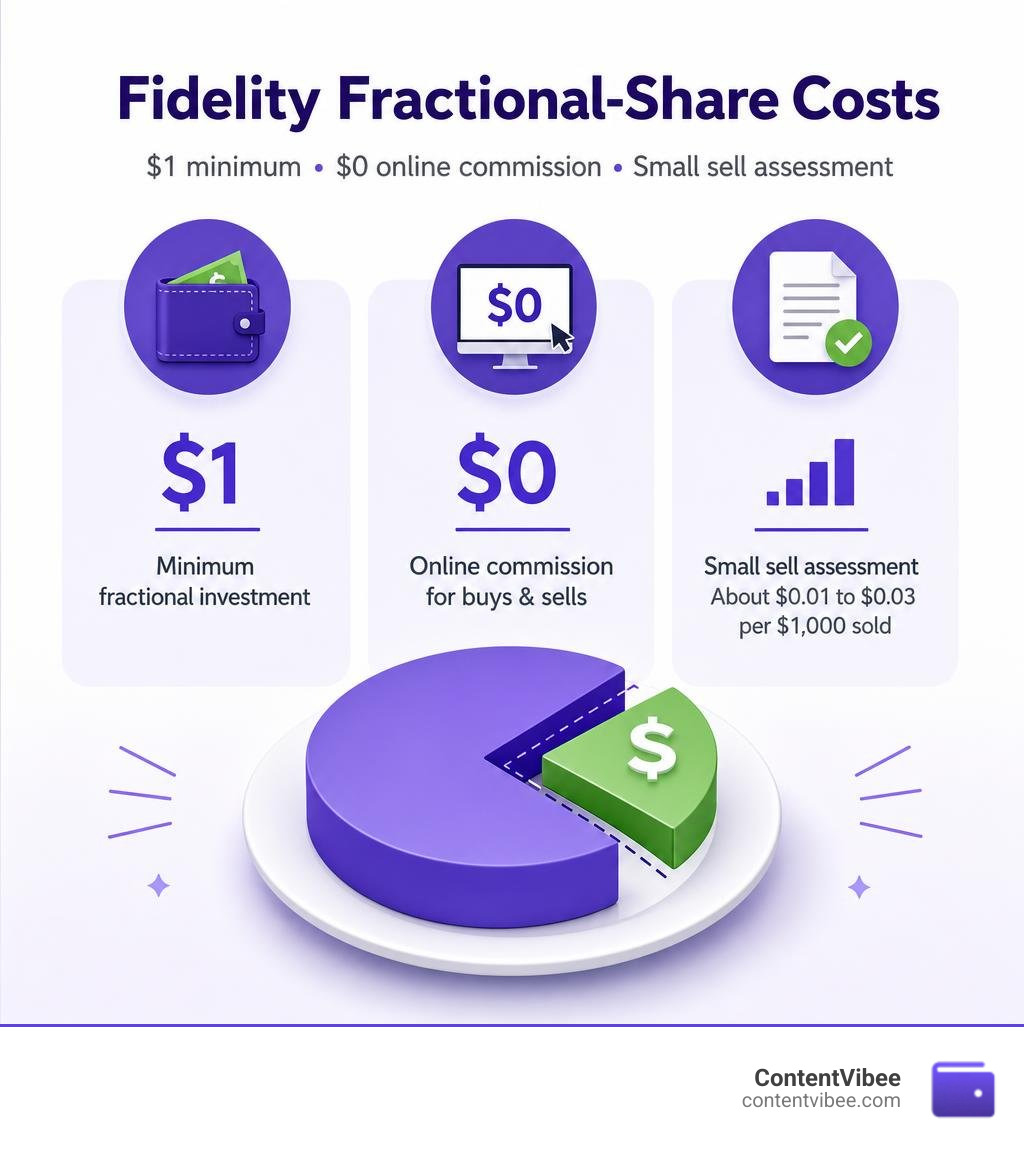
The fidelity fractional shares cost is usually $0 in online commissions for eligible U.S. stock and ETF trades. You can start with as little as $1, and Fidelity does not require an account minimum or charge a standard account maintenance fee.
The main cost to know is on sell orders:
| Cost item | What you may pay |
|---|---|
| Online fractional stock or ETF buy | $0 commission |
| Online fractional stock or ETF sale | $0 commission, plus a small regulatory assessment |
| Typical sell-order assessment | About $0.01 to $0.03 per $1,000 sold |
| Minimum fractional investment | $1.00 |
| Phone or representative-assisted trade | May carry separate service charges |
That makes fractional investing a low-cost way to put a set dollar amount into an eligible stock or ETF, including expensive shares that may otherwise be out of reach. But “commission-free” does not mean every detail is free of trade-offs. Bid-ask spreads, market movement, rounding, taxes after a sale, and limits on transfers can all affect what you receive or keep.
This guide separates the actual fees from the fine print, so you can decide whether Fidelity stock slices fit your budget and investing plan.
Breaking Down the Fidelity Fractional Shares Cost Structure
When we evaluate the true fidelity fractional shares cost, we have to look past the headline “$0 commission” banner. While online equity trades are indeed free of base commissions, understanding how different execution channels and backend fees work ensures you never run into an expensive surprise on your account statement.
Fidelity allows retail investors to trade stock slices (also known as “Stocks by the Slice”) with no account maintenance fees and no minimum deposit to open a brokerage or IRA account. This lowers the barrier to entry significantly compared to traditional investing models where buying high-priced securities required thousands of dollars in available capital.

Online Commissions vs Broker-Assisted Fidelity Fractional Shares Cost
How you place your fractional share trade directly dictates what you will pay. If you place your dollar-based order digitally through Fidelity’s website or mobile app, your online trade commission is $0.00. However, if you opt for alternative ordering channels, costs escalate quickly:
- Digital / Online Trades (Web & Mobile App): $0.00 commission per trade.
- FAST Automated Phone System: $12.95 per trade.
- Representative-Assisted Trades: $32.95 per trade.
For fractional share investors trading small dollar amounts—such as $5, $20, or $50 at a time—using a live broker representative or automated phone system would completely erase your investment principal in fees. Therefore, staying on self-directed digital channels is essential to maintaining zero-commission trades. You can review full fee schedule specifics in the official Fidelity Brokerage and Commission Fee Schedule.
How Regulatory Assessment Fees Impact Your Overall Fidelity Fractional Shares Cost
Even when trading online for $0 commission, every equity sale in the United States incurs mandatory government and self-regulatory organization (SRO) charges. Brokerages, including Fidelity, pass these fees directly through to the seller.
When you execute a sell order for fractional stock or ETF positions, you will see an “Additional Assessment” fee on your trade confirmation ticket. This fee is comprised primarily of the Section 31 transaction fee levied by the U.S. Securities and Exchange Commission (SEC) alongside Financial Industry Regulatory Authority (FINRA) activity assessment fees.
What does this assessment cost in practice?
- Typical Rate: Approximately $0.01 to $0.03 per $1,000 of principal value sold.
- Small Orders: If you sell $10 or $50 worth of stock, the proportional assessment is fractions of a cent, which typically rounds down to $0.00 or a minimum of $0.01 depending on settlement rules.
- Larger Positions: Selling $10,000 worth of stock results in a nominal fee of roughly $0.10 to $0.30.
Because these pass-through assessment fees go directly toward regulatory oversight rather than brokerage profits, they represent standard operational expenses across the financial industry rather than hidden broker surcharges.
Minimum Requirements, Precision, and Asset Eligibility
Trading stock slices allows everyday investors to allocate precise dollar amounts across expensive companies. However, you must follow specific system parameters regarding transaction sizes, decimal calculations, and eligible asset universes.

Minimum Dollar Order Limits and Decimal Accuracy
To buy or sell fractional shares on Fidelity, your order must meet a minimum transaction size of $1.00. You cannot place an order for $0.50 or a few pennies.
When configuring your order ticket, you can enter fractional orders in two ways:
- By Dollar Value: Entered up to 2 decimal places (for example, entering exactly $250.00 or $15.50).
- By Share Quantity: Entered up to 3 decimal places (for example, ordering 0.001 shares or 2.525 shares).
When you submit a dollar-based order, Fidelity converts your cash amount into an equivalent share count calculated out to three decimal places (.001). During this mathematical conversion, the calculated share quantity is rounded down to the nearest thousandth of a share. Because of this millishare rounding convention, the actual dollar value of the executed trade may be microscopic fractions of a cent lower than the requested round dollar entry.
Eligible Stocks and ETFs for Dollar-Based Trading
While Fidelity offers access to an expansive investment universe, not every stock on the planet can be purchased as a fraction. Fidelity supports fractional share trading on more than 7,000 U.S. stocks and ETFs.
To be eligible for fractional share execution, securities must meet the following criteria:
- Exchange-Listed Securities: Must be National Market System (NMS) securities listed on major U.S. exchanges, specifically the New York Stock Exchange (NYSE), Cboe, or Nasdaq.
- Exchange-Traded Funds (ETFs): Domestic ETFs traded on major U.S. exchanges are broadly eligible.
Certain security types are explicitly excluded from fractional dollar-based ordering:
- Over-the-Counter (OTC) “penny stocks” and bulletin board equities.
- Foreign ordinary shares traded outside major U.S. exchanges.
- Mutual funds (which operate under their own separate minimum contribution rules and traditional NAV pricing).
- Options contracts and fixed income bonds.
You can learn more about supported securities by reviewing the official Fractional Shares Overview.
Order Execution Mechanics and Market Hours Restrictions
Understanding how fractional trades are executed behind the scenes is vital for managing risk and setting expectation regarding execution price. Order routing for fractional shares differs significantly from standard whole-share order handling.
How “Not Held” Status Affects Trade Execution
When you place a fractional share trade or dollar-based order, the order is marked with a legal execution status known as “Not Held”.
Under standard whole-share market orders, brokers are held strictly to real-time consolidated market quotes. By contrast, a “Not Held” order gives the clearing brokerage—National Financial Services LLC (NFS), an affiliate of Fidelity Brokerage Services LLC (FBS)—time and price discretion to execute the trade during regular market hours.
Here is how the dual-capacity execution works:
- Whole Share Component: Handled in an agent capacity, routing directly to market execution venues.
- Fractional Portion: Handled in a principal capacity by the clearing firm, which combines and offsets fractional orders against its internal inventory.
Because fractional orders carry “Not Held” status, they are not eligible for traditional primary execution guarantees or certain automated price improvement metrics that apply to standard 100-share block trades. However, Fidelity’s trade execution infrastructure still seeks National Best Bid and Offer (NBBO) execution to ensure fair pricing.
Market Hours and Session Limitations
Unlike whole shares, which can often be traded during extended pre-market and after-hours trading sessions, fractional share trades face strict time windows:
- Trading Window: Fractional and dollar-based orders are only eligible for execution during standard U.S. market hours (9:30 a.m. to 4:00 p.m. Eastern Time).
- Order Duration: Orders are accepted only as Day orders. Good ‘Til Canceled (GTC) limit orders are not supported for fractional share tickets.
- Off-Hours Submissions: You can enter fractional orders outside of market hours, but they will sit in a pending queue marked “Not Held” and will automatically route for execution when the market reopens at 9:30 a.m. ET on the next business day.
Ownership Rights, DRIP Impact, and Account Transfer Restrictions
While fractional shares give you economic exposure to equity price movements, holding a fraction of a share is legally distinct from owning a whole share.
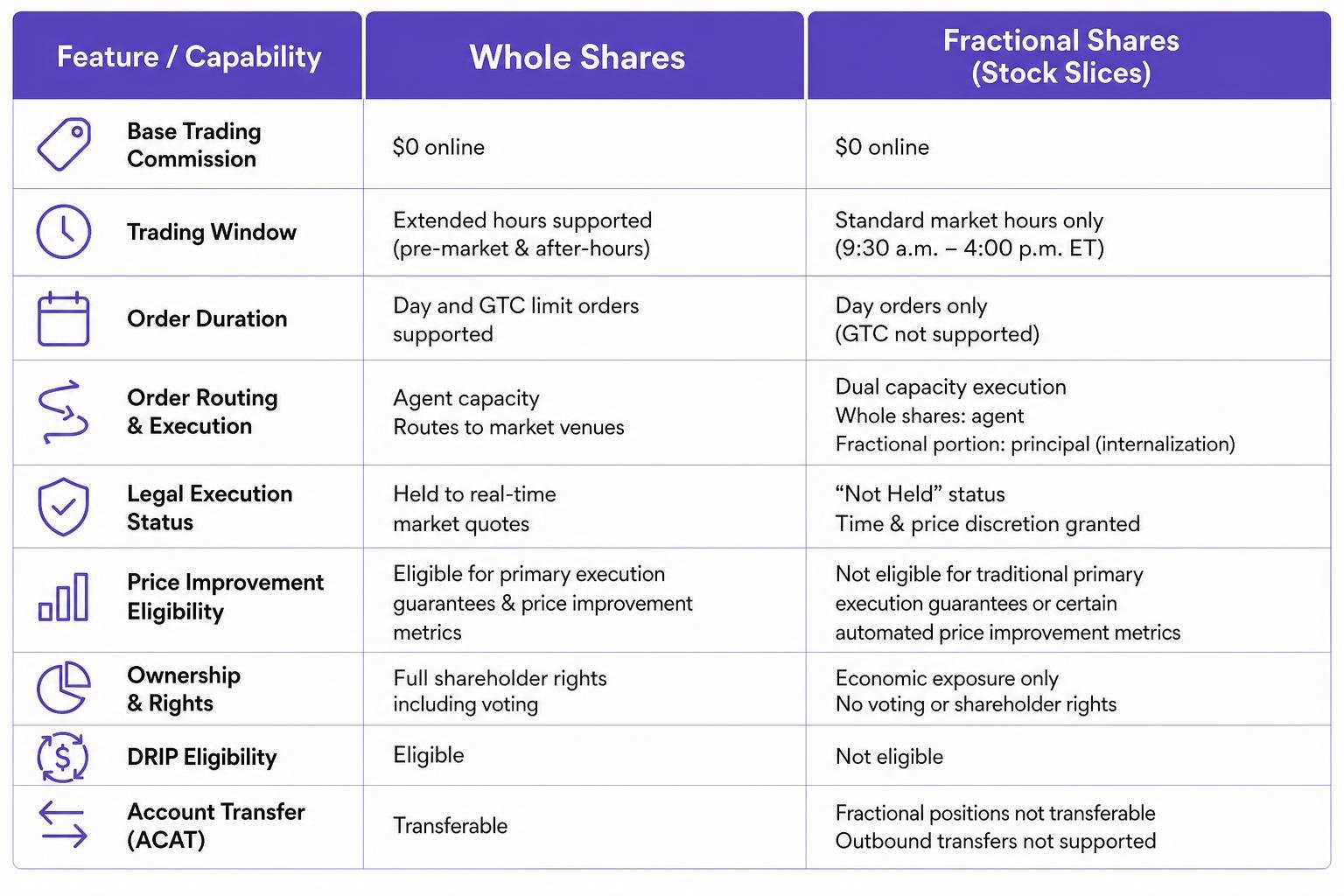
The key differences between holding whole shares versus fractional stock slices include:
| Feature / Capability | Whole Shares | Fractional Shares (Stock Slices) |
|---|---|---|
| Base Trading Commission | $0 online | $0 online |
| Minimum Order Size | 1 full share | $1.00 (down to 0.001 shares) |
| Proportional Dividend Payouts | Yes (100% of payout) | Yes (pro-rata down to $0.01) |
| Proxy Voting Rights | Full voting rights | No voting rights on fractional portion |
| ACATS External Transfer | Fully transferable | Non-transferable (Must be liquidated) |
| Physical Stock Certificates | Available (fees apply) | Ineligible |
| Trading Session Eligibility | Regular + Extended Hours | Regular Market Hours Only (9:30am-4:00pm ET) |
Proxy Voting Rights and Corporate Actions
One of the primary limitations of holding fractional positions revolves around corporate governance:
- Proxy Voting: You cannot vote proxies or participate in annual shareholder votes for the fractional portion of your holding. If you hold 10.4 shares of a company, you will receive proxy voting materials for the 10 whole shares, while the 0.4 fractional share carries no voting privileges.
- Mandatory Corporate Actions: For stock splits or reverse stock splits, your fractional position is adjusted proportionally.
- Voluntary Corporate Actions: Fractional shares generally do not support participation in voluntary tender offers or rights offerings.
Non-Transferability and Mandatory ACATS Liquidation
A critical structural restriction of fractional shares is that they exist strictly in “street name” book-entry form within Fidelity’s internal ledger. They cannot be moved across external brokerage infrastructure.
If you ever decide to transfer your investment account to another financial institution using the Automated Customer Account Transfer System (ACATS):
- Whole Shares: Will transfer intact in-kind to your new broker.
- Fractional Shares: Cannot be transferred via ACATS under industry clearing protocols.
- Mandatory Liquidation: Fidelity will automatically sell off any fractional share positions into cash prior to completing the transfer.
This forced cash liquidation means you cannot keep fractional positions when moving platforms, and selling those slices will create a taxable event.
Dividend Reinvestment Program (DRIP) Mechanics
Fractional shares are fully eligible to earn income. When a company declares a dividend, cash payouts are distributed to fractional owners on a strict pro-rata basis:
- Proportional Calculation: If you own 0.50 shares of a company paying a $2.00 quarterly dividend per share, your account receives exactly $1.00.
- Penny Distribution Floor: Dividend payments are supported down to the nearest penny ($0.01). If your fractional calculation yields less than half a cent ($0.005), the dividend distribution rounds down to $0.00.
Important Account Rule Change: Participating in manual fractional share trading changes your account’s Dividend Reinvestment Program (DRIP) behavior. Historically, when an investor sold their full position in a stock, any trailing fractional shares received from reinvested dividends were automatically swept and sold the following business day. Once you execute manual stock slice trades, this automatic sweep rule is disabled. If you want to close out a position entirely, you must manually specify that you are selling both whole and fractional components on your sell order ticket.
Tax Implications of Trading Stock Slices
Tax compliance for fractional shares follows the exact same Internal Revenue Service (IRS) regulations as whole share trading, but higher trade frequencies can make tracking cost basis slightly more complex.
Key tax rules to keep in mind include:
- Form 1099-B Reporting: Every time you sell a fractional share position, the transaction is recorded and reported to the IRS on Form 1099-B. Capital gains or losses are calculated based on your adjusted cost basis.
- Short-Term vs. Long-Term Gains: Slices held for one year or less are subject to short-term capital gains tax rates (taxed at ordinary income rates), while positions held longer than one year qualify for preferred long-term capital gains rates.
- Forced Liquidation Tax Events: As noted earlier, transferring an account to an external brokerage forces the liquidation of fractional positions into cash. This involuntary sale can trigger unexpected taxable capital gains in the year the transfer takes place.
- Wash-Sale Rules: IRS wash-sale rules apply equally to fractional shares. If you sell a fractional share at a loss and purchase a substantially identical security within 30 days before or after the sale, you cannot immediately claim the tax loss.
Because micro-investing makes it easy to execute dozens of small $1 or $5 trades throughout the year, keeping clean records or utilizing automated portfolio tracking tools is essential for seamless tax filing.
Frequently Asked Questions About Fidelity Fractional Shares
What is the minimum dollar amount required to trade fractional shares?
The minimum order size required to buy or sell fractional shares on Fidelity is $1.00. Orders can be placed in exact dollar increments (such as $1.00, $10.50, or $500.00) or by specifying share quantities down to three decimal places (0.001 shares).
Are there any hidden fees when selling fractional positions?
There are no hidden brokerage commissions for selling fractional shares online. However, all equity sales incur a standard regulatory assessment fee (Section 31 SEC fee and FINRA assessment) passed through by the broker. This fee typically ranges from $0.01 to $0.03 per $1,000 of principal value sold.
Can fractional share positions be transferred to another brokerage account?
No. Fractional shares cannot be transferred externally to another broker through the ACATS transfer system. If you initiate an account transfer, any whole shares will transfer in-kind, while fractional portions will automatically be liquidated into cash and transferred as monetary proceeds.
Conclusion
When analyzing the fidelity fractional shares cost, the conclusion for self-directed retail investors is overwhelmingly positive. With $0 online trade commissions, $0 account minimums, and a low $1.00 transaction entry limit, stock slices provide a cost-effective, accessible gateway to dollar-cost averaging and portfolio diversification.
By staying on digital trading platforms (avoiding representative-assisted phone charges), maintaining a clear view of minor sell-order assessment fees, and remembering ACATS transfer limitations, you can build wealth systematically without losing your hard-earned capital to unnecessary overhead.
At ContentVibee, our goal is to deliver clear, actionable money management insights that help you navigate financial products with confidence. To learn more about optimizing your brokerage setup, check out our comprehensive Fidelity Fractional Shares Review. Happy investing!


