Are Fidelity Fractional Share Fees Worth It?
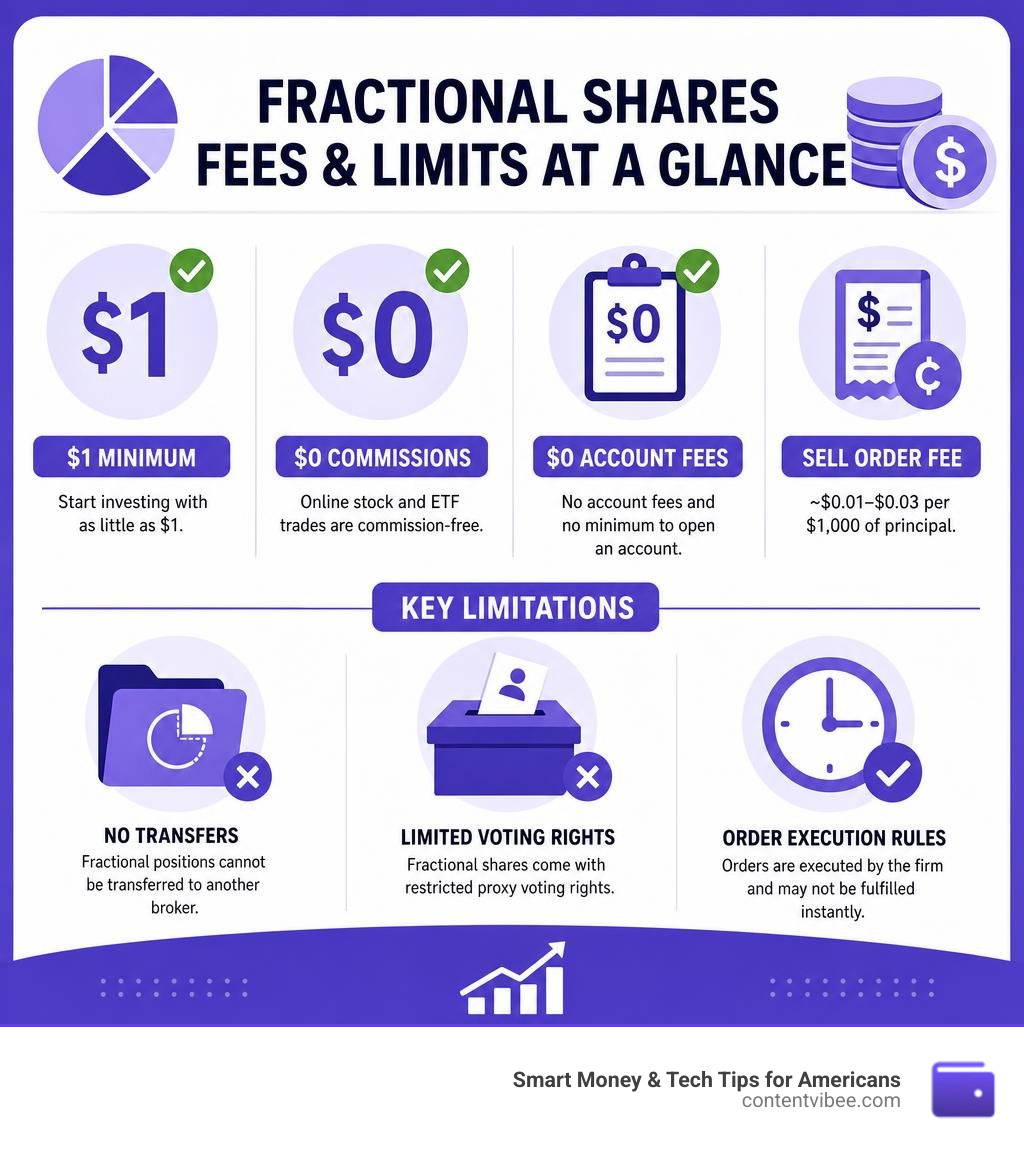
Fidelity fractional share fees are, in a word, minimal — and for most investors, the answer is straightforward:
| Cost Type | Amount |
|---|---|
| Online stock and ETF trades | $0 commission |
| Account fees | $0 |
| Minimum to open an account | $0 |
| Minimum to buy fractional shares | $1.00 |
| Sell order assessment fee | ~$0.01–$0.03 per $1,000 of principal |
The only real cost you’ll encounter is a small regulatory assessment fee on sell orders — and even that typically amounts to just pennies.
Fidelity lets you buy fractional shares of more than 7,000 US stocks and ETFs starting with as little as $1. You enter a dollar amount, and Fidelity converts it into shares down to three decimal places (for example, 153.846 shares). No commissions, no account minimums, no hidden charges for using the feature.
But “free” doesn’t mean no strings attached. There are real limitations — like not being able to transfer fractional positions to another broker, restricted proxy voting rights, and rules around how orders are executed. Those details matter, especially if you’re building a long-term portfolio.
This review breaks down exactly how Fidelity’s fractional share program works, what it truly costs, and where the fine print could catch you off guard.
What Are Fidelity Fractional Shares and How Do They Work?
At its core, a fractional share is simply a slice of a single whole share of a stock or an Exchange-Traded Fund (ETF). Historically, if you wanted to buy a stock trading at $3,000 per share, you needed at least $3,000 in cash to get your foot in the door. If you only had $150 to invest, you were completely locked out of that company.
Fidelity solved this hurdle by introducing “stock slices” through dollar-based orders. Instead of specifying how many shares you want to buy, you tell the platform exactly how many dollars you want to invest. Fidelity then calculates the exact fractional quantity of the stock you can afford.
For instance, if you want to invest $20,000 into a high-priced stock trading at $130 per share, you do not have to settle for 153 whole shares (leaving you with $110 in uninvested cash). Instead, you can purchase exactly 153.846 shares, ensuring every single dollar goes to work for you immediately.
Fidelity offers fractional share trading on National Market System (NMS) exchange-listed securities. This includes thousands of stocks and ETFs listed on the New York Stock Exchange (NYSE) and the Nasdaq. That some over-the-counter (OTC) stocks, foreign stocks, or highly illiquid equities may not be eligible for fractional trading. To find out more about eligible securities, you can consult the official Fidelity fractional shares guide or search for specific tickers directly on their platform.
How to Buy Fractional Shares on Fidelity
Buying fractional shares on Fidelity is incredibly straightforward, especially if you use the redesigned Fidelity mobile app or their website trade ticket. Here is a quick step-by-step guide to placing your first dollar-based trade:
- Log In: Open the Fidelity mobile app or log in to your account online.
- Search Ticker: Enter the company name or ticker symbol of the eligible stock or ETF you want to buy.
- Open the Trade Ticket: Click the “Trade” button.
- Switch to Dollars: In the trade ticket, change the order type setting from “Shares” to “Dollars.”
- Enter Amount: Input your desired investment amount (minimum of $1.00).
- Choose Order Type: Select either a market order or a limit order.
- Review and Submit: Preview your order to check the estimated share conversion, then click submit.
When you place a dollar-based order, Fidelity converts your cash amount into a share quantity rounded down to three decimal places (.001). Because of this rounding, the actual market value of your executed trade might be a tiny fraction of a cent higher or lower than the exact dollar amount you requested. For a deeper look at how Fidelity maintains transparency across all its trading features, check out our Fidelity cost transparency review.
Do Fidelity Fractional Share Fees Apply to ETFs?
If you prefer building your portfolio using Exchange-Traded Funds (ETFs) rather than individual stocks, you are in luck. Fidelity’s fractional share trading and commission-free structure apply equally to ETFs.
You can buy fractional slices of exchange-traded funds with the same $1.00 minimum. This makes it incredibly easy to build a highly diversified portfolio across different asset classes, sectors, or indexes without needing thousands of dollars to get started.
While online trades for US stocks and ETFs carry $0 commissions, you should always be mindful of internal fund fees. ETFs have built-in management fees known as expense ratios. These are ongoing fees taken directly out of the fund’s assets by the fund manager, not direct transaction fees charged by Fidelity. To understand how these product-level costs fit into your broader trading strategy, see our detailed guide on the Fidelity fee per trade.
Understanding Fidelity Fractional Share Fees
When evaluating Fidelity fractional share fees, it helps to look at the complete pricing structure. While online self-directed trades are free, other trading channels or special circumstances carry distinct costs.
| Trading Channel | Commission Fee | Additional Assessment Fee (Sells Only) |
|---|---|---|
| Online (App/Web) | $0.00 | $0.01 to $0.03 per $1,000 of principal |
| FAST Automated Phone | $12.95 | $0.01 to $0.03 per $1,000 of principal |
| Representative-Assisted | $32.95 | $0.01 to $0.03 per $1,000 of principal |
As shown above, the most cost-effective way to trade is always through Fidelity’s digital platforms. If you want to dive deeper into the official fee disclosures, you can review the Fidelity Brokerage and Commission Fee Schedule.
Online vs. Broker-Assisted Trading Costs
While online self-directed trades cost nothing in commissions, using alternative trading channels will trigger flat fees:
- FAST Automated Telephone System: If you place a trade using Fidelity’s automated phone system, you will be charged a commission of $12.95.
- Representative-Assisted Trades: If you call and have a live Fidelity representative place your fractional trade for you, the fee jumps to $32.95.
Additionally, all sell orders — whether placed online or with assistance — are subject to a tiny regulatory transaction fee. Often referred to as an “activity assessment fee” or “additional assessment fee,” this charge typically ranges from $0.01 to $0.03 per $1,000 of principal. This fee is not a markup by Fidelity; rather, it is passed through to offset fees charged to brokerages by self-regulatory organizations (SROs) like the SEC and FINRA. To learn more about how these assisted trades work and when they might apply to your account, read our breakdown of the Broker assisted trade fee Fidelity.
How Fidelity Fractional Share Fees Compare to Industry Averages
Fidelity’s pricing model is highly competitive compared to traditional brokerages and older fee-heavy platforms. By eliminating account service fees, account transfer-out fees, and account minimums, they make it easy for beginners to start small.
Fidelity calculates that investors save an average of $24.50 on a 1,000-share equity order compared to the industry average. This is because Fidelity focuses on high-quality order execution and does not charge hidden platform fees to subsidize their commission-free trading.
However, as smart investors, we should always ask: If the service is free, how does the broker make money? Fidelity generates revenue through other avenues, such as interest on cash balances, margin lending, payment for order flow (PFOF) on certain security types, and specialized advisory services. We explore this dynamic thoroughly in our article, Is Fidelity actually free or are you the product.
Account Eligibility, Limits, and Order Execution
Fidelity’s fractional share trading is available across a wide variety of retail accounts. You can trade stock slices in standard taxable retail brokerage accounts, as well as retirement accounts like Traditional IRAs, Roth IRAs, and Rollover IRAs.
However, fractional share trading is generally restricted to self-directed accounts. Managed portfolios, like those under specialized advisor programs, use fractional shares automatically to keep your asset allocation balanced, but those trades are handled by the portfolio managers rather than executed manually by you.
Minimum Investment and Decimal Precision
Fidelity has set incredibly accessible boundaries for dollar-based and fractional share orders:
- Minimum Order Value: Your order must be worth at least $1.00. You cannot place a trade for $0.50.
- Decimal Precision for Shares: If you enter a trade based on share quantity, you can enter it out to three decimal places (e.g., 0.001 shares).
- Decimal Precision for Dollars: If you enter a trade based on dollar value, you can enter it out to two decimal places (e.g., $10.50).
When you place a dollar-based order, the system converts that cash amount into a share quantity. If the math results in a fraction that goes beyond three decimal places, Fidelity rounds the quantity down to the nearest 0.001 share. This rounding means you might occasionally see a microscopic difference between your target dollar amount and the final executed value.
Order Types and Execution Rules
Fractional share orders are handled with a unique set of execution rules:
- Market Hours Only: Fractional share and dollar-based trades can only be placed and executed during regular market hours (approximately 9:30 a.m. to 4:00 p.m. Eastern Time). If the market is closed, you cannot queue a fractional order for the next day’s open.
- Order Types: You can place market orders or limit orders.
- Day-Only Restrictions: All fractional share orders are “good for the day only.” You cannot place “Good ’til Canceled” (GTC) orders for fractional shares.
- “Not Held” Status: Fractional and dollar-based orders are marked as “Not Held.” This legal designation gives Fidelity’s trading desk time and price discretion to execute your order in a mixed capacity (as both agent and principal) to find the best execution. While this helps secure a fair market price, it means your orders are not eligible for certain automated execution guarantees.
Risks, Limitations, and Tax Implications
While fractional share trading is an excellent tool for portfolio diversification, it does come with specific structural limitations that you must understand before diving in.
- No Direct Transfers (ACATS): Fractional shares cannot be transferred to another brokerage via the Automated Customer Account Transfer Service (ACATS). If you ever decide to move your portfolio from Fidelity to another broker, your fractional shares must be liquidated (sold) first. Only your whole shares can be transferred over.
- No Stock Certificates: You cannot request physical stock certificates for fractional positions.
- Proxy Voting Restrictions: Fractional shares do not carry proxy voting rights. If you own 10.5 shares of a company, you will only receive proxy voting materials and voting power for the 10 whole shares. The 0.5 fractional share portion does not count toward shareholder votes.
- Corporate Actions: For mandatory corporate actions like stock splits or mergers, your fractional shares are adjusted proportionally. However, for voluntary corporate actions (such as tender offers), fractional shares are generally not eligible to participate.
Dividend Reinvestment Program (DRIP) and Fractional Shares
Fidelity offers a robust, free Dividend Reinvestment Program (DRIP) that automatically uses your cash dividends to buy more shares of the dividend-paying stock or ETF. This process naturally creates fractional shares over time.
However, there is an important operational change that occurs once you place your first manual fractional share trade:
- DRIP Changes: Prior to enrolling in manual fractional trading, if you sold a stock position, any remaining fractional shares generated by DRIP were automatically liquidated on the next business day.
- Manual Fractional Trade Rules: Once you place your first manual fractional trade, this automatic liquidation feature is disabled. Going forward, when you decide to exit a position completely, you must explicitly specify both the whole and fractional share amounts on your sell order ticket to ensure the entire position is closed out.
Tax Implications of Fractional Share Trading
Every time you sell a fractional share, it is treated as a taxable event by the IRS, just like selling a whole share.
- Capital Gains: If you sell a fractional share for more than your cost basis, you will realize a capital gain. If you sell it for less, you will realize a capital loss.
- Cost Basis Tracking: Fidelity automatically tracks the cost basis for your fractional shares, making tax reporting straightforward. At the end of the year, these transactions will be compiled on your Form 1099-B.
- Wash Sales: Wash sale rules still apply to fractional shares. If you sell a fractional share at a loss and buy the same security within 30 days before or after the sale, you cannot claim the tax loss immediately.
For a deeper understanding of how trading fees, options, and taxes interact on the platform, take a look at our guide to Fidelity options fees explained and demystified.
Frequently Asked Questions about Fidelity Fractional Shares
Can I transfer fractional shares to another broker?
No. Fractional shares are held on Fidelity’s internal books and cannot be transferred through the standard ACATS system. If you transfer your account to another brokerage, your fractional shares will be automatically liquidated into cash, and the cash balance will be transferred along with your whole shares.
Do fractional shares receive dividends?
Yes! Fractional shares receive dividend payments on a proportional basis. For example, if a company pays a dividend of $1.00 per share and you own 0.5 shares, you will receive $0.50. Fidelity supports these payments down to the nearest penny ($0.01).
Can I vote in proxy decisions with fractional shares?
No. Proxy voting rights are reserved exclusively for whole shares. While you can vote with any whole shares you own in a company, the fractional portion of your position will not be counted toward proxy voting or shareholder resolutions.
Conclusion
Fidelity’s fractional share program is a highly efficient, virtually free tool that lowers the barrier to entry for everyday investors. By eliminating commission fees and setting a tiny $1.00 minimum investment, they make it easy to practice dollar-cost averaging and build a diversified portfolio.
While the program has minor drawbacks — such as transfer limitations, day-only order rules, and restricted proxy voting — these are standard across the brokerage industry and rarely impact long-term buy-and-hold investors.
If you are ready to take control of your financial future, starting small with stock slices is one of the smartest moves you can make. For more details on transaction costs and platform pricing, check out our comprehensive Fidelity Fee Per Trade Guide.