


Does Fidelity Allow Fractional Shares?
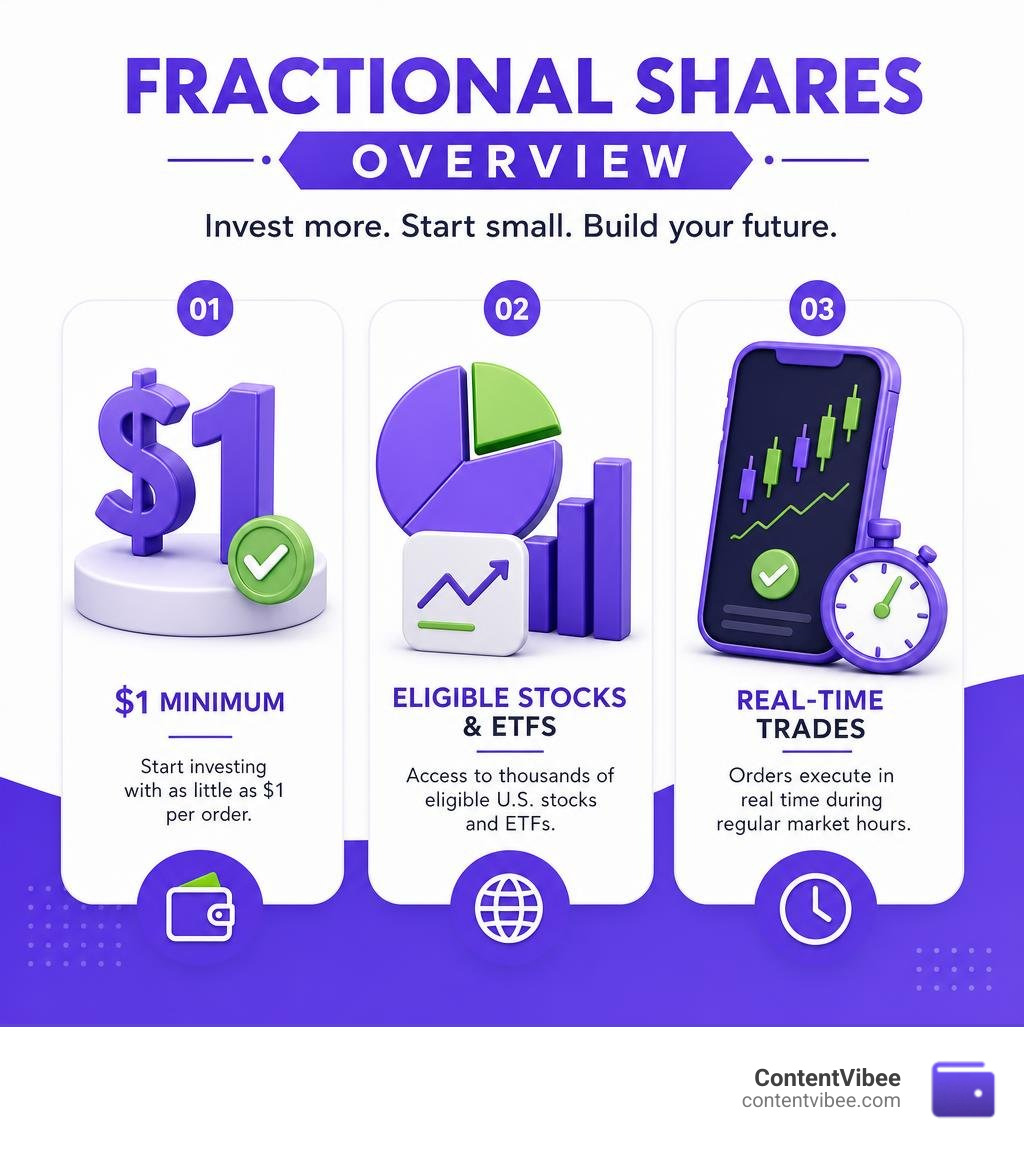
Fidelity allow fractional shares for more than 7,000 eligible U.S. stocks and ETFs. You can invest by dollar amount instead of buying a full share, with a minimum order of $1.
| Quick answer | Fidelity’s rule |
|---|---|
| Minimum investment | $1 per order |
| Eligible investments | Many NMS-listed U.S. stocks and ETFs |
| Trade precision | As little as 0.001 share |
| Online commission | $0 for U.S. stock and most ETF trades |
| When orders execute | In real time during regular market hours |
A fractional share is simply a piece of one share. If a stock costs $500, you do not need $500 to begin. You could invest $25 and own a small portion instead.
That can make investing feel less out of reach when money is tight. It also lets you spread a modest amount across several investments rather than putting all of it into one stock.
Still, fractional shares have rules worth knowing. Eligible securities, order types, dividends, transfers, voting rights, taxes, and Fidelity’s dividend reinvestment program can all work a little differently from whole-share investing. This guide explains the important details in plain English.
Does Fidelity Allow Fractional Shares? Understanding the Basics
Yes, fidelity allow fractional shares trading through their branded feature called “Stocks by the Slice.” This capability lets you buy or sell stock slices based on dollar amounts rather than unit share quantities. Instead of waiting until you have accumulated $3,000 to purchase a single share of an expensive tech giant, you can put whatever cash you have available to work right away.
Fidelity supports fractional trading across more than 7,000 National Market System (NMS) exchange-listed securities. This includes single U.S. stocks listed on the New York Stock Exchange (NYSE) or Nasdaq, as well as exchange-traded funds (ETFs). However, over-the-counter (OTC) penny stocks, foreign securities not listed on major U.S. exchanges, and non-NMS products are generally excluded.
The barrier to entry is deliberately low:
- Minimum Investment: You can start with as little as $1.00.
- Fractional Precision: Orders calculate out to three decimal places (0.001 of a share).
- Dollar Precision: Orders accept values down to two decimal places ($0.01).
- Real-Time Execution: Unlike some platforms that accumulate customer orders and batch execute them at standard times during the day, Fidelity processes your order in real time during core market hours.
To learn more about how real-time trading was introduced, you can read the official Real-time trading announcement.
How Fidelity Allow Fractional Shares Trading Works in Practice
When you open a trade ticket on standard platforms, you are typically prompted to specify an exact number of shares (for instance, 10 shares of stock X). When fidelity allow fractional shares trading, you gain two options:
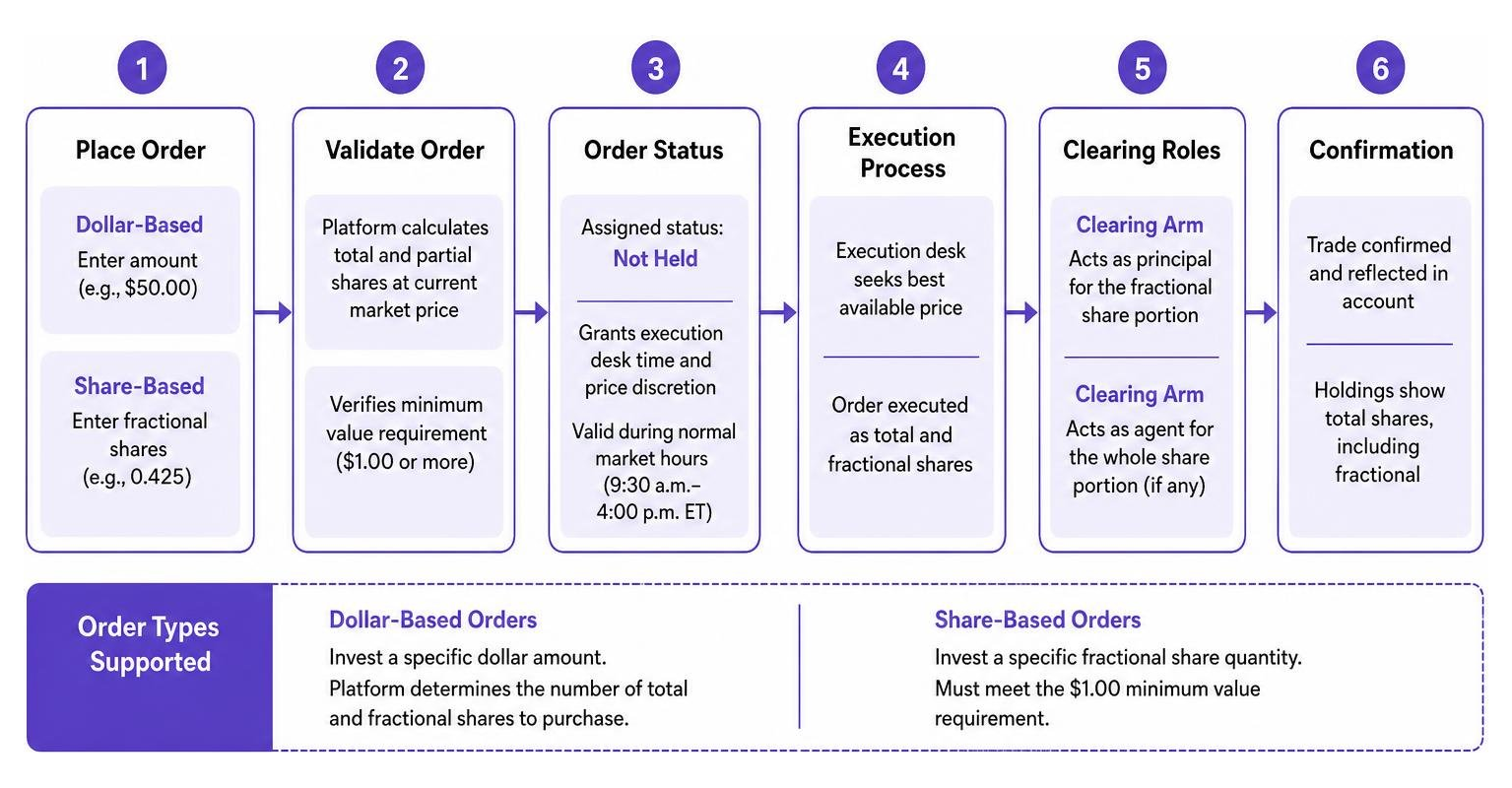
- Dollar-Based Orders: You enter the specific amount of money you want to spend (e.g., $50.00). The trading platform calculates how many total and partial shares that cash can buy based on prevailing market prices.
- Share-Based Orders: You enter a specific fractional share quantity (e.g., 0.425 shares) directly on the ticket, provided the calculated value meets the $1.00 minimum threshold.
Behind the scenes, when you place a dollar-based or fractional trade, your order receives a legal execution status known as Not Held. This order designation grants Fidelity’s execution desk time and price discretion to handle your trade during normal market operating hours (9:30 a.m. to 4:00 p.m. Eastern Time).
In executing these orders, Fidelity Brokerage Services acts as an agent, while its clearing arm, National Financial Services (NFS), operates in a mixed capacity—acting as principal for the fractional slice and as an agent for any whole share components involved in the trade.
Account Types That Fidelity Allow Fractional Shares In
Fractional share capabilities are available across most popular retail and self-directed account types. You do not need a specialized account tier to unlock fractional trading; it is integrated directly into standard user profiles.
Account types supporting fractional trades include:
- Individual Retail Brokerage Accounts: Standard taxable brokerage accounts with no account minimums or account maintenance fees.
- Joint Brokerage Accounts: Taxable accounts held by spouses or family members.
- Traditional IRAs & Roth IRAs: Tax-advantaged retirement accounts, enabling investors to maximize compounding on tax-deferred or tax-free growth.
- Health Savings Accounts (HSAs): Self-directed investment HSAs where account holders can invest healthcare savings into partial shares.
- Custodial Accounts: Accounts managed for minors, making fractional investing an accessible teaching tool for youth.
- Self-Directed Workplace Accounts: BrokerageLink accounts where plan rules permit direct share trading.
Trading Mechanics, Fees, and Order Execution Rules
Understanding the fee structure and trading environment ensures you aren’t surprised by unexpected overhead costs. Fidelity built its reputation on low-cost investing, being among the first major brokerages to offer zero-commission stock trades alongside zero account fees for retail customers.
Here is how the cost structure breaks down when trading fractional shares:
- Online Trading Commission: $0.00 for online U.S. stock and ETF trades.
- Account Maintenance Fees: $0.00 across retail accounts.
- Assisted Trading Costs: If you call a customer representative to place a trade for you, a standard broker-assisted fee of $32.95 applies. Automated phone trades via the FAST system incur a $12.95 fee.
- Regulatory Assessment Fees: On all sell orders, regulatory bodies (such as the SEC and FINRA) levy small assessment fees ranging from approximately $0.01 to $0.03 per $1,000 of principal value. These are standard pass-through charges across all brokerage platforms.
Step-by-Step Guide to Placing Fractional Trades
Placing a fractional order on the mobile app or web interface takes only a few simple steps:
- Log In: Open the mobile app or sign into your online account on your browser.
- Search Securities: Search for an eligible U.S. stock or ETF ticker symbol (e.g., AAPL, MSFT, or VTI).
- Open the Trade Ticket: Click or tap Trade.
- Toggle Order Type to Dollars or Fractional Shares: Change your order dropdown selection from “Shares” to “Dollars” (or enter fractional share values down to 0.001).
- Enter Amount: Enter your chosen purchase amount ($1.00 or greater).
- Select Order Type: Choose either a Market Order or a Limit Order set to “Good for Day.”
- Preview and Submit: Review the estimated share count calculated by the system, accept the fractional disclosures if it is your first time trading, and submit your order.
Order Execution Mechanics and Not Held Status
Fractional share mechanics differ from conventional whole-share trading in execution timing and order parameters.
| Feature / Execution Parameter | Fractional Share Orders | Whole Share Orders |
|---|---|---|
| Supported Order Types | Market Day Orders, Limit Day Orders | Market, Limit, Stop, Stop-Limit, Trailing Stop |
| Trading Hours | Regular Market Hours (9:30 a.m. – 4:00 p.m. ET) | Pre-Market, Regular Hours, Extended After-Hours |
| Order Duration | Day Orders Only | Day, Good ‘Til Canceled (GTC) |
| Legal Status | Not Held | Standard / Held Execution |
| Clearing Capacity | Mixed (Agent for full shares, Principal for fraction) | Pure Agency |
| Real-time Execution | Yes (Executed immediately during regular hours) | Yes |
Because fractional share trades require special handling by the clearing firm (NFS), orders are processed strictly during regular U.S. market hours. You cannot place fractional share orders during pre-market or extended after-hours sessions. Furthermore, “Good ‘Til Canceled” (GTC) durations are not allowed; unexecuted limit orders automatically expire at the market close.
Key Benefits and Limitations for Retail Investors
Fractional shares offer distinct structural advantages for both beginning investors and experienced wealth managers handling smaller capital bases.
Key advantages include:
- Dollar-Cost Averaging: Instead of attempting to time the market or waiting months to accumulate capital for high-priced stocks, you can automate regular recurring investments (such as $50 every payday).
- Full Capital Efficiency: You don’t leave cash uninvested on the sidelines. If you deposit $500, you can allocate the entire $500 across your target stocks without leaving residual cash balances floating unused.
- Instant Diversification: A $250 monthly contribution spread across five distinct high-priced stocks ($50 each) builds a diversified portfolio immediately, rather than concentrating capital in a single share.
To illustrate the long-term impact of consistent investing, consider a hypothetical comparison: contributing $250 per month over a 30-year period into an investment account earning a nominal 7% average annual return yields an estimated $304,993. By comparison, putting that same $250 per month into a traditional savings account yielding a 0.39% national deposit rate results in roughly $95,460.
Dividends, Corporate Actions, and DRIP Integration
When you own fractional shares, you remain entitled to economic benefits like dividend distributions and stock splits, though administrative policies differ slightly from full shares.
For official documentation on how Fidelity manages fractional holdings, review the Fidelity fractional share trading guide.
Here is how key corporate events function:
- Proportional Dividends: Fractional shares earn dividend payouts proportionally down to the nearest penny ($0.01). For example, if a stock pays a quarterly dividend of $2.00 per share and you own 0.25 shares, your account receives $0.50. If a calculated fractional dividend works out to less than $0.01, no dividend is paid out.
- Dividend Reinvestment Program (DRIP): If you enroll your securities in Fidelity’s automatic DRIP, cash dividends are automatically used to purchase additional fractional shares of the underlying security.
- Stock Splits: In mandatory corporate actions like forward or reverse stock splits, your fractional holdings adjust proportionally. If you own 1.5 shares prior to a 2-for-1 forward stock split, you will own 3.0 shares after the split completes.
- Proxy Voting Rights: Proxy voting rights do not extend to the fractional share portion of your position. Voting privileges apply exclusively to your whole-share holdings.
Key Risks, Transfer Limits, and Tax Considerations
While fractional share trading simplifies access, investors should keep several practical constraints in mind.
| Operational Factor | Whole Shares | Fractional Shares |
|---|---|---|
| ACATS Transferability | Fully transferable to external brokerages in-kind | Non-transferable; automatically liquidated to cash prior to transfer |
| Stock Certificate Issuance | Physical certificates available for select securities | Physical certificates strictly prohibited |
| Proxy Voting Eligibility | Fully eligible | Fractional portion excluded from voting |
| Tax Reporting (Form 1099-B) | Standard cost basis tracking | Standard cost basis tracking; cash liquidations trigger taxable events |
| Wash Sale Tracking | Subject to 30-day wash sale rules | Subject to 30-day wash sale rules |
The most critical limitation involves brokerage account transfers. Fractional shares exist on internal firm ledgers and cannot be transferred outside of Fidelity via the Automated Customer Account Transfer Service (ACATS). If you request a full account transfer to another financial institution, your fractional positions will be automatically liquidated into cash. This forced sale creates a taxable capital gain or loss event that must be reported on your tax return.
From a tax perspective, selling fractional share positions generates standard short-term or long-term capital gains and losses. You will receive an end-of-year Form 1099-B detailing sales proceeds and adjusted cost basis. Additionally, fractional trades remain fully subject to IRS 30-day wash sale rules.
Industry Comparison and Market Positioning

How does Fidelity’s fractional share architecture hold up when evaluated against rival brokerages?
Most leading brokerages now offer some form of dollar-based or fractional share investing, but operational rules vary considerably:
- Order Processing Speed: Fidelity executes fractional trades in real time during normal market operating hours. Certain competing brokerages accumulate fractional client orders throughout the day and execute them in a single batch window, which can result in trade execution prices that diverge from when you originally placed the order.
- Minimum Investment Requirements: Fidelity requires only $1.00 per trade order. Competitors like E*TRADE maintain higher minimum notional order amounts, such as $5.00 per transaction.
- Security Catalog Selection: With coverage across more than 7,000 NMS-listed stocks and ETFs, Fidelity offers one of the broadest universe selections in the retail brokerage sector.
Comparing Order Execution Speed and Minimum Investments
The table below contrasts key operational parameters across retail trading platforms:
| Feature / Criteria | Fidelity | E*TRADE | Standard Industry Average |
|---|---|---|---|
| Minimum Order Size | $1.00 | $5.00 | $1.00 – $5.00 |
| Execution Timing | Real-time market hours | Real-time & batch windows | Often batched once daily |
| Precision | 3 decimal places (0.001) | 3 decimal places (0.001) | 3 to 4 decimal places |
| Commission Fees | $0.00 online | $0.00 online | $0.00 online |
| Eligible Assets | 7,000+ stocks & ETFs | Select stocks & ETFs | S&P 500 / major indices |
Fidelity’s commitment to real-time order processing provides superior price transparency, helping traders avoid the price slippage inherent in batch-execution systems.
Frequently Asked Questions About Fidelity Fractional Shares
Can I transfer fractional shares out of Fidelity to another broker?
No. Fractional shares cannot be transferred in-kind to another brokerage firm through ACATS or standard security transfer systems. They exist exclusively on internal ledger systems. If you initiate an outbound account transfer, the system will automatically liquidate all fractional holdings into cash, leaving whole shares intact for transfer.
Do fractional shares receive dividend payouts and voting rights?
Fractional shares receive proportional dividend payouts credited as cash to your account, rounded to the nearest penny ($0.01). However, fractional share portions do not confer proxy voting rights or eligibility for voluntary corporate tender offers. Voting privileges are restricted strictly to whole-share balances.
What order types are supported for fractional share trades on Fidelity?
Fidelity supports market orders and limit orders designated as “Good for Day” placed during regular market trading hours (9:30 a.m. to 4:00 p.m. ET). Stop orders, stop-limit orders, extended-hours trades, and “Good ‘Til Canceled” (GTC) order durations are not supported for fractional share orders.
Conclusion
Understanding how fidelity allow fractional shares gives everyday investors a flexible, cost-effective avenue to build long-term wealth. By stripping away traditional barriers—such as high per-share price tags and strict whole-unit constraints—fractional trading makes broad portfolio diversification achievable for budgets of all sizes.
Whether you are placing your first $1.00 trade or maintaining automated monthly investments across high-priced equities, leveraging stock slices keeps your capital working efficiently. To explore detailed fee structures, regulatory fine print, and trade execution limits, Read our full review of Fidelity fractional share fees and limits.


