


What Structured Settlement Meaning Really Is — and Why It Matters
Understanding the structured settlement meaning is essential if you’ve received a personal injury award, workers’ compensation claim, or wrongful death settlement and need to decide how to take your money.
Quick Answer: What Is a Structured Settlement?
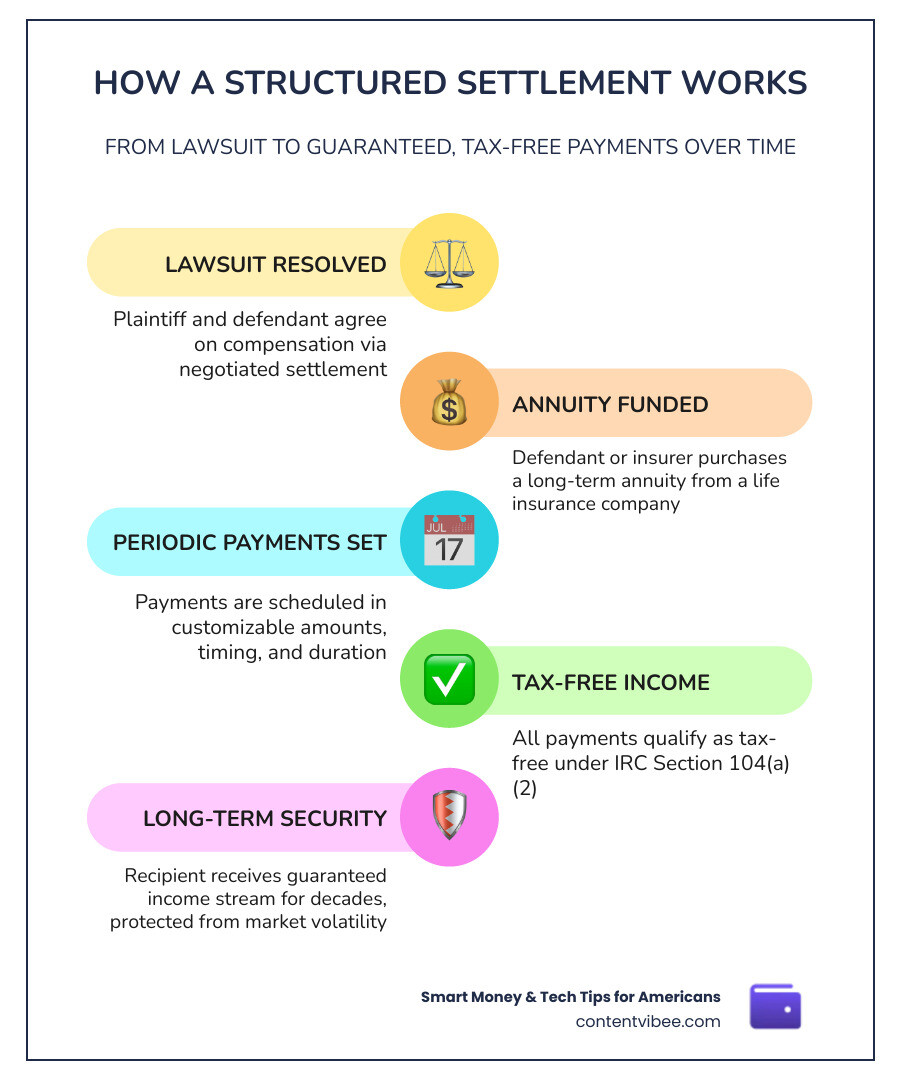
A structured settlement is a legal financial arrangement where, instead of receiving one large lump-sum payment, an injured person receives their compensation as a series of periodic payments over time. Those payments are:
- Tax-free under IRC Section 104(a)(2)
- Funded by an annuity purchased from a life insurance company
- Guaranteed regardless of market conditions
- Customizable in timing, amount, and duration
The U.S. currently sees an estimated $10 billion in annual structured settlement payments issued to over 30,000 recipients.
Obtaining a settlement award is only half the battle. How you receive that money can shape your financial security for decades. A single lump-sum check may feel like a win, but studies and real-world cases show that large sums can be depleted quickly — especially when friends, family, and unexpected expenses come knocking.
Structured settlements were designed specifically to solve that problem. They turn a lawsuit award into a reliable, long-term income stream — more like a paycheck than a windfall.
This guide breaks down everything you need to know: how they work, their pros and cons, tax rules, and what happens if you ever need to sell your payments.
Defining the Structured Settlement Meaning and How It Works
At its simplest, the structured settlement meaning refers to a negotiated financial agreement. When a plaintiff (the person suing) and a defendant (the person being sued) resolve a case, they can agree that the money won’t be handed over all at once. Instead, the defendant or their insurance company agrees to pay a specific amount of money over a set period.

This isn’t just a handshake deal. To make it work, the defendant typically pays a lump sum to a life insurance company to purchase an annuity. This annuity is the engine that drives the periodic payments. Because the money is invested by the insurance company, the total amount paid out over time is often significantly higher than the initial lump sum would have been.
For example, if we look at a $500,000 settlement, taking it as a lump sum means you get $500,000 today. However, if that same $500,000 is used to fund a structured settlement for a 21-year-old, it could potentially provide over $2,000 a month for 30 years or even for life. Over 30 years, that $500,000 could turn into a total payout of nearly $1.5 million.
To get a better idea of how these numbers look for your specific situation, you can use a Structured Settlement Calculator to compare your options.
| Feature | Lump-Sum Payment | Structured Settlement |
|---|---|---|
| Payment Frequency | One-time check | Periodic (Monthly/Annual) |
| Tax Implications | Earnings on invested funds are taxable | Entire payment (including interest) is tax-free |
| Flexibility | High (you have all the cash now) | Low (payments are fixed and hard to change) |
| Risk of Depletion | High (easy to spend quickly) | Low (guaranteed income stream) |
| Market Risk | You manage the investment risk | Insurance company manages the risk |
For more technical definitions, you can explore this Structured settlement definition.
The Core Components of Structured Settlement Meaning
To understand how these work in May 2026, we have to look at the four main “players” involved in the process:
- The Claimant (Plaintiff): The injured party who is receiving the money.
- The Defendant: The party responsible for the injury (or their liability insurance company).
- The Assignment Company: This is a crucial middleman. To keep the payments tax-free for the claimant and move the debt off the defendant’s books, a “qualified assignment” takes place. The defendant transfers the obligation to pay the claimant to this third-party company.
- The Life Insurance Company: The assignment company then buys an annuity from a highly-rated life insurance company to fund the actual payments.
This process ensures that the claimant doesn’t have “constructive receipt” of the money all at once, which is what allows the payments to remain tax-free. You can find more details on these roles through the National Structured Settlements Trade Association.
Understanding the Legal Structured Settlement Meaning in the US
The legal backbone of these arrangements is found in the Internal Revenue Code (IRC). Specifically, IRC Section 104(a)(2) allows damages received for personal physical injuries or physical sickness to be excluded from gross income. IRC Section 130 provides the framework for “qualified assignments,” allowing defendants to transfer their liability to an assignment company.
Historically, these settlements gained traction after the Periodic Payment Settlement Act of 1982. Before this, many injury victims would burn through their settlements within a few years, leaving them with no way to pay for lifelong medical care.
Today, 47 states have enacted structured settlement protection acts. Most of these, including here in California, are based on the model act from the National Conference of Insurance Legislators (NCOIL). These laws are designed to protect you from making rash decisions or being taken advantage of by predatory companies. For a deeper dive into the statutes, check out this Structured Settlement Law and Legal Definition.
Advantages and Disadvantages of Periodic Payments
Choosing between a big check and a steady stream of income is a major life decision. We always recommend looking at both sides of the coin.
The Advantages
The biggest “pro” is the tax benefit. In a typical investment, you pay taxes on the interest you earn. With a structured settlement, the interest earned inside the annuity is also tax-free. This means a structured settlement can often outperform a lump sum that you invest yourself, simply because Uncle Sam isn’t taking a cut of the growth.
Other benefits include:
- Spendthrift Protection: It protects you from yourself. If you struggle with impulsive spending, a structured settlement ensures you can’t spend your entire future in one weekend.
- Guaranteed Income: These payments are not tied to the stock market. Even if the S&P 500 crashes, your monthly check remains the same.
- Protection from Pressure: It’s much easier to tell a “helpful” relative that you can’t lend them $50,000 because the money is locked in an annuity than it is to explain why you won’t give them cash you have in the bank.

The Disadvantages
The primary downside is illiquidity. Once the agreement is signed and the annuity is purchased, the terms are generally “fixed and determinable.” You cannot simply call up the insurance company and ask for next year’s money today because you have an emergency.
Other risks include:
- Inflation: If you set up a fixed payment in 2026, that same amount of money might buy significantly less in 2046 if inflation rises sharply.
- Lower Returns: In very low-interest-rate environments, the “growth” inside the annuity might be lower than what you could get in a diversified stock portfolio (though the tax-free status often offsets this).
- Public Benefits: If not handled correctly, a settlement can disqualify you from needs-based government programs.
For residents specifically looking at how this plays out in the Golden State, read more about Lump Sum vs. Structured Settlements in California.
Customizing Your Payout Options
One of the best features of a structured settlement is that it doesn’t have to be a flat monthly check. We often see “hybrid” approaches that offer the best of both worlds.
- Immediate Payments: Monthly checks start right away to cover current bills.
- Deferred Annuities: Payments start years later, perhaps to coincide with retirement.
- Step-up Payments: Payments increase by a certain percentage each year to help fight inflation.
- Lump-sum “Bullets”: You can schedule larger one-time payments at specific dates—for example, $50,000 every five years to cover the cost of a new car or medical equipment like prosthesis replacements.
To learn more about how these can be tailored to your life, visit What is a Structured Settlement? Understanding the Basics.
Protecting Government Benefits and Long-Term Eligibility
If you rely on Medicaid or Supplemental Security Income (SSI), receiving a large settlement—even a structured one—can be a double-edged sword. These programs have strict asset and income limits. If your settlement payments push you over those limits, you could lose your health coverage or monthly benefits.
To solve this, many people use a Special Needs Trust (SNT). The settlement payments go directly into the trust rather than to the individual. Because the individual doesn’t “own” the money, it typically doesn’t count toward the asset limits for Medicaid or SSI.
Another tool is the Medicare Set-Aside (MSA). If your injury is expected to require future medical care that Medicare would normally cover, the government may require you to set aside a portion of your settlement specifically for those costs. A structured settlement is an excellent way to fund an MSA because it ensures the money is available exactly when those medical bills arrive.
Preserving your eligibility requires careful planning before the settlement is finalized. It’s one of those areas where the “tech” part of our advice comes in—using modern financial modeling to ensure you aren’t leaving money (or benefits) on the table.
Selling Your Payments: The Secondary Market and Factoring
Life happens. Maybe in 2030, you decide you want to start a business or you’re facing a foreclosure, and that monthly check isn’t enough. This is where the “secondary market” comes in.
Companies known as “factoring companies” will offer to buy your future payments for a lump sum of cash today. However, this comes at a steep price.
Navigating the Secondary Market Structured Settlement Meaning
When you sell your payments, you aren’t getting a dollar-for-dollar exchange. Factoring companies apply a discount rate, which typically ranges between 9% and 18%.
For example, if you sell $100,000 worth of future payments, you might only receive $60,000 or $70,000 in cash today. This is why selling should always be a last resort.
The Legal Safeguards: You can’t just sell your payments on a whim. Under IRC Section 5891 and various state protection acts, a judge must approve the sale. You have to go to court and prove to a judge that selling the payments is in your “best interest.” Judges are often skeptical; they want to ensure you won’t end up on public assistance because you sold your future financial security for a quick buck.
Before you consider this route, it is vital to weigh the long-term impact. You can read more about the differences between Structured Settlement Or Lump Sum options in worker’s comp cases. For a general overview of the secondary market, Wikipedia’s structured settlement entry provides a good historical context.
Frequently Asked Questions about Structured Settlements
Is a structured settlement better than a lump sum?
There is no “one size fits all” answer. A structured settlement is generally better if you need long-term financial security, want to avoid taxes on investment growth, or worry about spending the money too quickly. A lump sum is better if you have immediate high-interest debt to pay off or if you are an experienced investor who can consistently beat the returns of an annuity (after taxes).
Are structured settlement payments taxable?
If the settlement is for a physical injury or physical sickness, the payments (including the interest growth) are 100% income tax-free under federal law. However, settlements for things like breach of contract or purely emotional distress are usually taxable.
Can I sell my structured settlement for cash?
Yes, but it requires court approval and you will lose a significant portion of the value to the factoring company’s discount rate. Always consult with a financial advisor before pursuing this.
Conclusion
At Smart Money & Tech Tips for Americans, we believe that the structured settlement meaning is ultimately about one thing: peace of mind. In the fast-moving financial world of May 2026, having a “set it and forget it” source of tax-free income is a powerful tool for long-term stability.
Whether you are navigating a personal injury claim or dealing with the aftermath of a workplace accident, you don’t have to make these decisions alone. Proper planning today—perhaps involving a hybrid approach or a special needs trust—can ensure that your settlement serves you for the rest of your life.
If you’re currently dealing with legal proceedings, you might also find our guide on Navigating the financial maze of family law costs helpful for understanding how legal fees and structures impact your bottom line. Take your time, run the numbers, and choose the path that secures your future.


