


What You’re Really Paying When You Hire a Workers’ Comp Lawyer in New York
If you’re wondering how much do workers comp lawyers charge in New York, here’s the short answer:
| Situation | Typical Fee |
|---|---|
| Lump sum settlement (Section 32) | 15% of compensation awarded |
| Schedule Loss of Use or retroactive award | 15% of compensation in excess of prior payments |
| Permanent total disability or death benefits | 15% of excess compensation + 15 weeks of pay |
| Ongoing temporary disability (weekly benefits) | 1/3 of one week’s compensation (one-time) |
| Upfront cost to you | $0 – fees come out of your award |
The bottom line: You pay nothing out of pocket. Fees are taken directly from your settlement or award – and a judge must approve every single fee before your lawyer gets paid. At Smart Money & Tech Tips for Americans, we provide nationwide financial and legal insights from our California headquarters to help citizens in every state, including New York, navigate complex fee structures.
New York is different from most states. Lawyers here can’t just take a flat percentage and call it a day. Under New York Workers’ Compensation Law Section 24, all attorney fees must be reviewed and approved by a Workers’ Compensation Law Judge (WCLJ). If a fee isn’t approved, it isn’t enforceable – and collecting an unapproved fee is actually a criminal misdemeanor in New York.
This system is designed to protect injured workers. Whether you’re dealing with a denied claim, a serious injury, or a complex settlement, you can get legal help without worrying about upfront costs eating into your savings.
Understanding How Much Do Workers Comp Lawyers Charge in New York
When we talk about legal costs, most people immediately think of high hourly rates or expensive retainers. In New York workers’ comp, that’s just not how it works. We want to emphasize that the system is built so that even if you’re currently out of work and low on funds, you can still afford top-tier representation.
The primary law governing these costs is N.Y. Workers’ Compensation Law Section 24 – Costs and fees (2026). This statute ensures that legal fees are consistent and regulated. Unlike other areas of law where you might pay a flat fee, workers’ comp lawyers work on a contingency basis. This means their payment is “contingent” on them winning your case or securing a settlement. If they don’t get you money, they don’t get paid.
No Out-of-Pocket Expenses
One of the most reassuring aspects of hiring a lawyer in New York is that you will never receive a bill in the mail for their time. The fee is handled as a lien on the award. This is just a fancy legal way of saying the insurance company pays the lawyer’s fee directly out of your settlement or back-pay award before the rest of the money reaches your bank account.
This alignment of interests is great for you. Since the lawyer’s fee is tied to how much you receive, they are naturally incentivized to maximize your benefits. It’s a win-win situation. If you’re curious about how this compares to other fields, you can read more info about personal injury lawyer costs to see how different fee structures operate.
Misdemeanor Penalties for Illegal Fees
New York takes its protection of injured workers very seriously. It is actually a misdemeanor for any person (including a lawyer) to solicit business or to receive a fee that has not been approved by the Workers’ Compensation Board. This prevents “ambulance chasing” and ensures that lawyers can’t take advantage of workers during a vulnerable time. If someone asks you for cash under the table to “speed up” your case, run the other direction!
Statutory Limits on How Much Do Workers Comp Lawyers Charge in New York
As of May 2026, the fee landscape is very clearly defined by the 2023 statutory amendments. These changes moved the system away from a “guessing game” of what is reasonable and toward a strict mathematical schedule. Here is how those limits break down:
1. Section 32 Waiver Agreements (Lump Sum Settlements) A Section 32 settlement is a full and final closure of your claim. You get a big check, but you give up your right to future medical care or weekly benefits for that injury. For these settlements, the fee is capped at 15% of the compensation due. Importantly, this 15% does not apply to any money set aside for future medical expenses. The law protects your medical fund so every penny of it goes toward your health.
2. Schedule Loss of Use (SLU) Awards If you injure a specific body part (like a finger, arm, or leg) and it never fully returns to 100% function, you may receive an SLU award. The attorney fee here is 15% of the compensation awarded in excess of any payments you’ve already received.
3. Permanent Total Disability and Death Benefits In the most tragic cases involving permanent total disability or a workplace fatality, the fee structure is slightly higher to account for the complexity. The lawyer receives 15% of the excess compensation plus an additional amount equal to 15 weeks of compensation at the fixed rate.
For a deeper dive into how these percentages compare to other types of legal representation, check out this guide on How Much Does a Workers’ Comp Lawyer Charge in New York?.
Fee Structures for Ongoing Benefits and Settlements
Not every case ends in a massive lump sum. Many workers receive ongoing weekly checks while they are recovering. You might worry that a lawyer will take 15% of every single check you receive for the next three years. Luckily, that’s not how it works in the Empire State.
The “One-Third” Rule for Ongoing Benefits
If your lawyer successfully argues at a hearing that your weekly benefits should continue, the judge will typically approve a one-time fee. This is usually 1/3 of one week’s compensation.
For example:
- You receive $600 per week.
- Your lawyer goes to a hearing and prevents the insurance company from stopping your payments.
- The judge approves a $200 fee ($600 divided by 3).
- The insurance company deducts that $200 from one of your checks and sends it to the lawyer.
- After that, you continue to receive your full $600 every week.
Retroactive Awards (Back Pay)
Sometimes, it takes months to get a judge to order payments. If the judge eventually decides you should have been paid for the last 20 weeks, you’ll receive a “retroactive award” (back pay). In this case, the lawyer is entitled to 15% of that back-pay amount. This is fair because, without their work at the hearing, you might not have received that back pay at all.
This structured approach ensures that your ongoing livelihood isn’t drained by legal fees. If you’re comparing these costs to other legal hurdles, you might find our article on more info about personal injury lawyer charges helpful for context.
The Judicial Approval Process for Legal Fees
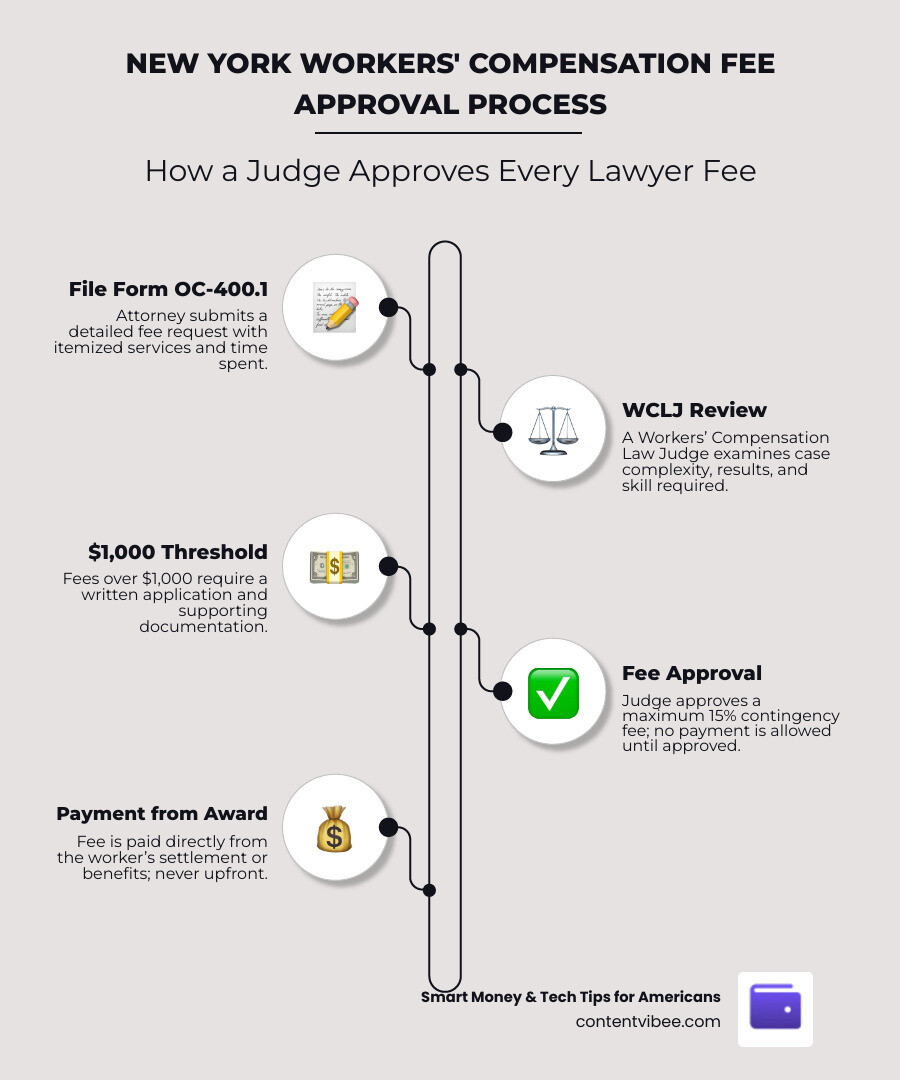
In New York, a lawyer cannot just send you an invoice. Every cent they earn must be approved by a Workers’ Compensation Law Judge (WCLJ). This process is highly regulated and recently underwent a digital transformation to make it more efficient.
Form OC-400.1 and the $1,000 Threshold
Whenever a lawyer wants to be paid, they must submit a fee application.
- Fees under $1,000: These can often be requested orally during a hearing. The lawyer simply states the amount they are requesting based on the statutory schedule, and the judge makes a ruling on the record.
- Fees over $1,000: These require a formal, written application using Form OC-400.1.
On this form, the lawyer must certify that the fee they are asking for matches the statutory percentages. Before 2023, lawyers had to list every single minute they spent on your case. Now, the Board has streamlined this. As long as the fee follows the 15% or “one-third” rules, the administrative process is much faster.
Administrative Automation
The New York Workers’ Compensation Board uses a system called eCase. This allows judges to see exactly how much you have been paid in the past, making the calculation of the 15% fee very precise. This automation reduces errors and ensures that the lawyer isn’t accidentally paid more than the law allows.
| Type of Award | Fee Calculation | Approval Method |
|---|---|---|
| Ongoing Weekly Benefits | 1/3 of one weekly check | Oral or Written |
| Section 32 Settlement | 15% of total (minus medical) | Written (Form OC-400.1) |
| SLU / Back Pay | 15% of the award amount | Oral (if <$1k) or Written |
| Death Benefits | 15% + 15 weeks of pay | Written |

Factors Judges Consider for How Much Do Workers Comp Lawyers Charge in New York
While the 2023 rules made the fees more “automatic” based on percentages, judges still have the final say. They don’t just rubber-stamp every request. They look at several factors to ensure the fee is fair to the injured worker.
- Case Complexity: Was this a straightforward claim where the insurance company admitted fault? Or was it a complex battle involving pre-existing conditions and multiple medical experts?
- Attorney Skill: Did the lawyer demonstrate a high level of expertise in navigating the Board’s complex rules?
- Results Achieved: This is the big one. Did the lawyer successfully secure benefits that were previously denied?
- Financial Status of the Claimant: The judge considers your financial health. If a fee would leave you unable to pay rent, the judge has the discretion to structure the payment differently.
- Time Spent: Although itemization isn’t always required for the math anymore, the judge still considers whether the lawyer actually “earned” the fee through their efforts.
It’s worth noting that according to How Much a Workers’ Comp Lawyer Costs in Every State in 2024, New York’s 15% cap is actually lower than many other states, where fees can reach 25% or even 33%. This makes New York one of the more “worker-friendly” states when it comes to legal costs.
Additional Costs and Disbursements Beyond Attorney Fees
This is where many people get confused. There is a difference between attorney fees (the money the lawyer keeps as profit) and disbursements (the actual costs of running the case).
Even though the lawyer’s fee is capped at 15%, there are other expenses involved in winning a workers’ comp case. These typically include:
- Medical Records: Doctors and hospitals charge fees to copy and send your records.
- Expert Witness Fees: If your lawyer needs a specialist doctor to testify at a hearing or write a complex report, that doctor will charge for their time.
- Deposition Costs: Paying for a court reporter to transcribe testimony.
- Travel Expenses: Costs for the lawyer to attend distant hearings (though many are now virtual).
Who Pays These Costs?
In most cases, the law firm will “advance” these costs. This means they pay the doctor or the court reporter out of their own pocket while the case is ongoing. If you win, these costs are reimbursed to the lawyer from your settlement, in addition to the 15% fee.
If you lose the case, most workers’ comp lawyers in New York will not ask you to pay them back for these costs. However, you should always clarify this during your initial consultation. Dealing with these nuances is similar to Navigating the Financial Maze of Family Law Costs, where understanding the difference between fees and “costs” is vital for your budget.
Frequently Asked Questions about New York Workers’ Comp Fees
Do I have to pay my lawyer if I lose my case?
Generally, no. Because workers’ comp lawyers in New York work on a contingency basis, they only get paid if they secure a financial award for you. If your claim is denied and all appeals are exhausted without any money being awarded, you typically owe the lawyer $0 in fees. This is the ultimate safety net for injured workers.
Are initial consultations with NY workers’ comp lawyers free?
Yes! Almost every reputable workers’ comp attorney in New York offers a free initial consultation. During this meeting, they will evaluate the strength of your case, explain the potential value of your claim, and discuss the fee structure in detail. You are under no obligation to hire them after this meeting. It’s a great way to “shop around” and find a lawyer you trust.
Can I object to the fee my lawyer requests from the judge?
Absolutely. When a lawyer submits a written fee request (Form OC-400.1), you are supposed to see it. If you believe the lawyer didn’t do the work they claimed, or if the fee seems mathematically incorrect, you can check a box on the form to object. You can also speak up during the hearing. The judge will listen to your concerns before making a final decision. You have 30 days to appeal a judge’s decision regarding attorney fees if you feel it was unfair.
Conclusion
Navigating a workplace injury is stressful enough without worrying about how you’ll afford a lawyer. At Smart Money & Tech Tips for Americans, we believe that knowledge is power. While our main offices are located in California, our mission is to empower Americans in every state with the data they need to make informed financial decisions. Understanding that how much do workers comp lawyers charge in New York is strictly regulated – and that you’ll never pay a dime out of pocket – should give you the confidence to seek the legal help you deserve.
By hiring an expert, you aren’t just getting someone to fill out forms; you’re getting an advocate who can often double the value of your settlement compared to going it alone. If you found this guide helpful, you might also want to explore our other financial legal guides, such as How Much Do Divorce Lawyer Fees Really Cost? to stay informed on all your legal rights and expenses.
Stay safe, stay informed, and remember: the law in New York is on your side.


