


The Age to Collect SS: What You Need to Know Before You Claim
The age to collect ss retirement benefits is one of the most important financial decisions you’ll make — and getting it wrong can cost you tens of thousands of dollars over your lifetime.
Here’s the quick answer:
| Claiming Age | Who It Applies To | Benefit You Receive |
|---|---|---|
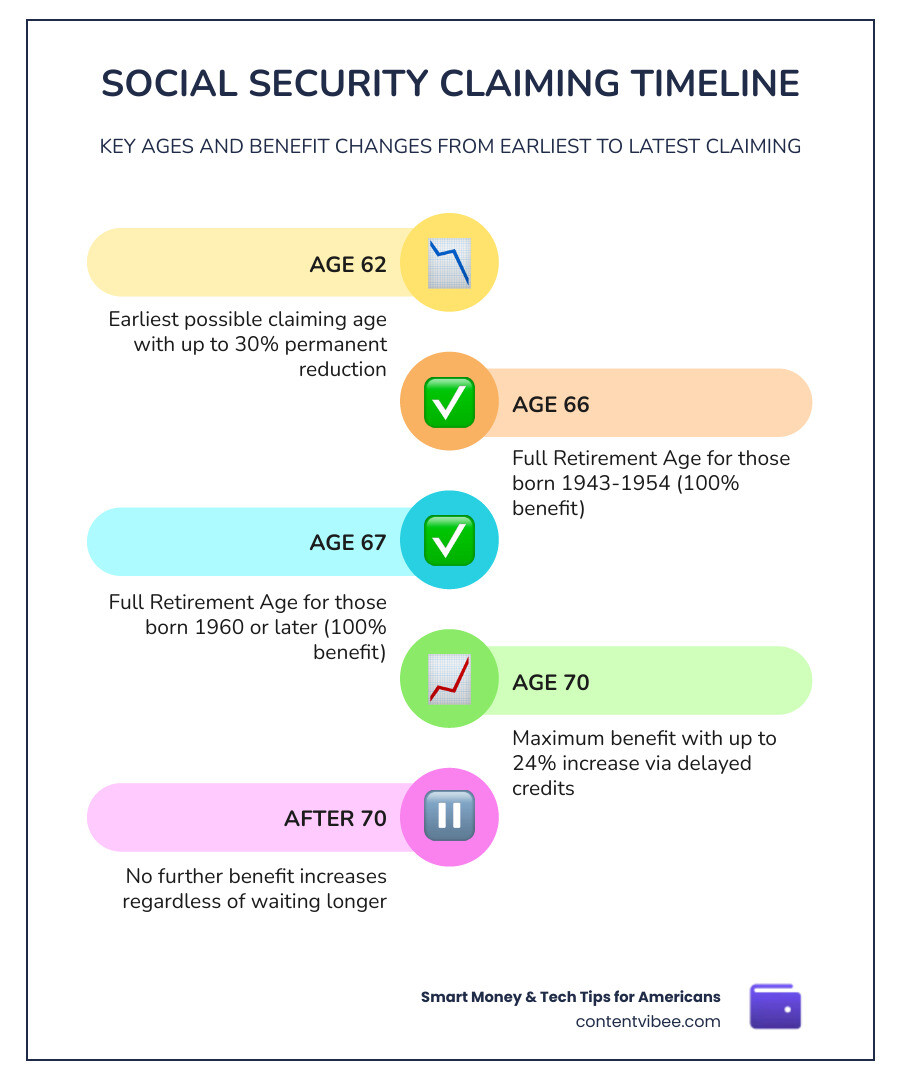
| 62 | Everyone (earliest possible) | Up to 30% less than full benefit |
| 66 | Born 1943–1954 | 100% (Full Retirement Age) |
| 66 + 2–10 months | Born 1955–1959 | 100% (Full Retirement Age) |
| 67 | Born 1960 or later | 100% (Full Retirement Age) |
| 70 | Everyone (latest for max benefit) | Up to 24% more than full benefit |
No additional benefit increases happen after age 70, no matter how long you wait.
Social Security replaces roughly 40% of the average worker’s pre-retirement income — but the exact amount you receive depends heavily on when you start claiming.
Claim too early and you lock in a permanent reduction. Wait too long and you might leave years of payments on the table.
The right answer is different for everyone. It depends on your health, your spouse’s situation, your other income, and how long you expect to live. About 1 in 3 people who are 65 today will live past 90 — which means this decision carries more weight than most people realize.
This guide walks you through everything you need to know to make a smart, confident choice.
Understanding the Earliest Age to Collect SS and Your Full Retirement Age
Deciding on the right age to collect ss starts with understanding two major milestones: age 62 and your Full Retirement Age (FRA). While age 62 is the “open for business” sign for Social Security, it isn’t necessarily the most profitable time to walk through the door.
To be eligible for any retirement benefits at all, you generally need to have earned 40 credits. In Social Security, this usually translates to about 10 years of work in the United States. If you’ve hit that mark, you’re in the game. But before you circle a date on your calendar, you need to know your “full” number.

How Birth Year Determines Your Age to Collect SS
Your Full Retirement Age isn’t a fixed number for everyone; it’s a moving target based on when you were born. For a long time, the standard was age 65, but Congress changed the rules in 1983 because Americans are living longer and staying healthier.
- Born 1943–1954: Your FRA is 66.
- Born 1955–1959: Your FRA increases by two months for every year. For example, if you were born in 1959, your FRA is 66 and 10 months.
- Born 1960 or later: Your FRA is 67.
If you want to see your exact timeline, the Social Security Administration provides a Retirement Age Calculator to help you pinpoint your specific date. It is especially important for those born in 1960 or later to realize that age 67 is the new 100% mark.
The 62 vs. 67 Dilemma
We often see people rushing to claim at 62 because they want their money as soon as possible. While you can start at 62, there is a catch: a permanent reduction in your monthly check.
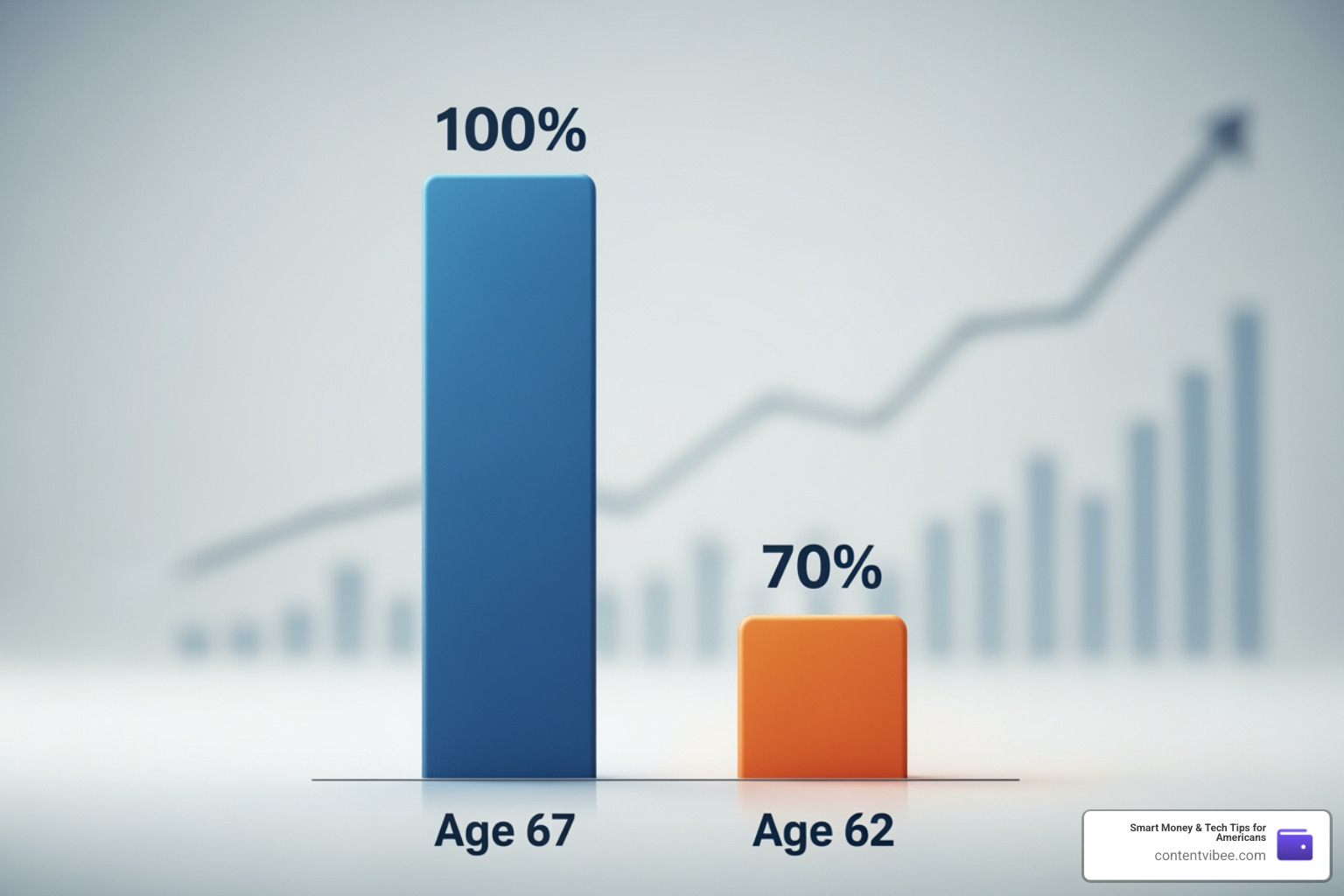
If your FRA is 67 and you claim at 62, you are hit with a 30% penalty. This isn’t a temporary “early bird” fee; it’s a reduction that stays with you for the rest of your life. The SSA calculates this reduction month-by-month, so every month you wait between 62 and 67 slightly increases your lifelong benefit. According to AARP, the decision of “can” versus “should” is the most critical hurdle in retirement planning.
The Cost of Claiming Early: Reductions and Penalties
When you choose an early age to collect ss, you’re essentially trading a larger monthly check tomorrow for a smaller check today. For many, that 30% reduction is a tough pill to swallow. Considering that Social Security typically replaces only 40% of an average worker’s income, starting with a 30% haircut means you’re relying on a much smaller safety net.
The SSA has a strict formula for this. For the first 36 months before your FRA, your benefit is reduced by 5/9 of 1% for each month. If you claim even earlier than that, the reduction is 5/12 of 1% for each additional month. You can find the full breakdown of these retirement age and benefit reductions on the official SSA website.
Impact on Spousal and Survivor Benefits
It’s not just your check that’s at risk. Your choice affects your family, too. If you claim early, your spouse’s benefit could be reduced by up to 35%. This is a huge factor for couples who are trying to maximize their joint income.
Furthermore, survivor benefits are tied to when the primary earner claimed. If the high-earner claims at 62 and then passes away, the surviving spouse could be stuck with a permanently lower survivor benefit. We recommend understanding what a Social Security Spousal Benefit is before making a final call. You can even use a Social Security Spousal Benefit Calculator to see the numbers for your specific situation.
Benefit Comparison Table (Born in 1960 or Later)
| Age Claimed | Worker Benefit % | Spouse Benefit % |
|---|---|---|
| 62 | 70% | 32.5% |
| 65 | 86.7% | 41.7% |
| 67 (FRA) | 100% | 50.0% |
| 70 | 124% | 50.0%* |
Note: Spousal benefits do not earn delayed retirement credits and cap at 50% of the worker’s FRA amount.
Maximizing Your Monthly Check: The Power of Delaying Until Age 70
If you can afford to wait, the rewards are substantial. For every year you delay past your Full Retirement Age, the government adds “delayed retirement credits” to your account. This amounts to an 8% annual increase in your benefit.
If your FRA is 67 and you wait until age 70, you will receive 124% of your base benefit. That is a massive difference compared to the 70% you’d get at age 62. According to Charles Schwab, this is one of the few places where you can get a guaranteed 8% return on your “investment.”
Calculating the Break-Even Age to Collect SS
The “break-even age” is the point in time where the total amount of money you’ve received from waiting (larger checks) finally surpasses the total amount you would have received by starting early (more checks).
- Age 62 vs. 67: The break-even age is typically around 78 years and 8 months.
- Age 62 vs. 70: The break-even age is approximately 80 years and 4 months.
If you believe you will live past age 80, waiting is almost always the mathematically superior choice. You can read more about these calculations in the SSA’s guide on when to start receiving retirement benefits.
Longevity and the 50/50 Chance
We often underestimate how long we’ll be around. Statistics show that 1 out of every 3 65-year-olds today will live until at least age 90, and 1 out of 7 will live to 95. For married couples, there is a 50/50 chance that at least one person will live past 90.
Delaying your age to collect ss acts as a form of longevity insurance. Since Social Security includes Cost-of-Living Adjustments (COLA), starting with a higher base at age 70 means your annual inflation raises will also be larger in dollar terms.
Working While Receiving Benefits and the Medicare Connection
Can you have your cake and eat it too? Yes, you can work and collect Social Security, but there are rules if you haven’t reached your Full Retirement Age.
If you are under your FRA, there is an earnings limit. If you earn more than that threshold, the SSA will temporarily withhold $1 in benefits for every $2 you earn over the limit. The good news? This money isn’t gone forever. Once you reach your FRA, the SSA recalculates your benefit to “give back” the months that were withheld, resulting in a higher monthly check moving forward. You can find more details on applying for benefits before FRA here.
The Earnings Test and Your Age to Collect SS
Once you hit the magic month of your Full Retirement Age, the earnings test disappears. You can earn $1 million a year at your job and still receive your full Social Security check. This is why many people wait until their FRA to start receiving retirement benefits if they plan to keep working.
Medicare Enrollment Timing
Don’t let your Social Security decision mess up your health insurance. Even if you decide to wait until 70 to collect Social Security, you should almost always sign up for Medicare at age 65.
If you don’t sign up for Medicare Part B during your initial enrollment period (the 7-month window around your 65th birthday), you could face permanent late-enrollment penalties. The SSA provides more info on when to start benefits and how that interacts with Medicare. Remember: Medicare and Social Security are separate decisions!
Frequently Asked Questions about Social Security Timing
What is the absolute earliest age to collect SS?
For standard retirement benefits, the earliest age is 62. However, if you are a widow or widower, you may be eligible for survivor benefits as early as age 60 (or age 50 if you have a disability).
Can I change my mind after I start collecting benefits?
Yes, but there are strict rules. You have a one-time “reset” option within 12 months of starting benefits. You must repay every cent you (and your family) received, and then you can stop the benefits and wait until a later age to restart them for a higher amount.
How does my spouse’s age affect my claiming decision?
If you are the higher earner, your spouse’s future survivor benefit depends on you. If you wait until 70 to claim, you are essentially buying a larger “life insurance policy” for your spouse, as they will inherit your higher monthly amount if you pass away first.
Conclusion
At Smart Money & Tech Tips for Americans, we believe that the “best” age to collect ss isn’t just about math — it’s about your personal peace of mind. Whether you need the money at 62 to enjoy an active early retirement or you choose to wait until 70 to maximize your safety net, the key is having a personalized strategy.
Don’t leave money on the table by guessing. Consider your health, your work goals, and how both spouses collect Social Security to build a plan that lasts as long as you do. Your future self will thank you for taking the time to get these numbers right today!


