


Why Every Pre-Retiree Needs a 401(k) Balance Calculator
A 401k balance calculator is one of the fastest ways to see if your retirement savings are on track — here’s how it works in plain terms:
How to use a 401(k) balance calculator:
- Enter your current age and target retirement age
- Input your current 401(k) balance
- Add your annual income and monthly contribution amount
- Include your employer match percentage
- Set an expected annual return (6–7% is a common conservative estimate)
- Hit calculate — your projected retirement balance appears instantly
Most people are surprised by two things: how much the employer match matters, and how much starting just a few years earlier changes the final number.
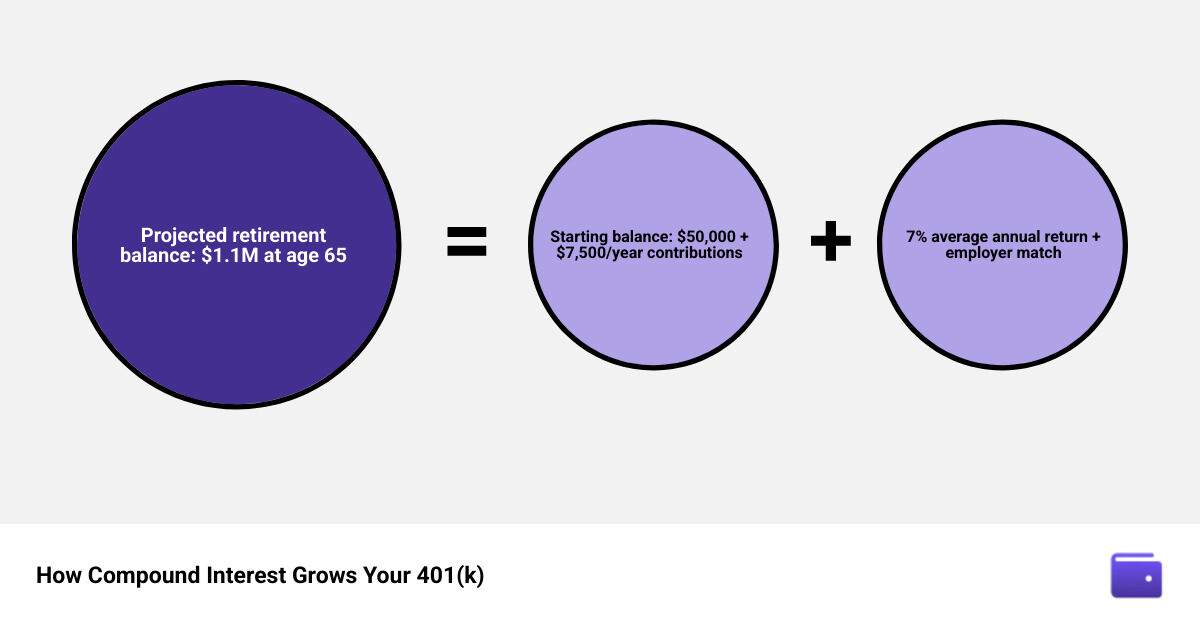
Consider this: a 30-year-old contributing $7,500 per year at 7% for 35 years could end up with roughly $1.1 million. Wait just five years to start, and that same strategy produces closer to $756,000 — a difference of over $350,000 from one decision.
The math isn’t complicated once you break it down. But most people never run the numbers at all.
That’s exactly what this guide will help you fix.
How a 401k Balance Calculator Projects Your Future Wealth
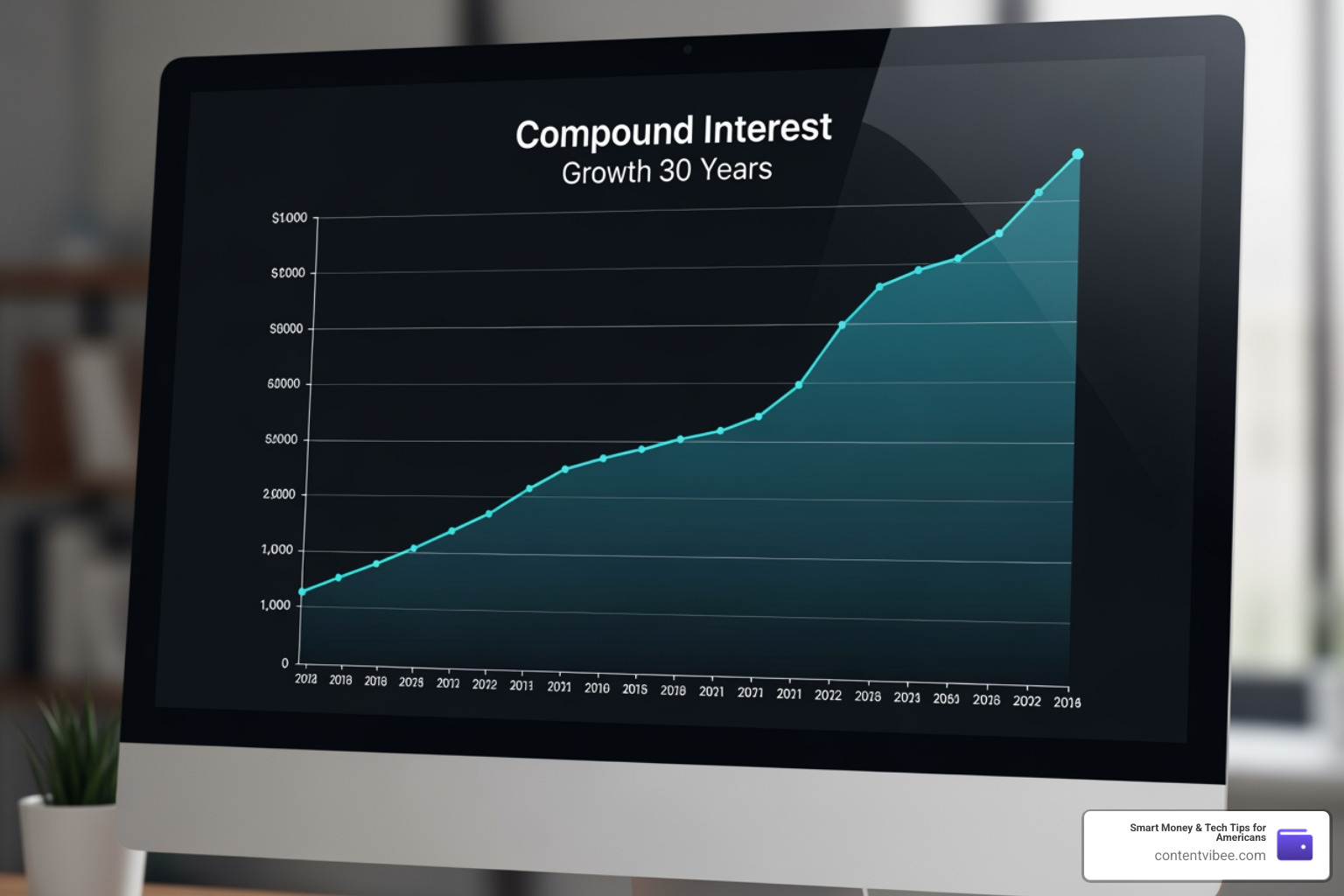
When we talk about retirement planning, we are really talking about two things: how much you save and how long that money has to grow. A 401k Balance Calculator takes these two factors and applies the “magic” of compound interest. Compound interest is simply the process of earning interest on your interest. Over a long time horizon, this growth becomes the engine of your wealth accumulation.
Most of us think of our 401(k) as a simple bucket of money. In reality, it is a dynamic growth machine. The calculator uses a specific formula to project that if you put in $X today, and it grows by Y% every year while you add $Z every month, you will arrive at a specific destination by age 65 or 67. This visualization is crucial because it moves retirement from a vague “someday” to a concrete number you can plan for.
Adjusting Variables in Your 401k Balance Calculator for Realistic Goals
To get the most out of a 401k balance calculator, you have to be honest with the numbers you plug in. If you assume a 15% annual return every year, your results will look amazing, but they won’t be realistic. Historically, the 30-year average annual return of the S&P 500 has been roughly 10–12%. However, many experts suggest using a “real” return of 6–7% to account for inflation.
Inflation is the silent killer of purchasing power. If your million-dollar nest egg is worth a million dollars in 2056, it won’t buy nearly as much as it does in May 2026. Another variable to watch is salary growth. The U.S. Bureau of Labor Statistics reports average annual wage growth of about 3–4%. If you assume your income stays flat for 30 years, your calculator will likely understate your final balance. Ensuring Your Investment Calculator is Accurate is about finding that “Goldilocks” zone—not too optimistic, not too pessimistic.
Essential Inputs for an Accurate 401(k) Projection
To get a projection that actually means something, you need to gather a few pieces of data. Why Investment Calculator Accuracy and Financial planning go hand-in-hand is simple: garbage in, garbage out.
Here are the non-negotiables:
- Current Age and Retirement Age: This defines your “time horizon.” The longer the gap between these two numbers, the more work compound interest can do for you.
- Starting Balance: How much is in the account right now?
- Annual Income: Your gross salary before taxes.
- Contribution Percentage: The portion of your check you’re tucking away.

Maximizing the Employer Match in Your 401k Balance Calculator
If your boss offered you a 3% pay raise today, you’d take it, right? That is exactly what an employer match is—it’s “free money.” In fact, 43% of employees surveyed said they would actually prefer a pay cut in exchange for a higher employer 401(k) contribution.
When using our Smart Money Retirement Tools, pay close attention to the “Employer Match” and “Employer Maximum” fields. A common setup is a 50% match up to 6% of your salary. This means if you contribute 6%, your employer adds another 3%. That is an immediate 50% return on your investment before the market even moves!
However, keep an eye on vesting schedules. You might “see” that employer money in your account, but you don’t truly own it until you’ve stayed with the company for a certain period.
- Cliff Vesting: You own 0% of the match until you hit a milestone (like 3 years), then you own 100%.
- Graded Vesting: You own a percentage each year (e.g., 25% after year one, 50% after year two) until you are fully vested.
Factoring in 2026 IRS Contribution Limits
As we move through May 2026, it is vital to stay updated on the latest IRS rules. The government limits how much you can squirrel away in these tax-advantaged accounts to prevent people from hiding too much income from the taxman.
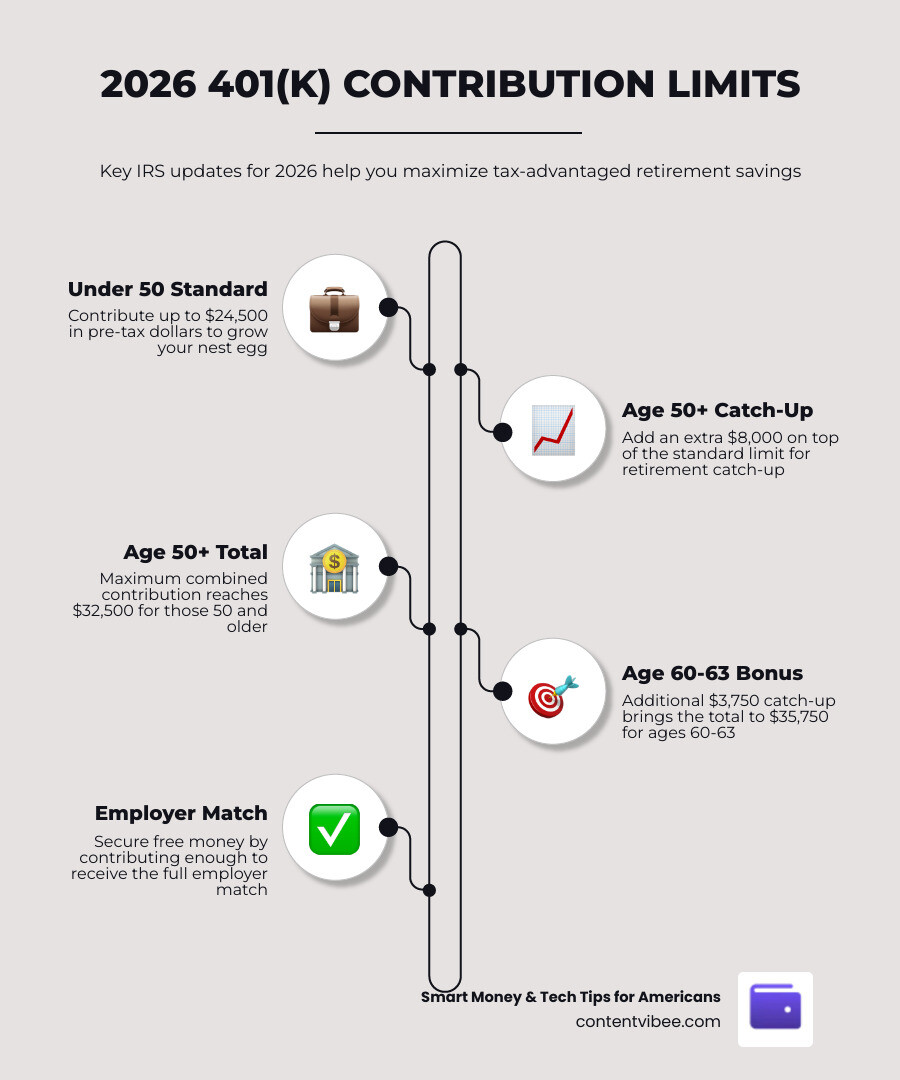
For 2026, the limits have seen a healthy increase. If you are under 50, you can contribute up to $24,500. If you are 50 or older, you get to take advantage of “catch-up” contributions.
| Category | 2025 Limit | 2026 Limit |
|---|---|---|
| Standard Contribution (Under 50) | $23,500 | $24,500 |
| Catch-up (Age 50+) | $7,500 | $8,000 |
| Total for Age 50+ | $31,000 | $32,500 |
| Special Catch-up (Ages 60-63) | $11,250 | $11,250 |
| Combined (Employee + Employer) | $70,000 | $72,000 |
Note the special SECURE 2.0 Act provision: if you are aged 60 to 63, your total contribution limit jumps to $35,750 ($24,500 base + $11,250 catch-up). This is a massive opportunity to supercharge your balance in the final years before retirement.
Advanced Factors: Fees, Returns, and Tax Diversification
Even the best 401k balance calculator can be thrown off by hidden costs. Most 401(k) plans aren’t free. They come with administrative fees and “expense ratios” on the mutual funds you choose. While a 1% fee sounds small, it can eat up nearly 25-30% of your final balance over 30 years. How to Use an AUM Fee Calculator to Save Your Retirement can help you visualize this impact.
On the flip side, your rate of return is the wind in your sails. While the S&P 500 has a strong historical track record, your actual return depends on your asset allocation—how much you have in stocks versus bonds. A younger worker might aim for a higher stock percentage to maximize growth, while someone nearing retirement might shift toward bonds to protect their “nest egg.”
Traditional vs. Roth 401(k) Options
One of the biggest choices you’ll face is whether to go Traditional or Roth.
- Traditional 401(k): You contribute pre-tax money. This lowers your tax bill now, but you will pay income tax on everything you withdraw in retirement.
- Roth 401(k): You contribute after-tax money (no tax break today). However, the money grows tax-free, and your withdrawals in retirement are 100% tax-free.
Which is better? It depends on your current tax bracket versus your expected bracket in retirement. If you are in a low bracket now, Roth is often the winner. If you are a high earner today, the immediate tax break of a Traditional 401(k) might be more valuable. Many experts recommend “tax diversification”—having a bit of both—to give you flexibility later.
Understanding Withdrawals, RMDs, and Penalties
A 401(k) is a “locked” box until you reach age 59.5. If you try to take money out before then, the IRS usually hits you with a 10% early withdrawal penalty on top of the regular income taxes you’ll owe. There are exceptions for “hardship withdrawals” (like medical emergencies or preventing eviction), but these should be a last resort.
There is also the Rule of 55. If you leave your job in or after the year you turn 55, you may be able to take penalty-free withdrawals from that specific employer’s 401(k). This is a great tool for early retirees to bridge the gap to Social Security. For more details, check out our Retirement Planning Resources.
Managing Required Minimum Distributions (RMDs)
The government eventually wants its tax money. This is where Required Minimum Distributions (RMDs) come in. Once you reach age 73, you must start taking money out of your Traditional 401(k) and paying taxes on it. If you don’t, the penalty is a staggering 50% of the amount you were supposed to withdraw.
Proper distribution planning is just as important as the savings phase. You want to withdraw enough to live comfortably and satisfy the IRS, but not so much that you jump into a higher tax bracket or run out of money. Our Tools can help you model these later-life scenarios.
Frequently Asked Questions about 401(k) Planning
What happens to my 401(k) if I change jobs?
You generally have four options:
- Leave it where it is: If the plan allows and has low fees.
- Roll it over to your new employer: Keeps your retirement funds in one place.
- Roll it over to an IRA: Often gives you more investment choices and lower fees.
- Cash it out: We almost never recommend this. You’ll pay taxes and penalties, and you’ll lose out on years of future compound growth.
Can I withdraw from my 401(k) early without a penalty?
Yes, in specific cases. Aside from the Rule of 55, the IRS allows “72(t)” distributions (Substantially Equal Periodic Payments) or withdrawals for specific hardships. However, these are complex and can permanently reduce your retirement security.
How much should I contribute to get the full employer match?
You should contribute at least the percentage your employer is willing to match. If they match 50% up to 6%, you should contribute at least 6%. Failing to do this is like leaving a part of your salary on the table.
Conclusion
At Smart Money & Tech Tips for Americans, we believe that financial independence isn’t about being a math genius—it’s about using the right tools to make informed decisions. A 401k balance calculator takes the guesswork out of your future and gives you a clear roadmap to the retirement you’ve worked so hard for.
Whether you are just starting your career or looking at the 2026 catch-up limits as a way to finish strong, time is your greatest asset. Don’t wait for “the right time” to start. Use our Tools Finance Calculator today, run your numbers, and take control of your financial destiny. Your future self will thank you.


