


What You Need to Know About Social Security Benefits Before You Claim
Social Security benefits are monthly payments from the federal government designed to replace a portion of your income when you retire, become disabled, or lose a working family member.
If you’re trying to figure out whether you qualify — and how much you might get — here’s the short version:
Who qualifies for Social Security retirement benefits:
- You must be age 62 or older
- You must have worked and paid Social Security taxes for at least 10 years (40 credits)
- Family members — including spouses, ex-spouses, and dependent children — may also qualify based on your work record
The main types of Social Security benefits:
| Benefit Type | Who It’s For |
|---|---|
| Retirement | Workers age 62+ with 10+ years of work history |
| Disability (SSDI) | Workers who can’t work due to disability or blindness |
| Survivor | Spouses, children, and dependent parents of deceased workers |
| Supplemental Security Income (SSI) | People with little income who are disabled, blind, or age 65+ |
| Medicare | People age 65+, or those with certain disabilities |
Checking your eligibility takes about 10 minutes using the official SSA tool at ssa.gov.
For retirees, the stakes are high. Claim too early and you lock in a permanently reduced payment. Wait too long and you leave money on the table. And if you’re married, the decisions you make affect your spouse’s survivor benefits too.
This guide walks you through everything — eligibility, benefit types, how your payment is calculated, when to claim, and how to apply — so you can make the most informed decision possible.
Understanding Social Security Benefits and Eligibility

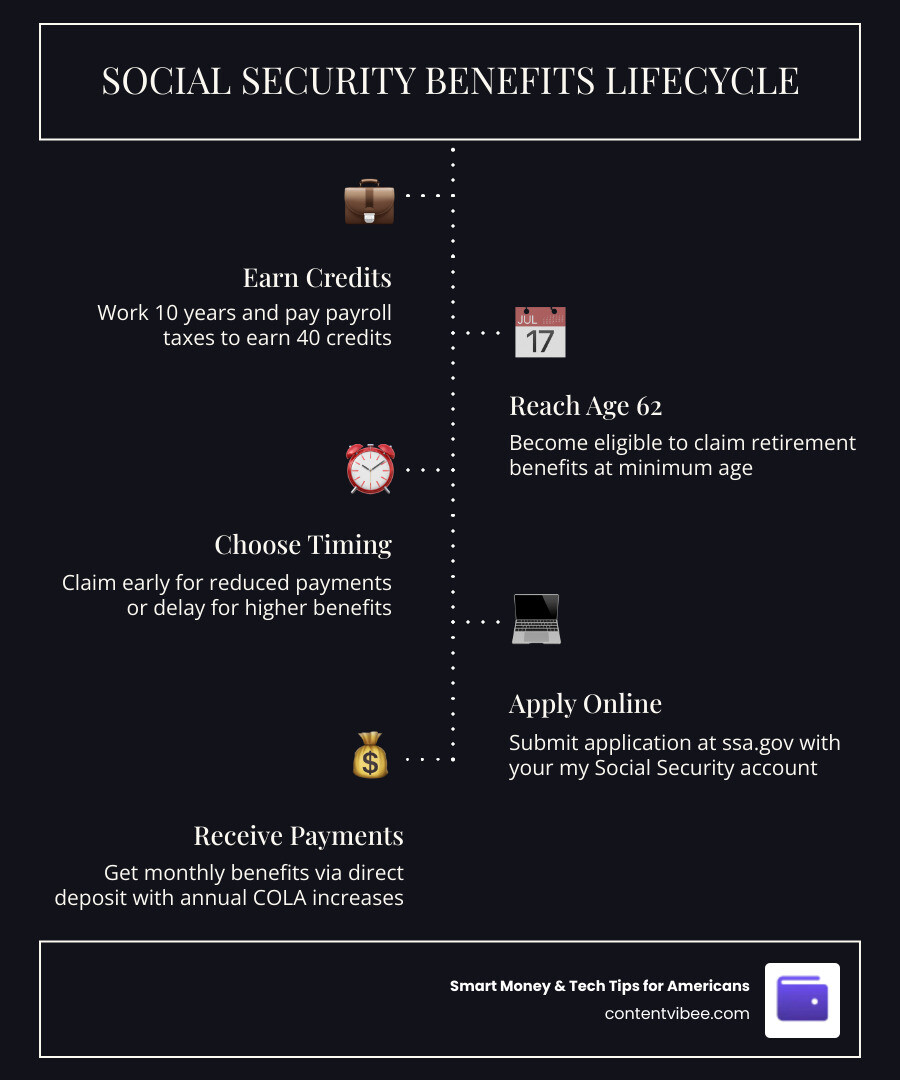
At its core, the Social Security system is a “pay-as-you-go” program. While you work, you pay payroll taxes (FICA) into the system, which are then used to pay out benefits to current retirees. To eventually receive social security benefits yourself, you generally need to earn “credits.”
In May 2026, the rule remains consistent: you need 40 credits to qualify for retirement benefits. Since you can earn a maximum of four credits per year, this typically translates to a 10-year work requirement. If you haven’t reached that 10-year mark yet, don’t worry—those credits stay on your record until you earn enough to qualify.
To get the most accurate picture of where you stand, we recommend visiting The United States Social Security Administration. Their portal is the gold standard for official information.
Qualifying for Retirement and Disability
While retirement is the most common reason people seek benefits, it isn’t the only one. Eligibility hinges on your specific life circumstances:
- Retirement: The minimum age threshold is 62.
- Disability: If you have a medical condition that prevents you from working for at least a year or is expected to result in death, you may qualify for Social Security Disability Insurance (SSDI).
- Blindness: Specific rules apply to those with visual impairments, often providing more flexibility regarding work credits.
Checking Your Eligibility Status
Gone are the days of waiting in long lines at a local office just to ask a question. You can now perform a Check eligibility for Social Security benefits online in about 10 minutes. By creating a “my Social Security” account, you can see exactly how many credits you have and what your estimated payments look like. For a deep dive into the specific categories, you can explore Benefit types | SSA.
Different Types of Social Security Benefits Available

Social Security is often called the “safety net” of America, and for good reason. It covers a wide range of family dynamics. While you might be focusing on your own retirement, it’s important to understand how your work history protects your loved ones.
Survivor and Family Benefits
If a worker passes away, their surviving family members may be eligible for monthly payments. This includes:
- Widows and Widowers: Full benefits at full retirement age, or reduced benefits as early as age 60.
- Dependent Children: Generally unmarried children under 18 (or up to 19 if still in high school).
- Ex-Spouses: If you were married for at least 10 years, you might be eligible for benefits based on your ex-spouse’s record.
To see how these payments stack up, you can review the Social Security beneficiaries by benefit level. Furthermore, many people ask, What is a Social Security Spousal Benefit? Essentially, it allows a spouse to receive up to 50% of the worker’s benefit amount if that is higher than their own earned benefit.
Supplemental Security Income (SSI)
SSI is distinct from standard retirement benefits. It is a needs-based program for those with limited income and resources. It serves:
- Adults and children with a disability or blindness.
- Seniors aged 65 and older without disabilities who meet financial hardship criteria.
How Your Social Security Benefits Are Calculated
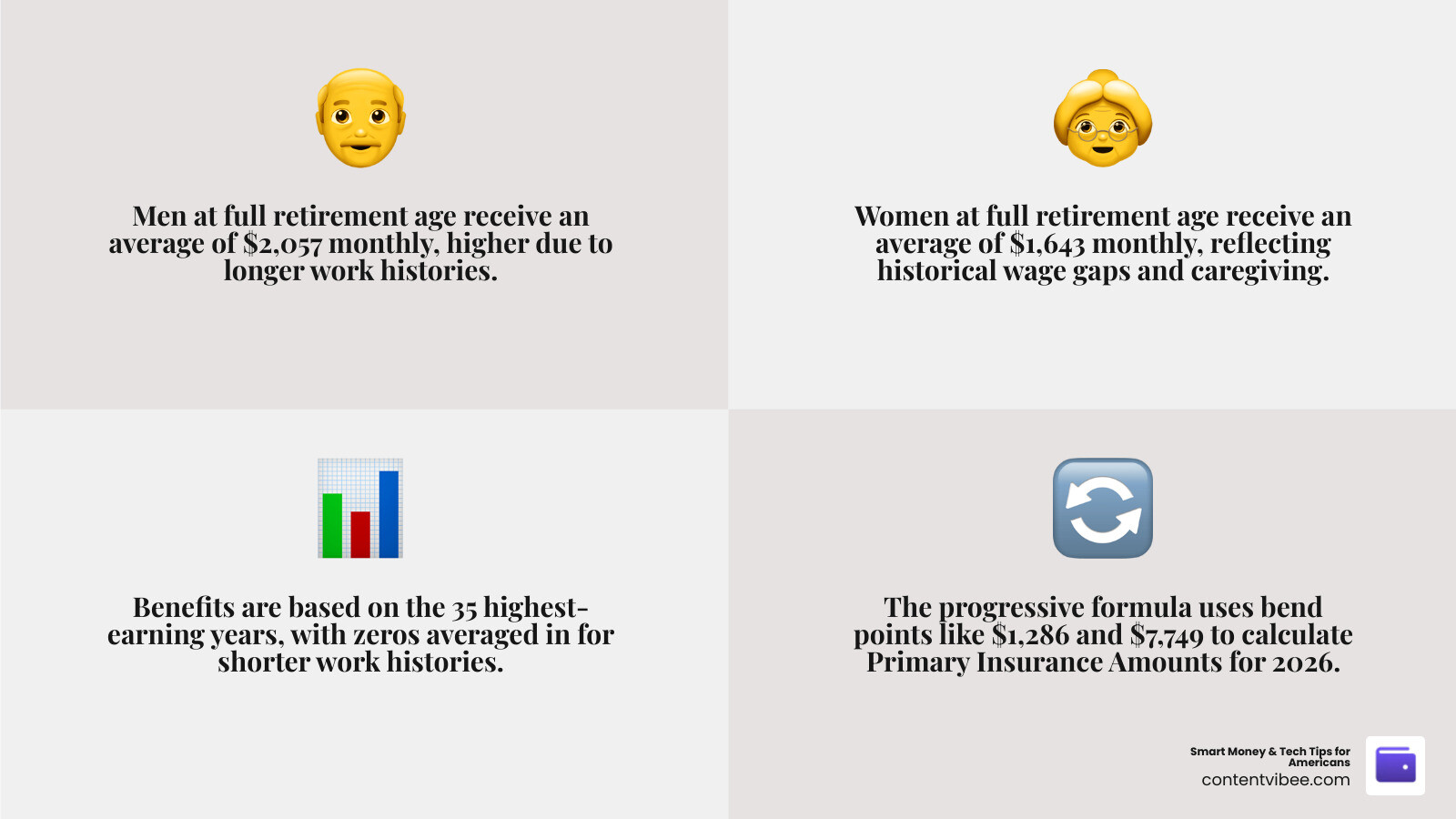
Understanding the math behind your check can feel like trying to solve a Rubik’s Cube in the dark, but we can break it down. The SSA uses your 35 highest-earning years to calculate your “Average Indexed Monthly Earnings” (AIME). If you worked fewer than 35 years, the remaining years are averaged as zeros, which can significantly lower your check!
The Role of AIME and PIA
Once your AIME is determined, the SSA applies a formula to find your Primary Insurance Amount (PIA). This formula uses “bend points”—dollar amounts that change annually based on the national average wage index. For 2026 eligibility, these bend points are $1,286 and $7,749.
The formula is designed to be progressive, meaning lower-income workers receive a higher percentage of their pre-retirement income than higher-income workers. You can get a personalized calculation using the Estimated Social Security Benefit tool or check the technical Social Security Benefit Amounts page for the latest formulas.
Gender and Age Statistics in Benefit Averages
It is a documented fact that earnings history impacts monthly payments. On average, men currently receive higher benefits than women, largely due to historical wage gaps and time taken out of the workforce for caregiving.
Average Monthly Retirement Benefits (2022 Data):
| Age | Men | Women |
|---|---|---|
| 67 (Full Retirement Age) | $2,057 | $1,643 |
| 70 | $2,033 | $1,631 |
| 75 | $2,152 | $1,686 |
| 80 | $2,176 | $1,652 |
Maximizing Your Social Security Benefits: Timing and Strategy
Timing is everything. Your Full Retirement Age (FRA) is the age at which you can claim your unreduced benefit. For anyone born in 1960 or later, the FRA is 67.
A common question we see at Smart Money & Tech Tips for Americans is: Do Both Spouses Collect Social Security? The answer is yes! Both can collect their own earned benefits, or one may collect a spousal benefit while the other collects their own. Strategizing as a couple is one of the best ways to maximize your household income.
The Impact of Early vs. Delayed Social Security Benefits
You can start as early as age 62, but there’s a catch: your monthly check will be permanently reduced by up to 30%. On the flip side, if you delay past your FRA, you earn Delayed Retirement Credits.
For every year you wait past age 67 (up to age 70), your benefit increases by a permanent 8%. That means waiting until 70 could result in a check that is 24% larger than it would have been at age 67! You can explore more about these timing options at Retirement benefits | SSA.
Working While Receiving Social Security Benefits
Can you have your cake and eat it too? Yes, but with limits. If you are under your FRA and earn more than a certain threshold, the SSA will temporarily withhold part of your benefits. This is known as the “Earnings Test.”
Once you reach your FRA, there is no limit on how much you can earn while receiving full benefits. To see how your specific income might change your check, try the Tools/Finance Calculator/Social Security Spousal Benefit Calculator.
How to Apply for and Manage Your Benefits
When you’re ready to make it official, the easiest way is to Apply for Social Security Benefits | SSA online. It’s faster than visiting an office and allows you to save your progress as you go.
Using the my Social Security Online Account
We cannot stress this enough: create your account today. Even if you are decades away from retirement, a my Social Security | SSA account allows you to:
- Verify your earnings history (and fix errors before they cost you money!).
- Request a replacement Social Security card.
- Set up or change direct deposit.
- Get instant benefit verification letters.
Understanding COLA and Annual Adjustments
To ensure your social security benefits keep up with inflation, the SSA applies a Cost of Living Adjustment (COLA) almost every year. This adjustment is based on the Consumer Price Index for Urban Wage Earners and Clerical Workers (CPI-W). When prices for groceries and gas go up, your Social Security check usually follows suit, helping you maintain your purchasing power throughout retirement.
Frequently Asked Questions about Social Security
What is the best age to start receiving benefits?
There isn’t a “one-size-fits-all” answer. If you need the income immediately or have health concerns, age 62 might be right. However, if you are still working and in good health, waiting until age 70 provides the highest possible monthly payment for life.
Can I receive benefits from a divorced spouse’s work record?
Yes, provided you were married for at least 10 years, you are currently unmarried, and you are age 62 or older. The best part? Claiming on your ex-spouse’s record does not affect their benefit amount or the benefits of their current spouse.
How do I report a change in my address or bank account?
The quickest way is through your online “my Social Security” account. Keeping this information updated is crucial to ensure you receive your payments and important tax forms (like the SSA-1099) without delay.
Conclusion
Navigating social security benefits can feel overwhelming, but taking the time to understand the rules can result in thousands of extra dollars over your lifetime. At Smart Money & Tech Tips for Americans, we believe that financial security starts with education.
Whether you are deciding between claiming early or waiting until 70, or wondering Do Both Spouses Collect Social Security, the key is to plan ahead. Use the tools provided by the SSA, check your eligibility early, and stay informed about annual COLA changes. Your future self will thank you for the extra effort today!


