


Why Management Expense Ratio Mutual Funds Fees Can Make or Break Your Returns
Management expense ratio mutual funds charge investors an annual percentage fee that covers the cost of running the fund — and it comes straight out of your returns before you ever see them.
Quick answer: What is a management expense ratio (MER)?
| Question | Answer |
|---|---|
| What is it? | A yearly fee, expressed as a percentage of your investment, that covers fund management and operating costs |
| What does it include? | Portfolio management, administrative costs, legal fees, taxes, and (in some series) advisor commissions |
| How is it charged? | Automatically deducted from fund assets daily — no separate bill |
| Typical range | ~0.20% for passive index funds to 2%+ for actively managed funds |
| Example cost | A 1% MER on a $10,000 investment = $100 per year in fees |
Most investors never see this fee leave their account. It’s already gone before your return is reported. That’s what makes it so easy to ignore — and so costly to overlook over time.
Here’s the uncomfortable truth: even a seemingly small difference in fees, say 0.75% vs. 1.85%, can add up to thousands of dollars in lost growth over a decade or two. The math is unforgiving, and compounding works just as powerfully against you as it does for you.
Whether you’re navigating a major financial transition or simply trying to keep more of what you earn, understanding what you’re paying — and why — is one of the most practical money moves you can make.
Decoding the Management Expense Ratio Mutual Funds Formula
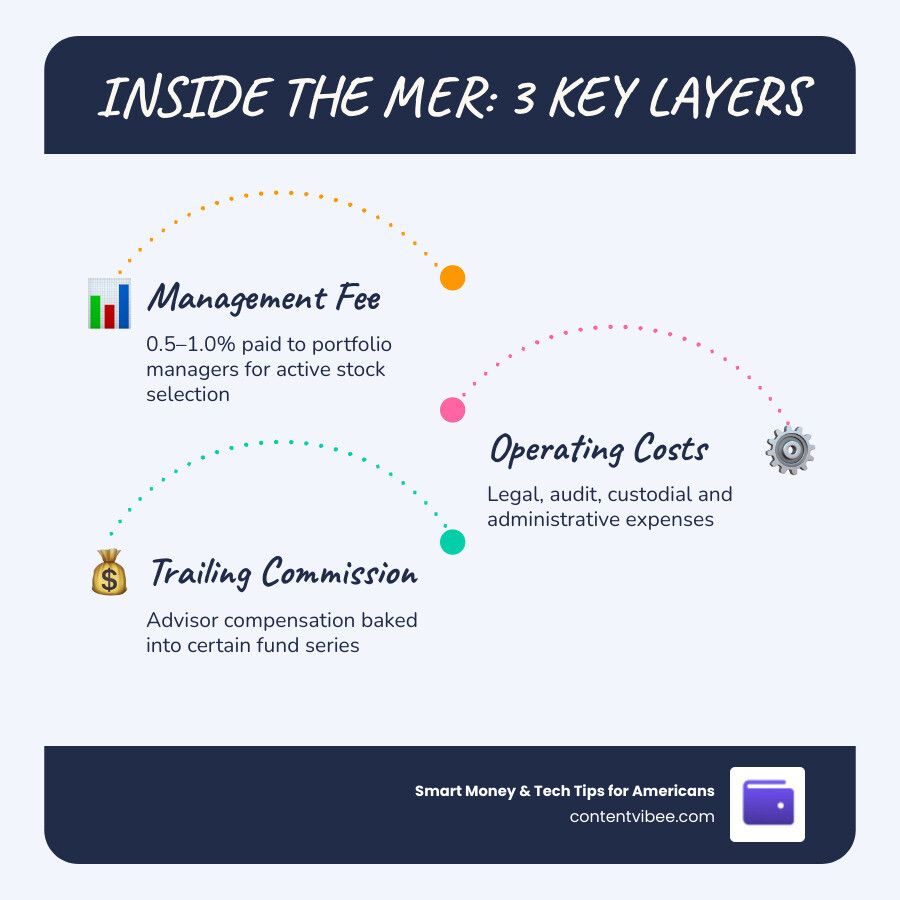
To master the art of investing, we first need to peel back the layers of the management expense ratio mutual funds formula. Many investors confuse the “management fee” with the MER, but they are not the same thing. Think of the management fee as the price for the “chef” (the portfolio manager), while the MER is the total bill for the entire restaurant experience—including the rent, the waiters, the cleaning crew, and the taxes.
The Management Fee vs. Management Expense Ratio distinction is critical. The management fee typically ranges from 0.5% to 1.0% of assets under management (AUM) and goes directly to the investment advisor for their expertise in picking stocks or bonds. However, the MER is the “all-in” number. It includes that management fee plus all the administrative and operating costs required to keep the fund running.
| Fee Component | What It Covers | Part of MER? |
|---|---|---|
| Management Fee | Professional stock picking and research | Yes |
| Operating Expenses | Audits, legal fees, and record-keeping | Yes |
| 12b-1 Fees | Marketing and distribution costs | Yes |
| Sales Loads | Commissions paid at purchase or sale | No |
| Trading Expenses | Brokerage commissions for fund trades | No |
What’s Actually Inside Your Management Expense Ratio Mutual Funds?
When we look inside a fund’s annual report, the MER covers a surprising variety of services. It isn’t just a “black box” fee; it pays for the infrastructure of your investment. This includes:
- Portfolio Management: The salaries of the analysts and managers who decide what to buy and sell.
- Custodial Fees: By law, funds must store their assets with a qualified custodian (like a bank) to protect shareholders if the fund company goes bankrupt.
- Legal and Audit Fees: Ensuring the fund complies with SEC regulations and that the books are balanced.
- Trailing Commissions: In certain fund series (like Series A), a portion of the MER is paid to your financial advisor for ongoing service.
- Taxes: Funds must pay sales tax (like GST/HST in some jurisdictions) on their management and admin fees.
Understanding What Are Wealth Management Fees helps clarify why these bundled costs exist. For many Americans, paying an MER is the trade-off for gaining access to professional research that would be nearly impossible to replicate on an individual level.
How the MER is Calculated and Expressed
The MER is expressed as an annual percentage of the fund’s average net assets. However, it isn’t deducted in one giant lump sum on December 31st. Instead, it is accrued daily.
Every day, the fund’s Net Asset Value (NAV) is adjusted to account for 1/365th of the annual fee. This means the performance you see reported in the news or on your statement is already “net of expenses.” If a fund’s assets grew by 10% in a year but it has a 1% MER, your reported return will be 9%. This is why Why Investment Accounting Software Cost is a factor for fund companies; they need precise systems to handle these daily micro-deductions across millions of shareholders.
How to Compare Fund Series and Management Styles
Not all management expense ratio mutual funds are created equal, even if they hold the exact same stocks. Mutual funds often come in different “series” or “classes,” tailored to how you buy them.
- Series A (or Class A): These are “advisor-led” funds. They usually have higher MERs because they include a trailing commission (often 1%) paid to the advisor who sold you the fund.
- Series F: These are “fee-based” funds. They have significantly lower MERs because the advisor’s commission is stripped out. Instead, you pay your advisor a separate, transparent fee.
Comparing these is essential for cost-conscious investors. You can find these details in the “Fund Facts” document or the Mutual Funds – Fees and Expenses | FINRA.org resources. Seeing a Comprehensive Fee Comparison Guide can help you decide if you are better off in a bundled or unbundled fee structure.

Active vs. Passive Management Expense Ratio Mutual Funds
One of the biggest drivers of MER costs is the management style.
- Passive Management (Index Funds): These funds simply track a benchmark like the S&P 500. Because they don’t need a room full of highly-paid analysts to “beat the market,” their MERs are often rock-bottom (sometimes as low as 0.05%).
- Active Management: These funds aim to outperform the market. This requires extensive research and more frequent trading, which leads to higher MERs (often 1.0% to 2.0%).
As a fund grows in size, it should benefit from “economies of scale.” Fixed costs like legal and audit fees get spread across more investors, which should lower the MER. When performing an Investment Management Expense Analysis, we always look for funds that pass these savings onto the shareholders.
Beyond the MER: Factors to Consider
While we focus heavily on the MER, it shouldn’t be the only factor in your decision. A fund with a 0.5% MER that loses money is a worse deal than a fund with a 1.5% MER that consistently provides strong, risk-adjusted returns.
Consider these elements alongside the fee:
- Risk Management: How does the fund perform during market crashes?
- Manager Tenure: Has the same person been running the fund successfully for a decade, or is there high turnover?
- Investment Objectives: Does the fund align with your specific goals, such as saving for a home in California or planning for retirement?
- Other Service Fees: Sometimes, Credit Union Service Fee Overview or Brokerage Account Fee Breakdown details show that account maintenance fees can add to your total cost of ownership.
The Impact of MER and Hidden Costs on Long-Term Wealth
The real danger of a high MER isn’t the cost this year—it’s the lost compounding over the next thirty years.
Let’s look at a $10,000 investment. If you invest in a fund with a 1% MER, you pay $100 in the first year. That doesn’t sound like much. But if that $100 had stayed invested and earned 7% annually for 30 years, it would have grown significantly. When you multiply that by every year you hold the fund, the “wealth gap” becomes staggering.
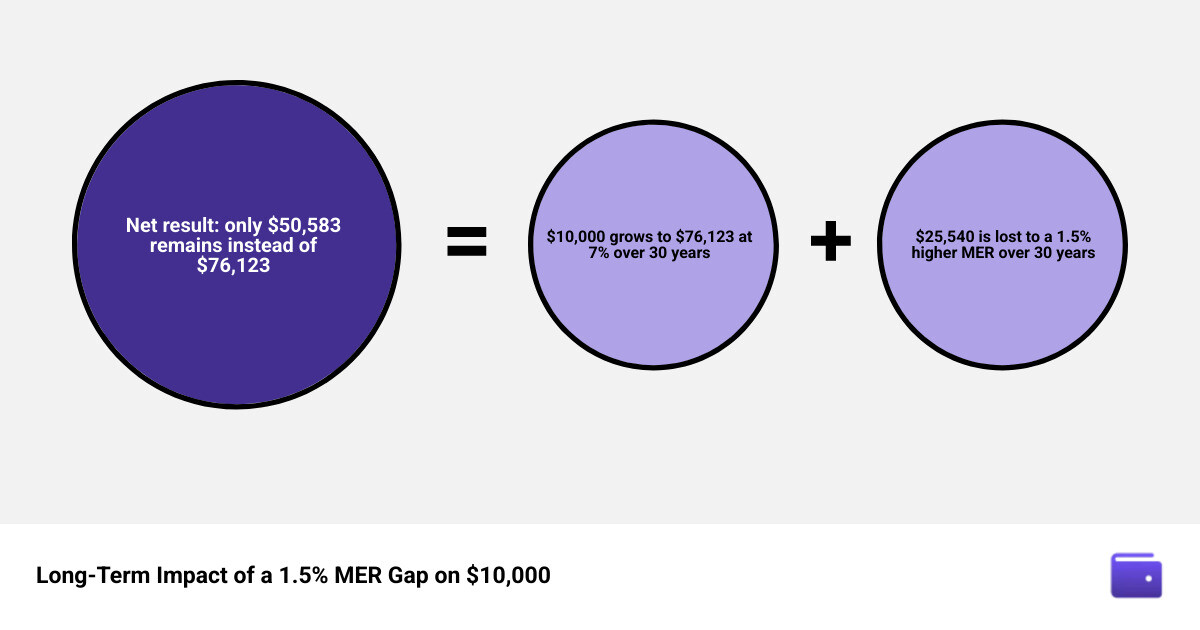
Research shows that even small fee reductions can lead to massive differences in final portfolio value. Interestingly, while fees take away from wealth, professional advice can add to it. Statistics suggest that working with a financial advisor over 15 years can result in up to 2.3x more wealth compared to self-managed accounts, largely because advisors help with “better savings habits” (as reported by 88% of mutual fund investors). The goal is to find the balance: pay for value, but don’t overpay for “closet indexing” (active funds that just mimic the index).
Gross vs. Net Expense Ratios and Fee Waivers
When you read a prospectus, you might see two numbers: a Gross Expense Ratio and a Net Expense Ratio.
- Gross Expense Ratio: The total cost of running the fund.
- Net Expense Ratio: What you actually pay after “fee waivers” or “reimbursements.”
Sometimes, a fund company will waive a portion of the fee to keep the fund competitive or to support a new fund with low assets. For example, a fund might have a 1.2% gross ratio but a 0.9% net ratio because the manager is absorbing 0.3% of the costs. Be careful, though—these waivers are often temporary. If the waiver expires, your costs will jump. Understanding Why Investment Manager Software Fees are structured this way can help you spot when a “teaser rate” might be ending.
Tax Implications and Trading Expense Ratios (TER)
There are two “hidden” costs that aren’t included in the management expense ratio mutual funds but still affect your bottom line:
- Trading Expense Ratio (TER): This covers the brokerage commissions the fund pays when it buys and sells stocks. A fund with high turnover (frequent trading) will have a higher TER, which further drags down returns.
- Tax Efficiency: In taxable accounts, high-turnover funds can trigger capital gains taxes for you, even if you didn’t sell any shares. This is why many Americans prefer holding high-fee or high-turnover funds in tax-deferred accounts like IRAs or 401(k)s.
For those in high-tax states like California, looking at specific municipal bond funds can be a smart move. Examples include the VCTXX-Vanguard California Municipal Money Market Fund or the SWCAX | Schwab California Tax-Free Bond Fund. These funds focus on tax-exempt income, which can be more valuable than a low MER alone.
Frequently Asked Questions about Mutual Fund Costs
How is the MER deducted from my investment?
It is an automatic deduction from the fund’s assets. You will never receive a bill in the mail for your MER. Instead, the fund’s managers calculate the fee daily and subtract it from the Net Asset Value (NAV). If you see that your fund is worth $50.00 per share, that $50.00 is already what’s left after the fees have been taken out.
Can a management expense ratio be higher than the management fee?
Yes, and it almost always is! As we discussed, the management fee only pays the portfolio manager. The MER includes that fee plus administrative overhead, legal filings, audit fees, and custodial costs. In some cases, especially with smaller funds that don’t have “economies of scale,” the operating costs can be quite high relative to the management fee.
What is the difference between a front-end load and an MER?
A front-end load is a one-time “shareholder fee” paid when you first buy the fund (a sales commission). For example, if you invest $10,000 with a 5% front-end load, only $9,500 actually gets invested. The MER, on the other hand, is an ongoing annual expense. Even “no-load” funds (which have no sales charge) still charge an MER every year.
Conclusion
Mastering management expense ratio mutual funds doesn’t require a math degree, but it does require a bit of detective work. By looking past the headline returns and digging into the “Fund Facts,” you can ensure that more of your hard-earned money stays in your pocket.
At Smart Money & Tech Tips for Americans, we believe that financial discipline combined with the right tools is the key to long-term wealth accumulation. Whether you choose to go the DIY route with low-cost index funds or work with an advisor to benefit from the “2.3x wealth multiplier,” being aware of the costs is the first step toward a secure financial future.
For more actionable tips on managing your portfolio and navigating state-specific financial fees, More info about our services is available on our main site. Stay smart, stay tech-savvy, and keep those ratios in check!


