


Understanding Fidelity Fractional Shares Fees and Account Costs
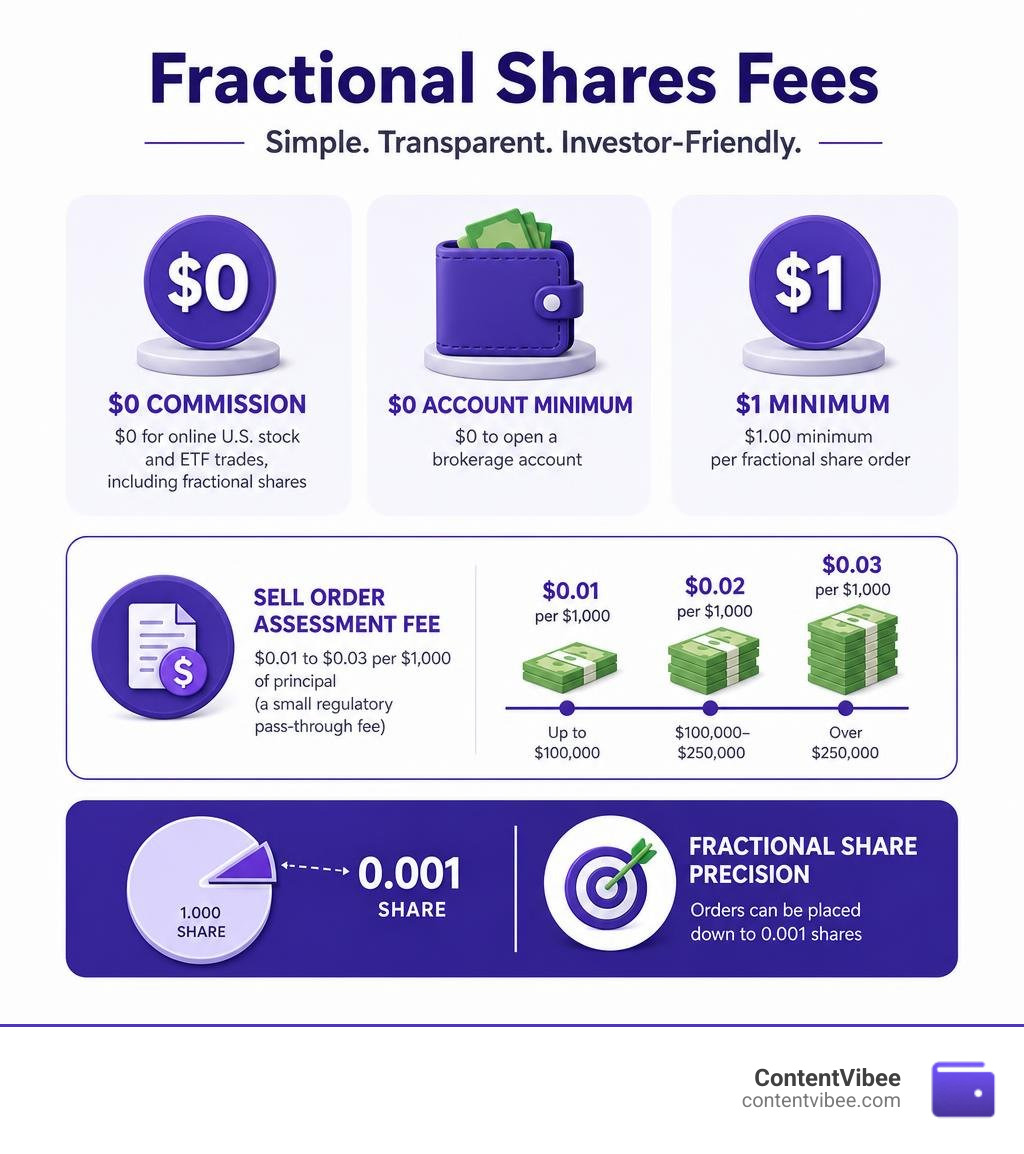
Fidelity fractional shares fees are, in short, $0 for online trades. There are no commissions, no account minimums, and no extra charge just because you’re buying a slice instead of a whole share. Here’s the quick breakdown:
- Trading commission: $0 for online U.S. stock and ETF trades, including fractional shares
- Account minimum: $0 to open a Fidelity brokerage account
- Minimum transaction: $1.00 per fractional share order
- Sell order assessment fee: $0.01 to $0.03 per $1,000 of principal (a small regulatory pass-through fee)
- Fractional share precision: Orders can be placed down to 0.001 shares
So if you want to invest $10 in a stock trading at $500 per share, Fidelity lets you do it — with no extra cost beyond that tiny regulatory fee on sells.
But here’s where it gets a little more nuanced.
Zero commissions doesn’t mean zero considerations. Fractional shares come with rules around transfers, corporate actions, and tax reporting that every investor should understand before diving in — especially if you’re building toward retirement and want no surprises later.
This guide walks you through exactly what it costs to trade stock slices at Fidelity, what the fine print says, and how to use fractional shares the smart way.
When we look at the landscape of modern retail investing in July 2026, the barrier to entry has never been lower. Historically, if you wanted to buy a stock like Amazon, Alphabet, or any high-priced exchange-traded fund (ETF), you had to save up enough cash to purchase at least one full share. Today, fractional share trading—or what Fidelity calls “stock slices”—allows you to buy a portion of a share based on the exact dollar amount you want to invest.
The most common question we get here at ContentVibee is whether this convenience comes with a hidden catch. Do you pay more in fees when you trade in slices?
To answer this simply: No, trading fractional shares online at Fidelity does not cost anything extra in commissions. Whether you buy 100 shares of a company or 0.001 shares of a company, the online commission rate is a flat $0.00.
Furthermore, you don’t have to worry about monthly maintenance fees or account setup charges. Fidelity has structured its retail brokerage accounts with:
- $0 Account Fees: No annual fees or inactivity fees to keep your account open.
- $0 Minimum Balance: You can open an account with a $0 balance and fund it only when you are ready to invest.
- $0 Online Commissions: $0.00 per trade for online U.S. stock, ETF, and options trades (though options contracts still carry a $0.65 per-contract fee).
For a complete and highly detailed breakdown of their charges, you can review the official Fidelity Brokerage and Commission Fee Schedule | Trading information.
By keeping account minimums and trading costs at zero, retail investors can use dollar-based investing to build a diversified portfolio gradually. This is a massive win for those who want to practice dollar-cost averaging without seeing their principal eaten away by transaction costs.
Are There Hidden Fidelity Fractional Shares Fees on Sell Orders?
While online buy orders are completely free of commissions, there is a tiny, easily overlooked cost when you sell your fractional shares. This is not a fee designed by Fidelity to make a quick buck; rather, it is a standard regulatory pass-through fee.
Whenever you sell an equity security (including stocks, ETFs, and fractional shares) on any U.S. exchange, the transaction is subject to an Activity Assessment Fee (often referred to as an SEC fee or Section 31 fee). This fee is charged by the Securities and Exchange Commission and self-regulatory organizations to cover the costs of supervising and regulating the securities markets.
Fidelity passes this regulatory transaction fee directly to the client. The fee typically amounts to:
- $0.01 to $0.03 per $1,000 of principal (the total value of your sell order).
For example, if you sell a fractional share position worth $100, the assessment fee will be less than a single penny. Because fractional pennies are rounded up, you might see a one-cent deduction on your trade confirmation. If you sell a larger position worth $10,000, the fee will only be about $0.10 to $0.30.
While it is practically negligible for small-scale investors, we believe in complete transparency. You can read more about how these regulatory fees are assessed and calculated on the Straightforward and Transparent Pricing – Fidelity page.
Additionally, if you place your trades through an automated telephone system (FAST), it will cost $12.95 per trade. If you use a live representative over the phone to execute your trade, you will be charged a steep $32.95 representative-assisted fee. To keep your fidelity fractional shares fees at exactly $0, always place your orders online or through the mobile app!
How Do Fidelity Fractional Shares Fees Compare to Industry Averages?
To truly appreciate the value of Fidelity’s fractional share program, it helps to look at how they stack up against other major brokerages. While many firms have adopted $0 commissions, the rules around fractional share trading minimums, asset availability, and margin rates vary wildly.
Here is a side-by-side comparison of how Fidelity compares to other prominent retail brokers in July 2026:
| Feature / Fee | Fidelity | Charles Schwab | Vanguard | Interactive Brokers (IBKR Lite) |
|---|---|---|---|---|
| Online Commission | $0.00 | $0.00 | $0.00 | $0.00 |
| Fractional Minimum | $1.00 | $5.00 | $1.00 | $1.00 |
| Eligible Securities | 7,000+ U.S. Stocks & ETFs | S&P 500 Stocks Only | ETFs Only | Eligible U.S./European Stocks & ETFs |
| Fractional Precision | 3 decimal places (0.001) | 4 decimal places (0.0001) | 3 decimal places (0.001) | Up to 4 decimal places |
| Lowest Margin Rate | 7.50% | 10.075% | 10.00% | Competitive tiered rates |
| Zero-Expense Funds | Yes (Fidelity ZERO Funds) | No | No | No |
As the table shows, Fidelity holds a distinct advantage in several areas:
- Transaction Minimums: Fidelity allows you to buy fractional shares with as little as $1.00, whereas Charles Schwab’s “Stock Slices” program requires a $5.00 minimum per transaction.
- Security Selection: Fidelity offers fractional trading on over 7,000 U.S. stocks and ETFs. Schwab limits fractional trading strictly to stocks within the S&P 500 index, meaning you cannot buy fractional shares of mid-cap stocks, small-cap stocks, or ETFs. Vanguard limits fractional trading strictly to Vanguard-branded ETFs.
- Margin Rates: For investors who utilize leverage, Fidelity’s lowest published margin rate is highly competitive at 7.50%, compared to Schwab at 10.075% and Vanguard at 10.00%. (Note: Fidelity’s base margin rate is 10.575%, but they offer tiered discounts for larger balances).
- Execution Quality: Fidelity is known for its superior order routing technology. They calculate an average savings of $24.50 on a 1,000-share equity order compared to the industry average of $4.34 due to price improvement. Even on smaller fractional trades, this means you are highly likely to get the best possible market price.
To explore more about their margin structures and standard commission rates, check out the Trading Commissions and Margin Rates | Fidelity resource page.
How to Buy Fractional Shares on Fidelity: A Step-by-Step Guide
Now that we have demystified the fee structure, let’s look at the practical side of things. How do you actually execute a fractional share trade on Fidelity’s platform?
Fidelity has spent considerable resources redesigning its mobile app and web interface to make dollar-based investing as intuitive as possible. Whether you are using your desktop or your smartphone, the process is streamlined to help you dollar-cost average into your favorite assets.
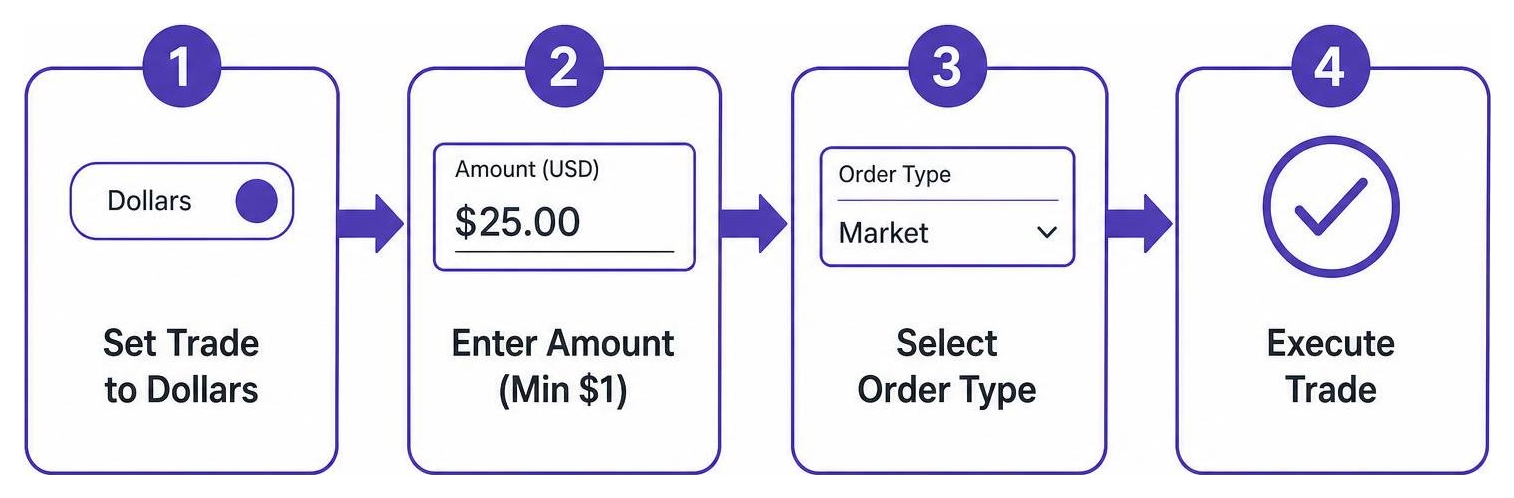
Here is a visual overview of how the trade flow works before we walk through the steps:
To learn more about the exact mechanics of stock slices, you can visit Fractional Shares | Invest in Stock Slices | Fidelity. Below is our step-by-step guide to getting up and running.
Step 1: Open and Fund Your Account
Before you can buy any stock slices, you need an active, funded account.
- Account Types: You can trade fractional shares in standard individual brokerage accounts, Joint accounts, Traditional IRAs, Roth IRAs, and even Fidelity Youth Accounts.
- What You Need: To open an account, you will need to provide standard personal information, including your full name, physical address, Social Security Number (SSN), date of birth, and email address. You will also answer a few brief questions about your financial situation and investment goals.
- Funding: Once your account is open, link a bank account to transfer funds. Because Fidelity has a $0 minimum deposit rule, you can transfer as little as $1.00 to start trading. That you must wait for your funds to settle (or use Fidelity’s “instant funding” feature for eligible accounts) before executing a trade.
Step 2: Navigate to the Trade Screen and Select Dollars
Once your account is funded, log into the Fidelity mobile app or desktop platform.
- Click on the “Trade” tab (usually represented by a dollar sign or a direct button in the main menu).
- Enter the ticker symbol or company name of the stock or ETF you wish to buy (e.g., AAPL for Apple or VOO for the Vanguard S&P 500 ETF).
- Look for the trade execution settings. By default, most brokerage accounts are set to trade in “Shares.”
- Crucial Step: Toggle or change this setting from “Shares” to “Dollars.” This action activates the fractional share trading engine.
Step 3: Execute Your Order
With “Dollars” selected, you can now customize your order.
- Enter the Amount: Input the exact dollar amount you want to invest. This can be any amount starting at $1.00, and you can enter it out to two decimal places (e.g., $10.50 or $100.00). Fidelity’s system will automatically calculate the share quantity out to three decimal places (0.001) once the order executes.
- Select Order Type: You can place either a Market Order or a Limit Order.
- Market Orders will execute immediately during regular market hours at the best available price.
- Limit Orders allow you to set a maximum price you are willing to pay per share, though they are only good for the day (“Day-Only” orders).
- Review and Submit: Click “Preview Order” to review the details, verify there are no unexpected commissions, and click “Submit.”
- Pro-Tip (Recurring Investments): If you want to make investing a habit, you can set your fractional trades on repeat. Fidelity allows you to set up automatic, recurring dollar-based investments on a weekly, bi-weekly, or monthly schedule.
Risks, Limitations, and Tax Impacts of Trading Stock Slices
While fractional share trading is an incredibly powerful tool for portfolio diversification, it does come with specific structural limitations and unique tax rules. Before you load up your portfolio with dozens of stock slices, we want to make sure you are fully aware of how these assets behave behind the scenes.
Non-Transferability and Liquidation Rules
One of the most critical limitations of fractional shares is their non-transferability.
If you decide to move your brokerage account from Fidelity to another financial institution in the future, you will likely use the Automated Customer Account Transfer Service (ACATS). While your whole shares will transfer over smoothly, fractional share positions cannot be transferred between brokerages.
Here is what happens if you initiate an account transfer:
- Fidelity will automatically liquidate (sell) any fractional share portions of your holdings.
- The cash proceeds from that liquidation will then be transferred to your new broker.
- The whole shares will transfer intact.
For example, if you own 10.5 shares of a stock, the 10 whole shares will transfer to your new broker, while the 0.5 fractional share will be sold at the prevailing market price, and the cash will be sent over.
Additionally, you cannot request physical stock certificates for fractional shares. Because fractional shares are held in “street name” and managed internally on Fidelity’s book-entry system, they only exist digitally within your account.
Dividends, DRIP, and Tax Reporting
How do dividends work when you only own a fraction of a share? Fortunately, Fidelity fully supports dividends for fractional shares, but there is a rounding catch.
- Proportional Payouts: If a company pays a dividend of $1.00 per share, and you own 0.5 shares, you will receive $0.50.
- Rounding Limit: Fidelity supports dividend payouts down to the nearest penny ($0.01). If your fractional share holding would generate a dividend of less than half a cent ($0.005), it rounds down to zero. If it is $0.005 or more, it rounds up to $0.01.
- Dividend Reinvestment Program (DRIP): You can set your account to automatically reinvest dividends back into the stock or ETF that paid them. This process naturally creates more fractional shares over time, compounding your wealth without incurring any transaction fees.
Tax Implications to Keep in Mind
From a tax perspective, the IRS treats fractional shares exactly like whole shares. When you sell a fractional share, it triggers a taxable event (capital gains or capital losses).
- Cost Basis Tracking: Fidelity automatically tracks your cost basis for fractional shares, which is highly convenient.
- Taxable Liquidation: Because transferring your account forces the liquidation of fractional shares, that forced sale will trigger a capital gains tax liability for that tax year. If you have significant fractional positions, be prepared for a small tax bill upon liquidation.
- No Tax Advantage/Disadvantage: Outside of the forced liquidation rule, buying stock slices does not penalize you or benefit you on your Form 1099-B.
Frequently Asked Questions About Fidelity Fractional Shares
We have gathered some of the most common questions our readers ask about the mechanics and costs of trading stock slices at Fidelity.
What is the minimum investment for fractional shares at Fidelity?
The minimum transaction value for any fractional share trade at Fidelity is $1.00. You can enter your order as a dollar amount (e.g., $1.00 minimum, out to two decimal places) or as a share quantity (which can be entered out to three decimal places, i.e., 0.001 shares, as long as the total value of the order is at least $1.00).
Can I trade fractional shares after market hours?
You can place fractional share and dollar-based orders at any time—before, during, or after market hours. However, fractional share orders only execute during regular market hours (9:30 a.m. to 4:00 p.m. Eastern Time).
If you submit a dollar-based order overnight or over the weekend, it will be held and executed as a day-only order once the market opens on the next business day. Because of this, dollar-based orders are marked as “Not Held” orders, which gives Fidelity’s trading desk time and price discretion to execute the order safely during market hours.
Which stocks and ETFs are eligible for fractional trading?
Fidelity offers fractional share trading for over 7,000 U.S. stocks and ETFs. To be eligible, the security must be an NMS (National Market System) exchange-listed stock or ETF traded on major exchanges like the New York Stock Exchange (NYSE) or Nasdaq.
Please note that foreign stocks, over-the-counter (OTC) “penny” stocks, mutual funds, and certain low-liquidity equities are not eligible for fractional share trading. The list of eligible securities is subject to change based on market conditions and liquidity.
Conclusion
Fidelity makes it incredibly easy and cost-effective to build a diversified portfolio. With fidelity fractional shares fees sitting at a clean $0 for online trades, zero account minimums, and a tiny $1.00 transaction threshold, there are virtually no cost-related barriers preventing you from owning a piece of the world’s most successful companies.
While you must keep in mind minor limitations—such as the non-transferability of fractional slices and the tiny regulatory assessment fees on sell orders—the benefits of dollar-cost averaging and proportional dividend payouts far outweigh these structural rules.
At ContentVibee, our goal is to deliver straightforward, actionable money management advice to help you secure your financial future. Happy investing!

