


The TCJA Expiration Date: What Already Happened and What It Means Now
The TCJA expiration date was one of the most talked-about tax deadlines in recent memory — and if you’re wondering whether it already passed, the short answer is: yes, and no.
Here’s the quick version:
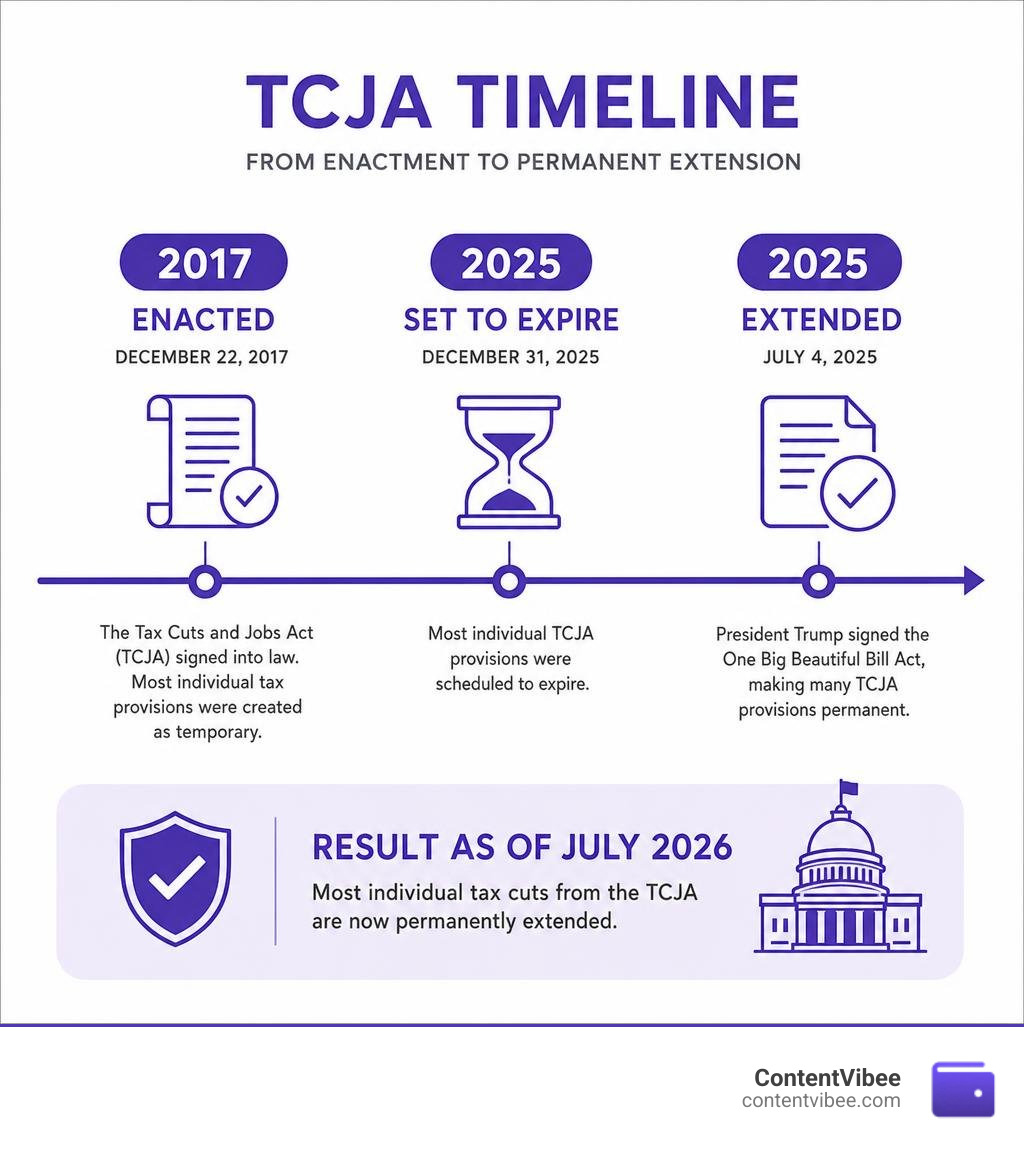
- Original expiration: Most individual Tax Cuts and Jobs Act (TCJA) provisions were set to expire on December 31, 2025
- What actually happened: President Trump signed the One Big Beautiful Bill Act on July 4, 2025, which made many of those provisions permanent before they could expire
- Result as of July 2026: Most individual tax cuts from the TCJA are now permanently extended, with some new additions and a few temporary provisions still set to phase out
So the “tax cliff” that millions of Americans feared? It was largely avoided — but the details matter a lot for your wallet.
The TCJA, formally known as P.L. 115-97, was signed into law on December 22, 2017. The New York Times called it “the most sweeping tax overhaul in decades.” It cut individual tax rates, nearly doubled the standard deduction, and doubled the child tax credit. But most of those individual changes were always meant to be temporary — built-in sunsets that Congress would eventually have to deal with.
That reckoning arrived in 2025.
Understanding the TCJA Expiration Date and the 2025 Tax Cliff
To understand why the TCJA expiration date caused so much panic, we have to look at how the law was structured. Back in 2017, Congress used a legislative process called budget reconciliation to pass the tax package. Under these rules, the bill could not add to the federal deficit beyond a 10-year window.
To meet these strict budget limits, lawmakers made a strategic choice: corporate tax cuts were made permanent, while almost all individual income tax provisions were given a hard “sunset” or expiration date of December 31, 2025.
If Congress had failed to act, we would have faced a massive “tax cliff” on January 1, 2026. Overnight, tax rates for about 160 million American filers would have jumped back to their pre-2018 levels. The standard deduction would have been cut in half, the Child Tax Credit would have shrunk, and the Alternative Minimum Tax (AMT) would have swept in to affect millions of middle-class families.
The Original TCJA Expiration Date for Individual Taxpayers
Under the original rules of the 2017 law, the clock was ticking down to December 31, 2025. Had those provisions expired, individual tax brackets would have reverted to pre-TCJA levels:
- The top marginal tax rate would have bounced from 37% back to 39.6%.
- The standard deduction would have plummeted, forcing millions of households to go back to itemizing their deductions.
- The personal exemption (which was zeroed out by the TCJA) would have returned at $4,150 per person, but without the larger standard deduction to support it.
- The Child Tax Credit (CTC) would have dropped from $2,000 per child to a mere $1,000.
For a detailed look at how these rules were originally laid out, you can explore the CRS Report on Expiring Provisions. This official legislative reference table details the exact pre- and post-TCJA tax parameters that kept financial planners awake at night.
How the One Big Beautiful Bill Act of 2025 Rewrote the TCJA Expiration Date
The ultimate deadline never arrived. On July 4, 2025, the legislative landscape shifted with the signing of H.R. 1, also known as the One Big Beautiful Bill Act (OBBBA) or the Working Families Tax Cut.
This sweeping package permanently extended most of the individual income tax brackets and the higher standard deduction introduced by the TCJA. However, it didn’t just copy and paste the old rules. It introduced entirely new elements to the tax code:
- No Tax on Tips and Overtime: A major structural change designed to support hourly and service-industry workers, phasing out at specific modified adjusted gross income (MAGI) thresholds.
- Trump Accounts: A brand-new savings vehicle for minors where the government provides a $1,000 contribution for babies born between 2025 and 2028, and employers can contribute up to $2,500 per year tax-free.
- Enhanced Deductions: A new $6,000 “Senior Bonus” deduction for taxpayers aged 65 and older.
For an in-depth economic analysis of how these changes interact with the broader federal budget, you can read the CRS Economic Issues Report, which tracks the transition from temporary relief to permanent policy.
Individual Tax Changes: Standard Deduction, SALT, and Credits
With the One Big Beautiful Bill Act now in full effect as of July 2026, the tax rules have changed significantly compared to both pre-2018 laws and the temporary TCJA rules.
Let’s look at how key individual tax parameters compare across the three eras:
| Tax Parameter | Pre-TCJA Rules (Pre-2018) | Temporary TCJA Rules (2018-2025) | New OBBBA Rules (2026 & Beyond) |
|---|---|---|---|
| Top Marginal Rate | 39.6% | 37% | 37% (Permanent) |
| Standard Deduction (Joint) | ~$12,700 (adjusted for inflation) | $29,200 (in 2024) | $31,500 (in 2025/2026) |
| Child Tax Credit | $1,000 per child | $2,000 per child | $2,200 per child (Permanent) |
| SALT Deduction Cap | Uncapped | $10,000 cap | $40,000 cap (Phases out above $600k MAGI) |
| Mortgage Interest Limit | $1,000,000 | $750,000 | $750,000 |
| Estate Tax Exemption | ~$5.49 million per person | ~$13.61 million per person | $15 million per person (in 2026) |
The Standard Deduction and the Senior Bonus
The TCJA nearly doubled the standard deduction, which simplified the filing process for over 90% of taxpayers. The 2025 legislation preserved this simplification. For the 2025 and 2026 tax years, the standard deduction stands at $15,750 for single filers, $23,625 for heads of household, and $31,500 for married couples filing jointly.
Additionally, we now have a bonus deduction of $6,000 per person for taxpayers aged 65 and older, raising the total standard deduction for an eligible senior couple to $43,500.
The SALT Cap Relief
One of the most controversial elements of the 2017 TCJA was the $10,000 cap on the State and Local Tax (SALT) deduction. This cap heavily impacted middle- and high-income families living in high-tax states like New York, California, and New Jersey.
The OBBBA provided relief by raising the SALT deduction cap to $40,000 for married couples filing jointly ($20,000 for married filing separately). However, to offset the cost, this higher cap phases out entirely for joint filers with a MAGI over $600,000.
Child Tax Credits and Estate Taxes
The Child Tax Credit has been permanently increased to $2,200 per qualifying child, up from the TCJA’s $2,000. On the high-net-worth side, the estate and gift tax lifetime exemption — which was set to drop back to around $7 million — has been boosted to a permanent $15 million per person ($30 million for married couples) starting in 2026, allowing families to structure their long-term wealth transfers with greater certainty.
Business and Corporate Tax Implications under Section 199A

While individual taxpayers received a major update in 2025, business owners must navigate a unique mix of permanent, phasing-out, and newly modified provisions.
The Section 199A Pass-Through Deduction
One of the most critical business provisions of the TCJA was the Section 199A deduction, which allowed eligible sole proprietorships, partnerships, and S-corporations to deduct up to 20% of their Qualified Business Income (QBI). Because this was an individual-side tax provision, it was originally tied to the December 31, 2025 TCJA expiration date.
Under the 2025 legislation, the 199A QBI deduction has been permanently extended. This is a major victory for small business owners, who would have otherwise faced a significant tax increase.
Corporate Tax Rates and Expensing Rules
The corporate tax rate remains at a flat 21%. Unlike individual provisions, this rate was made permanent in the original 2017 legislation and was not threatened by the 2025 sunset.
However, other business provisions have followed a different path:
- Bonus Depreciation: The 100% immediate expensing for business equipment has been phasing down (dropping to 80% in 2023, and continuing its downward trajectory). Businesses must plan capital expenditures carefully as this benefit becomes less generous.
- R&D Amortization: The 2017 TCJA required businesses to amortize research and development expenses over five years rather than deducting them immediately. The 2025 law restored immediate expensing for domestic R&D expenditures paid after December 31, 2024, providing a significant incentive for US-based innovation.
- International Provisions: Key international frameworks designed to prevent base erosion — such as GILTI, FDII, and BEAT — are seeing automatic rate adjustments. For example, the GILTI tax rate is scheduled to increase from 10.5% to 13.125%, and the FDII rate will rise to 16.4%, unless further legislative actions modify them.
For a retrospective on how these business rules have evolved since their inception, you can read the analysis on the 7th Anniversary of TCJA.
Budgetary Costs and Economic Impacts of the Tax Extensions
Making the TCJA provisions permanent alongside new tax cuts comes with a substantial federal price tag. Understanding these numbers is essential for grasping the broader economic picture.
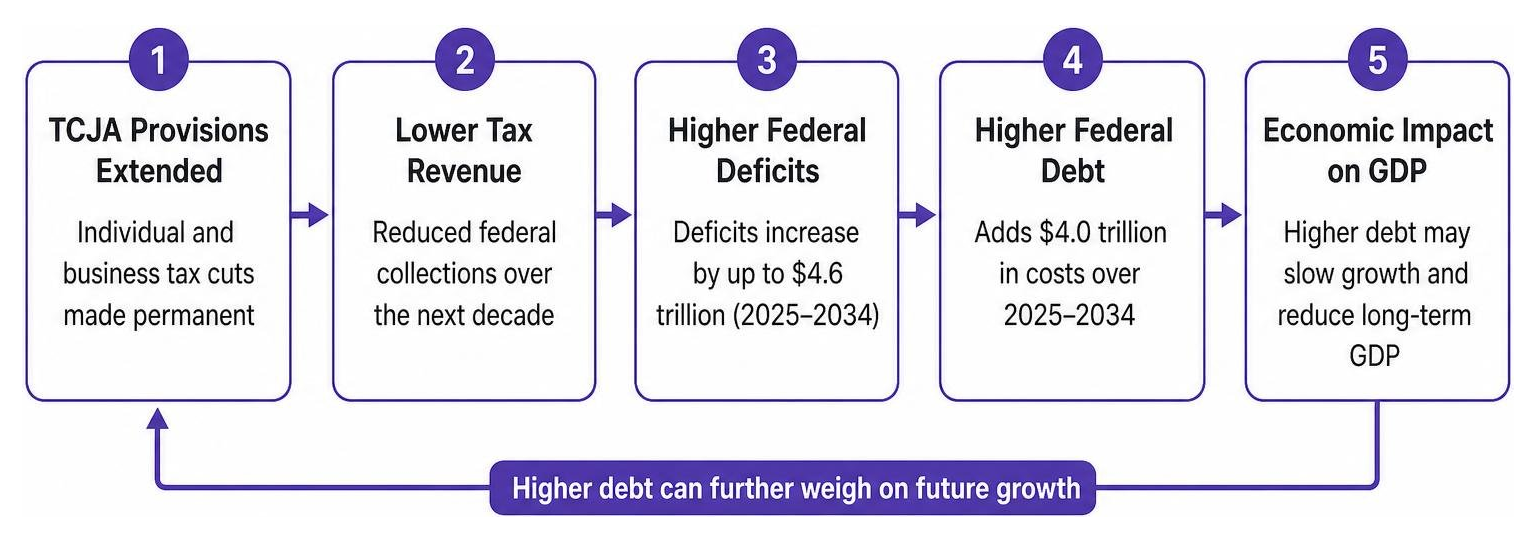
According to estimates from the Congressional Budget Office (CBO) and the Joint Committee on Taxation (JCT):
- The Cost of Extensions: Extending all expiring TCJA provisions through the 2025-2034 budget window is projected to cost $4.0 trillion.
- The Original Estimates: At the time of the TCJA’s passage in 2017, the JCT estimated the law would cost $1.5 trillion over its first ten years (FY2018-FY2027). The actual long-term fiscal impact has proved to be much larger.
- Deficit Projections: The CBO estimates that permanently extending these tax cuts without matching spending cuts or revenue offsets could add up to $4.6 trillion to federal deficits over the next decade.
- Economic Growth vs. Inflation: Economists remain divided on the long-term impact. Supply-side models, such as those from the Tax Foundation, suggest the permanent extensions could boost long-run steady-state GDP by up to 1.1% by encouraging business investment. Conversely, demand-side analyses warn that injecting trillions of dollars of tax relief into the economy could worsen inflationary pressures and increase the cost of servicing the national debt.
Frequently Asked Questions about the TCJA Expiration
What was the original TCJA expiration date?
The original TCJA expiration date for almost all individual income tax provisions was December 31, 2025. This sunset clause was built into the original 2017 law to comply with Senate budget reconciliation rules, which prevent legislation from adding to the federal deficit beyond a 10-year window. Corporate tax provisions, including the flat 21% rate, did not have an expiration date.
How did the 2025 legislation change the standard deduction?
The One Big Beautiful Bill Act of 2025 permanently extended the higher standard deduction framework. For the 2025/2026 tax years, the standard deduction is set at $15,750 for single filers and $31,500 for married couples filing jointly. It also introduced a new $6,000 Senior Bonus deduction for taxpayers aged 65 and older, bringing their potential standard deduction to $21,750 (single) or $43,500 (married joint if both qualify).
Is the 21% corporate tax rate permanent?
Yes, the 21% corporate tax rate is permanent and was not subject to the 2025 sunset provisions. While there have been political proposals to adjust this rate — such as lowering it to 15% for domestic manufacturers — any changes would require new legislation to pass both houses of Congress.
Conclusion
The shifting timeline of the TCJA expiration date highlights the importance of proactive financial planning. While the “tax cliff” of 2025 was largely resolved by the One Big Beautiful Bill Act, tax laws are never entirely static. New vehicles like Trump Accounts, the expanded SALT cap, and the Senior Bonus deduction mean that your wealth management strategy should be reviewed regularly.
At ContentVibee, we believe that understanding the tax code is the first step toward securing your financial future. Whether you are managing business income under Section 199A or planning your retirement distributions, keeping your plan aligned with current tax laws is essential for protecting your hard-earned wealth.
To learn more about optimizing your long-term financial strategy, explore our resources to understand how taxes can impact your retirement income and Social Security benefits.


