


What It Really Means to Roll a 403(b) Into an IRA
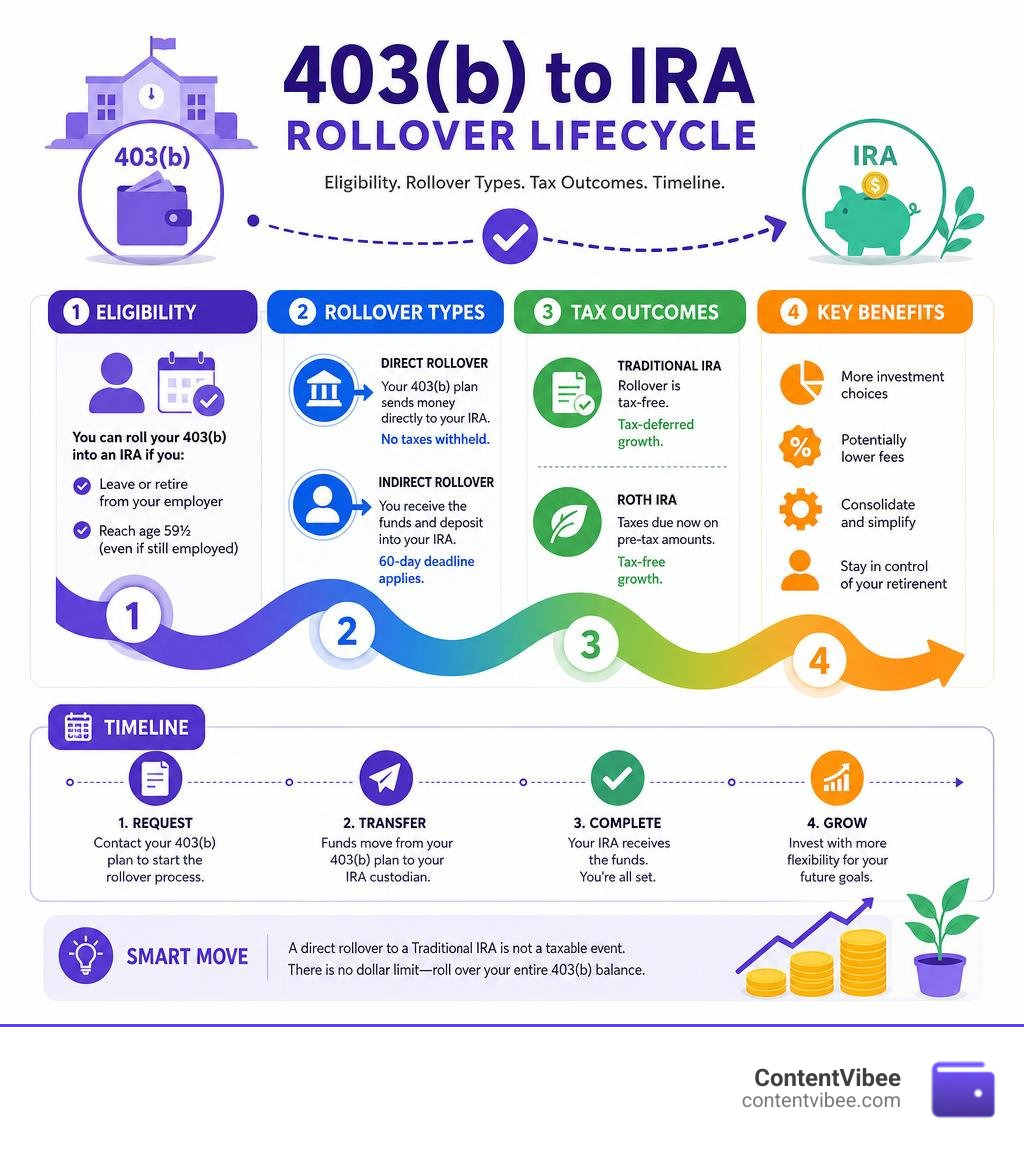
If you’re ready to roll a 403(b) into an IRA, here’s the short answer:
How it works at a glance:
- Choose your IRA type — Traditional IRA (tax-deferred) or Roth IRA (tax-free growth, but taxes due now on pre-tax funds)
- Request a direct rollover — Your 403(b) plan sends the money straight to your new IRA custodian
- No taxes withheld — A direct rollover to a Traditional IRA is not a taxable event
- No dollar limit — You can roll over your entire 403(b) balance; rollover amounts don’t count against annual IRA contribution limits
- Complete within 60 days — Only applies if you receive the funds yourself (indirect rollover); direct rollovers have no deadline
Changing jobs or retiring from a school, hospital, or nonprofit often means leaving a 403(b) plan behind. That account can feel like an afterthought — sitting at an old employer, invested in options you didn’t choose, and charging fees you barely notice.
But those fees and limitations add up fast. A $150,000 balance in a high-cost 403(b) annuity charging 0.90% in expenses costs around $1,350 a year. The same balance in a low-cost index fund at 0.05% costs just $75.
Rolling over to an IRA puts you in control — of your investments, your costs, and your retirement timeline.
This guide walks you through everything: the rules, the tax traps, the step-by-step process, and what to watch out for before you make the move.
Understanding the Basics: What Are 403(b) Plans and IRAs?
Before we dive into the logistics of how to roll a 403(b) into an IRA, let’s make sure we have our financial vocabulary straight. Think of these accounts as different types of vehicles designed to get you to the same destination: a comfortable, stress-free retirement.
What is a 403(b) Plan?
A 403(b) plan is a tax-advantaged retirement plan specifically designed for employees of public schools, universities, hospitals, and certain 501(c)(3) tax-exempt nonprofit organizations. If you are a teacher, nurse, professor, or charity worker, this is likely the plan you’ve been contributing to.
Historically, 403(b) plans allow you to build up retirement savings directly from your paycheck. For the current 2026 tax year, the IRS allows you to contribute up to $24,500 of your pre-tax salary into your 403(b). If you are lucky enough to have an employer who matches your contributions, the maximum combined limit (your contributions plus employer contributions) is a generous $72,000 in 2026.
What is an IRA?
An Individual Retirement Account (IRA) is an account you open on your own with a brokerage firm, bank, or investment platform. Unlike an employer-sponsored plan, you are completely in the driver’s seat.
There are several types of IRAs, each serving a unique purpose:
- Traditional IRA: Contributions are often tax-deductible, and your investments grow tax-deferred. You only pay taxes when you withdraw the money in retirement.
- Roth IRA: You contribute after-tax dollars, meaning you don’t get a tax break today. However, your money grows entirely tax-free, and qualified withdrawals in retirement are also 100% tax-free. To maximize this option, check out The Ultimate Guide To Your 2026 Max Roth Ira Contribution.
- SEP IRA & SIMPLE IRA: These are specialized IRAs designed for small business owners and self-employed individuals.
For the 2026 tax year, the annual IRA contribution limit is $8,000, with an additional $1,100 catch-up contribution allowed for those aged 50 and older.
While these annual limits are much lower than a 403(b), here is the golden rule of rollovers: Rollover balances do not count toward your annual contribution limits. If you have $200,000 in an old 403(b), you can move the entire amount into an IRA in one go without worrying about the $8,000 limit.
Why You Should Roll 403b Into IRA Accounts
If your 403(b) is already sitting quietly and growing, why should you go through the effort to roll a 403(b) into an IRA?
The truth is, leaving your money in an old employer’s plan is often like leaving your favorite winter coat at an ex-partner’s house. It’s safe, but you have no control over it, and accessing it can be a hassle.
By utilizing Smart Strategies To Defer Taxes And Boost Your Retirement Savings, consolidating your old accounts into a single IRA gives you a unified view of your financial future.
The Benefits of More Investment Choices
Most employer-sponsored 403(b) plans offer a very limited menu of investment options—often just a handful of mutual funds or expensive variable annuities hand-selected by the employer.
When you roll your funds into an IRA, the entire investment universe opens up. You can invest in:
- Individual stocks
- Exchange-Traded Funds (ETFs)
- Low-cost index funds
- Real estate investment trusts (REITs)
This freedom allows you to build a highly customized, diversified portfolio. For example, low-cost index funds from major providers have an incredible track record; 83% of Vanguard funds outperformed their peer-group averages over the last 10 years.
To see which accounts can legally be combined, you can consult the official IRS Rollover Chart.
How to roll 403b into ira to Avoid High Fees
Perhaps the most compelling reason to roll over is fee reduction. Many school districts and nonprofit 403(b) plans are notoriously stuffed with high-cost annuity contracts.
These annuities often carry:
- Administrative fees: Ongoing charges just to keep the account open.
- High expense ratios: Annual fees charged by mutual funds, sometimes exceeding 1% to 2%.
- Surrender charges: Steep penalties (often starting around 7% to 8% and lasting up to 11 years) if you try to move your money out of a specific annuity contract.
If you aren’t careful, these hidden costs will quietly eat away at your nest egg. By moving your money to a self-directed IRA with a low-cost custodian, you can eliminate these unnecessary layers of fees and keep more of your hard-earned money working for you.
The Rules and Tax Implications of a 403(b) Rollover
Before making any moves, we must look at how Uncle Sam views the transfer. If you follow the rules, rolling over is entirely tax-free. If you make a mistake, you could trigger a massive, unexpected tax bill.
| Rollover Source | Destination Account | Tax Consequence |
|---|---|---|
| Traditional 403(b) (Pre-Tax) | Traditional IRA | Tax-Free: Money remains tax-deferred; no immediate tax bill. |
| Traditional 403(b) (Pre-Tax) | Roth IRA | Taxable Conversion: You must pay ordinary income tax on the entire converted amount. |
| Roth 403(b) (After-Tax) | Roth IRA | Tax-Free: Money moves from one Roth account to another; no tax due. |
If you are considering moving pre-tax funds into a Roth account, read our breakdown on how to navigate this process smoothly: Can You Move Your 403B To A Roth Ira.
Direct vs. Indirect Rollovers
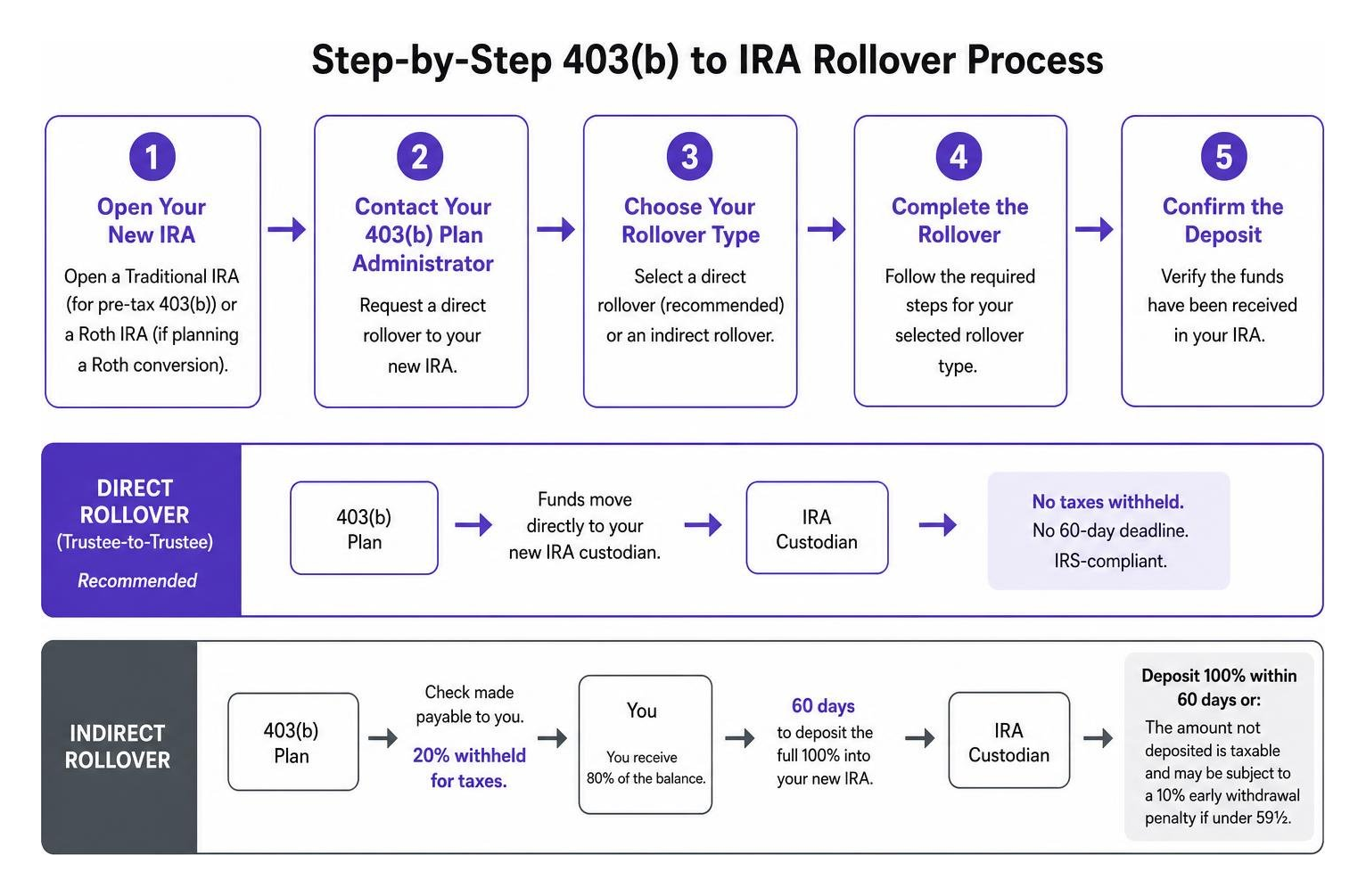
When you decide to roll a 403(b) into an IRA, you have two pathways: the easy, safe way (Direct) and the stressful, risky way (Indirect).
1. Direct Rollover (Trustee-to-Trustee)
With a direct rollover, the money moves directly from your old 403(b) provider to your new IRA custodian. Sometimes, the old provider will mail a physical check, but it will be made out directly to your new custodian (e.g., “Fidelity Management Trust Co. FBO [Your Name]”).
This is the gold standard. No taxes are withheld, the IRS is happy, and you don’t have to worry about deadlines.
2. Indirect Rollover
In an indirect rollover, the 403(b) provider cuts a check made out directly to you. By law, the administrator must withhold 20% of your balance for federal income taxes.
You then have exactly 60 days from the date of receipt to deposit the entire 100% of the original balance into your new IRA. To do this, you must use your own personal savings to make up for the 20% that was withheld. If you fail to deposit the full amount within 60 days, the missing money is treated as a taxable distribution and could be subject to a 10% early withdrawal penalty if you are under age 59½.
To understand the timing rules of leaving a job and moving your accounts, check out our guide on How Long Do You Have To Rollover A 401K After Quitting.
Rules to roll 403b into ira While Still Employed
Can you roll over your funds if you are still working for the employer who sponsors your 403(b)?
Generally, you can only roll over your account after you leave the employer (due to quitting, retiring, or termination). However, some plans allow for what is called an in-service distribution.
To qualify for an in-service rollover, you typically must:
- Reach age 59½.
- Meet specific vesting requirements.
- Have a plan document that explicitly permits in-service transfers.
Be sure to consult our 403B Rollover Guide Master Your Retirement Account Move to see if your current plan allows you to make a move while still on the payroll.
Step-by-Step Guide to Executing Your Rollover
Ready to take action? We’ve simplified the rollover process into five clear, manageable steps.
Step 1: Open Your New IRA
If you don’t already have an IRA, you need to open one with a reputable financial institution or online brokerage. Make sure you match the tax status of your accounts: if your 403(b) is pre-tax, open a Traditional IRA. If you are planning a Roth conversion, open a Roth IRA.
Step 2: Contact Your 403(b) Plan Administrator
Reach out to the HR department or the financial institution that manages your old 403(b) plan. Let them know you want to initiate a direct rollover to an IRA.
Step 3: Request a Direct Transfer (and Watch Out for Surrender Fees)
Explicitly ask for a trustee-to-trustee direct transfer. Ask the administrator if your funds are currently held in mutual funds or annuity contracts. If they are in annuities, ask for a written statement detailing any potential surrender charges or exit fees. If the surrender fee is high, you may want to wait until the penalty window expires.
Step 4: Complete the Paperwork
Your old administrator will provide distribution forms. Fill these out carefully. You will need to provide your new IRA account number and the exact mailing address of your new custodian. Once processed, the old custodian will issue a Form 1099-R in the following tax year to report the distribution to the IRS (which will show up as a non-taxable rollover if done correctly).
For those converting to a Roth account, you can find a comprehensive walkthrough here: The Ultimate Guide To Converting Your 403B To A Roth Ira.
Step 5: Deposit and Invest Your Funds
Once the funds arrive in your new IRA, don’t let them sit there as cash! Log into your new account, review your asset allocation, and purchase the low-cost index funds, ETFs, or stocks that align with your long-term retirement goals.
Frequently Asked Questions About 403(b) to IRA Rollovers
Navigating retirement rules can feel like reading a foreign language. Here are answers to the most common questions we hear.
What are the RMD rules for a rolled-over IRA in 2026?
Required Minimum Distributions (RMDs) are the government’s way of making sure you eventually pay taxes on your tax-deferred retirement savings. In 2026, the RMD age is 73.
If you leave your money in a traditional 403(b) or a traditional IRA, you must start taking annual withdrawals once you hit age 73. If you fail to take your RMD, the IRS imposes a steep 25% penalty on the amount that should have been withdrawn (which can be reduced to 10% if corrected quickly).
Note: Roth IRAs do not have RMDs during the owner’s lifetime, making them highly attractive for long-term wealth preservation.
What happens to my 403(b) loan if I roll over my account?
If you have an outstanding loan against your 403(b) and you leave your employer, you cannot roll that loan over into an IRA.
You generally have two choices:
- Repay the loan balance in full before initiating the rollover.
- Treat the outstanding loan as a taxable distribution (called a plan loan offset). This means the remaining loan balance will be taxed as ordinary income and may face a 10% early withdrawal penalty.
Are there any alternatives to rolling over my 403(b)?
Yes, you aren’t forced to roll your money into an IRA. Your other options include:
- Leave the money where it is: If your old plan has low fees and great investment options, you can leave it alone (provided your balance is above the plan’s minimum threshold, usually $7,000).
- Roll it into a new employer’s plan: If your new employer offers a high-quality 401(k) or 403(b) that accepts rollovers, you can consolidate your funds there.
- Cash out: You can withdraw the cash. However, we highly discourage this. If you are under 59½, you will lose a massive chunk of your savings to immediate income taxes and a 10% penalty.
Creative Alternative: If you are looking for advanced ways to fund a Roth account, you might want to look into the 2026 Backdoor Roth Guide Dodging The Pro Rata Tax Trap or explore unique avenues like The Ultimate Guide To Moving Unused College Funds To A Roth Ira.
Conclusion
Breaking up with an employer doesn’t have to mean breaking up with your retirement momentum. Deciding to roll a 403(b) into an IRA is one of the most proactive steps you can take to lower your investment fees, clear away account clutter, and secure your financial freedom.
At ContentVibee, we believe that managing your money shouldn’t require a finance degree. By taking control of your old accounts today, you are paving the way for a simpler, wealthier tomorrow.
If you’re planning your retirement with a partner, don’t forget to look at the bigger picture—take a moment to Calculate Spouse Retirement Benefits so you can maximize your joint income and enjoy your golden years to the absolute fullest!


