

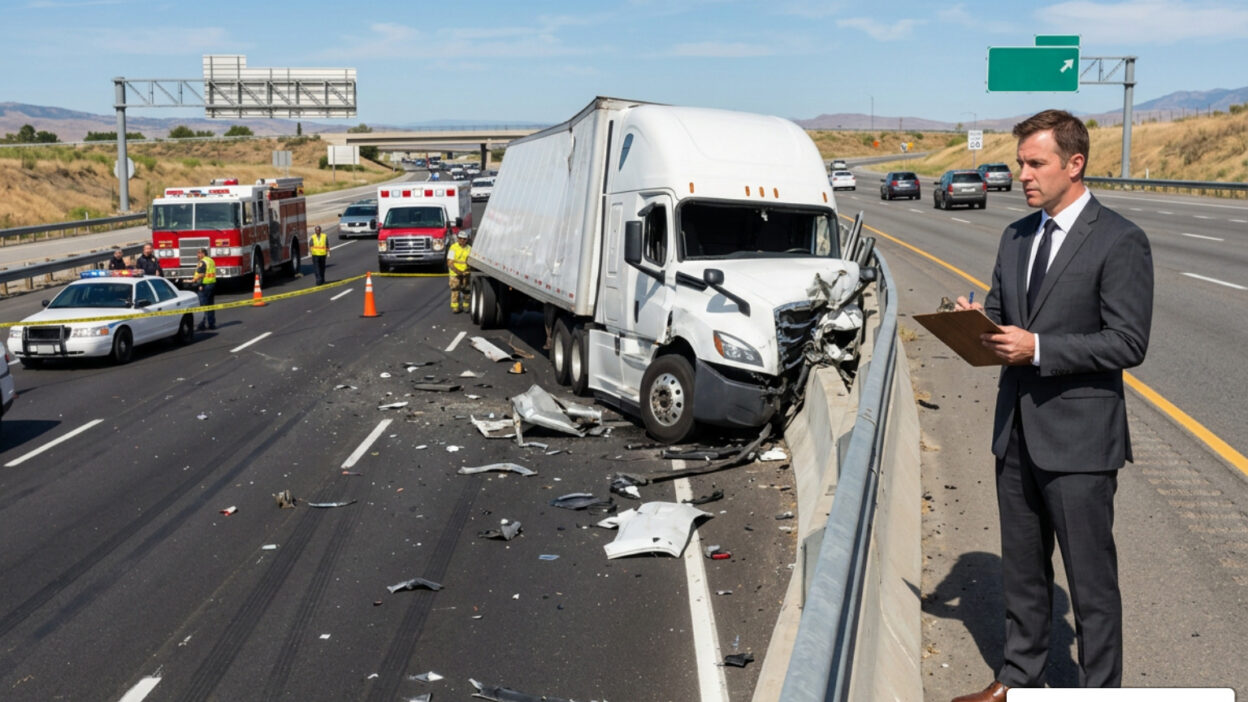
Why Finding the Best Truck Accident Attorney Matters
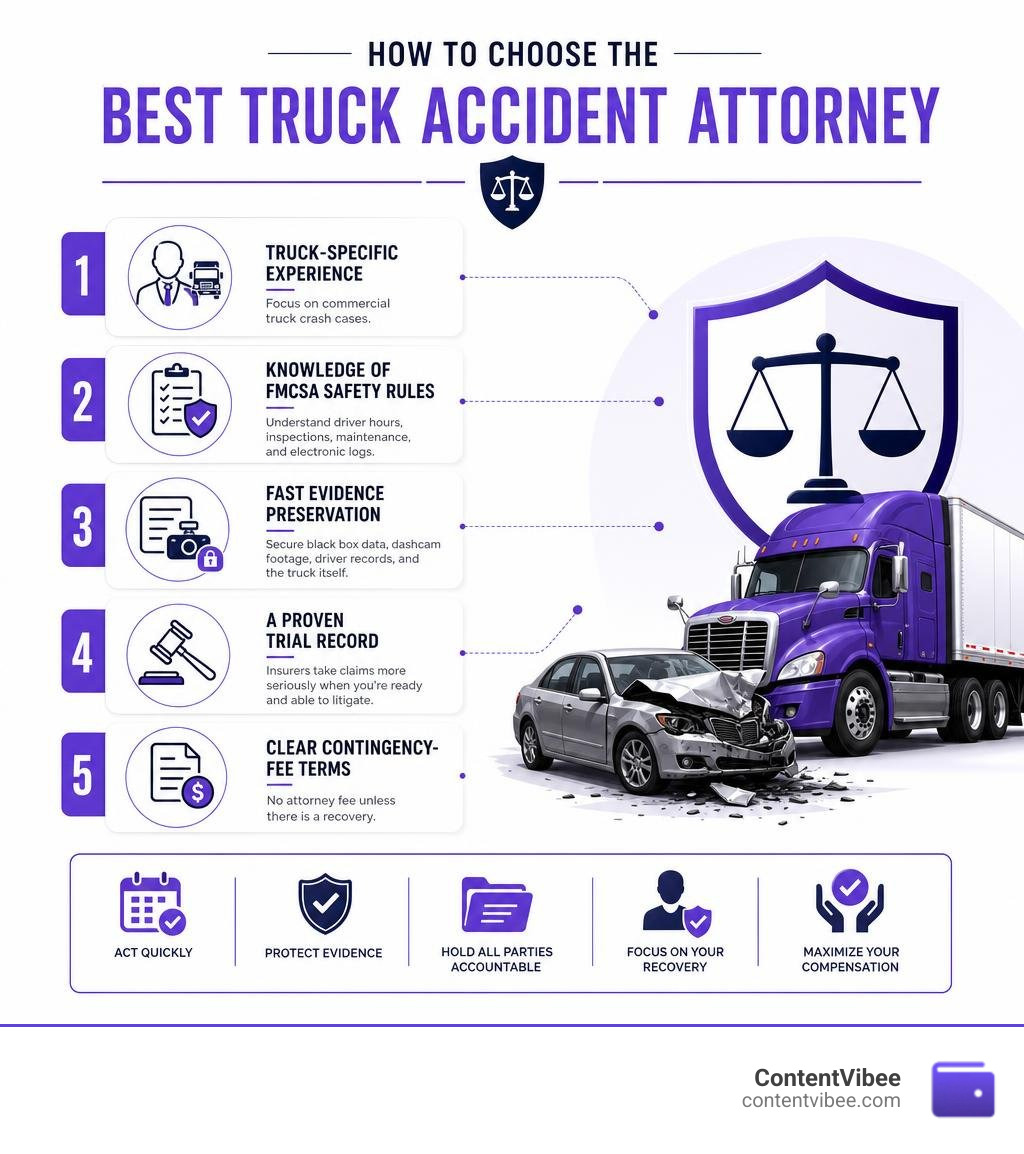
The best truck accident attorney is a lawyer who focuses on commercial truck crashes, understands federal trucking rules, acts quickly to preserve evidence, and has the resources to take a case to trial when needed.
Look for these basics first:
- Truck-specific experience – not only general car accident cases.
- Knowledge of FMCSA safety rules – including driver hours, inspections, maintenance, and electronic logs.
- Fast evidence preservation – such as black box data, dashcam footage, driver records, and the truck itself.
- A proven trial record – insurers often evaluate claims differently when a firm is ready and able to litigate.
- Clear contingency-fee terms – usually no attorney fee unless there is a recovery.
A crash involving an 18-wheeler, delivery truck, or other commercial vehicle is rarely a simple insurance claim. The vehicles are heavier, the injuries can be life-changing, and responsibility may extend beyond the driver to the trucking company, freight broker, cargo loader, maintenance provider, or manufacturer.
Just as important, critical records can disappear quickly. Trucking companies may repair vehicles, overwrite data, or follow short record-retention schedules. Prompt medical care, a police report, photographs, witness information, and early legal guidance can help protect your claim while you focus on recovery.
How Commercial Truck Accidents Differ From Standard Car Crashes
At ContentVibee, we often emphasize that commercial truck collisions are not simply magnified car crashes. A fully loaded semi-truck can weigh up to 80,000 pounds, whereas a standard passenger car weighs around 3,000 to 4,000 pounds. When these two collide, physics alone dictates that occupants in smaller passenger vehicles suffer the brunt of the impact.
Beyond the sheer physical forces involved, the legal and regulatory landscape of commercial trucking operates under completely different rules. Standard traffic laws govern commuter cars, but interstate commercial motor vehicles are subject to strict oversight from federal agencies.

The table below highlights how passenger car crashes contrast with commercial truck collisions:
| Feature | Standard Car Accident | Commercial Truck Accident |
|---|---|---|
| Governing Rules | State motor vehicle traffic codes | Title 49 CFR (FMCSA) & state regulations |
| Potentially Liable Parties | Usually the driver or car owner | Driver, motor carrier, broker, cargo loader, manufacturer |
| Primary Digital Evidence | Dashcams, optional telematics, cell phones | ECM “Black Box”, ELD logs, fleet telematics, cab cameras |
| Insurance Limits | Standard state minimum policy limits | Commercial policy limits often $750,000 to $5,000,000+ |
| Evidence Retention | Minimal regulatory deletion deadlines | Logbooks kept 6 months by default unless legally preserved |
Federal Regulations and Industry Standards
Commercial trucking companies must follow federal rules under Title 49 of the Code of Federal Regulations (49 CFR), enforced by the Federal Motor Carrier Safety Administration (FMCSA). These regulations set standards for:
- Hours of Service (HOS): Rules dictating strict driving limits and mandatory rest breaks to prevent fatigued driving.
- Electronic Logging Devices (ELDs): Digital hardware installed in commercial trucks to log driving hours automatically.
- Driver Qualifications: Medical evaluations, mandatory drug and alcohol screenings, and driving history checks.
- Vehicle Inspections and Maintenance: Systematic requirements for inspecting brakes, tires, and lighting systems.
When an attorney evaluates a truck crash, establishing that the motor carrier or driver violated these federal standards provides strong evidence of negligence.
Multiple Liable Entities in Commercial Crashes
In a typical car collision, liability usually rests on one or both drivers. In commercial truck litigation, accountability often extends to several parties:
- The Truck Driver: For reckless driving, fatigue, speeding, or driving while impaired/distracted.
- The Motor Carrier (Trucking Company): For negligent hiring, demanding unsafe delivery timelines, or poor vehicle maintenance.
- Freight Brokers and Shippers: For hiring unsafe or unfit trucking companies to transport goods.
- Cargo Loading Companies: For improperly loading, balancing, or securing cargo, leading to roll-overs or jackknife crashes.
- Equipment Manufacturers: For defective mechanical components, such as faulty brake assemblies or tire blowouts.
Navigating these overlapping relationships requires deep regulatory knowledge. Victims seeking counsel in major metropolitan hubs often work with dedicated regional firms, such as a Miami Truck Accident Lawyer | Zayed Law Offices, to unearth multi-party liability networks.
Key Qualifications of the Best Truck Accident Attorney
Selecting the best truck accident attorney requires evaluating specialized credentials rather than relying solely on billboards or general legal advertising. Because commercial trucking litigation is highly technical, top-tier attorneys maintain focused qualifications, trial readiness, and national legal resources.
What to Look for in the Best Truck Accident Attorney
When researching legal counsel, we recommend asking specific questions about industry credentials:
- Board Certification in Truck Accident Law: The National Board of Trial Advocacy (NBTA) offers specialized board certification in Truck Accident Law. Less than 1% of attorneys in the United States hold this distinction, which requires rigorous testing, extensive trial experience, and proof of legal mastery in commercial vehicle litigation.
- Commercial Driver Credentials (Class-A CDL): Some premier attorneys possess a Class-A Commercial Driver’s License or undergo commercial driving school. This hands-on training gives them technical knowledge of truck air brakes, pre-trip inspection standards, and real-world vehicle dynamics.
- FMCSR Certification and Crash Training: Top attorneys undergo hundreds of hours of training on Federal Motor Carrier Safety Regulations, forensic crash reconstruction, and trauma medicine.
For instance, national leaders like Grant Lawson, Truck Accident Attorney | The Law Firm For Truck Safety combine NBTA board certification with specialized commercial driver training to analyze complex telematics and black box data effectively.
Industry Thought Leadership and Legal Authority
The most effective truck accident lawyers are recognized leaders who teach other attorneys how to handle commercial vehicle claims. These legal experts frequently:
- Author industry-standard legal treatises on motor carrier litigation.
- Educate trial lawyer associations and law enforcement on commercial vehicle crash reconstruction.
- Work closely with biomechanical engineers, accident reconstructionists, and heavy-vehicle mechanics.
- Maintain a dedicated practice where commercial truck cases account for the vast majority of their caseload, rather than treating them as routine personal injury claims.
Evidence Preservation and Proving Negligence Under FMCSA Rules
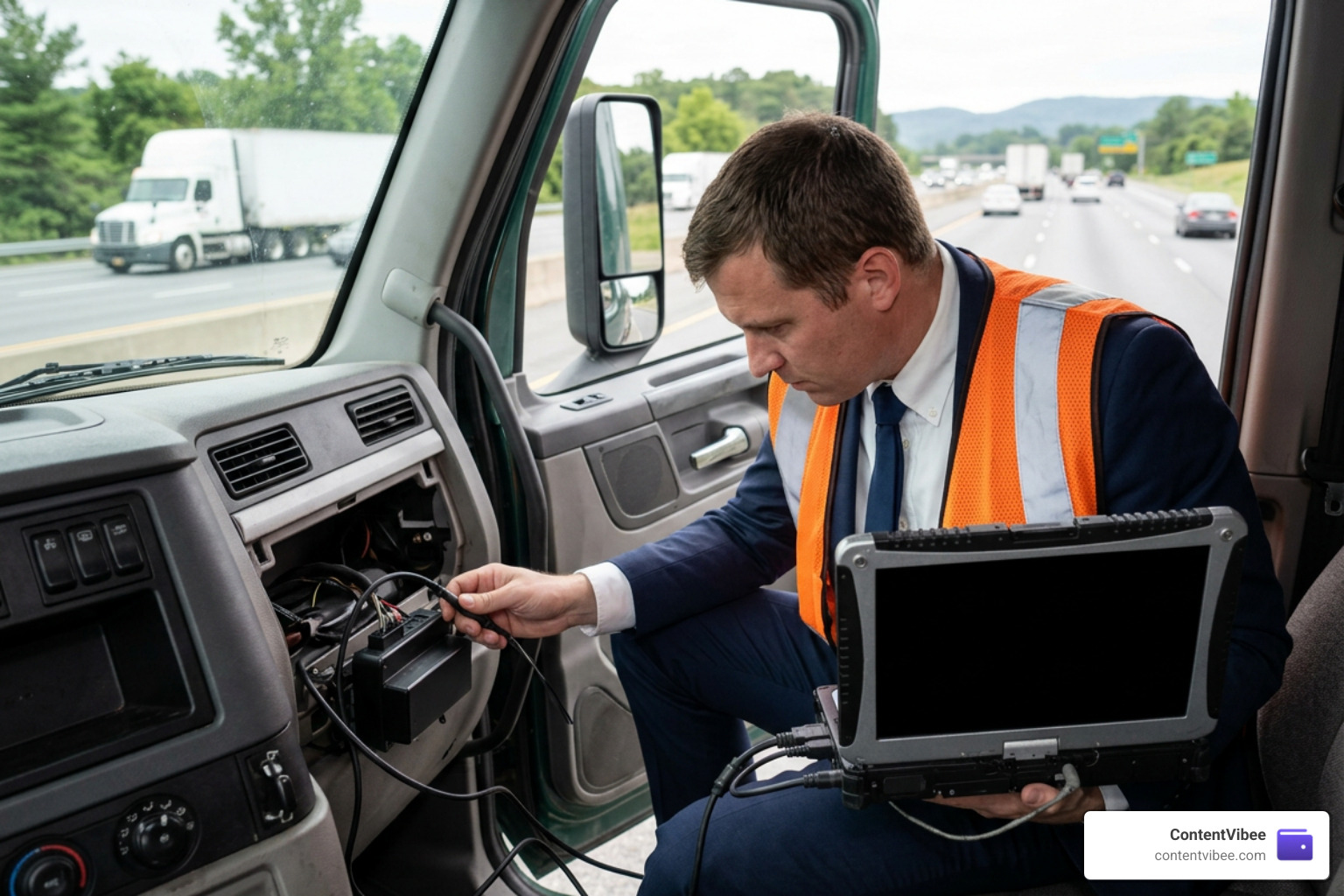
Proving fault in a commercial truck claim relies on physical and digital evidence. However, federal rules permit trucking companies to destroy certain routine records—such as driver logs—after just six months unless a formal legal preservation demand is issued.
Immediate Steps for Scene Evidence Retention
The moment a severe crash occurs, commercial insurers often send rapid-response defense teams to the scene. To prevent critical data from disappearing, your attorney must immediately issue formal spoliation letters. These legal notices command the carrier to preserve key evidence, including:
- Engine Control Module (ECM) Data: The truck’s “black box,” which records vehicle speed, brake application, throttle position, and engine RPM prior to impact.
- Electronic Logging Device (ELD) Records: Digital logs revealing driver hours, rest periods, and potential driving-time violations.
- Dashcam Footage and Telematics: Forward-facing or cab-facing video feeds alongside GPS tracking metrics.
- Maintenance and Inspection Records: Historical reports showing whether known brake failures, tire defects, or mechanical issues were ignored.
Experienced trial attorneys, including experts like Joseph V. Camerlengo | Board Certified Truck Accident Attorney , emphasize that acting within days of a collision is often the deciding factor in securing critical digital evidence before systems are overwritten.
Using FMCSA Violations to Demonstrate Liability
Demonstrating that a truck driver or motor carrier violated federal safety standards helps establish negligence. Key regulatory breaches include:
- Hours-of-Service (HOS) Violations: Drivers operating beyond strict federal limits face fatigue, slowing reaction times.
- Distracted Driving Rules: FMCSA rules strictly ban hand-held cell phone use for commercial drivers. Federal civil fines reach up to $2,750 for drivers and up to $11,000 for motor carriers permitting hand-held device use.
- Improper Cargo Securement: Overloaded or unbalancing cargo breaches specific acceleration/deceleration restraint standards, leading to loss of control.
- Negligent Vehicle Maintenance: Operating commercial vehicles with worn brake pads, bald tires, or out-of-adjustment pushrods breaches safety laws.
What to Expect: Compensation, Fees, and Legal Process
Navigating a commercial truck claim involves establishing total case valuation, structuring medical care projections, and understanding how attorneys are compensated.
How the Best Truck Accident Attorney Determines Case Value
Calculating fair compensation requires evaluating immediate and long-term costs. A specialized attorney works with financial analysts, life-care planners, and medical specialists to project damages across several categories:
- Past and Future Medical Costs: Hospitalizations, surgeries, physical therapy, assistive devices, and long-term care facilities.
- Lost Earning Capacity: Compensation for lost salaries, missed performance bonuses, or complete inability to work due to permanent disability.
- Non-Economic Damages: Physical pain, emotional trauma, reduced quality of life, and loss of consortium.
- Aggravating Factors & Punitive Damages: In cases of severe misconduct—such as reckless driving under the influence or intentional falsification of driver logs—courts may allow punitive damages to punish the wrongdoer.
Under state comparative fault laws (such as Florida’s modified comparative fault system), your final settlement or verdict may be reduced by your percentage of fault. In states with a 50% threshold, being found more than 50% at fault bars financial recovery completely, making detailed evidence collection vital.
Understanding Contingency Fees and Settlement Timelines
Most commercial truck accident attorneys operate on a contingency fee basis. This means:
- Zero Upfront Costs: Clients pay no initial retainers or out-of-pocket fees.
- Fee Structure: Legal fees are collected as an agreed percentage (typically 33% to 40%) of the final monetary recovery.
- Case Expenses: Investigation costs, expert witness fees, and record retrieval costs are covered upfront by the firm and reimbursed upon successful resolution.
While many claims settle out of court within several months to a year, complex cases involving catastrophic injuries or disputed liability may require trial preparation, taking two years or longer depending on local court dockets.
Frequently Asked Questions About Commercial Truck Claims
How soon should I contact an attorney after a semi-truck crash?
You should contact a qualified attorney as soon as possible after receiving urgent medical treatment. Trucking companies and their insurance adjusters dispatch investigators quickly. Early legal representation ensures that spoliation notices are sent immediately to lock down ECM black box data, ELD records, and physical evidence before it can be altered, overwritten, or discarded.
Can a freight broker or shipping agency be held liable for a crash?
Yes. A landmark unanimous 9-0 ruling by the U.S. Supreme Court affirmed that freight brokers can be held legally accountable for truck crash injuries and deaths if they negligently select unsafe or unfit motor carriers to transport cargo.
What if I am partially at fault for the truck accident?
You may still recover compensation depending on your state’s comparative fault rules. In pure comparative fault states, your recovery is reduced by your percentage of responsibility. In modified comparative fault states, you can recover damages as long as your fault does not exceed 50% or 51%, depending on local jurisdiction.
Conclusion
Finding the best truck accident attorney is one of the most critical decisions you can make following a catastrophic commercial vehicle collision. Commercial trucking litigation requires specialized knowledge of FMCSA safety standards, immediate evidence preservation tactics, multi-party liability strategy, and proven trial capability.
At ContentVibee, our mission is to empower you with clear, practical guidance when navigating complex legal situations. By selecting an attorney with verified credentials, specialized training, and a focus on motor carrier litigation, you protect your legal rights and maximize your potential financial recovery.


