


How to Evaluate a Truck Accident Attorney Atlanta Victims Can Trust
Choosing a truck accident attorney Atlanta victims can rely on means looking beyond ads and big settlement claims. A serious truck crash can involve federal safety rules, several responsible companies, fast-disappearing electronic evidence, and life-changing injuries.
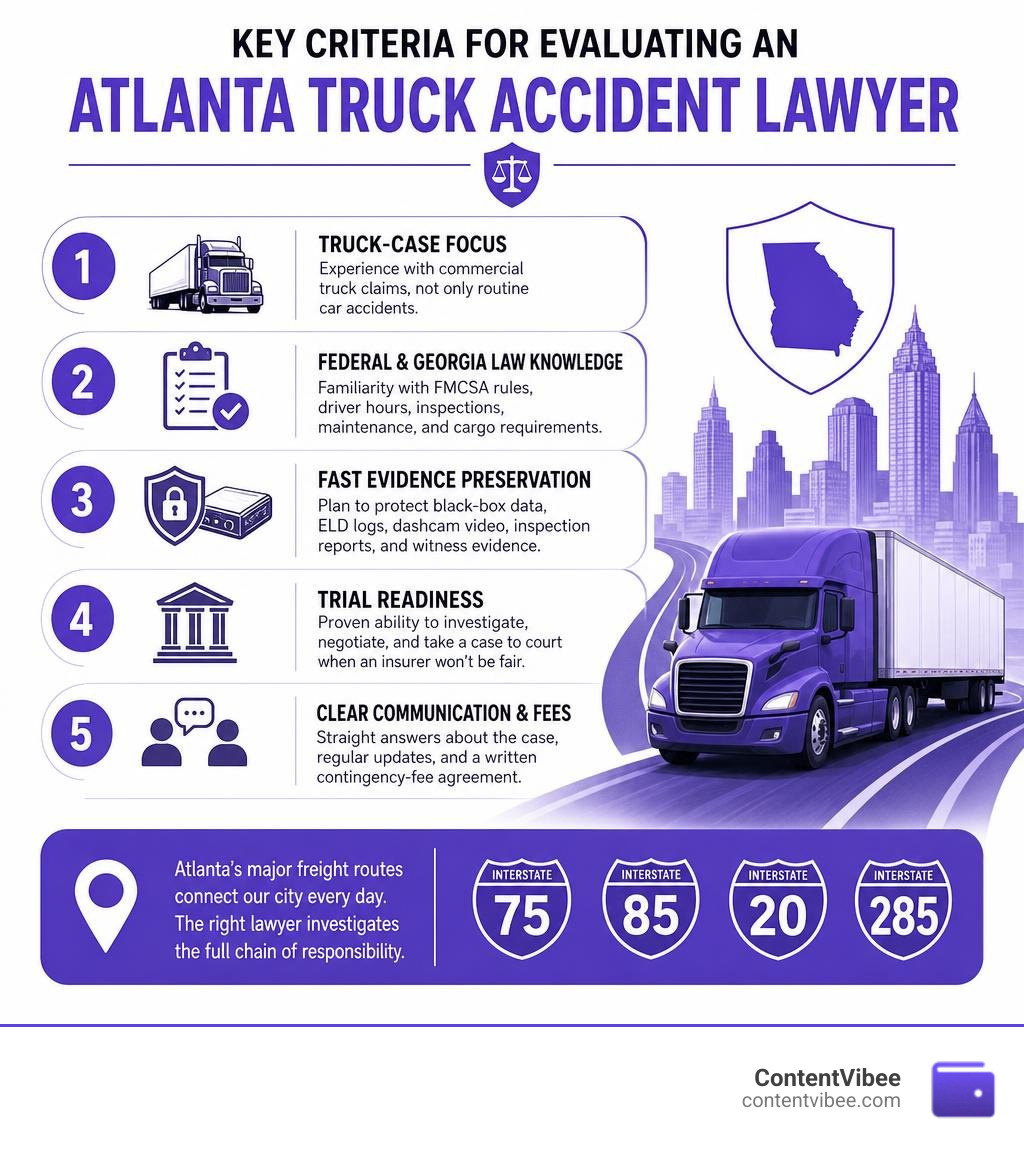
For a quick evaluation, look for an attorney or legal team with:
- Truck-case focus: Experience with commercial truck claims, not only routine car accidents.
- Federal and Georgia law knowledge: Familiarity with FMCSA rules, driver hours, inspections, maintenance, and cargo requirements.
- Fast evidence preservation: A clear plan to protect black-box data, ELD logs, dashcam video, inspection reports, and witness evidence.
- Trial readiness: A proven ability to investigate, negotiate, and take a case to court when an insurer will not make a fair offer.
- Clear communication and fees: Straight answers about the case, regular updates, and a written contingency-fee agreement.
Atlanta’s busy freight routes, including I-75, I-85, I-20, and I-285, put passenger vehicles beside large commercial trucks every day. These cases can involve the driver, motor carrier, cargo company, maintenance provider, broker, or equipment maker. The right lawyer should be prepared to investigate the full chain of responsibility, not just file a claim against one driver.
Core Factors to Evaluate When Choosing Legal Representation
When we evaluate legal representation following a major collision, we have to look past glossy billboards and TV catchphrases. Commercial vehicle accidents operate in an entirely different legal universe than standard fender-benders. In Georgia, large commercial trucks account for nearly 12% of fatal road collisions, making these cases high-stakes, highly technical battles against massive insurance corporations.

Evaluating a truck accident attorney Atlanta residents turn to during a crisis requires examining four main factors:
- Dedicated Industry Focus: Does the attorney devote a substantial portion of their practice specifically to commercial motor carrier litigation?
- Financial and Technological Resources: Commercial trucking cases require hiring forensic accident reconstructionists, medical experts, and mechanical engineers right away.
- Trial Record and Courtroom Presence: Insurance adjusters keep track of which lawyers settle for pennies on the dollar and which ones take cases all the way to a jury verdict.
- Transparent Fee Structure: The firm should work on a contingency fee basis (where you pay no upfront fees and only pay if they win compensation) with no hidden administrative costs.
Specialized Knowledge of Federal and Georgia Trucking Laws
A standard personal injury lawyer might know general traffic rules, but a specialized trucking lawyer understands the Federal Motor Carrier Safety Regulations (FMCSR). The FMCSR applies to any commercial motor vehicle operating in interstate or intrastate commerce weighing over 10,001 pounds under 49 C.F.R. § 390.3(e). This includes fully loaded 80,000-pound 18-wheelers, box trucks, flatbeds, and utility vans.
When reviewing candidates, check if they thoroughly understand key federal guidelines:
- Hours of Service (HOS) Limits (49 CFR Part 395): Federal law limits property-carrying commercial drivers to a maximum of 11 hours of driving time after 10 consecutive hours off duty.
- Driver Qualification Standards: Carriers must maintain complete Driver Qualification Files (DQFs), including annual driving record reviews, physical certifications, and mandatory pre-employment drug screenings.
- Vehicle Inspection and Maintenance (49 CFR Part 396): Trucking companies are legally required to keep detailed pre-trip and post-trip inspection records and routine brake/tire maintenance logs.
Understanding these rules allows an attorney to discover violations that prove corporate negligence. Learn more about choosing top-tier counsel by reading our detailed breakdown on finding the best truck accident attorney.
Rapid Response Capability for Evidence Preservation
Time is the biggest enemy of a truck accident victim. While you or your family member is in the hospital, the trucking company’s risk management team and defense investigators are already at the crash scene collecting evidence to minimize their financial liability.
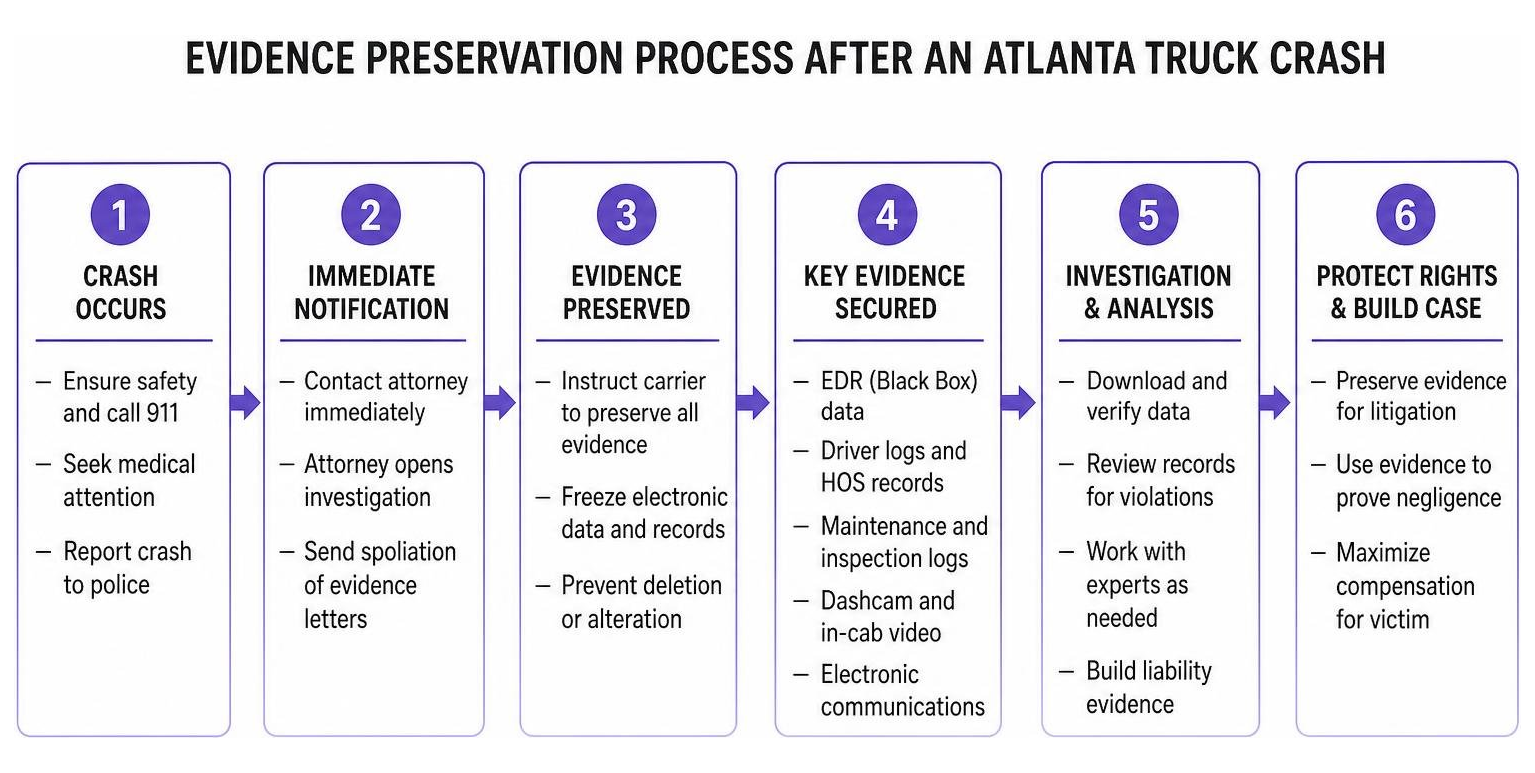
To protect your legal rights, your attorney must immediately send formal spoliation of evidence letters to the motor carrier, cargo shipper, and insurance companies. Under Georgia law, if a party destroys or overwrites evidence after receiving a formal spoliation notice, the court can penalize them and instruct the jury to presume the missing evidence would have proven the trucking company’s guilt.
Key evidence that must be frozen immediately includes:
- Event Data Recorder (EDR / Black Box): Records speed, engine RPMs, throttle position, seatbelt usage, and hard-braking events in the seconds before impact.
- Electronic Logging Devices (ELDs): Tracks actual driving hours digitally to expose HOS violations or log tampering.
- Inward and Outward Dashcams: Systems like Lytx capture driver distraction, drowsiness, and forward road conditions.
- Maintenance and Repair History: Uncovers hidden mechanical failures, such as worn brake pads or bald tires.
For further insights into local legal standards across metro area courts, explore this overview of Georgia Trucking Collision Legal Guidance.
Why You Need a Dedicated Truck Accident Attorney Atlanta Specialist
Commercial truck collisions are fundamentally different from standard two-car crashes. The sheer physical force of a fully loaded 80,000-pound semi-truck striking a 3,000-pound passenger car frequently causes catastrophic injuries—including traumatic brain injuries (TBIs), spinal cord damage resulting in paralysis, multiple fractures, severe burns, and internal organ damage.
Because the stakes are so high, commercial motor carriers carry liability policies ranging from $750,000 to well over $5,000,000. Where large insurance policies exist, corporate defense teams fight vigorously to deny fault or shift blame onto the injured victim.
| Feature / Criteria | Standard Car Accident Claim | Commercial Truck Accident Claim |
|---|---|---|
| Vehicle Weight | ~3,000 – 4,000 lbs | Up to 80,000 lbs |
| Applicable Laws | Georgia Motor Vehicle Code | FMCSR Federal Rules + Georgia State Statutes |
| Potentially Liable Parties | At-fault driver | Driver, Carrier, Cargo Loader, Maintenance Provider, Manufacturer |
| Insurance Coverage | $25,000 minimum (typical personal) | $750,000 to $5,000,000+ commercial policy |
| Critical Evidence | Police report, photos, witness statements | Black box (EDR), ELD logs, dashcams, maintenance files |
| Defense Resources | Local insurance adjuster | Aggressive corporate legal teams and rapid response adjusters |
Qualifications to Demand from Your Truck Accident Attorney Atlanta Representative
When you interview a truck accident attorney Atlanta crash victims recommend, demand specific proof of their qualifications. You need a legal team with the firepower to match corporate defendants.
Make sure to ask these direct questions during your initial consultation:
- “What percentage of your practice is dedicated to truck accidents?” (Look for firms that focus heavily on commercial motor carrier cases rather than general slip-and-fall or routine auto claims).
- “Do you have in-house resources or access to top forensic experts?” (Reconstructing an 18-wheeler wreck requires expert witness testimonies, digital mapping, and mechanical teardowns).
- “What is your actual trial track record?” (Insurance companies know which lawyers take cases to trial and which ones fold under pressure).
- “How do you handle client communication?” (You deserve direct attorney access rather than being passed off entirely to paralegals).
To better understand how a claim moves from initial filing to resolution, read our comprehensive overview on how a truck accident injury lawsuit works.
How a Truck Accident Attorney Atlanta Professional Handles Insurance Adjusters
Insurance adjusters working for commercial carriers are trained negotiators whose main job is to protect their company’s bottom line. Shortly after a crash, an adjuster may reach out to you acting helpful and sympathetic, offering a quick cash settlement or asking for a recorded statement.
Here is how a specialized attorney protects you from common defense traps:
- Blocking Recorded Statements: Adjusters use clever questioning techniques to trick injured victims into making statements that minimize their pain or accept partial fault. Your lawyer handles all communications so you don’t say anything that harms your claim.
- Exposing Strategic Lowball Settlement Offers: Early settlement offers rarely cover long-term medical care, future surgeries, or permanent loss of earning capacity.
- Resolving Healthcare and Medical Liens: An experienced attorney works directly with hospitals and health insurance providers to resolve medical liens, ensuring more of the final settlement goes into your pocket.
Discover actionable strategies for protecting your recovery rights in our step-by-step guide on how to handle a truck accident injury claim.
Key Georgia Truck Accident Laws, Damages, and Deadlines

Navigating a commercial truck accident claim in Georgia requires a clear understanding of state statutes, deadline exceptions, and financial recovery categories.
Georgia Statute of Limitations and Fault Rules
In Georgia, timing is everything. Under O.C.G.A. § 9-3-33, the statute of limitations for personal injury and wrongful death claims is generally two years from the date of the accident. If you miss this strict deadline, you lose your legal right to seek financial compensation forever.
However, critical exceptions exist that can drastically alter this timeline:
- Government Vehicles (Ante Litem Notice): If the truck involved was owned or operated by a municipal, county, or state government entity (such as a local public works vehicle or transit bus), you must send a formal ante litem notice within 6 months for municipal claims or 1 year for state claims.
- Tolling of the Statute: If criminal charges or traffic citations resulting from the crash are pending against the truck driver, the two-year statute of limitations may be paused (“tolled”) until those legal proceedings are resolved, up to a maximum of six years (O.C.G.A. § 9-2-60).
Georgia also operates under a modified comparative fault system pursuant to O.C.G.A. § 51-12-33. Under this law:
- You can recover damages as long as you are less than 50% responsible for the crash.
- Your financial recovery is reduced proportionally by your percentage of fault. For instance, if a jury awards you $1,000,000 but finds you 10% responsible because of minor speeding, your payout is reduced by 10% to $900,000.
- If you are found 50% or more at fault, you are completely barred from recovering any compensation.
For more information on legal standards in local jurisdictions, review these Marietta Truck Injury Litigation Standards.
Recoverable Economic, Non-Economic, and Punitive Damages
Victims of commercial trucking collisions in Atlanta can seek several distinct types of legal compensation:
Economic Damages (Measurable Financial Losses):
- Emergency medical expenses and hospital bills
- Long-term rehabilitation, physical therapy, and home care
- Lost wages and missed bonuses
- Loss of future earning capacity due to disability
- Property damage and vehicle repair costs
Non-Economic Damages (Quality of Life Impacts):
- Physical pain and suffering
- Mental anguish, anxiety, and PTSD
- Loss of enjoyment of life
- Loss of consortium (impact on marriage and relationships)
- Permanent scarring or disfigurement
Punitive Damages (O.C.G.A. § 51-12-5.1): Unlike standard damages meant to make the victim whole, punitive damages are designed to punish the offender and deter future egregious conduct. In Georgia, punitive damages require clear and convincing evidence that the defendant’s actions showed willful misconduct, malice, fraud, or conscious indifference to safety. Examples include cases where a truck driver was operating under the influence of drugs or alcohol (where CDL holders face a strict 0.04% BAC limit) or where a trucking company knowingly forced a driver to operate with failing brakes.
Georgia Wrongful Death Claims (O.C.G.A. § 51-4-1 et seq.): If a truck wreck results in a loss of life, surviving family members (spouse, children, or parents) can file two separate legal claims:
- The Full Value of the Life of the Decedent: Covering tangible and intangible financial and emotional losses from the victim’s perspective.
- The Estate Claim: Recovering pre-death medical expenses, funeral costs, and conscious pain and suffering.
Check out our guide on filing a semi truck accident claim guide for a step-by-step breakdown of calculating your total case value.
Critical Red Flags to Avoid When Selecting Legal Counsel
Not every personal injury firm is equipped to handle complex commercial trucking litigation. Spotting red flags early saves you from hiring an attorney who might compromise your claim.
Watch out for these warning signs when choosing your legal representation:
- Settlement Mills: Be wary of high-volume law firms that advertise heavily on TV but rarely set foot in a courtroom. These firms often process high numbers of cases quickly, pushing clients to accept fast, low settlement offers.
- Guaranteed Results: No honest attorney can guarantee a specific dollar payout or settlement timeline. Every truck crash case carries unique liability factors, insurance limits, and injury complexities.
- Lack of Specialized Trucking Experience: An attorney who primarily handles minor car accidents or slip-and-fall cases may not understand federal safety regulations (FMCSR) or how to retrieve black box EDR data before it is deleted.
- Unclear Fee Agreements: If an attorney cannot explain their contingency fee percentage, case expense structure, or billing terms clearly in writing, look elsewhere.
- Poor Communication: If you struggle to get direct responses during your initial consultation, communication will likely worsen once you sign a contract.
Learn how to safeguard your rights by reviewing our advisory on getting reliable truck accident legal help.
Frequently Asked Questions About Atlanta Truck Accidents
How long do I have to file a truck accident claim in Atlanta?
In Georgia, you generally have two years from the exact date of the crash to file a personal injury or wrongful death lawsuit under O.C.G.A. § 9-3-33. However, if the crash involved a city, county, or state government vehicle, you may have as little as six months to file a formal ante litem notice. Additionally, if the driver received traffic citations or criminal charges, the deadline may be paused (“tolled”) while those charges are handled in court. Because electronic black box data can be overwritten in weeks, you should contact an attorney as soon as possible after the incident.
Who can be held liable for a commercial truck crash in Georgia?
Liability in a truck accident frequently extends beyond the truck driver. Potentially liable parties include:
- The Trucking Company (Motor Carrier): For negligent hiring, poor driver training, pressuring drivers to break Hours of Service rules, or failing to maintain vehicles properly.
- Cargo Loaders and Shippers: For improperly loading, balancing, or securing heavy cargo, which can cause jackknife or rollover wrecks.
- Maintenance Contractors: For performing improper repairs or failing to spot dangerous mechanical issues like worn brakes.
- Equipment Manufacturers: For defective truck parts, such as failing tires, steering systems, or hitch assemblies.
- Freight Brokers: For hiring unsafe motor carriers with a documented history of federal safety violations.
What evidence is most critical after an 18-wheeler crash?
The most critical evidence includes the vehicle’s Event Data Recorder (EDR / Black Box), which logs speed, braking, and engine data immediately prior to impact. Other vital evidence includes Electronic Logging Device (ELD) records (proving driving hours), inward/outward dashcam footage, Driver Qualification Files, pre-trip inspection logs, toxicological test results, and the official police crash report.
Conclusion
Finding the right truck accident attorney Atlanta offers is the most important decision you can make after a severe commercial vehicle collision. By focusing on attorneys with deep federal regulatory knowledge, fast evidence preservation capabilities, strong trial records, and transparent communication, you give yourself the best opportunity to recover full compensation for your medical expenses, lost wages, and pain and suffering.
At ContentVibee, our mission is to empower you with practical, actionable legal knowledge so you can protect your rights and rebuild your life after a serious crash. Take action quickly to secure your electronic evidence, understand your rights under Georgia law, and consult with a dedicated legal advocate who will fight for you every step of the way. Explore our complete Atlanta Truck Accident Lawyer Guide for additional insights.


